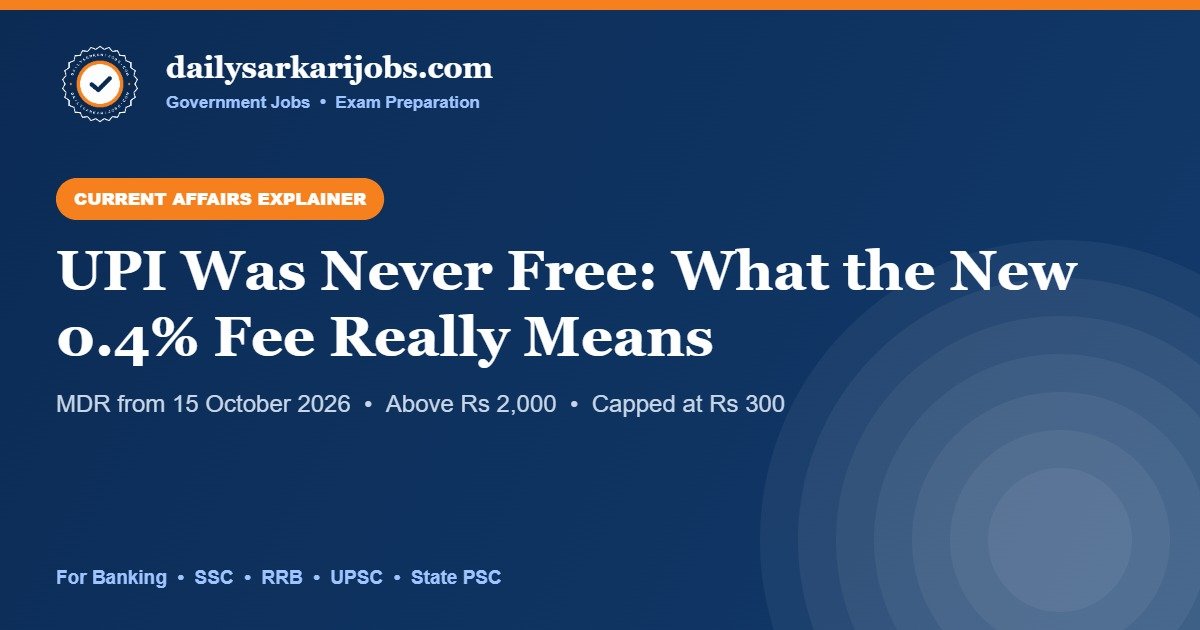
From 15 October 2026, UPI payments to merchants above ₹2,000 will carry a fee of 0.4 per cent, capped at ₹300 a transaction. Money you send to another person stays free, and so does any merchant payment of ₹2,000 or less. This explainer tells you, in very plain words, what that fee actually is, why a system everyone calls “free” was never really free, and the points most likely to be asked in banking exams, SSC CGL and CHSL, RRB NTPC, UPSC and State PSC.
⚡ QUICK FACTS
💸 The fee
0.4% MDR, capped at ₹300
🎯 Applies to
Merchant payments above ₹2,000
🆓 Stays free
Person-to-person, and small payments
📅 From
15 October 2026
Updated 17 September 2026
An official clarification issued on 16 September 2026 has settled the fine print this post originally flagged as unsettled. About 96 per cent of merchant transactions are unaffected, and small merchants receiving up to ₹1 lakh a month through a UPI QR code pay zero MDR on every transaction. The full breakdown is in the section “Update: The Official Clarification” below.
First: UPI Was Never Free
This is the sentence that makes the whole story make sense, and almost no news report says it plainly:
UPI was never free. Somebody was always paying for it — it just was not you.
Think about what happens in the two seconds after you scan a QR code. A payment app has to accept your request. Your bank has to check your balance and your PIN. A central system has to route the message. The shop’s bank has to receive the money. Fraud checks run. Records are stored. If something fails, a complaint desk has to fix it.
All of that costs real money — servers, staff, security. Someone pays those bills every single time. For years that someone was mainly the government, which reimbursed banks and payment apps through an incentive paid out of the Budget. In other words, the convenience was funded by the taxpayer.
So the honest way to describe this change is not “UPI is becoming costly”. It is: the bill is being moved from the taxpayer to the shopkeeper who earns from the sale — and only when the sale is a large one.
What Is MDR, in One Line
MDR stands for Merchant Discount Rate. It is the fee a shop pays its bank for accepting a digital payment. It is not deducted from you.
You have been paying MDR indirectly your whole life without noticing. When you swipe a credit card, the shop typically pays somewhere around 1 to 2 per cent of the bill to the banks involved. The price tag does not change, so the customer never sees it. MDR is a cost of doing business for the merchant, not a charge on the buyer — and that single fact is the most commonly misunderstood part of this news.
The fee is then split between the people who did the work: the shop’s bank, your bank, the payment app you used, and the network that carried the message.
What Exactly Changes on 15 October
Type of Payment
What Happens
You send money to a friend or family (person-to-person)
Completely free. No change at all.
You pay a shop ₹2,000 or less
Free. The threshold is deliberately set above everyday spending.
You pay a shop more than ₹2,000
The merchant pays 0.4% of the amount. You still pay exactly the amount on the bill.
Very large payments
The fee is capped at ₹300, so it stops growing beyond a point.
Worked examples, because the arithmetic is the question: on a ₹3,000 payment the fee is ₹12. On ₹50,000 it is ₹200. On ₹1,00,000 it would be ₹400 by the percentage — but the cap holds it at ₹300. Practise the cap, because that is where a numerical question will be set.
Why ₹2,000, and Why Person-to-Person Stays Free
These two exemptions are not generosity. They are careful design, and understanding why is what turns this from a news item into an answer worth marks.
A fee changes behaviour at the bottom of the market, not the top. If a tea stall or a vegetable seller had to pay a cut on a ₹40 sale, many would simply stop accepting UPI and ask for cash. India spent a decade getting those sellers onto digital payments. A fee there would undo it.
The same logic applies to money sent between people. If splitting a dinner bill or sending money home started costing something, people would go back to cash — and the whole point of UPI is that it is the easiest way to move money, not the cheapest-looking one.
So the fee is aimed where it does least damage: larger payments, to businesses big enough that a 0.4% cost is a normal business expense rather than a reason to refuse the payment. Tax the part of the system that can afford it; leave the part that would break.
Who Decided This, and Where It Sits
The framework has been introduced by the National Payments Corporation of India (NPCI), which operates UPI. NPCI is not a regulator — it is a not-for-profit company that runs India’s retail payment systems, and it is itself regulated by the RBI. That distinction is asked directly, and we cover it in our banking awareness capsule.
NPCI also runs IMPS and RuPay, and was set up in 2008.
UPI itself was launched in 2016.
The stated reasons are financial sustainability — letting the system pay for its own upkeep, security and expansion rather than depending on a yearly government incentive.
The Argument on the Other Side
A good answer shows both sides, so here is the case against.
Critics point out that UPI’s extraordinary growth happened precisely because it cost nothing, and that introducing any fee — however carefully targeted — risks slowing that down. Medium-sized merchants, who are above the small-merchant line but working on thin margins, may feel it most. There is also a worry that some shops will quietly discourage large UPI payments, or add the cost to prices.
Supporters answer that a system funded by a yearly budget decision is fragile — the incentive can shrink or stop, and then the infrastructure has no money. A payment network that earns a little from the transactions it carries can plan, invest in fraud protection, and survive without asking the government each year.
Both positions are reasonable. The real test will be the numbers after October — whether large-value UPI payments keep growing at the same rate.
Why This Matters Beyond Payments
UPI is not only how you pay a shop. It is part of the same set of rails that carries government money to citizens — the bank accounts, Aadhaar links and mobile phones that make Direct Benefit Transfer possible. Every rupee of a scheme like PM-KISAN travels on that infrastructure. Keeping it funded and secure is therefore not a private matter for banks; it is a public one. The scale of digital payments is also now large enough to show up in the consumption figures behind India’s growth numbers.
Update: The Official Clarification of 16 September 2026
When this explainer first went up, reports differed on how completely small merchants were protected. That question is now answered. An official clarification issued on 16 September 2026 sets out exactly who pays and who does not, and the headline is this: person-to-person transfers stay completely free, and about 96 per cent of merchant transactions are untouched.
Type of payment
What is charged
Person to person (P2P)
Completely free, whatever the amount.
Merchant payments up to ₹2,000
No MDR.
Small merchants receiving up to ₹1 lakh a month through a UPI QR code — street vendors and small shops
Zero MDR on all their transactions, whatever the size of each one.
Other merchant payments above ₹2,000
0.4 per cent, with the ₹300 cap taking effect at ₹75,000 and above.
Essential sectors — railways, telecom, insurance, fuel and agricultural inputs
A flat ₹5 per transaction above ₹2,000.
Capital market transactions
0.02 per cent, capped at ₹300.
The plain-words version: two separate shields, and a payment only needs one of them. The first shield is the size of the payment — anything up to ₹2,000 is free. The second is the size of the shop — if a merchant takes ₹1 lakh or less a month through a UPI QR code, every one of their payments is free, even a ₹5,000 one. A vegetable seller and a tea stall are covered by the second shield no matter what any single customer pays.
Why the ₹300 cap bites at ₹75,000: 0.4 per cent of ₹75,000 is exactly ₹300. Below that the percentage is smaller than the cap, so the percentage applies; above it the cap applies and the charge stops growing. That is a neat one-line calculation an examiner can build a question around.
What to carry into the exam hall:0.4 per cent, above ₹2,000, capped at ₹300, from 15 October 2026; P2P free; small merchants up to ₹1 lakh a month free; essentials at a flat ₹5; capital markets at 0.02 per cent. Those seven figures now come from an official clarification rather than from press reports, so they are safe to learn.
Practice Questions
Q1. From 15 October 2026, MDR on UPI applies to: (a) All UPI transactions (b) Person-to-person transfers only (c) Merchant payments above ₹2,000 (d) All payments above ₹500 Answer: (c) Merchant payments above ₹2,000 Person-to-person transfers remain free, and so do smaller merchant payments — the threshold is set deliberately above everyday spending.
Q2. Who actually pays the Merchant Discount Rate? (a) The customer making the payment (b) The merchant accepting the payment (c) The Reserve Bank of India (d) The state government Answer: (b) The merchant accepting the payment MDR is a cost of accepting a digital payment and is not deducted from the customer — the same way card MDR has always worked. This is the most commonly misunderstood point in the news.
Q3. On a UPI merchant payment of ₹1,00,000, the MDR payable would be: (a) ₹400 (b) ₹300 (c) ₹200 (d) Nil Answer: (b) ₹300 0.4% of ₹1,00,000 is ₹400, but the fee is capped at ₹300, so ₹300 is payable. The cap is exactly where a numerical question will be set.
Q4. UPI is operated by: (a) The Reserve Bank of India (b) The National Payments Corporation of India (c) The Ministry of Finance (d) The State Bank of India Answer: (b) The National Payments Corporation of India NPCI also runs IMPS and RuPay. Note that it is a not-for-profit company regulated by the RBI — it is not itself a regulator, which is a standard trap.
Q5. Before this change, the cost of running UPI was largely met by: (a) Customers through small per-transaction fees (b) A government incentive paid from the Budget (c) Advertising revenue on payment apps (d) A levy on bank deposits Answer: (b) A government incentive paid from the Budget The incentive reimbursed banks and payment providers. That is why the honest description of this change is a shift in who pays, not the arrival of a cost that did not exist before.
Common Mistakes to Avoid
Saying “UPI is no longer free for customers”. For customers it is unchanged. The merchant pays.
Applying the fee to money sent to a friend. Person-to-person transfers are free.
Forgetting the ₹300 cap. The percentage stops mattering above ₹75,000.
Calling NPCI a regulator. It operates the system; the RBI regulates it.
Confusing MDR with GST. There was a separate, much-denied rumour about GST on UPI payments above ₹2,000. MDR is not a tax — it is a service fee shared among banks and payment providers.
Missing the small-merchant exemption. A merchant receiving up to ₹1 lakh a month through a UPI QR code pays no MDR at all, even on a payment above ₹2,000. The ₹2,000 threshold is not the only protection.
Applying 0.4 per cent to everything above ₹2,000.Essential sectors pay a flat ₹5 and capital market transactions pay 0.02 per cent. Three different rules sit above the same threshold.
Test Yourself
Reading an explainer is not the same as recalling it under time pressure. Our Test Your Knowledge page carries free current affairs and Static GK quizzes, each with an explanation for every answer and a downloadable PDF for offline revision.
Sources: National Payments Corporation of India material on the revised merchant discount rate framework effective 15 October 2026, as reported by multiple independent outlets on 16 September 2026; and standard references on NPCI’s role, UPI’s launch and the earlier government incentive scheme for digital payments. Reports differ on the precise treatment of small merchants and that difference is flagged in the text rather than resolved here. Check the latest NPCI circular before an exam. Updated on 17 September 2026 with the official clarification issued on 16 September 2026, which sets out the small-merchant exemption, the essential-sector flat fee and the capital-market rate, and confirms that about 96 per cent of merchant transactions are unaffected.