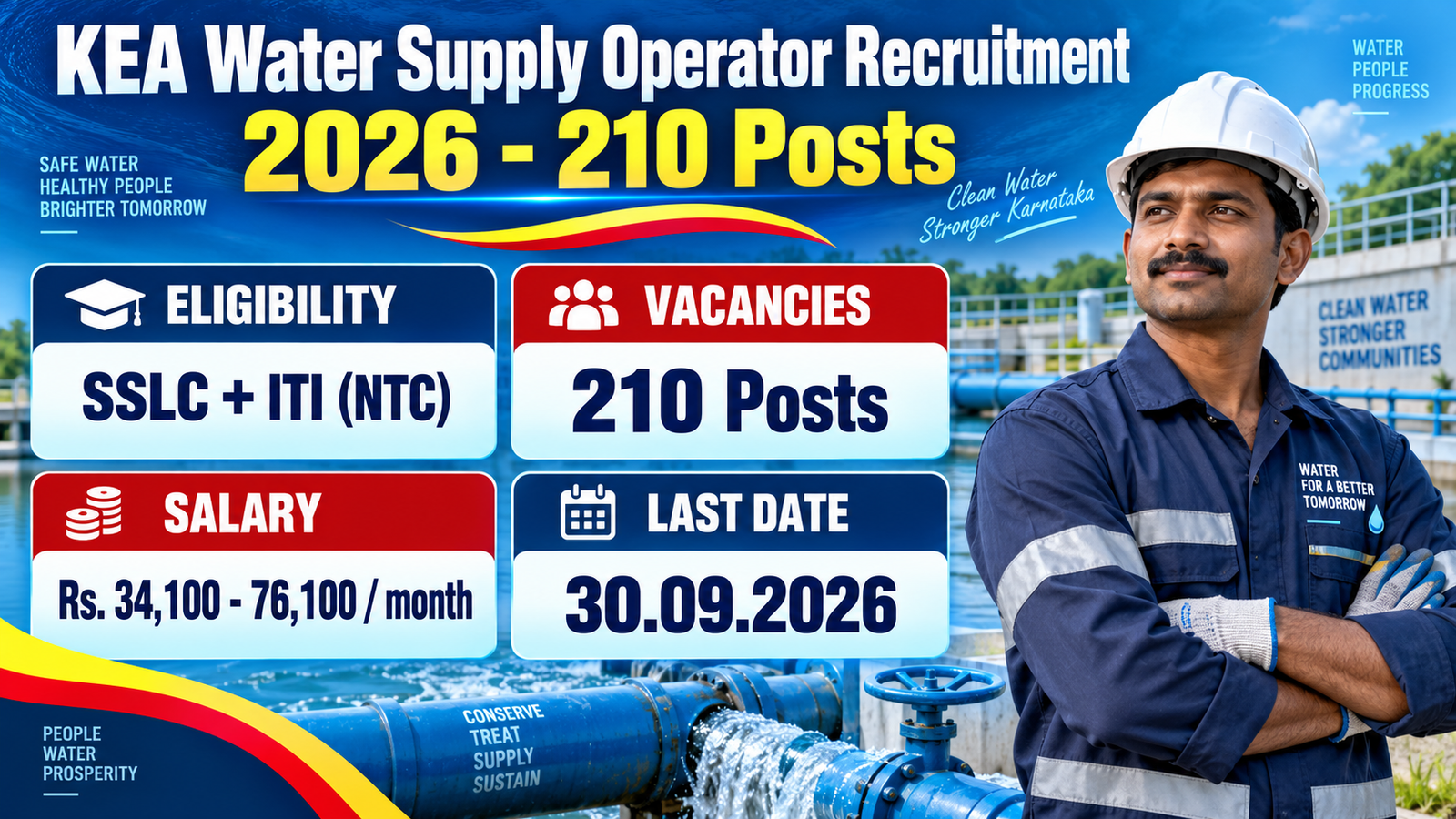
The Karnataka Examination Authority (KEA), Bengaluru has released Notification No. ED/KEA/46/NE.A./2026(KK) dated 11.09.2026 inviting online applications for 210 Group-C posts in the Urban Local Bodies of the Kalyana-Karnataka region, under the Directorate of Municipal Administration. The vacancies cover Water Supply Operator, Assistant Water Supply Operator, Electrician Grade-1 and Electrician Grade-2. Candidates who have passed SSLC along with a two-year ITI course (NTC) can apply online from 16.09.2026 to 30.09.2026, with the competitive examination expected in November 2026.
SSLC or equivalent, plus a two-year ITI course in Electrical or Fitter trade (NTC). Water Supply Operator and Electrician Grade-1 additionally need one year of Apprenticeship Training (NAC).
Age Limit
18 years minimum; maximum 40 / 43 / 45 years depending on category, as on the last date to apply Check your age eligibility →
Selection Process
Kannada Language Exam (qualifying) → Paper-1 General Knowledge → Paper-2 Specific Paper → Merit List → Document Verification
Pay Scale
Starting around Rs. 37,500 per month for Water Supply Operator and Electrician Grade-1, and around Rs. 34,100 per month for the Assistant and Grade-2 posts, plus NPS
How to Apply
Online only, through the KEA online application portal
Persons with Benchmark Disability (Special Ability)
Rs. 250/-
Note: Fee is payable online only and is non-refundable. Candidates should confirm that they meet the education, age and other eligibility conditions before paying.
Vacancy Details
Post
Pay Scale (Rs.)
Vacancies
Water Supply Operator
37,500 – 76,100
80
Electrician Grade-1
37,500 – 76,100
03
Assistant Water Supply Operator
34,100 – 67,600
122
Electrician Grade-2
34,100 – 67,600
05
Total
—
210
Note: The notification states that post-wise and category-wise vacancy details are published separately by the Directorate of Municipal Administration, and that these figures may be revised in line with the post-wise and category-wise details submitted by the department from time to time.
Eligibility Criteria
Criterion
Detail
Water Supply Operator
Passed SSLC or equivalent; holds a two-year ITI Certificate in Electrical or Fitter trade from a Government-recognised Industrial Training Institute resulting in a National Trade Certificate (NTC); and has completed one year of Apprenticeship Training in any industry resulting in a National Apprenticeship Certificate (NAC)
Electrician Grade-1
Passed SSLC or equivalent; passed a two-year course in Electrical trade from a Government-recognised ITI resulting in NTC; and has completed one year of Apprenticeship Training resulting in NAC
Assistant Water Supply Operator
Passed SSLC or equivalent; and passed a two-year course in Electrical or Fitter trade from a Government-recognised ITI resulting in NTC (no apprenticeship required)
Electrician Grade-2
Passed SSLC or equivalent; and passed a two-year course in Electrical trade from a Government-recognised ITI resulting in NTC (no apprenticeship required)
Accepted as SSLC equivalent
CBSE and ICSE Class 10; Class 10 of other State examination boards; the Secondary course of the National Institute of Open Schooling (NIOS); and the Secondary-level course of the Karnataka Secondary Education Examination Board
Age Limit
Minimum 18 years as on the last date to apply; maximum 40 years (General Merit), 43 years (2A, 2B, 3A, 3B) or 45 years (SC, ST, Category-1) Check your age eligibility →
Language requirement
A qualifying Kannada Language Examination applies, unless the candidate is exempt (see Selection Process below)
Local cadre
These posts belong to the Kalyana-Karnataka Local Cadre. Reservation for candidates belonging to the Kalyana-Karnataka region under Article 371(J) applies, and eligible candidates must hold the Annexure-A eligibility certificate with an RD number
Other restrictions
Must be an Indian citizen. A male candidate with more than one living wife, and a female candidate who has married a man already having a living wife, are not eligible unless exempted by the Government. Candidates must be physically and mentally fit. Anyone permanently debarred from examinations or recruitment by a Public Service Commission, KEA or a university is not eligible.
Age Relaxation
Category
Maximum Age / Relaxation
General Merit candidates
40 years
Category 2A, 2B, 3A and 3B candidates
43 years
Scheduled Caste / Scheduled Tribe / Category-1 candidates
45 years
Serving or former employees of the Karnataka State Government, a local authority, a statutory body or a corporation under state control
Length of service rendered, or 10 years, whichever is less
Ex-Servicemen
Period of service rendered plus 3 years
Persons released after full-time service as a National Cadet Corps cadet instructor
Period of service rendered
Gram Sahayaka Parisheelaka appointed under the State Government’s rural development scheme
10 years
Persons with Benchmark Disability (Special Ability) candidates
10 years
Serving or former employees of a Government of India public sector undertaking located in Karnataka
Length of service rendered, or 5 years, whichever is less
Widows (supported by a certificate from the competent authority)
10 years
Persons released from bonded labour under the Karnataka Bonded Labour System (Abolition) order
10 years
The maximum ages of 40, 43 and 45 years already include the one-time five-year relaxation granted by Government Order No. DPAR 262 SRR 2025 dated 29.01.2026. The service-based relaxations listed above are applied on top of these limits as per the Karnataka Civil Services (General Recruitment) Rules, 1977.
Not sure whether you are within the age limit?
Enter your date of birth, the 30.09.2026 cut-off date and your category relaxation to see instantly whether you fall inside the 18 to 40, 43 or 45 year band that applies to you.
Stage 1 — Kannada Language Examination (qualifying)
A compulsory multiple-choice paper set at SSLC standard, carrying a maximum of 150 marks. A candidate must score at least 50 marks to pass. Marks scored here are not counted towards merit or seniority for the posts. Candidates who studied in Kannada medium from Class 1 to Class 10, or who passed SSLC or a higher examination with Kannada as a language, or who have already passed a Kannada language test conducted by a commission or other authority, are exempt from this paper. A candidate who fails this paper is not eligible for the selection process.
Stage 2 — Paper-1: General Knowledge
100 questions, 100 marks, 2 hours. Covers general knowledge of current events; everyday domestic science; school-level topics of the Constitution of India; Indian history with special reference to Karnataka; Indian geography with special reference to Karnataka; state and regional administration; rural development, Panchayat Raj institutions and rural governance including sub-topics on the economic development of Karnataka; and environmental issues and development in Karnataka.
Stage 3 — Paper-2: Specific Paper
100 questions, 100 marks, 2 hours. Post-specific technical paper. Two separate syllabi apply — one for Electrician Grade-1 and Grade-2, and one for Water Supply Operator and Assistant Water Supply Operator. The full topic-wise syllabus is given further down this page.
Examination mode
Online Computer Based Test (CBT) or offline OMR type. The detailed exam schedule and centre details will be published later, and admit cards must be downloaded from the KEA website. Candidates must carry a printed admit card plus one original photo ID (PAN card, driving licence, passport, voter ID, Aadhaar card or government service ID). Exam centres will not be changed for any reason.
Minimum qualifying marks
A candidate must score at least 35 per cent in the competitive examination. Candidates scoring below this are not eligible for selection.
Negative marking
0.25 mark is deducted for each wrong answer. Only one option may be marked out of the four given. In the OMR mode, candidates get an extra five minutes after the final bell to shade any answers left blank on the 5th copy of the paper; if any question is still left unshaded or is shaded more than once after that, 0.25 mark is deducted for that question.
After the examination
The eligibility list of successful candidates in the written examination is forwarded to the Directorate of Municipal Administration, which then carries out all further recruitment steps, including document verification, as per the rules. Original certificates must be produced at the time of document verification.
Annexure-1 — Electrician Grade-1 and Electrician Grade-2
Unit
Topics
I. Basic Electrical Engineering and Electrical Calculations
Fundamentals of electricity — electric current, voltage, resistance, power and energy; units of electrical quantities; Ohm’s Law and its applications; series, parallel and series-parallel circuits; Kirchhoff’s Laws — elementary applications; electrical work, power and energy calculations; AC and DC fundamentals; frequency, cycle, time period, phase and waveform; single-phase and three-phase AC systems; star and delta connections — basic concepts; power factor and its significance; basic electrical load calculations
II. Electrical Safety, Tools, Materials and Workshop Practice
Electrical safety rules and precautions; electrical hazards and prevention of accidents; Personal Protective Equipment (PPE); electric shock — rescue and first aid; electrical fires and fire extinguishers; safe isolation of electrical circuits; hand tools and power tools used by electricians; care and maintenance of electrical tools; conductors, insulators and semiconductors; electrical materials and their properties; soldering, crimping, cable joints and terminations
III. Electrical Wiring, Cables and Installations
Types of electrical wires and cables; cable size, insulation, current-carrying capacity and voltage rating; cable joints, lugs, glands and terminations; domestic, commercial and industrial wiring; conduit wiring and other wiring systems; switches, sockets and wiring accessories; distribution boards; single-phase and three-phase wiring; staircase, corridor and godown wiring; wiring of lamps, fans and other electrical appliances; identification and rectification of common wiring faults; load calculation and selection of cables; basic electrical installation in municipal/public buildings
IV. Electrical Measuring Instruments, Testing and Fault Finding
Ammeter, voltmeter, wattmeter and energy meter; multimeter and clamp meter; insulation resistance tester / Megger; earth resistance tester; measurement of voltage, current, resistance, power and energy; continuity and insulation resistance tests; testing of electrical wiring and installations; detection of open circuit, short circuit and earth leakage; identification of common electrical faults; basic troubleshooting methods
V. Electrical Machines
Transformers: principle and working; single-phase and three-phase transformers; transformer ratio, losses and efficiency; basic transformer maintenance. Motors: principle of electric motors; AC and DC motors — basic concepts; single-phase and three-phase induction motors; squirrel-cage and slip-ring induction motors; motor nameplate particulars; star and delta connections; DOL and star-delta starters; reversal of direction of motors; common motor faults and basic maintenance. Generators: basic principle of generators and alternators; basic operation of generator sets
VI. Switchgear, Protection and Control Circuits
Switches, isolators and fuses; MCB, MCCB, RCCB/ELCB and RCBO; contactors and relays; thermal overload relay; timers; motor starters; basic motor control circuits; short-circuit protection; overload protection; earth leakage protection; single-phasing and phase-failure protection; basic distribution panels and control panels
VII. Earthing and Electrical Safety
Purpose and necessity of earthing; types and methods of earthing; equipment earthing and system earthing; earth electrodes; earth resistance; testing of earthing systems; leakage current and earth faults; electrical safety in wet areas; safety precautions in pump houses and public places; safe working practices on electrical installations
VIII. Illumination and Street Lighting
Fundamentals of illumination; lumen and lux; types of lamps and luminaires; LED lamps and LED luminaires; LED drivers — basic concepts; street-light wiring; street-light feeder panels; timers and contactors; photocell/LDR-based switching; basic automatic street-light control; common street-light faults and their rectification; energy-efficient lighting
IX. Pumps and Water-Supply Electrical Installations
Basic types of pumps; centrifugal and submersible pumps; pump motors; electrical connections of pumps; pump starters; pump control panels; float switches and level controls; dry-run protection — basic concept; common electrical faults in pump installations; basic maintenance of pump motors; electrical safety in water-supply installations
X. Basic Electronics, Renewable Energy and Energy Efficiency
Resistors, capacitors and inductors; diodes and rectifiers — basic concepts; transistors — elementary concepts; relays and sensors; basic solar photovoltaic systems; solar panels, batteries and inverters — basic concepts; solar street lights; energy conservation; energy-efficient motors and lighting; power factor improvement — basic awareness
XI. Electrical Drawing, Symbols and Estimation
Standard electrical symbols; reading simple wiring diagrams; basic single-line diagrams; motor wiring diagrams; basic layout of electrical installations; calculation of connected load; basic estimation of wires, cables, switches and other electrical materials
Annexure-2 — Water Supply Operator and Assistant Water Supply Operator
Unit
Topics
I. Municipal Water-Supply Systems and Operations
Sources of municipal water supply; surface and groundwater sources; intake structures — basic concepts; raw-water transmission; pumping systems; water treatment plants; clear-water storage; transmission and distribution systems; GLR, sump, overhead tanks and service reservoirs; gravity and pumping systems; water demand and consumption — basic concepts; flow, pressure and head; basic water-supply scheduling; operational requirements of urban water-supply systems; coordination between pumping, storage and distribution
II. Pumps, Pumping Systems and Troubleshooting
Types and working principles of pumps; centrifugal pumps; submersible pumps; vertical and horizontal pumps; pump components — impeller, casing, shaft, bearings, seals and couplings; suction and delivery arrangements; static head, dynamic head and total head; discharge and pump efficiency; priming; cavitation — causes, effects and prevention; pump characteristic concepts; pumps in series and parallel; selection of pumps; starting and stopping procedures; dry running and its effects; pump overheating; excessive vibration and noise; low discharge and failure to deliver water; mechanical seal and gland problems; bearing failures; alignment and coupling problems; preventive and breakdown maintenance; systematic troubleshooting of pumping installations
III. Electrical Motors, Starters, Panels and Protection
Basic electrical quantities and calculations; single-phase and three-phase supply; three-phase induction motors; motor ratings and nameplate particulars; star and delta connections; DOL and star-delta starters; contactors and control relays; thermal overload relays; timers; motor control circuits; fuses, MCB, MCCB and RCCB/ELCB; short-circuit and overload protection; single-phasing and phase-failure protection; phase sequence and phase reversal; under-voltage and over-voltage — basic concepts; pump control panels; power and control circuits; basic automatic pump-control systems; float/level-controlled pump operation; VFD — basic principle and application to pumps; identification of common motor, starter and panel faults; electrical testing and troubleshooting; electrical safety and earthing
IV. Pipes, Valves, Fittings and Mechanical Maintenance
Types of pipes used in municipal water supply; pipe fittings and joints; flanges, gaskets and couplings; pipe threading and fitting; sluice/gate valves; butterfly valves; non-return/check valves; air valves; scour/washout valves; pressure-reducing/control valves; correct operation of valves; common valve defects and maintenance; leakage from pipes and joints; bearings and lubrication; shafts, couplings and alignment; mechanical seals and gland packing; fasteners; basic fitting and maintenance tools; identification and rectification of common mechanical faults
V. Water Treatment Plant Operation
Objectives of water treatment; raw-water quality — basic concepts; screening and aeration; coagulation and flocculation; coagulants and basic dosing concepts; sedimentation; filtration; slow and rapid sand filtration; filter operation and cleaning/backwashing; disinfection; chlorination; chlorine demand and residual chlorine; chlorine/bleaching powder dosing; safe handling and storage of treatment chemicals; basic operational problems in treatment units; importance of maintaining treatment process records; prevention of contamination during treatment and storage
VI. Water Distribution, Reservoir and Network Operation
Transmission mains and distribution networks; service reservoirs; distribution zones — basic concepts; valve operation and regulation; maintaining adequate distribution pressure; water-supply scheduling; reservoir filling and drawdown; balancing pumping and distribution; low-pressure and no-water conditions — causes and remedies; pipeline leakage and bursts; air locking — basic concept; isolation of pipelines during repair; flushing of pipelines; prevention of contamination during repairs; Non-Revenue Water (NRW) — basic concepts; water losses and leakage control; equitable distribution of water
VII. Instrumentation, Measurement and Operational Monitoring
Water meters and flow meters; pressure gauges; level indicators; float switches and level sensors; basic flow and pressure measurement; multimeter and clamp meter; insulation resistance tester / Megger; earth resistance testing — basic awareness; monitoring motor current and voltage; recording pump operating hours; monitoring reservoir levels; maintaining operating logs and records; basic awareness of automatic monitoring/control systems used in water-supply installations
VIII. Preventive Maintenance and Fault Management
Preventive, predictive and breakdown maintenance — basic concepts; daily/periodic inspection of pumps and motors; maintenance schedules; lubrication schedules; monitoring vibration, temperature and noise; inspection of electrical panels; inspection of pipelines and valves; fault reporting and recording; identification of recurring faults; basic spare-parts management; maintenance logbooks; safe shutdown and restoration of equipment
IX. Water Quality, Disinfection and Public Health
Basic drinking-water quality parameters; colour, odour and turbidity; pH — basic concept; residual chlorine; basic bacteriological contamination awareness; sampling — basic precautions; prevention of contamination; cleaning and disinfection of reservoirs; importance of maintaining safe drinking-water supply; public-health implications of contaminated water
X. Safety and Emergency Procedures
Electrical and mechanical safety; PPE; safe operation of pumps and panels; lockout/tagout — basic concept; electrical shock and first aid; fire safety; chemical/chlorine safety; safety in wet locations; confined-space hazards; safety during pipeline repairs; emergency shutdown procedures; basic response to pump/power failure
XI. Basic Engineering Calculations, Drawings and Energy Efficiency
Units and conversions relevant to water supply; flow/discharge calculations; tank and reservoir capacity calculations; basic head and pressure calculations; electrical power and energy calculations; reading basic pump-house and pipeline layouts; reading motor/pump nameplate data; basic single-line and control diagrams; energy-efficient operation of pumps; power factor — basic concept; avoidance of unnecessary pumping and energy loss
Salary and Benefits
Component
Detail
Pay Scale — Water Supply Operator and Electrician Grade-1
Rs. 37,500 per month for Water Supply Operator and Electrician Grade-1; Rs. 34,100 per month for Assistant Water Supply Operator and Electrician Grade-2
Pension
The National Pension Scheme (NPS) applies to all four posts
Probation
Candidates selected through direct recruitment serve a probation period of two years
Note: The notification states the pay scales and the applicability of NPS. Allowances such as DA and HRA are not itemised in this notification and will be paid as per the rules in force.
How to Apply
Visit the Karnataka Examination Authority website and open the online application link at cetonline.karnataka.gov.in/kea on or after 16.09.2026.
Read the full notification and all eligibility instructions before starting, then fill the online application form carefully with correct details.
Upload a recent passport-size photograph (JPEG, white background, 50 KB to 200 KB) and a scanned signature (JPEG, signed with a black or blue pen on white paper, 50 KB to 70 KB).
Pay the application fee online on or before 01.10.2026 and download the fee payment challan once the payment is confirmed.
Download and save a printed copy of the completed application before the process closes — applications submitted on or before 30.09.2026 are accepted.
Note: Applications are accepted online only. Once an application is submitted, no change, correction or modification of any information is allowed, and no manual application will be entertained at any stage. Applications without an uploaded photograph and signature will be rejected. Candidates should not wait for the last day, as KEA is not responsible for technical problems faced while applying or paying the fee at the last moment.
Photograph or signature rejected by the upload form?
The KEA form accepts a JPEG photo between 50 KB and 200 KB and a JPEG signature between 50 KB and 70 KB. Resize both to exactly the size the form will accept, in seconds, without any software.
Signed with a black or blue pen on white paper and scanned, JPEG format, file size between 50 KB and 70 KB
Aadhaar Card
Required for all candidates
SSLC or equivalent marks card, ITI (NTC) and NAC certificates
All semester marks cards and certificates for the prescribed qualification, obtained on or before the last date to apply
Date of birth proof
SSLC or equivalent marks card, school certificate, birth certificate, or the relevant extract of the cumulative record showing the date of birth
Caste / category certificate
Issued by the concerned Tahsildar with signature and barcode, hologram or watermark and carrying an RD number, valid as on the last date to apply. Form D for SC, ST and Categories A, B and C; Form E for Category-1; Form F for Categories 2A, 2B, 3A and 3B. Income certificates for 2A, 2B, 3A and 3B must be valid as on the last date to apply.
Rural reservation certificate
Annexure-1 with an RD number, countersigned by the head of the school and the field education officer; Annexure-2 as well for candidates claiming rural reservation under SC, ST, Cat-1, 2A, 2B, 3A or 3B
Kannada medium certificate
For candidates claiming Kannada Medium Student reservation — a certificate of study in Kannada medium from Class 1 to Class 10 with the school head’s signature and seal
Kalyana-Karnataka (Article 371-J) certificate
Annexure-A eligibility certificate with an RD number, issued by the concerned Assistant Commissioner of the sub-division
Ex-Servicemen documents
Discharge certificate from service plus pension or gratuity documents, or the dependency certificate for the dependants of an ex-serviceman, or the permanent disability certificate where applicable
Persons with Benchmark Disability certificate
Disability certificate or UDID certificate in the prescribed form from the competent medical authority, valid as on the last date to apply; a candidate must have at least 40 per cent disability
Transgender certificate
Certificate issued by the District Magistrate under the Transgender Persons (Protection of Rights) Act 2019, valid as on the last date to apply
No Objection Certificate
Candidates already in service must obtain an NOC in the prescribed form from their appointing authority and submit it to the recruiting authority
KEA helpline: For queries about this recruitment, the notification gives the KEA information centre number 080-23460460, available from 10:00 AM to 6:00 PM. KEA does not correspond with candidates by letter, so candidates contacting the authority should keep their application number, post name, full name in block letters and registered mobile number ready.
Common Mistakes to Avoid
Do not apply before completing the prescribed qualification — the SSLC, ITI (NTC) and, where required, the NAC certificate must all be held on or before 30.09.2026, and candidates awaiting results are not eligible.
Do not apply for Water Supply Operator or Electrician Grade-1 without the one-year Apprenticeship Training (NAC) certificate, as those two posts require it while the Assistant and Grade-2 posts do not.
Do not enter a wrong or another candidate’s RD number on the caste, income or rural reservation certificate — the notification states that the candidate alone bears the consequence of disqualification.
Do not leave the photograph or signature upload for last, as applications without both uploaded are rejected outright, and the file must be a JPEG within the exact size limits stated.
Do not assume mistakes can be corrected later — no change or modification of any submitted information is permitted at any stage after submission.
Do not wait until 30.09.2026 to apply or until 01.10.2026 to pay, since KEA takes no responsibility for technical failures at the last moment and the fee is non-refundable.
Frequently Asked Questions
1. What is the last date to apply for KEA Water Supply Operator Recruitment 2026? The last date to submit the online application is 30.09.2026, and the last date to pay the application fee is 01.10.2026.
2. How many vacancies are there in this notification? There are 210 vacancies in total — 80 Water Supply Operator, 122 Assistant Water Supply Operator, 3 Electrician Grade-1 and 5 Electrician Grade-2 posts.
3. What qualification is needed to apply? A pass in SSLC or an equivalent examination plus a two-year ITI course in Electrical or Fitter trade resulting in a National Trade Certificate, and additionally one year of Apprenticeship Training (NAC) for the Water Supply Operator and Electrician Grade-1 posts.
4. What is the age limit for these posts? The minimum age is 18 years as on the last date to apply, and the maximum age is 40 years for General Merit candidates, 43 years for Categories 2A, 2B, 3A and 3B, and 45 years for SC, ST and Category-1 candidates.
5. What is the application fee? Rs. 750 for General Merit and Categories 2A, 2B, 3A and 3B; Rs. 500 for SC, ST, Category-1, Ex-Servicemen and Transgender candidates; and Rs. 250 for Persons with Benchmark Disability.
6. Where do I apply for this recruitment? Applications are accepted online only, through the KEA online application portal at cetonline.karnataka.gov.in/kea, from 16.09.2026 onwards.
7. What is the selection process and when is the exam? Selection is through a qualifying Kannada Language Examination followed by Paper-1 (General Knowledge) and Paper-2 (Specific Paper), each of 100 marks and 2 hours, with the examination expected in November 2026.
8. Are these posts open to candidates from anywhere in Karnataka? These are Kalyana-Karnataka Local Cadre posts, so reservation under Article 371(J) applies and candidates claiming it must hold the Annexure-A eligibility certificate with an RD number issued by the concerned Assistant Commissioner.
Disclaimer: The information above has been compiled from the official notification for the convenience of job seekers. Candidates are advised to verify all details from the official website before applying.