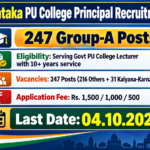
The Karnataka Examinations Authority (KEA) has released the detailed syllabus and exam pattern for the Principal (Pre-University) direct recruitment competitive examination under Notification No. ED/KEA/29/NE.VI/2026 (KK) dated 03.09.2026. The examination has three papers of 150 marks each — Paper-1 (Kannada Language) is qualifying only, while Paper-2 (General Studies) and Paper-3 (Karnataka Service and Education Rules) decide the merit list. Online applications for the 31 Kalyana-Karnataka cadre Principal posts remain open till 04.10.2026.
To be announced — detailed timetable will be published on the KEA website
Deadline to Pass Computer Literacy Test
31.12.2026
Exam Pattern
Stage
Details
Paper-1 — Kannada Language Test
150 questions, 150 marks, 3 hours. Qualifying paper only — a candidate must score a minimum of 50 marks to be eligible for the Principal post. These marks are not counted in the merit list. The standard of this paper is SSLC first-language Kannada, and the syllabus follows the pattern prescribed under the Karnataka Gazetted Probationers (Recruitment by Competitive Examination) Rules, 1997. Multiple choice format.
Paper-2 — General Studies
150 questions, 150 marks, 3 hours. Merit paper. The syllabus is the same as the main examination General Studies syllabus prescribed under the Karnataka Gazetted Probationers (Recruitment by Competitive Examination) Rules, 1997, and covers 12 broad areas from Indian and Karnataka history to Ethics, Integrity and Aptitude. Question paper available in Kannada and English.
Paper-3 — Karnataka Service and Education Rules
150 questions, 150 marks, 3 hours. Merit paper. Multiple choice format, available in Kannada and English. Covers Karnataka Civil Services Rules, KCS (CCA) Rules 1957, Karnataka Financial Code, Karnataka Treasury Code, Manual of Contingent Expenditure, the Karnataka Education Act 1983, and related psychology and administrative topics.
Negative Marking and the OMR 5th Circle Rule
Every question carries 4 options with one correct answer. 0.25 marks are deducted for each wrong answer. On the OMR answer sheet a 5th circle is provided — a candidate must shade this 5th circle for every question left unanswered. If the 5th circle is left blank, 0.25 marks are deducted for that question as well.
Merit Calculation
Only Paper-2 and Paper-3 marks are used. A list of candidates in a 1:2 ratio to the notified vacancies is published for original document verification; after verification a final 1:1 merit list is prepared as per the roster and reservation rules. In case of a tie, the older candidate is placed higher. An additional waiting list of up to 20% of the notified vacancies is also prepared.
Paper-1 Syllabus — Kannada Language Test (Qualifying)
Topic
Coverage
Comprehension
Overall comprehension of the given subject or passage
Word Usage
Correct usage of words in Kannada
Precis and Communication
Summarising and communicating the given subject
Word Knowledge
Vocabulary and knowledge of words
Translation
Translation from English into Kannada
Note: Paper-1 is set at the standard of SSLC first-language Kannada. A minimum of 50 marks is compulsory to qualify, but the marks scored are not added to the merit list — this paper is purely of a qualifying nature.
Paper-2 Topic-wise Syllabus — General Studies
This is the complete subject-wise General Studies syllabus released by KEA on 04.09.2026. It is the single most important document for this examination, since Paper-2 carries 150 of the 300 merit-deciding marks.
Subject
Topics
1. History and Cultural Heritage (India and Karnataka) — Cultural Heritage of India
Indus Civilization: destination between Indus Civilization and Vedic Civilization, evolution of Varna, Jathi/caste system, religious condition, emergence of religious movements. Literature: Sanskrit literature (ancient), Vedic literature, the epics and the Puranas and their impact on the life and culture of the Indian people, prose works on polity, ethics (neeti), popular stories and Pancha Tantra (only important works), Mughal contributions to literature. Science and Technology: Mathematics, Astronomy, Physics, Chemistry, Botany, Zoology, Physiology and Medicine (including surgery), ship-building, mining and metallurgy, engineering and architecture. Arts (excluding Karnataka): the Maurya and Gupta periods, the Khajuraho temples, Jain temples at Mount Abu, the Odishan temples, Pallava, Chola and Pandyan contributions, Mughal architecture, cathedral architecture, Bom Jesus Old Goa, St. Paul’s Kolkata and St. Thomas Chennai; painting — Ajanta frescoes, Mughal and Rajput schools; dance and music — classical music and dance, Mughal contributions to music, folk arts of India. India’s cultural contributions to the outside world — Central Asia, China, Japan, South-East Asia and Sri Lanka. Religions of India: Hindu Dharma — general characteristics and common beliefs, Purusharthas, rituals and ethics, festivals and sacred days, pilgrimage and fairs, Hindu sects, Hinduism as a federation of various sects (Shaiva, Vaishnava and Shakta), philosophy of the Upanishads, the Bhagavad-Gita, Yoga philosophy of Patanjali; Jainism — Ratnatraya, code of morals, equality (samana), Ahimsa, Digambara and Swethambara sects; Buddhism — Four Noble Truths, the Eight-fold path, Nirvana, moral doctrines, Hinayana and Mahayana sects; Christianity — teachings of Jesus Christ, Christian doctrines and theology, groups in Christianity, the Roman Catholic Church, the Eastern Orthodox churches and the Protestant churches, missionary activities in India; Islam — principles and practices, God, Confession of Faith, the Five Pillars of Islam, sacred places and days, the family system and the shariah, Sufis of Karnataka, Shia and Sunni sects; Sikhism — principles, practices and its evolution.
2. Modern Indian History — from the beginning of the 19th century, Reforms and Reformers
Eradication of social and religious wrongs; the Vedas for all — the casteless society; ideal of service; emancipation of the depressed class; the “Two-Nation” theory and Islamic revivalism; empowerment of the depressed class through religion and education; Hindutva and patriotism; the Dravida Movement; struggle for emancipation of Dalits and their empowerment; socialist approach and Total Revolution; Gram Swaraj, Satyagraha and Bhoodana.
3. From Kadambas to the Hoysalas
Antiquity of Karnataka, Kannada language and literature, extent of Kannadanadu, State and District Gazetteers, museums and archives in Karnataka, preservation and protection of historical monuments, work of the Archaeological Survey of India, World Heritage Sites in Karnataka. From the Kadambas to the Hoysalas — contributions to architecture, sculpture, literature and religion.
4. The Vijayanagara Empire and thereafter (1336–1799)
Vijayanagara Empire — origin, aims and aspiration of the Empire, Vidyaranya; political history — Harihara Bukka, Immadi Devaraya, Krishnadevaraya and Aliya Ramaraya; the battle of Talikote and its consequences; glory of the capital, administration, society, economy and religion, arts, painting, music, dance, literature, architecture and sculpture, foreign accounts of Vijayanagara. Religious sects — Shankaracharya, Ramanujacharya, Madhwacharya, Sri Basaveshvara, Veerashaivism and the Vachana movement, the Haridasa movement, Kalamukha, Shakta and Pashupatha sects. The Bahmanis — Mahamud Gawan, contributions of the Bahamani Adil Shahis of Bijapur, contributions to literature and architecture, Sufis in Karnataka. Chikkadevaraja Wodeyar, the Nayakas of Keladi and Chitradurga, Rani Chennamma and Sangolli Rayanna of Kittur, the Yalahanka Nadaprabhu, Hyder Ali and Tippu Sultan (1761–1799).
5. Modern Mysore (1799–1947)
Krishnaraja Wodeyar III and his contributions; armed rebellion in Karnataka against the British; Commissioner’s Rule (1831–1881); Nizam’s rule in Hyderabad-Karnataka; progress of Mysore under the Dewans.
6. Freedom Movement in Karnataka and Unification (1885–1956)
Rise of nationalism — pre-Gandhian era (1885–1920), Gandhian era (1920–1948); freedom movement in Hyderabad-Karnataka; important personalities in the freedom struggle; unification of Karnataka, causes for the rise of the unification movement, Alur Venkatarao, role of literacy, cultural associations and print media, three stages in the unification of Karnataka (1947–1956); social and cultural developments — spread of education by missionary and voluntary bodies, printing and the press, literary and scholarly studies, new literary genres in Kannada literature, the Backward Class movement, Miller Committee Report, folk arts of Karnataka.
7. Social and Political Perspective
Post Independent Karnataka: towards political consolidation, attempts of successive governments, backward classes and social justice, reports of the Havnur Committee, Venkataswamy Committee and Chinnappa Reddy Committee, recent trends; Dalit Movement, Devaraja Urs and land reforms; the language issue — Gokak Movement, issues and perspectives; inter-state disputes — boundary disputes, Mahajan committee report and its impact, water disputes, farmers movement, regional imbalance and the Nanjundappa committee report. Social Change and Movement: social structure and social change, theories of social change, social disorganization and social movements, directed social change, social policy and social development. Social Change and Modernisation: problems of role conflict, intergenerational gap, youth unrest and commercialization of education, emergence of India as an educational force, changing status of women, industrialization and urbanization, role of pressure groups, Sanskritisation, westernisation and modernization, modernism versus traditionalism, current social evils, fundamentalism and terrorism, Naxalism, nepotism, corruption and black money. Government and Political System: legislature, executive and judiciary, functioning of the democratic political system in a traditional society, political parties and their social composition. Decentralisation of power: decentralisation of power and political participation, Union Government, Parliament, Cabinet, Supreme Court, judicial review, Centre-State relations, State Government, role of the Governor, Panchayati Raj, class and caste in Indian politics, politics of regionalism, linguism and communalism, problems of secularisation policy and national integration, political participation and voting, vote bank politics. Socio Economic System: the Jajmani system and its bearing on traditional society, market economy and its social consequences, occupational diversification and social structure, profession and professionalisation, role of trade unions, social determinants and consequence of economic development, economic inequalities, exploitation and corruption, globalisation and its social impact. Rural Social System and Rural Development: socio-cultural dimensions of village community, traditional power structure, democratization and leadership, poverty, indebtedness, bonded labour, social consequences of land reforms, rural development projects, green revolution, new strategies of rural development, the changing rural scene.
8. Indian Economy — Planning — Rural Development
Indian Economy: post-independence growth, experience of agriculture, industry and tertiary sectors, growth and distributive justice, poverty and inequality, growth of the Karnataka economy during the plan era, growth and sectoral changes and linkages in the State economy. India and international economic relations: growth and trade-volume, composition and direction of exports and imports, domestic and foreign capital in economic development, changes in India’s foreign trade policy, balance of payments and foreign exchange, Karnataka’s exports — volume, composition and direction. Development patterns and disparities: among regions and between rural and urban areas, public policies to mitigate disparities, prospects and problems of Special Economic Zones, development disparities in Karnataka and public policies, redressal of development disparities, Regional Development Boards. Planning: planning goals, objectives and approaches, achievements and failures of the Five Year Plans (I to VII), development plans under the new economic policies regime (VIII Five Year Plan onwards), planning in Karnataka. Decentralization: pros and cons of top-down and bottom-up planning, planning mechanism and experience in Panchayati Raj institutions, planning and capacity building, planning and financing, decentralized planning in Karnataka, resource mobilization and devolution, District Planning Committee, State finances and local finances, State Finance Commission. Rural Development: importance of agriculture in the national economy, Gandhian approach to rural development and land reforms, size of farms and productivity, problems of irrigation and dry land farming, food security, rural credit, agricultural marketing, agricultural labour, rural industries and employment, agricultural problems in Karnataka, rural economic infrastructure (energy, irrigation, transport, communication, markets), rural social infrastructure — housing, drinking water, sanitation and drainage, rural health systems and their delivery, development of economic and social infrastructure in Karnataka, rural markets in Karnataka, rural housing and health care schemes in Karnataka. Rural Development Initiatives: poverty alleviation-cum-employment generation programmes, Five Year Plan and inclusive growth, rural financial institutions, development and conservation of common property resources — village grasslands and woods, water bodies, provision of urban amenities in rural areas (PURA), rural development schemes in Karnataka, self help groups and micro finance institutions in Karnataka, external assistance for rural tank rejuvenation, drinking water, sanitation and health care in Karnataka. Data Collection Analysis-Interpretation: collection, interpretation and appreciation of statistical data, study of graphs and charts — bar graphs, line graphs and pie charts, problems based on tabular and diagrammatical data, data sufficiency in statistics, problems based on probability, permutations and combinations, quantitative aptitude — number sequences, series, averages, number systems, ratio and proportion, profit and loss, percentages, time and work, speed-time-distance, simple interest, analytical and critical reasoning, reading comprehension.
9. Physical Features and Natural Resources — Geography of the World
Lithosphere — place of the Earth in the Solar System, rocks, earthquakes, volcanoes, plate tectonics, agents of erosion. Atmosphere — structure and composition, elements of climate and weather, broad climatic types. Hydrosphere — world oceans, salinity, ocean currents and tides, ocean deposits. Physiography of continents and demographic distribution — mountains, rivers, forests, grass lands, deserts, human races, population change, distribution and demographic transition, density, sex ratio, quality of life, life expectancy, literacy, standard of living and migration.
10. Geography of India
Physiography of India — climate, rivers, soil, natural vegetation. Mineral resources — iron ore and manganese, copper and bauxite, coal, petroleum and natural gas, nuclear deposits. Major crops — distribution and production of cereals, millets, oilseeds, plantation crops, commercial crops. Indian demography — growth, composition, distribution, density, Human Development Index, demographic database. Industrial planning and development — growth and distribution of major, medium, small and tiny industries, industrial regions of India, industrial infrastructure, railways, roads and ports, backward regions and rural industrialisation, regional planning and development, tribal and hill areas, drought prone areas, command areas and river basins, classification of towns and cities, urban structure.
11. Geography of Karnataka
Physiographic divisions — climate, rivers, rainfall distribution, natural vegetation and soil. Agriculture and agro climatic regions, major crops, plantation and commercial crops of Karnataka. Mineral resources of Karnataka. Sources of power (hydro, thermal, solar, nuclear and wind). Major, medium and small scale industries, agro based industries. Transportation and communication systems in Karnataka. Geographic information system. Urban land use policy and urbanisation — demographic features, literacy and urbanisation, population problems and policies, literacy, city classification and urban spheres of influence, rural urban fringe, problems of urban growth, land use, town planning, slums and urban housing, intra and inter regional trade and the role of rural market centers.
12. Overview of Indian Constitution
Nature of the Constitution — constitutional developments, salient features of the Constitution, Preamble, Directive Principles of State Policy, Indian federation. Fundamental Rights — Right to Equality, Right to Freedom, Right against Exploitation, Right to Freedom of Religion, Cultural and Educational Rights, Right to Constitutional Remedies; reasonable restrictions, provision for Scheduled Castes, Scheduled Tribes and minorities, reservations for SC/ST and OBCs, prevention of SC/ST Atrocities Act, National and State SC/ST Commission. Distribution of legislative powers between the Union and the State, administrative and financial relations between the union and the states, powers and functions of constitutional bodies, powers and functions of the Governor, Council of Ministers and Cabinet, judicial remedies. Unicameral and bicameral legislations — functions and crisis of accountability, delegated legislation, legislative procedure and committees of legislature, legislative and judicial control over delegated legislation, judicial review of administrative action, Comptroller and Auditor General of India, Attorney General of India. Important Amendments of the Constitution — basic structure theory, emergency provisions and decentralization, Panchayati Raj, the Seventy-third and Seventy-fourth amendments. Welfare mechanism in India — Directive Principles of State Policy and their relationships, Right to Property, Election Commission, Public Service Commissions, Women’s Commission, National and State Minorities Commission, Backward Commission, Human Rights Commission, Information Commission, Finance Commission, Planning Commission, National Development Council. Services under the Union and State — constitutional provisions relating to Government and public servants.
Paper-2 Syllabus (continued) — Administration, Science, Environment, Ethics and Aptitude
Subject
Topics
13. Public Administration and Management — International Relations
Private and Public Administration — its role in society, Public Administration as an art and a science, New Public Administration and New Public Management, responsive administration, difference between administration and management, difference between public and private administration. Structure of Organisation — personnel, financial, administrative law, maintenance of law and order, administration for welfare, issues of areas in Indian administration, development administration. Organisational Behaviour and management concepts — organisation structure, systems, processes, strategiest, policies and objectives, decision making, communication, centralisation, decentralisation, delegation of organisational authority, responsibility, control. Formal and informal organisation — functional management: finance, HR, marketing, production, leadership and motivation. Management tools and techniques — decision making under uncertainty, PERT and CPM, PIME, POSD CORB, SWOT analysis, performance standards and appraisal, PDCA cycle, personnel policies, manpower policy and planning, training and development, conflict management, management of change and development, team building, quality tools (brain storming, nominal group technique, pareto chart, fishbone diagram and process chart). Administrative Reforms — ethics and values in public service, public relations, good governance, accountability and control, program monitoring and evaluation, Lokpal and Lokayukta, redressal of citizens grievances, district administration and Panchayati Raj system, law and order and development functions, development programmes, welfare programmes for SC/ST and women, people’s participation, Administrative Reforms Commissions — Central and State. United Nations and specialised agencies, other international organisations and agencies, origin and development of the UNO, role in international relations, General Assembly, Security Council, Economic and Social Council, Trusteeship Council, International Court of Justice, UN and peace keeping operations, UN and disarmaments, future of the UN, special agencies like WHO, ILO, FAO etc., international organisations like IMF, World Bank, ADB, WTO, EU, ASEAN, SAARC, AU, NATO, NAM, OPEC, G-8, IAEA etc., role of developing countries in international relations, India and her neighbours.
14. Role and Impact of Science and Technology in Development of India, Information Technology in Public Domain
Basics of Science and Technology: classical and emerging areas of science and technology, value addition by science and technology, current science and technology developments in India, importance of science and technology as an engine for national development, industrial development and urbanization, National Policy of Science and Technology and changes in policy from time to time, technology missions; ICT — basics of computers, communication, telephone and television, broadband, Internet and web, IT industries, BPO, economic and employment growth, e-governance, e-commerce and e-learning, IT and rural applications, digital divide and its prevention, computers in mass media. SPACE Science and Technology: a brief history of global space programmes and current space programmes, space programme in India — INSAT, IRS systems, EDUSAT and Chandrayana-1 etc., and future programmes, application of space technology in India with special reference to educational, agricultural and other rural developmental activities. Energy Resources: Indian energy scenario — hydel, thermal, nuclear and renewable, their potential, harnessing and options; importance of renewable resources — solar, wind, small/mini/micro hydel, biomass, waste based, geothermal, tidal, hydrogen and fuel cells; enabling legislations, financial and procedural incentives and business opportunities for investors. Disasters, Pests and Pollution: climatic change, floods, cyclone, tsunami, natural and manmade disasters and disaster management, crop science in India, fertilizers, control of pests and crop diseases, safe drinking water and supply, sanitation and waste disposal, urbanization, industrialization and pollution control. Related Perceptions: universalizing science and technology literacy, technology with a human face, Human Development Index (HDI), contribution to growth of GDP, facing global competition, preservation and promotion of culture and indigenous knowledge. Knowledge Society: human capital and its power, imparting education, skill and values, role of knowledge for economic growth, social development, cultural enrichment and political empowerment, achieving goals around knowledge, eradication of poverty, universal primary education, gender equality. Rural Upliftment and Science and Technology: advance infrastructure in rural areas, establishing physical, electronic, knowledge and economic connectivity, regional language usage in ICT, horticulture — hybrid seed production with R and D, setting up fruit and vegetable processing plants, packaging and marketing, agro food processing — forming village clusters and establishing food storage, food processing and food packaging and marketing, bio-fuel cultivation and extraction, scientific water harvesting.
15. Advancement and Modern Trends in Natural Sciences, Life Sciences, Agricultural Science, Health and Hygiene
Natural Science: plants — crop plants, forest species, medicinal and aromatic plants, usefulness of plants and human affairs (utility), photosynthesis, transpiration, harmful plants; common classification of animals — domestic and wild animals, usefulness of animals and human affairs (utility); microorganisms — common bacteria, virus, fungi and their beneficial and harmful effect on mankind. Agriculture Science: agriculture scenario and importance of agriculture in the national and state economy, crop production and protection, chemical fertilizers and vermi compost, cost benefit and investment analysis of agricultural enterprises, programmes for production and productivity enhancement — green, white, yellow and blue revolutions, recent trends in organic farming and farm mechanization, farming systems and sustainability, agro-processing and agro-based industries, post-harvest technology and value addition, management of land and water resources. Horticulture and Sericulture: importance of horticulture — floriculture, vegetables, fruits, plantation crops, spices, aromatic and medicinal plants; hi-tech horticulture (green/poly house cultivation), post-harvest management and value addition, special promotional programmes for horticulture development; sericulture — importance of sericulture in India and Karnataka, distribution of mulberry and non-mulberry sericulture (area, production and productivity across states), cocoon production. Initiatives in Biotechnology: concept of biotechnology, introduction and application of genetic engineering and stem cells research, molecular breeding and marker assisted selection, transgenic plants (genetically modified) and their beneficial and harmful effects on environment and society, biotechnology in agriculture (bio-fertilizers, bio-pesticides, bio-fuels, tissue culture, cloning), food bio-technology, food safety and microbial standards, food quality standards, food laws and regulations. Animal Husbandry (veterinary, dairy and fishery sciences): importance of livestock in the national and state economy, important exotic and Indian breeds of cattle, buffalo, sheep, goat, swine and poultry, milk production management and dairy development, milk co-operative unions and their role in the rural economy — AMUL, KMF; fisheries resources in India, marine fisheries resources and potential, exclusive economic zone of India, coastal agriculture and mari culture, inland water resources, commercially important fishes, responsible fishing, ornamental fish production, value addition of livestock products and quality control. Agriculture development policies, programmes and trade: salient features of national and Karnataka state agricultural policies, agriculture price policy, national seed policy, agricultural credit policy, National Agricultural Research System (NARS), farmers welfare programmes in India, farm women development programmes, agriculture under the Five Year Plans, development and strengthening of agricultural marketing infrastructure, grading and standardization, Crop Insurance Scheme — National Agricultural Insurance Scheme (NAIS), Weather Based Crop Insurance Scheme (WBCIS), food security, National Watershed Development Programme, export potential of agriculture horticulture livestock products, commercialization and globalization of agriculture, WTO, AoA (Agreement on Agriculture). Health and Hygiene: human digestive, circulatory, respiratory, excretory and reproductive systems; allopathic and Indian System of Medicine, Naturopathy and Yoga (AYUSHI), NRHM, National HIV Programme, Tuberculosis programme, P and SM (Preventive and Social Medicine); diseases — communicable diseases, epidemic diseases, endemic diseases, vector borne diseases; basic knowledge of infections caused by different groups of microorganisms — gastroenteritis, cholera, tuberculosis, malaria, viral infections, HIV, encephalitis, chikungunya, bird flu, dengue; preventive measures during outbreaks, vaccines, introduction to immunity, production of DPT and rabies vaccine and hepatitis vaccine, application of immunological methods in diagnosis, health awareness programmes.
16. Challenges and Issues of Development on Environment and Ecology
Environmental Segments: promotions and protection, forest conservation and environmentalism, protection of wild life, Project Tiger, national parks and sanctuaries, impact of mining on forest and environment, Red Data Book, endangered species, eco tourism and any other related current issues. Natural Resources: forest — types and conservation of forest and forest resources; water resources — flood and drought occurrences, water resource management, land resources, rain water harvesting, infrastructure development — dams, roads, rails, bridges, industry, urbanization and waste water management, acquisition and rehabilitation and other issues due to human interventions and any other related current issues. Eco System and Biodiversity: ecology — basic concepts, eco system, food chain, biodiversity and its conservation, hot spots of biodiversity, threats to diversity, forest sustainable development and management, any other related current issues, IPR. Environment Pollution and Solid Waste Management: air pollution, water pollution, soil pollution, noise pollution and remedies; solid waste management — types of solid waste management, factors affecting solid waste generation, impact of solid waste, recycling and reuse, any other related current issues; Environment Protection Act, Air (Prevention and Control of Pollution) Act, Water (Prevention and Control of Pollution) Act, water pollution cess Act. Role of Information Technology in Environment and Human Health: global environmental issues like climate change, acid rains, global warming, wasteland reclamation, watershed management, watershed approach for sustainable development, linking of rivers, water crisis, any other related current issues. State community-civil society interface: joint forest management system, community participation, development, displacement and rehabilitation, disaster management, sustainable forest development, flood, earthquake, drought, tsunami, global warming, ozone layer, CFC, carbon credit.
17. Ethics
Essence, determinants and consequences of ethics in human action, dimensions of ethics, ethics in private and public relationships. Ethics in public administration — status and problems, ethical dilemmas in Government and private institutions, laws, rules, regulations and conscience as source of ethical guidance. Accountability and ethical governance, strengthening of ethical and moral values in governance, ethical issues in international relations and funding, corporate governance. Concept of public service, philosophical basis of governance, information sharing and transparency in Government, Right to Information, codes of ethics, codes of conduct, citizen charters, work culture, quality of service delivery, utilization of public fund, challenges of corruption. Human values — lessons from the lives and teachings of great leaders, reformers and administrators; role of family, society and educational institutions in inculcating values.
18. Integrity
Integrity, impartiality and non partisanship, objectivity, dedication to public service, empathy, tolerance and compassion towards the weaker sections.
19. Aptitude
Aptitude and foundational values for civil service — content, structure, function, its relation with thoughts and behavior, moral and political attitudes, social influence and persuasion. Aptitude and foundational values for civil service, emotional intelligence and their utilities and application in administration and governance, contributions of moral thinkers from India and the world.
Paper-3 Syllabus — Karnataka Service and Education Rules
Subject
Coverage
Karnataka Civil Services Rules
Service conditions, pay, leave, allowances and related provisions applicable to Karnataka State Government servants
Karnataka Civil Services (Classification, Control and Appeal) Rules, 1957
Classification of services, disciplinary authorities, penalties, disciplinary procedure and appeals
Karnataka Financial Code
Financial rules and procedures governing State Government offices and institutions
Karnataka Treasury Code
Treasury procedures, drawal and disbursement of Government money, bills and accounts
Manual of Contingent Expenditure
Rules and procedures for contingent expenditure in Government offices
Karnataka Education Act, 1983
Provisions of the Act governing educational institutions in Karnataka, including pre-university education
Related psychology and other subjects
Psychology and other subjects relevant to administrative purposes, as stated in the official notification
How to Apply
Applications for the Principal posts covered by this syllabus are still open. Serving Government PU College Lecturers with at least 10 years of service can apply as follows.
Open the online application link provided on the portal and register with a valid mobile number and e-mail ID — all communication is sent to the details entered here.
Fill in every field carefully, including personal, service and reservation details. Once the application is submitted, no change or correction is permitted at any stage.
Upload a recent passport-size photograph (JPEG, 50 KB to 200 KB) and your signature (JPEG, 50 KB to 70 KB), along with the Service Certificate, Article 371(J) Kalyana-Karnataka eligibility certificate and any reservation certificates you are claiming.
Pay the fee online — Rs. 1,500 for General Merit and Categories 2A, 2B, 3A, 3B; Rs. 1,000 for SC, ST, Category-1, Ex-Servicemen and Third Gender candidates; Rs. 500 for Persons with Disability — by 05.10.2026, then download and keep a printout of the submitted application and fee challan.
Note: Applications are accepted online only. The fee once paid is not refundable, and applications without the uploaded photograph and signature are rejected.
Photograph or signature rejected by the upload form?
This application needs a JPEG photograph between 50 KB and 200 KB and a JPEG signature between 50 KB and 70 KB. Resize both to the exact size the KEA form will accept, free and in your browser.
Do not ignore Paper-1 because it is only qualifying — a candidate who scores below 50 marks in the Kannada Language Test is out of the race regardless of how well Paper-2 and Paper-3 go.
Do not spend equal preparation time on all three papers — only Paper-2 and Paper-3 marks build the merit list, so those 300 marks deserve the bulk of your study hours.
On the OMR sheet, remember to shade the 5th circle for every question you choose to leave unanswered; leaving it blank costs you 0.25 marks per question, exactly like a wrong answer.
Do not guess blindly — with 0.25 negative marking across 450 questions, careless guessing can wipe out a genuine score.
Do not prepare Paper-2 from a generic state GK book — this syllabus is the Karnataka Gazetted Probationers main examination syllabus, which goes far deeper into Karnataka history, economy, administration and current issues.
Do not leave the computer literacy test to the last minute — it must be passed by 31.12.2026 under the Karnataka Civil Service (Computer Literacy Test) Rules, 2012, and failing to clear it disqualifies you even after selection.
Frequently Asked Questions
Q1. How many papers are there in the KEA PU College Principal examination 2026? There are three papers — Paper-1 (Kannada Language Test), Paper-2 (General Studies) and Paper-3 (Karnataka Service and Education Rules) — each of 150 questions, 150 marks and 3 hours.
Q2. Which papers count towards the merit list? Only Paper-2 and Paper-3 marks are counted for the merit list, giving a merit total of 300 marks.
Q3. What is the qualifying mark for Paper-1 Kannada Language Test? A candidate must score a minimum of 50 marks in Paper-1 to be eligible for the Principal post, and those marks are not added to the merit list.
Q4. Is there negative marking in this examination? Yes — 0.25 marks are deducted for every wrong answer, and on the OMR sheet an unanswered question also costs 0.25 marks unless its 5th circle is shaded.
Q5. Can I write the exam in English? Yes, Paper-2 and Paper-3 question papers are available in both Kannada and English, and candidates may answer in either language.
Q6. What is the Paper-2 General Studies syllabus based on? Paper-2 follows the main examination General Studies syllabus prescribed under the Karnataka Gazetted Probationers (Recruitment by Competitive Examination) Rules, 1997.
Q7. When will the exam date be announced? The exam date is not yet announced — KEA has stated that the detailed timetable for Paper-1, Paper-2 and Paper-3 will be published on its website later.
Q8. Will the exam be computer-based or on OMR sheets? KEA has stated that the competitive examination may be conducted either online as a Computer Based Test (CBT) or offline in OMR format, and the exam centre once allotted cannot be changed for any reason.
Disclaimer: The information above has been compiled from the official notification for the convenience of job seekers. Candidates are advised to verify all details from the official website before applying.