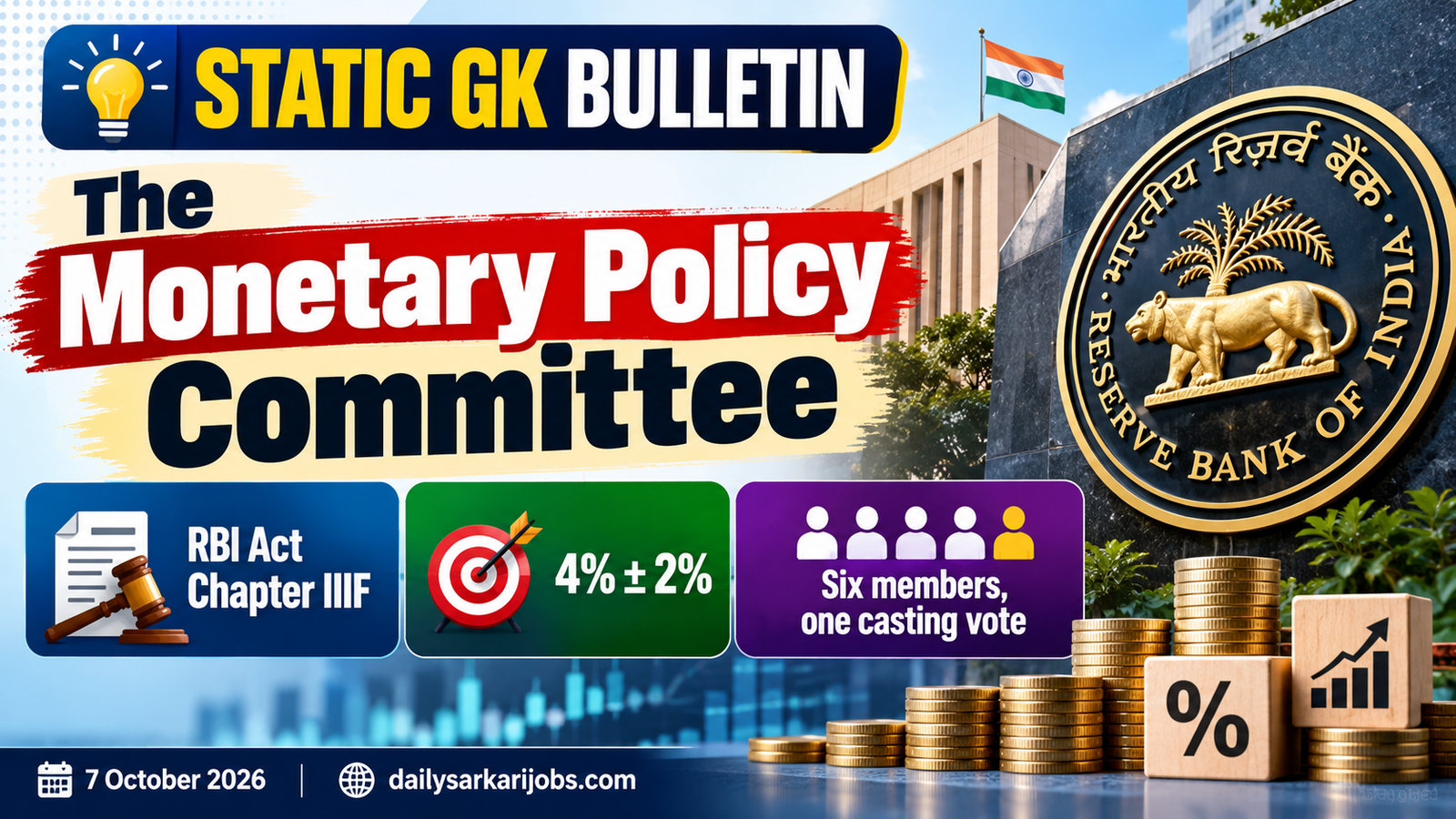
Ask a simple question about any institution and you usually get a simple answer. What is the Election Commission for? To hold elections. What is the Comptroller and Auditor General for? To audit the government. Now ask: what is the Reserve Bank of India for?
Until 2016 there was no legal answer. The Reserve Bank of India Act of 1934 set up a bank and said almost nothing about what it was supposed to achieve. The Governor decided interest rates by himself, advised by a committee he was free to ignore. Then in 2016 Parliament gave the Bank one number to hit, and a committee to hit it with. This capsule opens a new series on the economy, and is explained in plain language for SSC, RRB NTPC, banking exams, State PSC and UPSC Prelims.
⚡ QUICK FACTS
Law
RBI Act, 1934 — Chapter IIIF, inserted 2016
Target
4% CPI inflation
Band
2% to 6% — that is 4% ± 2%
Set by
Central Government, once in five years
Current period
1 April 2026 to 31 March 2031
MPC size
6 members, at least 4 meetings a year
What Changed in 2016, and Why It Was a Big Deal
Three things happened, in this order, and exams ask about all three.
Date
What happened
January 2014
The Urjit Patel Committee — formally the Expert Committee to Revise and Strengthen the Monetary Policy Framework — recommended that India adopt inflation targeting and use the Consumer Price Index as the anchor
20 February 2015
The Government and the Reserve Bank signed the Monetary Policy Framework Agreement. Monetary policy would primarily maintain price stability while keeping the objective of growth in mind. This was an agreement, not a law
2016
The Finance Act, 2016 amended the RBI Act, changed its preamble and inserted Chapter IIIF — sections 45ZA to 45ZO. The agreement became statute
5 August 2016
The first inflation target was notified in the Gazette: 4 per cent, with a band of 2 to 6 per cent
29 September 2016
The first Monetary Policy Committee was constituted
Hold on to the distinction between the 2015 agreement and the 2016 law, because it is the most commonly confused pair on this topic. An agreement between a government and its central bank can be torn up by the next government. A chapter in an Act cannot, without Parliament.
What the Target Actually Says
Under section 45ZA, the Central Government, in consultation with the Bank, determines the inflation target in terms of the Consumer Price Index, once in every five years, and notifies it in the Official Gazette.
Notice who sets it. The Government sets the target; the Bank hits it. That division is the whole architecture, and it is the same division a company uses between its board and its chief executive — the board says what success looks like, the executive decides how to get there.
Period
Notified on
Target
Band
5 Aug 2016 to 31 Mar 2021
5 August 2016
4%
2% to 6%
1 Apr 2021 to 31 Mar 2026
31 March 2021
4%
2% to 6%
1 Apr 2026 to 31 Mar 2031
25 March 2026
4%
2% to 6%
Three renewals, ten years, and the number has never changed. That is itself the finding. Before the 2026 renewal the Bank ran a public consultation; about two-thirds of respondents wanted the band kept as it was, and twenty-one proposed narrowing it, most often to plus or minus 1.5 per cent. The band was kept at plus or minus 2 per cent because that width has absorbed large external shocks without forcing the Bank to do something foolish.
One point of precision that catches people out: the target is 4 per cent. The band is not the target. Inflation at 5.8 per cent is inside the band and still a miss; the Bank is aiming at 4, not at “anywhere under 6”.
The Committee: Do the Arithmetic Yourself
Section 45ZB constitutes the Monetary Policy Committee. Six members, and the split is the interesting part.
Member
How they get there
Side
The Governor of the Reserve Bank
Ex officio, and Chairperson of the Committee
Bank
The Deputy Governor in charge of monetary policy
Ex officio
Bank
One officer of the Bank
Nominated by the Central Board of the Bank
Bank
Three persons
Appointed by the Central Government
Government
So it is three and three. Now apply the device that worked on the GST Council — work out what each side can and cannot do alone before reading a word about independence.
Decisions are taken by a majority of votes, each member having one vote
The quorum is four members, one of whom must be the Governor
In the event of a tie, the Governor has a second, or casting, vote
Run the arithmetic and the answer falls out. If the three Government appointees vote together against the three Bank members, the vote is three-all and the Governor breaks the tie in the Bank’s favour. The Government appoints half the committee and still cannot carry a decision against the Bank. Equally, the Bank cannot ignore the committee, because it needs only one of its own three to defect for the position to flip.
That is what “operational independence” means in practice, and it is a casting vote rather than a speech.
Two more provisions worth memorising. Under section 45ZC, the three Government appointees hold office for four years and are not eligible for re-appointment; they are selected on the recommendation of a Search-cum-Selection Committee chaired by the Cabinet Secretary. Under section 45ZD, the Bank must organise at least four meetings a year.
That no-re-appointment rule should look familiar. It is the same one-way door the Constitution builds for the Union Public Service Commission under Article 319: a person with no second term to hope for cannot be courted with one. Three different laws, written decades apart, reaching for the same device.
What Happens If the Bank Misses
Here is where the design gets genuinely interesting, because the answer is: it has to write a letter.
Section 45ZN says that where the Bank fails to meet the inflation target, it shall set out in a report to the Central Government the reasons for the failure, the remedial actions proposed, and an estimate of the time within which the target will be achieved.
The Act does not itself define failure — it leaves that to a Government notification, and the notification sets it at average inflation outside the 2 to 6 per cent band for three consecutive quarters.
Question
Answer
Is anyone fined?
No
Does anyone resign?
No
Is the report made public?
The requirement is a report to the Central Government; the fact of a miss is public well before it, because the inflation data is published monthly
So what is the actual penalty?
Having to explain yourself, in writing, to the government that appointed you
This series has a name for that shape: accountability by embarrassment. It first appeared in the capsule on the Comptroller and Auditor General, who can neither stop, recover nor punish anything, and in the Election Commission’s Model Code, which binds nobody in law. Several of the most powerful institutions in the Indian system have no power to compel and no penalty to fear. What they have is an obligation to be seen.
The seeing is not accidental, either. Under section 45ZL, the Bank must publish on the fourteenth day after every meeting the minutes of the proceedings, including how each member voted and the statement of each member’s reasons. An external member who votes badly does so under his own name, in public, a fortnight later. That is the enforcement mechanism, and there is no other.
The Tools the Committee Actually Uses
The committee decides one thing: the policy repo rate. Everything else follows from it. The detail of the rate corridor belongs to the banking awareness capsule, but the short version is worth having here.
Rate
What it is
Repo rate
The rate at which the Reserve Bank lends short-term money to commercial banks against government securities. This is the one the MPC votes on
Standing Deposit Facility rate
The rate at which banks park surplus money with the Reserve Bank without collateral. The floor of the corridor
Marginal Standing Facility rate
The emergency rate at which banks borrow beyond their normal limit. The ceiling of the corridor
Bank Rate
Moves with the Marginal Standing Facility rate; used for penalties on shortfalls in reserve requirements
Cash Reserve Ratio and Statutory Liquidity Ratio are not decided by the Monetary Policy Committee. They are regulatory requirements set by the Reserve Bank itself, and a question that puts them in the MPC’s hands is testing exactly that confusion.
Why a Reader Should Care
Inflation is the only economic number that reaches every household without being announced. A tax has to be passed by Parliament; a price rise does not. Someone on a fixed salary who gets a five per cent increment in a year of seven per cent inflation has taken a pay cut that nobody voted for and nobody has to defend.
That is why the target sits in a statute rather than in a speech, and why six people have to put their names to a number every two months. Growth figures make the headlines; the inflation number is the one that reaches the kitchen.
Practice Questions
Q1. The Monetary Policy Committee was given statutory backing by which law? (a) The Banking Regulation Act, 1949 (b) The Finance Act, 2016 amending the RBI Act, 1934 (c) The Fiscal Responsibility and Budget Management Act, 2003 (d) A resolution of the Union Cabinet Answer: (b) The Finance Act, 2016 amending the RBI Act, 1934 The committee sits in a chapter that did not exist in the original 1934 statute — Chapter IIIF was inserted, along with the new preamble, by an amendment carried through a Budget-session money law. The 2015 arrangement that preceded it was only an agreement.
Q2. Under section 45ZA of the RBI Act, how often is the inflation target determined? (a) Every year (b) Once in three years (c) Once in five years (d) Whenever the Government chooses Answer: (c) Once in five years The interval is deliberately longer than the life of a Monetary Policy Committee member’s term, so that the goal does not move while the people chasing it are still in office. Three notifications have now been issued, in 2016, 2021 and 2026.
Q3. In the Monetary Policy Committee, in the event of a tie… (a) The decision is deferred to the next meeting (b) The Central Government decides (c) The Governor has a second or casting vote (d) The Deputy Governor has a casting vote Answer: (c) The Governor has a second or casting vote With three members from the Bank and three appointed by the Government, a split along those lines is perfectly possible, and the Act had to say what then happens. The tie is broken inside the Bank, which is the quiet source of its operational independence.
Q4. The minutes of a Monetary Policy Committee meeting, including each member’s vote and reasons, must be published… (a) On the day of the decision (b) On the seventh day after the meeting (c) On the fourteenth day after the meeting (d) Within three months Answer: (c) On the fourteenth day after the meeting Section 45ZL fixes a precise day rather than a deadline, and the gap is long enough for markets to absorb the decision first and short enough to matter. Publishing every member’s reasoning under his own name is the committee’s only real accountability mechanism.
Q5. The Reserve Bank is deemed to have failed to meet the inflation target if average inflation stays outside the band for… (a) One quarter (b) Two consecutive quarters (c) Three consecutive quarters (d) Four consecutive quarters Answer: (c) Three consecutive quarters A single bad month or quarter is noise rather than failure, which is why the test is set over a run. When it is triggered, the consequence is a written report to the Government setting out the reasons, the remedy and the expected time to get back inside the band.
Ten more questions on this and today’s Current Affairs explainer are waiting on our Test Your Knowledge page, with a free PDF. Today’s explainer is on the India-EFTA agreement at one year — the first Indian trade agreement in which the other side promised money rather than just tariff cuts.
Sources: the Reserve Bank of India Act, 1934, Chapter IIIF as published by the Department of Economic Affairs, for section 45ZA on the five-yearly inflation target, 45ZB on the composition of the Monetary Policy Committee, 45ZC on the four-year term, the bar on re-appointment and the Search-cum-Selection Committee chaired by the Cabinet Secretary, 45ZD on at least four meetings a year, 45ZE on the quorum of four and the Governor’s casting vote, 45ZL on publication of the minutes on the fourteenth day, and 45ZN on the report required when the target is missed; the Reserve Bank’s own monetary policy framework overview for the current target of 4 per cent with a 2 to 6 per cent band notified on 25 March 2026 for 1 April 2026 to 31 March 2031, and for the three-consecutive-quarter definition of failure, which the Act itself leaves to a Government notification; a Reserve Bank Bulletin article for the 2026 review consultation, in which about two-thirds of respondents favoured keeping the band and twenty-one proposed narrowing it; the Press Information Bureau release of 29 September 2016 constituting the first Committee; and published government accounts of the Monetary Policy Framework Agreement of 20 February 2015, the Finance Act 2016 amendment, and the first Gazette notification of the target on 5 August 2016. The serving Governor and the current external members are deliberately left out, because they change; check the Reserve Bank’s own website on the day rather than trusting any note, including this one.