In every trade agreement India has ever signed, both sides pay in the same currency: tariffs. You drop your duties, I drop mine, and we both hope trade grows. The India-EFTA agreement broke that pattern. India paid in tariffs. The other side paid in a number: one hundred billion dollars.
On 7 October 2026 the Commerce Secretary spoke at the second India-EFTA Prosperity Summit, marking one year since the Trade and Economic Partnership Agreement came into force. Explained in plain language for SSC, RRB NTPC, State PSC, banking general awareness and UPSC Prelims.
First, the Trap: EFTA Is Not the European Union
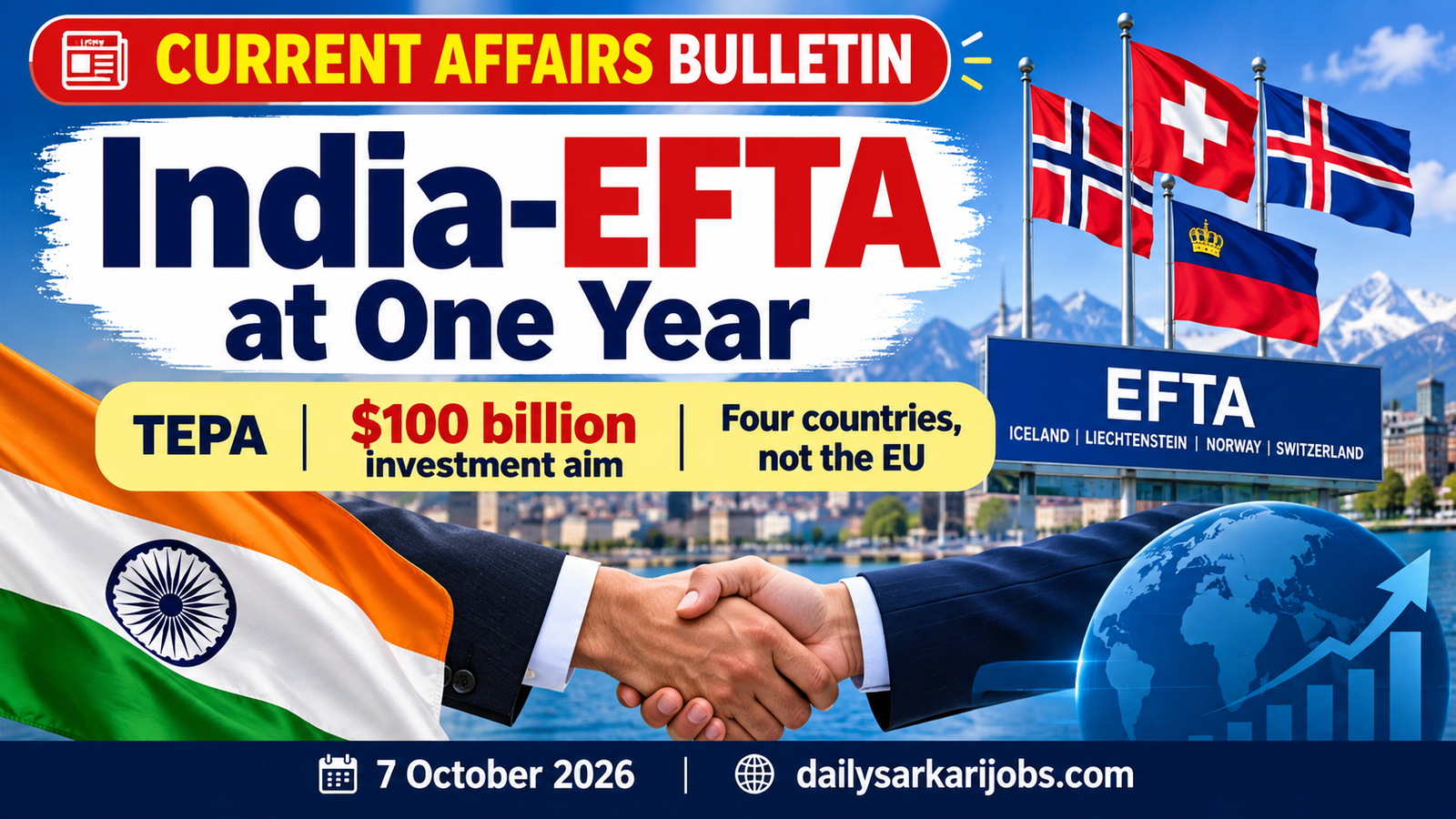
This is the single most common mistake on this topic, and it is worth fixing before anything else. EFTA is the European Free Trade Association, and it has exactly four members: Iceland, Liechtenstein, Norway and Switzerland. None of them is in the European Union.
| Country | In the EU? | In the European Economic Area? |
|---|---|---|
| Norway | No | Yes |
| Iceland | No | Yes |
| Liechtenstein | No | Yes |
| Switzerland | No | No — it trades with the EU through separate bilateral agreements |
A memory hook that works: EFTA is the small rich club of European countries that chose to stay outside the EU. Four countries, fewer than fifteen million people between them, and together they import more than half a trillion US dollars of goods and services a year. India’s agreement is with these four, and with nobody else in Europe.
The Hinge: One Side Paid in Tariffs, the Other Paid in Money
Open any free trade agreement and you will find the same bargain. Country A cuts its import duties on Country B’s goods; Country B does the same in return. Both sides give up tax revenue and hope that cheaper trade makes up for it. That is the entire deal in almost every agreement India has signed, including the one with New Zealand.
TEPA has that bargain too. But it has something else, in Chapter 7, that no earlier Indian agreement contains.
| What India gave | What EFTA gave |
|---|---|
| Tariff concessions on 82.7% of tariff lines, covering 95.3% of EFTA’s exports to India | Tariff concessions on 92.2% of tariff lines, covering 99.6% of India’s exports — complete coverage of non-agricultural goods |
| Commitments in 105 services sub-sectors | Commitments in 128 (Switzerland), 114 (Norway), 110 (Iceland) and 107 (Liechtenstein) services sub-sectors |
| — | An aim to raise the stock of foreign direct investment in India by USD 50 billion in ten years and a further USD 50 billion in the five years after that, and to facilitate 1 million direct jobs |
Read the last row again. A trade agreement that names an investment figure and a jobs figure is an unusual document. The ordinary way to attract investment is to improve your own conditions and wait. India instead wrote the number into the treaty and asked four governments to sign under it.
But Is It Binding? Read the Verb
This is where a careful reader earns marks, because the answer is genuinely two-sided and most notes give only one side of it.
The Minister who signed it described the agreement as carrying a binding commitment of USD 100 billion and 1 million direct jobs. The text of Article 7.1 says the EFTA States shall aim to increase foreign direct investment by those amounts.
| An obligation of result | An obligation of conduct | |
|---|---|---|
| What it means | You must achieve the outcome | You must make honest efforts towards the outcome |
| If it is not achieved | You have broken the agreement | You have broken it only if you did not genuinely try |
| Which one is Article 7.1? | — | This one — the words are “shall aim to” |
That does not make the chapter empty, and this is the part worth learning properly. Chapter 7 sets up an Investment Sub-Committee of government representatives that reviews progress at the five-year, ten-year and fifteen-year marks. If India believes the EFTA States have not made the effort, it may ask for consultations, and at the end of a long graded process it may take temporary and proportionate measures — in plain words, it may withdraw some of the tariff concessions it gave.
Two further details that sharpen the picture. The investment chapter is excluded from the agreement’s ordinary dispute settlement machinery, so no tribunal decides whether EFTA tried hard enough; and the chapter contains no investment protection and no investor-State dispute settlement — a foreign company cannot use it to sue India.
So the honest sentence is this: it is not a promise to deliver, it is a promise to try, with a remedy at the end of a long road. That is still more than any earlier Indian trade agreement obtained, and it is a great deal less than the headline suggests. Whenever a treaty is described as binding, go and find the verb.
Read the Exclusion List
The device that worked on the New Zealand agreement works here too: an agreement tells you more by what it leaves out than by what it covers. India opened 82.7% of its tariff lines. The interesting question is the other 17.3%.
- Dairy — protected in every Indian trade agreement without exception, because millions of small milk producers would be exposed
- Soya and selected food products
- Coal
- Pharmaceuticals and medical devices — India is a large producer and had no reason to open them
- Gold — which is the big one, explained below
More than 80 per cent of India’s imports from EFTA are gold, almost all of it from Switzerland. If India had cut the duty on gold, the agreement would have produced a large import bill and very little else. So the effective duty on gold was left unchanged.
That single decision is what makes the agreement affordable, and it is also the best example in Indian trade policy of the rule that a tariff-line percentage can be misleading. India opened four-fifths of its lines while keeping the one line that carries most of the money.
What Else Is in the Agreement
| Item | Detail |
|---|---|
| Chapters | 14, covering goods, rules of origin, trade facilitation, trade remedies, sanitary and phytosanitary measures, technical barriers to trade, investment promotion, services, intellectual property, trade and sustainable development, and legal provisions |
| Professional recognition | Mutual recognition arrangements in nursing, chartered accountancy and architecture, so Indian professionals can have qualifications accepted |
| First-year trade | Agricultural exports to EFTA about USD 72.37 million in 2024-25; engineering goods about USD 315 million, up about 18 per cent year on year; chemicals about USD 49 million |
| Size of the market | EFTA States together import more than USD half a trillion of goods and services a year |
The mutual recognition arrangements are quietly the most useful part for an ordinary reader. A tariff cut helps an exporter; recognition of a nursing or accountancy qualification helps a person. Very few Indian trade agreements contain any.
Why This Matters Beyond the Four Countries
India has spent a decade trying to raise manufacturing’s share of the economy through Make in India and the schemes underneath it, and trying to cut the cost of moving goods through bodies such as the new transport and logistics authority. Both of those are things India does to itself. TEPA is the first time India has asked a trading partner to put a number on what it will do in return.
Whether the number arrives is a question for the 2030s. But the template now exists, and India has since used the same idea in other negotiations. The test to apply to any future agreement is simple: did the other side promise only to buy from us, or did it also promise to build here?
The Honest Caution
One year is far too early to judge an agreement whose investment clock runs for fifteen. The first formal review under Chapter 7 is not due until the fifth year. The trade figures above are first-year numbers and will move; treat them as a snapshot rather than a trend, and recheck them before an exam.
Practice Questions
Q1. The India-EFTA Trade and Economic Partnership Agreement is with which group of countries?
(a) The European Union (b) Iceland, Liechtenstein, Norway and Switzerland (c) Germany, France, Italy and Spain (d) The Nordic Council
Answer: (b) Iceland, Liechtenstein, Norway and Switzerland Every option here is a real European grouping, which is exactly the trap. The association in question has four members, all of them outside the European Union, and three of them in the European Economic Area while the fourth trades with the EU bilaterally.
Q2. TEPA was signed on 10 March 2024. When did it come into force?
(a) Immediately on signature (b) 1 April 2025 (c) 1 October 2025 (d) 1 January 2026
Answer: (c) 1 October 2025 A trade agreement needs ratification by every party before it operates, and that gap was about eighteen months here. Signature and entry into force are separate events, and a question can ask for either.
Q3. Under Chapter 7 of TEPA, the EFTA States aim to increase foreign direct investment in India by…
(a) USD 10 billion in 5 years (b) USD 50 billion in 15 years (c) USD 100 billion in 15 years (d) USD 200 billion in 20 years
Answer: (c) USD 100 billion in 15 years The figure arrives in two instalments — half within ten years and the other half in the five years after — which is why one of the wrong options looks so plausible. Add the two together and note the full period.
Q4. Which commodity accounts for more than 80 per cent of India’s imports from EFTA, and had no change made to its effective duty?
(a) Crude oil (b) Machinery (c) Pharmaceuticals (d) Gold
Answer: (d) Gold Three of these are things India buys heavily from elsewhere rather than from four small European economies. The right answer comes mostly from Switzerland, and leaving its duty alone is what kept the agreement affordable.
Q5. TEPA provides for mutual recognition arrangements in which professions?
(a) Law, medicine and engineering (b) Nursing, chartered accountancy and architecture (c) Teaching, journalism and pharmacy (d) No professions are covered
Answer: (b) Nursing, chartered accountancy and architecture Recognition means a qualification earned in one country is accepted in the other, and very few Indian trade agreements contain any such provision at all. The three covered here are an unusual and genuinely useful inclusion.
Ten more questions on this and today’s Static GK capsule are waiting on our Test Your Knowledge page, with a free PDF. Today’s capsule opens a new series on the economy and is on the Monetary Policy Committee and inflation targeting — how the Reserve Bank got a legal job description in 2016.
Sources: the Press Information Bureau release of 7 October 2026 on the Commerce Secretary’s remarks at the second India-EFTA Prosperity Summit, for the tariff-line percentages, the first-anniversary framing and the half-a-trillion import figure; the Press Information Bureau backgrounder on TEPA for the signing date of 10 March 2024, the entry into force on 1 October 2025, the fourteen chapters, the exclusions, the gold duty, the services sub-sector counts, the mutual recognition arrangements and the first-year trade figures; the Press Information Bureau release of March 2024 for the Minister’s description of the investment commitment as binding; and published legal analysis of Chapter 7 of the agreement for the “shall aim to” wording of Article 7.1, the Investment Sub-Committee reviews at five, ten and fifteen years, the exclusion of the chapter from dispute settlement under Article 7.7, the consultation process and the temporary and proportionate remedial measures under Article 7.8, and the absence of investment protection and investor-State dispute settlement. Where the official description and the treaty verb differ, this post prints both rather than choosing. Trade figures are first-year snapshots and should be rechecked.