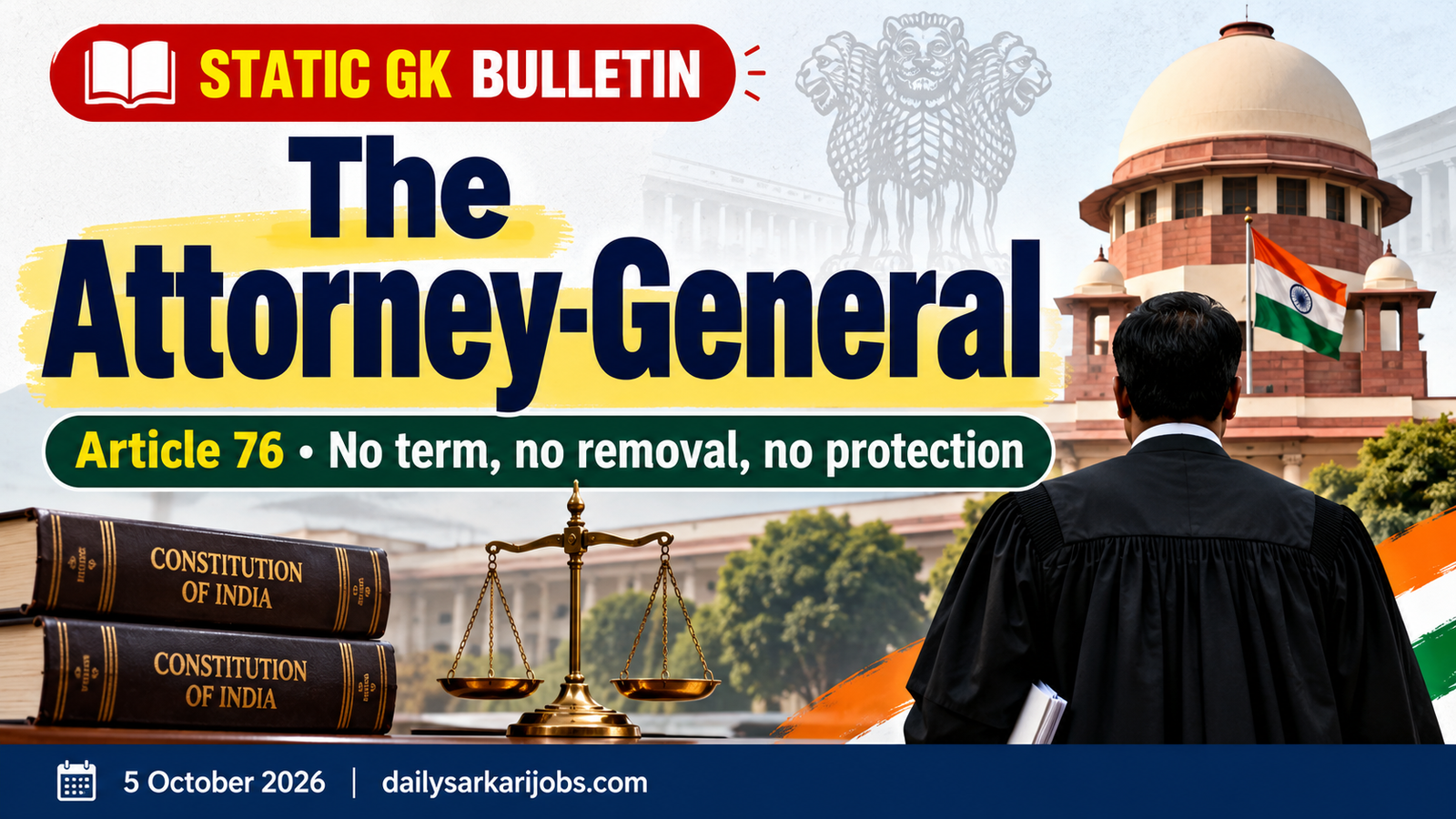
The Attorney-General can be dismissed tomorrow morning, for no reason, by a telephone call. No fixed term, no removal procedure, no salary fixed by the Constitution, no inquiry, no notice. He is the first law officer of India, he may walk into any court in the country as of right, he may speak in both Houses of Parliament — and he has less job security than a clerk. That is not an oversight. It is the design.
This is the fourteenth capsule in our polity depth series, going a level below the Constitution capsule, for SSC CGL and CHSL, RRB NTPC, State PSC, banking general awareness and UPSC Prelims.
The Hinge: Run the Old Test and Watch It Fail
Through this whole series we have used one test on every constitutional office: is this provision protecting the body, or limiting it? Put the provisions in two columns and the character of the institution appears at the bottom. It worked on the Election Commission, on the Supreme Court, on the Union Public Service Commission, and most of all on the Comptroller and Auditor General.
Now run it on the Attorney-General.
| Protection the Constitution gives the CAG | What the Attorney-General gets |
|---|---|
| A fixed term of six years or age 65 | Nothing. No term at all |
| Removable only like a Supreme Court judge, by both Houses | Nothing. He holds office during the pleasure of the President |
| Salary fixed by Parliament and charged on the Consolidated Fund, so it is never voted on | Nothing. Article 76(4) says he receives such remuneration as the President may determine |
| Barred from any further office under the Union or a State afterwards | Nothing. He may return to practice, and indeed never stopped |
Every box is empty. The protecting-or-limiting test, which has explained every office in this series, produces a blank column. That is the most interesting result it has given us, and the explanation is the point of the capsule.
Our capsule on the Comptroller and Auditor General showed an office with every protection and almost no power. The Attorney-General is its exact mirror: real power, and no protection whatsoever.
And the reason is the job. The CAG audits the Government, so he must be impossible to remove — an auditor the Government can sack is not an auditor. The Attorney-General is the Government’s own lawyer, so the Government must be able to replace him the moment it stops trusting him. You cannot force a client to keep a lawyer. Protections follow the job: an office that checks the Government needs independence from it, and an office that speaks for the Government needs exactly the opposite.
Keep that as the decoder. Before memorising any office’s protections, ask one question: does this body check the Government, or serve it? The answer predicts the whole list.
What Article 76 Actually Says
| Clause | What it provides |
|---|---|
| 76(1) | The President appoints a person qualified to be a judge of the Supreme Court to be Attorney-General for India |
| 76(2) | His duty is to advise the Government of India on legal matters referred to him by the President, to perform other duties of a legal character assigned by the President, and to discharge functions conferred by the Constitution or any law |
| 76(3) | He has right of audience in all courts in the territory of India |
| 76(4) | He holds office during the pleasure of the President and receives such remuneration as the President may determine |
Two things in that table repay attention. Right of audience in all courts is a privilege no other lawyer in India has — an ordinary advocate’s right to appear depends on where he is enrolled. And the qualification is fitness to be a Supreme Court judge, not any particular appointment: a citizen who has been a High Court judge for five years, or a High Court advocate for ten, or is a distinguished jurist in the President’s opinion. Our Supreme Court capsule sets out that qualification in full; it is reused here word for word.
‘During the pleasure of the President’ means in practice during the pleasure of the Government, because the President acts on ministerial advice — the point our capsule on the President and the Governor makes about almost every presidential power. By convention the Attorney-General resigns when the Government that appointed him resigns, exactly as a minister does.
He Sits in Two Places He Does Not Belong To
Article 88 gives the Attorney-General, along with every Minister, the right to speak in and take part in the proceedings of either House, any joint sitting, and any committee of Parliament of which he is named a member — but not the right to vote.
So he stands in Parliament without being a member of it, and appears in court for the Government without being a government servant. He is the Government’s lawyer, not the Government’s officer, and that distinction carries almost everything else in this capsule.
| He is | He is not |
|---|---|
| The first law officer of India | A member of the Cabinet |
| Appointed by the President | A government servant |
| Entitled to a Minister’s parliamentary privileges under Article 105 | Entitled to vote in Parliament |
| The Government’s counsel in the Supreme Court | A whole-time counsel barred from all other work |
The Fact That Surprises Everybody
The Attorney-General for India is allowed private practice. He is not a whole-time counsel of the Government, and the Constitution does not stop him taking other clients. In no other constitutional office does anything like this exist.
There are four limits, and they are asked:
- He may not advise or hold a brief against the Government of India.
- He may not advise or hold a brief in a case in which he has been called upon to advise the Government.
- He may not defend an accused person in a criminal prosecution without the Government’s permission.
- He may not accept appointment as a director of a company or corporation without the Government’s permission.
Read the list and the logic shows through: every restriction is about conflict of interest, and none is about his time. The Government is not buying his working hours. It is buying his loyalty in the matters it hands him, and leaving the rest of his practice alone.
One Law Officer in the Constitution, Two Dozen in Practice
This is the standing trap in the topic, and it is easy to get right once you have seen it.
| Office | Created by | Status |
|---|---|---|
| Attorney-General for India | Article 76 of the Constitution | Constitutional |
| Solicitor General of India | The Law Officers (Conditions of Service) Rules, 1987, made under Article 309 | Not constitutional |
| Additional Solicitors General | The same Rules | Not constitutional |
| Advocate-General of a State | Article 165 of the Constitution | Constitutional, at the State level |
The Constitution names exactly one law officer of the Union, and that is the Attorney-General. The Solicitor General and the Additional Solicitors General — there are more than twenty of them — are appointed by the Appointments Committee of the Cabinet under service rules, not by the Constitution. Note also that unlike the Attorney-General, those law officers are whole-time and may not hold briefs for any party other than the Government. If a question says the Solicitor General is a constitutional post, it is wrong.
The State mirror is worth one line, because it is a near-copy. The Advocate-General under Article 165 is appointed by the Governor, must be qualified to be a High Court judge, holds office during the Governor’s pleasure, and under Article 177 may speak in the State legislature without voting. Swap President for Governor and Supreme Court for High Court, and you have it.
The Office-Holders
The first Attorney-General was M. C. Setalvad, who took office on 28 January 1950 and served thirteen years — by a long way the longest tenure the office has had, and a useful reminder that ‘no security of tenure’ does not mean ‘short tenure’.
The serving Attorney-General is R. Venkataramani, in office since 1 October 2022. Office-holders change and this one has already been extended once; recheck it before an exam rather than trusting any note, including this one.
Traps Worth Marking
- Article 76 is the Attorney-General; Article 165 is a State’s Advocate-General; Article 88 is the right to speak in Parliament; Article 177 is the same right in a State legislature.
- He is appointed by the President, not by the Chief Justice and not by the Law Minister.
- Qualification is fitness to be a Supreme Court judge. For an Advocate-General it is a High Court judge.
- No fixed term and no removal procedure in the Constitution. He holds office during the President’s pleasure.
- He may speak in Parliament but never vote.
- He is not a member of the Cabinet and not a government servant.
- Private practice is allowed, subject to four restrictions.
- The Solicitor General is not a constitutional post — it comes from the Law Officers (Conditions of Service) Rules, 1987.
Five Practice Questions
Q1. The Attorney-General for India holds office…
(a) For a fixed term of five years (b) For a fixed term of six years or until the age of 65 (c) During the pleasure of the President (d) Until removed by both Houses of Parliament
Answer: (c) During the pleasure of the President Two of these options describe the Comptroller and Auditor General, whose protections are the most elaborate in the Constitution. This office has the opposite design, because its holder works for the Government rather than auditing it.
Q2. Which of these is NOT a constitutional post?
(a) The Attorney-General for India (b) The Advocate-General of a State (c) The Comptroller and Auditor General (d) The Solicitor General of India
Answer: (d) The Solicitor General of India Three of these are named in the Constitution, at Articles 76, 165 and 148. The fourth exists under the Law Officers (Conditions of Service) Rules, 1987, made under Article 309, and is appointed by the Appointments Committee of the Cabinet.
Q3. Under Article 88, the Attorney-General may…
(a) Vote in both Houses (b) Speak in both Houses but not vote (c) Vote only in a joint sitting (d) Neither speak nor vote
Answer: (b) Speak in both Houses but not vote He is not a member of either House, so a vote would be impossible; but the Constitution deliberately lets the Government’s senior lawyer explain a legal point on the floor. The same arrangement applies to every Minister who is not a member of that particular House.
Q4. To be appointed Attorney-General for India, a person must be qualified to be…
(a) A High Court judge (b) A Supreme Court judge (c) A Senior Advocate (d) A District Judge
Answer: (b) A Supreme Court judge A High Court judge is the standard for a State’s Advocate-General under Article 165, which is why that option is tempting. The Union office takes the higher of the two benchmarks, and seniority at the Bar is a professional designation rather than a constitutional qualification.
Q5. Which of the following is true of the Attorney-General for India?
(a) He is a member of the Union Cabinet (b) He may hold a brief against the Government (c) He is a whole-time government servant (d) He may carry on private practice, subject to restrictions
Answer: (d) He may carry on private practice, subject to restrictions The first three are each a common misunderstanding of the office. The correct statement is the one that surprises people: the first law officer of India is not bought by the hour, and the limits on him are about conflict of interest rather than about his time.
Ten more questions on this and today’s Current Affairs explainer are waiting on our Test Your Knowledge page, with a free PDF. Today’s explainer is on the India-Japan Joint Crediting Mechanism — a different question about who is allowed to claim something, settled by accounting rather than by law.
Sources: the Constitution of India, Articles 76, 88, 105, 165 and 177, read directly; the Law Officers (Conditions of Service) Rules, 1987, made under Article 309, for the status of the Solicitor General and the Additional Solicitors General and for the whole-time restriction on law officers other than the Attorney-General; and standard published accounts of the office for the four restrictions on private practice, the list of office-holders, the tenure of M. C. Setalvad and the convention that the Attorney-General resigns with the Government. The serving Attorney-General is printed with a recheck note.