
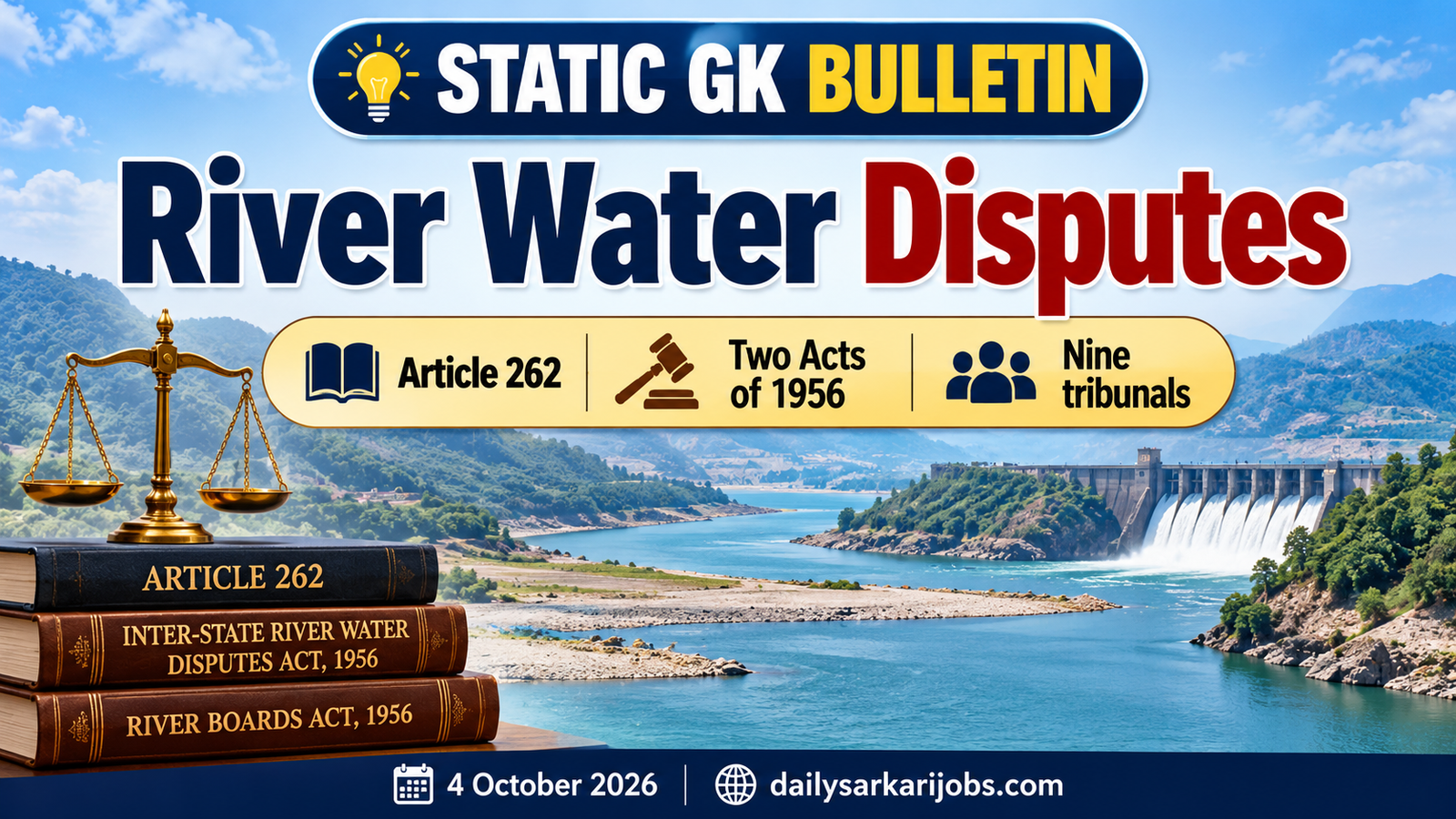
Article 262 is the one place in the Constitution where Parliament is allowed to shut the Supreme Court out of a subject completely. Parliament used that power in 1956. And the Supreme Court has been deciding water disputes ever since. Work out how both of those sentences can be true and you have understood this whole chapter.
This is the thirteenth capsule in our polity depth series, going a level below the Constitution capsule, for SSC CGL and CHSL, RRB NTPC, State PSC, banking general awareness and UPSC Prelims.
The Hinge: the Door Was Bolted, the Window Was Not
Article 262 has two clauses and they do two different jobs.
| Clause | What it allows Parliament to do |
|---|---|
| 262(1) | Provide by law for the adjudication of any dispute about the use, distribution or control of the waters of an inter-State river or river valley |
| 262(2) | Provide by law that neither the Supreme Court nor any other court shall exercise jurisdiction over such a dispute — and it opens with the words notwithstanding anything in this Constitution |
Parliament took up both offers. Section 11 of the Inter-State River Water Disputes Act, 1956 bars every court in the country from a water dispute that has gone to a tribunal. On paper, the courts are out.
Now the twist. In the Cauvery matter in February 2018, the Supreme Court held that the bar cannot take away Article 136 — the Court’s power to grant special leave to appeal from the decision of any court or tribunal in India. A water tribunal is a tribunal. So a State that dislikes an award cannot sue in the Supreme Court, but it can ask the Supreme Court for leave to appeal against the award, and the Court can hear it.
That is the decoder for this chapter: Article 262 closes the front door and Article 136 is a window nobody shut. A mechanism designed to keep water out of the courts has produced decades of litigation in the highest court in the country. Our Supreme Court capsule sets out the difference between Article 131 (original jurisdiction — suing in the Supreme Court) and Article 136 (appellate — appealing to it), and this is the single best worked example of why that difference matters.
Where the Power Comes From
Before the Article, the Lists. Water is one of the clearest cases in the Constitution of a subject that belongs to the States until it crosses a border.
| Entry | List | What it says |
|---|---|---|
| Entry 17 | State List | Water — water supplies, irrigation and canals, drainage and embankments, water storage and water power. Water is a State subject |
| Entry 56 | Union List | Regulation and development of inter-State rivers and river valleys to the extent Parliament declares by law to be expedient in the public interest |
Read Entry 56 slowly. It is not a free hand. The Union gets inter-State rivers only so far as Parliament has passed a law saying so — which is why almost every argument in this field is about whether a particular Union action is covered by a law or not. Entry 17 itself is expressly made subject to Entry 56, so the State subject yields where the Union has legislated, and nowhere else.
The Twins of 1956: One Act That Worked, One That Never Did
Parliament passed two laws in 1956 on the same problem. Their fates could not be more different, and the contrast is asked.
| The Act | What it does | What became of it |
|---|---|---|
| Inter-State River Water Disputes Act, 1956 | The Union Government refers a dispute to a tribunal; the tribunal investigates and makes an award; section 11 bars the courts | Nine tribunals have been set up under it, and it is the whole of this subject in practice |
| River Boards Act, 1956 | Allows the Union to set up a River Board to advise on the development and regulation of an inter-State river basin as a whole | Not a single River Board has ever been constituted, in seventy years |
That second row is the most quotable fact in the chapter. One of the two laws Parliament made under Article 262 has never once been used. And it is the better idea of the two: a river board would manage a whole basin before anyone fell out, while a tribunal only arrives after they already have. India chose to settle water fights rather than prevent them — not by argument, but by leaving one Act on the shelf. One sentence of that in a descriptive answer is worth more than the list below.
The Nine Tribunals
| Tribunal | Set up | States |
|---|---|---|
| Krishna (first) | 1969 | Maharashtra, Karnataka, Andhra Pradesh |
| Godavari | 1969 | Maharashtra, Andhra Pradesh, Karnataka, Madhya Pradesh, Odisha |
| Narmada | 1969 | Madhya Pradesh, Gujarat, Maharashtra, Rajasthan |
| Ravi and Beas | 1986 | Punjab, Haryana, Rajasthan |
| Cauvery | 1990 | Tamil Nadu, Karnataka, Kerala, Puducherry |
| Krishna (second) | 2004 | Andhra Pradesh, Telangana, Karnataka, Maharashtra |
| Vansadhara | 2010 | Odisha, Andhra Pradesh |
| Mahadayi | 2010 | Goa, Karnataka, Maharashtra |
| Mahanadi | 2018 | Odisha, Chhattisgarh |
Two groupings make this learnable instead of memorisable. Three tribunals were set up in a single year, 1969 — Krishna, Godavari and Narmada, the three big peninsular systems. And two were set up in a single year, 2010 — Vansadhara and Mahadayi. Our capsule on Rivers, Dams and Lakes has the geography: knowing which States a river actually runs through turns this table from a list into something you can reconstruct.
Notice also which river is missing. There is no Ganga or Brahmaputra tribunal, because those disputes are mostly with other countries rather than between Indian States, and a treaty is a different instrument from a tribunal.
The Time Limits, and Why They Did Not Fix It
The original Act set no deadlines at all, and tribunals took decades. The Sarkaria Commission said so, and an amendment in 2002 put clocks into the law:
- The Union Government must constitute a tribunal within one year of a State’s request, if the dispute cannot be settled by negotiation.
- The tribunal must give its award within three years, extendable by a further two years.
The deadlines bind the tribunal. They do not bind the appeal. So the stage that was given a clock finishes on time and the stage that was never meant to exist runs on indefinitely — which is the hinge of this capsule stated as a complaint. The Cauvery dispute is the standard illustration: a tribunal constituted in 1990, a final award in 2007, and the Supreme Court still deciding the matter in 2018.
The Bill That Lapsed
The obvious reform is to stop building a new tribunal for every river. The Inter-State River Water Disputes (Amendment) Bill, 2019 proposed exactly that:
- a single standing tribunal with benches, replacing the practice of constituting a fresh tribunal each time;
- a Dispute Resolution Committee to try to settle a dispute amicably first, with a chairperson, experts nominated by the Union Government and one officer from each State concerned.
It was introduced in the Lok Sabha on 25 July 2019 and passed by that House. It then sat in the Rajya Sabha. When the 17th Lok Sabha was dissolved in June 2024, the Bill lapsed under Article 107(5).
That is a free revision of our capsule on how a Bill becomes law, and the rule is exact: a Bill passed by the Lok Sabha and pending in the Rajya Sabha lapses when the Lok Sabha is dissolved. Compare it with the 64th Amendment Bill of 1989 on panchayats, which the Rajya Sabha defeated. Defeated and lapsed are two different deaths, and a question will use the right word for the one it means.
Three Doors, Revisited
Our Inter-State Council capsule set out the three routes a dispute between States can take. This capsule is the second door, opened up.
| Article | Route | Binding? |
|---|---|---|
| 131 | Sue in the Supreme Court — original jurisdiction | Yes. Barred for water disputes by section 11 |
| 262 | A tribunal set up by the Union Government under the 1956 Act | Yes, and the award is final on its own terms |
| 263 | The Inter-State Council — discussion and advice | No. It is advice, and it has no role in water disputes |
| 136 | Special leave to appeal against the tribunal’s award | Yes — and this is the door section 11 could not close |
Traps Worth Marking
- Article 262 is water; Article 263 is the Inter-State Council. They sit next to each other and do opposite things.
- Water is Entry 17 of the State List; inter-State rivers are Entry 56 of the Union List, and only to the extent Parliament declares.
- Two Acts in 1956, not one. The River Boards Act has never been used.
- It is the Union Government that constitutes a tribunal, on a State’s request — not the Supreme Court and not the President.
- Section 11 bars the courts; Article 136 survives it. The Supreme Court said so in the Cauvery matter in 2018.
- 2002 amendment: tribunal within one year; award within three years, extendable by two.
- The 2019 Amendment Bill lapsed in June 2024 under Article 107(5). It was never enacted, so there is still no single standing tribunal.
Five Practice Questions
Q1. Under Article 262, who may provide that no court shall exercise jurisdiction over an inter-State river water dispute?
(a) The President (b) Parliament (c) The Supreme Court itself (d) The Inter-State Council
Answer: (b) Parliament Only a law can do this, and only one body makes the law in question. The clause even opens with the words notwithstanding anything in this Constitution, which is how the Constitution signals that an ordinary rule is being overridden.
Q2. Which of these Acts, passed under Article 262, has never been used?
(a) The Inter-State River Water Disputes Act, 1956 (b) The River Boards Act, 1956 (c) The Inter-State Water Disputes Act, 2002 (d) The Dam Safety Act, 2021
Answer: (b) The River Boards Act, 1956 Two laws were passed in the same year under the same Article. One produced nine tribunals and the whole of this subject; the other allowed basin-wide bodies that no government has ever actually set up in seventy years.
Q3. Water is which entry of the State List?
(a) Entry 6 (b) Entry 14 (c) Entry 17 (d) Entry 56
Answer: (c) Entry 17 Fifty-six is the inter-State rivers entry, but it belongs to the Union List, so that option is in the wrong list rather than simply the wrong number. The State List entry covers water supplies, irrigation, canals, drainage and water power.
Q4. The Cauvery Water Disputes Tribunal was constituted in…
(a) 1969 (b) 1986 (c) 1990 (d) 2004
Answer: (c) 1990 Sixty-nine gave us Krishna, Godavari and Narmada in one year; 1986 was Ravi and Beas; and 2004 was the second Krishna tribunal. The one you want sits between them, and its award came seventeen years after it was set up.
Q5. The Inter-State River Water Disputes (Amendment) Bill, 2019…
(a) Was enacted and created a single standing tribunal (b) Was defeated in the Rajya Sabha (c) Was withdrawn by the Government (d) Lapsed when the 17th Lok Sabha was dissolved
Answer: (d) Lapsed when the 17th Lok Sabha was dissolved It got through one House and then ran out of time in the other, which is a different fate from being voted down. Article 107(5) kills a Bill that the Lok Sabha has passed and the Rajya Sabha has not, the moment the Lok Sabha is dissolved.
Ten more questions on this and today’s Current Affairs explainer are waiting on our Test Your Knowledge page, with a free PDF. Today’s explainer is on the Great Indian Bustard released into the wild — the same Thar landscape, and another argument about who gets to use a scarce resource.
Sources: the Constitution of India, Article 262 read clause by clause, with Entry 17 of the State List and Entry 56 of the Union List; the Inter-State River Water Disputes Act, 1956 and the River Boards Act, 1956, and the amendment of 2002 for the one-year and three-year time limits; published accounts of the nine tribunals and the years they were constituted; the Supreme Court’s Cauvery judgment of February 2018 for the holding that section 11 does not oust Article 136; and the Rajya Sabha record of June 2024 showing that the Inter-State River Water Disputes (Amendment) Bill, 2019 lapsed under Article 107(5) on the dissolution of the 17th Lok Sabha. If a new tribunal is constituted or the Bill is reintroduced, the tribunal table and the last section will need updating.