A container of machine parts leaves a factory in Pune and has to reach a ship in Mumbai. It travels on a State highway, then a national highway, then a railway siding, then a port road. Four different agencies built those four stretches. Now ask one question: who planned the journey? The honest answer, for most of India’s history, is nobody. Each agency planned its own piece very carefully and no one was responsible for the line joining them.
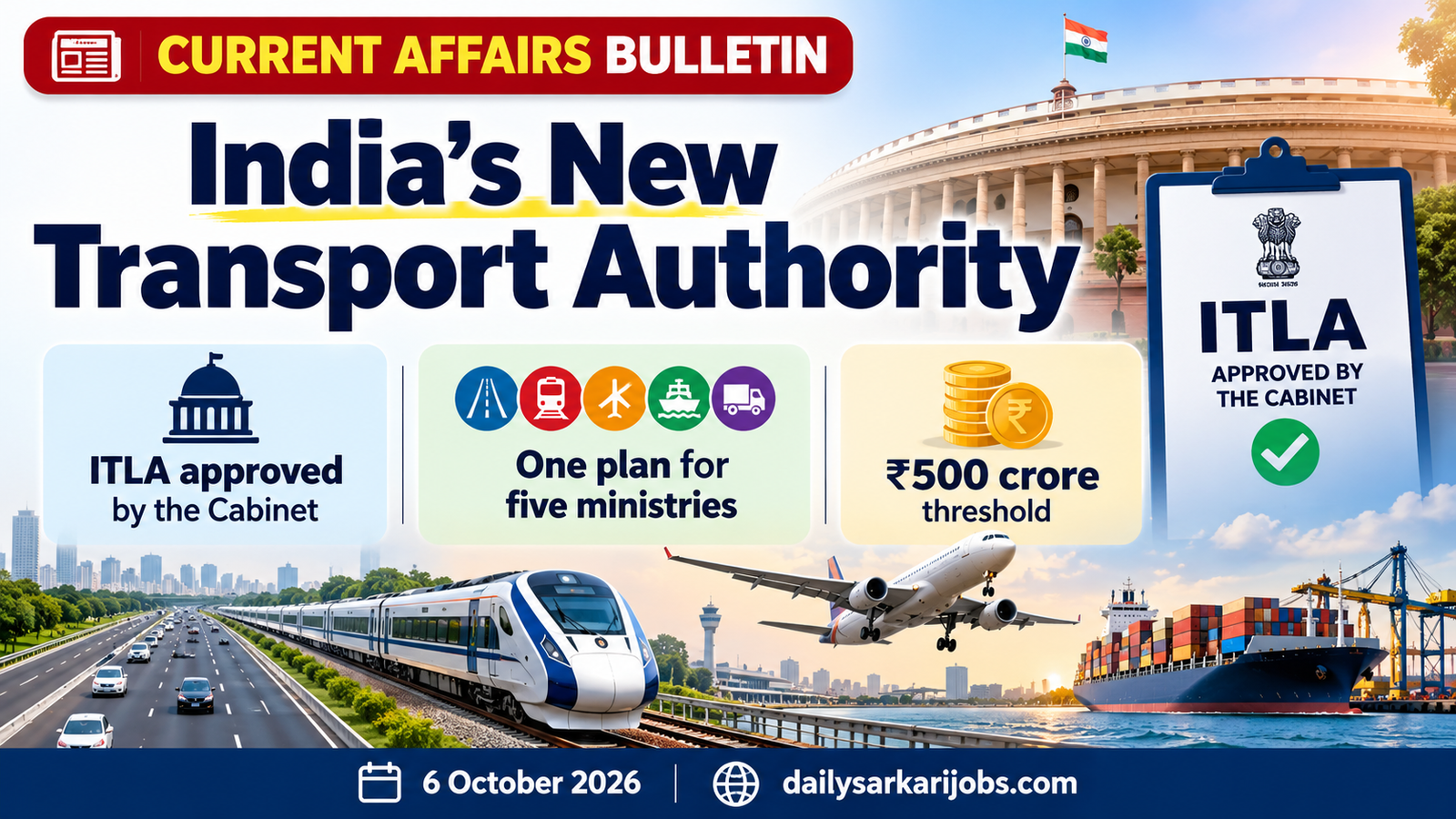
On 6 October 2026 the Union Cabinet approved the creation of the Integrated Transport & Logistics Authority (ITLA) — a standing body whose entire job is that line. Explained in plain language for SSC, RRB NTPC, State PSC, banking general awareness and UPSC Prelims.
⚡ QUICK FACTS
What
Integrated Transport & Logistics Authority (ITLA)
Approved by
The Union Cabinet, 6 October 2026
Legal form
A Special Purpose Vehicle (SPV)
Core job
A National Transport Master Plan, 10 years or more
The Hinge: India Does Not Have a Transport Ministry. It Has Five.
This is the fact that explains everything else, and almost no revision note says it out loud. There is no single Ministry of Transport in India. Instead the work is split across several ministries, each with its own budget, its own engineers and its own plan.
Mode
Who plans and builds it
Highways
Ministry of Road Transport & Highways
Railways
Ministry of Railways
Ports, shipping, inland waterways
Ministry of Ports, Shipping and Waterways
Airports and air routes
Ministry of Civil Aviation
Metros, city buses, urban roads
Ministry of Housing & Urban Affairs
Logistics policy across all of them
Logistics Division, Department for Promotion of Industry and Internal Trade (Ministry of Commerce & Industry)
Each of those ministries does its own job well. The problem is not inside any one of them. The problem is in the gaps between them. A new port is built, and the road to it is two lanes. A freight corridor opens, and the warehouses are on the wrong side of the city. A metro line ends four hundred metres from the railway station and the passenger walks.
Nobody was doing anything wrong. There was simply no one whose job was the whole journey.
The Pattern: India Has Answered This Question Five Times
Here is the part worth memorising, because it turns a list of schemes into a single story. Since 2010 every transport reform in India has answered one question — who makes the transport ministries act as one? — and each answer fixed the previous answer’s weakness while creating a new one.
Year
The answer tried
What it was
The weakness
2010
A committee
The National Transport Development Policy Committee under Dr. Rakesh Mohan
It reported in February 2014 and then dissolved. A committee cannot plan year after year
2021
A portal
PM Gati Shakti — a National Master Plan where every ministry puts its projects on one digital map
Everyone could now see the gaps. Nobody was obliged to close them
2022
A policy
The National Logistics Policy, launched 17 September 2022
A policy sets direction. It does not appraise a project or stop a bad one
2021 onwards
A group of officials
The Network Planning Group — network-planning heads of eight infrastructure ministries, meeting to vet projects
Officers who meet part-time, each still answerable to his own ministry
2026
A standing organisation
ITLA — a permanent body with its own staff, its own data and a plan of its own
Untested. It is an SPV, not a ministry, and it recommends rather than commands
If that shape feels familiar, it should. It is exactly the story of India’s defence reforms since Kargil — a committee, then a staff, then a chief, then theatre commands, each answering the question “who makes the three services act as one?” Civilian infrastructure has been having the same argument, in the same order, about five ministries instead of three services.
What ITLA Will Actually Do
The Cabinet release lists six jobs. Read them as three pairs, because they fall naturally into planning, policing and knowing.
Job
In plain words
National Transport Master Plan
One plan for all modes together, with a horizon of ten years or more — longer than any single government’s term
Checking sectoral plans
Reading each ministry’s five-year and annual plan and asking whether it fits the master plan
Technical appraisal
Examining every Central infrastructure project costing ₹500 crore or more before it is approved
Monitoring and post-completion review
Watching those same projects while they are built, and asking afterwards whether they did what was promised
National Transport Data Repository
One database pulling together GSTN, FASTag, Vahan, GPS feeds and traffic-management systems
Capacity building and research
Training, and reviewing the National Logistics Policy itself
Of those six, one carries real teeth: the ₹500 crore appraisal threshold. A body that merely advises can be ignored. A body that every large project must pass through before approval is in the room whether the ministry likes it or not. Whenever you read about a new authority, look for the number that decides what must come to it. The threshold is the power.
An SPV, Not a Ministry — and Why That Matters
The National Transport Development Policy Committee, which studied this problem for four years, asked for something stronger than what has arrived. Its report proposed a single unified transport ministry with one mandate to deliver a multi-modal system, and a permanent office of transport strategy to do the thinking.
What the Cabinet approved on 6 October 2026 is a Special Purpose Vehicle — a separate legal entity set up for one defined purpose. It is the thinking half of the recommendation, arriving about twelve years later. The five ministries remain five ministries.
That is not necessarily a criticism. Merging five ministries is a political operation of enormous difficulty; building one body that plans across them is an administrative one. Governments routinely take the administrative half of a reform and leave the political half, and the result still changes things — just more slowly and with more argument. You saw the same compromise in the Inter-State Council, a body with an impressive membership and nothing but advice to offer.
The Number Everyone Quotes, and Why It Is Probably Wrong
Almost every article on Indian logistics opens with the line that logistics costs 13 to 14 per cent of India’s GDP. It is quoted in newspapers, in coaching notes and sometimes in official speeches. It is not the Government’s own estimate, and it is almost certainly too high.
The Department for Promotion of Industry and Internal Trade commissioned the National Council of Applied Economic Research to measure it properly. The report, released on 14 December 2023, put aggregate logistics costs in the range of 7.8 to 8.9 per cent of GDP for 2021-22.
Figure
Where it comes from
Status
13–14% of GDP
A private consultancy estimate, modelled rather than measured, widely repeated since about 2017
Not an official Indian estimate
7.8–8.9% of GDP (2021-22)
NCAER study for DPIIT, released 14 December 2023
The Government’s own figure
The lesson is bigger than logistics: before repeating a famous number, ask who produced it and how. A figure can become a fact purely by repetition. The same report recommended that the estimate be redone every year, which tells you the authors thought the old number had been standing unchallenged for far too long.
The Machinery Already in Place
ITLA does not arrive into an empty room. Two things were built before it, and the exam asks about both.
PM Gati Shakti
National Logistics Policy
Launched
13 October 2021
17 September 2022
What it is
A National Master Plan on a digital platform, where ministries and States place their projects on one map
A policy to cut logistics cost and improve service
Nodal
Logistics Division, DPIIT, Ministry of Commerce & Industry
Same
Scale
44 Central ministries and 36 States and Union Territories, with 1,614 data layers
Target: India in the top 25 on the Logistics Performance Index by 2030
Work done
208 large projects worth about ₹15.39 lakh crore assessed
—
The three-tier structure under PM Gati Shakti is standard exam material: an Empowered Group of Secretaries chaired by the Cabinet Secretary with 23 ministries; a Network Planning Group of network-planning heads from eight infrastructure ministries; and a Technical Support Unit of subject experts. ITLA is widely expected to absorb the Network Planning Group’s work, turning a part-time committee of officers into a full-time organisation.
One more standing figure: on the World Bank’s Logistics Performance Index 2023, India stood 38th out of 139 countries, up six places from 44th in 2018. The 2030 target is the top 25.
Why a Reader Should Care
Logistics cost is one of the quietest taxes in an economy. It is paid by the farmer whose tomatoes rot in a queue, by the small manufacturer whose container waits three days at a port, and finally by the shopper. None of them can see it, and none of them voted for it. Every percentage point shaved off it behaves like a tax cut that nobody has to legislate.
That is also why this connects to Make in India. A factory that can be built in India is worth little if the goods cannot leave the country cheaply. Manufacturing policy and transport policy are two halves of one argument, and the Dedicated Freight Corridors were the first large admission that India’s freight needed a road of its own.
The Honest Caution
This post is being written on the day of the announcement. The Cabinet release gives the Authority’s name, legal form and functions. It does not give its outlay, its chairperson, its board, its staff strength or the date it starts work. Those will follow in later notifications.
Nor should a new body be mistaken for a solved problem. Look again at the fourth row of the pattern table: every previous answer looked convincing on the day it was announced. The question to ask in a year is not whether ITLA exists, but whether a ministry has ever had to change a project because ITLA said so.
Practice Questions
Q1. The Integrated Transport & Logistics Authority approved by the Union Cabinet in October 2026 is being set up as… (a) A constitutional body (b) A Special Purpose Vehicle (c) A new Union ministry (d) A statutory corporation under an Act of Parliament Answer: (b) A Special Purpose Vehicle Three of these would need either an amendment or fresh legislation, which is exactly why they were not chosen. The form picked is the quickest to create and the easiest to change later, and it leaves the five existing transport ministries untouched.
Q2. ITLA will carry out technical appraisal of Central infrastructure projects costing at least… (a) ₹100 crore (b) ₹250 crore (c) ₹500 crore (d) ₹1,000 crore Answer: (c) ₹500 crore The threshold is the single most important number in the announcement, because it decides what must pass through the new body and what need not. Remember it as the point at which a project stops being a ministry’s private business.
Q3. PM Gati Shakti, the National Master Plan for Multi-modal Connectivity, was launched in… (a) August 2021 (b) October 2021 (c) September 2022 (d) February 2023 Answer: (b) October 2021 August 2021 is when it was announced from the Red Fort and September 2022 belongs to the National Logistics Policy, so both are deliberate traps. The launch followed the announcement by about two months.
Q4. According to the NCAER study released for DPIIT in December 2023, India’s aggregate logistics cost in 2021-22 was about… (a) 4 to 5 per cent of GDP (b) 7.8 to 8.9 per cent of GDP (c) 13 to 14 per cent of GDP (d) 18 to 20 per cent of GDP Answer: (b) 7.8 to 8.9 per cent of GDP The famous figure quoted almost everywhere is a private modelled estimate, not an Indian government measurement, and the official study came out markedly lower. If an exam asks for the Government’s own number, it wants the measured range, not the famous one.
Q5. The National Transport Development Policy Committee, whose work led eventually to this reform, was chaired by… (a) Dr. Rakesh Mohan (b) Dr. Bibek Debroy (c) Shri Montek Singh Ahluwalia (d) Dr. Arvind Panagariya Answer: (a) Dr. Rakesh Mohan All four are economists associated with Indian policy bodies, so elimination will not help here. The committee was set up in 2010 and reported in February 2014, under the title India Transport Report: Moving India to 2032.
Ten more questions on this and today’s Static GK capsule are waiting on our Test Your Knowledge page, with a free PDF. Today’s capsule is on the National Human Rights Commission — the body whose own Act writes down everything it is not allowed to do.
Sources: the Press Information Bureau releases of 6 October 2026 on the Union Cabinet’s approval of the Integrated Transport & Logistics Authority, which give the SPV form, the six functions, the ₹500 crore appraisal threshold, the ten-year master plan horizon and the data sources for the repository; the Press Information Bureau backgrounder on PM Gati Shakti for the 13 October 2021 launch, the three-tier structure, the 44 ministries and 36 States and Union Territories, the 1,614 data layers, the 208 projects worth ₹15.39 lakh crore and the 17 September 2022 launch of the National Logistics Policy; the DPIIT release of 14 December 2023 and the NCAER report “Logistics Costs in India: Assessment and Long-Term Framework” for the 7.8 to 8.9 per cent range for 2021-22; and the World Bank Logistics Performance Index 2023 for India’s rank of 38 out of 139. The National Transport Development Policy Committee’s 2010 constitution under Dr. Rakesh Mohan and its February 2014 report are from published accounts of the committee; its specific recommendation of a unified transport ministry and a permanent transport-strategy office rests on summaries of the report rather than on the report text itself, so treat the recommendation as reported rather than quoted. Trade-press reporting from June 2026 described the same body under a working name and is the source for the expectation that it absorbs the Network Planning Group; the Cabinet release does not say so. Outlay, leadership and start date had not been announced when this was written.