In the company that will run your local government ITI, the Government of India owns 24.5 per cent, the State owns 24.5 per cent, and a private firm owns 51 per cent. The Government deliberately kept itself in a minority. Work out why, and you have understood the whole scheme.
PM-SETU completes its first year on 4 October 2026. It is the largest skilling scheme India has ever run, and the Ministry published a one-year backgrounder on 3 October. Explained in plain language for SSC, RRB NTPC, State PSC, banking general awareness and UPSC Prelims.
First, the Word You Need: ITI
An Industrial Training Institute is a government or private institute that trains school-leavers in a trade — electrician, fitter, welder, mechanic, draughtsman — in one or two years, and gives a National Trade Certificate at the end. There are thousands of them. They are the oldest and the largest piece of India’s vocational training system, and they are not colleges: a student goes in after Class 8 or Class 10 and comes out with a trade, not a degree.
The problem PM-SETU exists to fix is easy to state and hard to solve. Many government ITIs teach trades, and on equipment, that employers stopped using years ago. A certificate is earned, and no job follows.
The Hinge: Who Holds the Majority?
Here is the part of the design that nobody expects. Each cluster of upgraded ITIs is run by a Special Purpose Vehicle — a company created for one job and nothing else. The shareholding in that company is:
| Shareholder | Stake |
|---|---|
| The Anchor Industry Partner — a private company | 51% |
| The Union Government | 24.5% |
| The State Government | 24.5% |
Add the two governments together and you get 49. The Government put in most of the money and kept less than half of the control, on purpose.
Why? Because of what the problem actually is. If an ITI is teaching the wrong thing, no amount of government money fixes it — the Government is not the one doing the hiring. The only people who know which skills will get a young person hired are the people who do the hiring. So the scheme hands them the steering wheel and asks them to put ₹10,000 crore of their own money into the tank.
The Government’s own phrase for the model is worth memorising exactly: government-owned, industry-managed.
Keep this as a decoder. Whenever you meet a partnership scheme, look at who holds the majority stake and ask what that tells you about the problem. A government that keeps 51 per cent is worried about misuse of public money. A government that gives away 51 per cent has decided the private partner knows something it does not. The shareholding is the diagnosis.
Hub and Spoke, in Plain Words
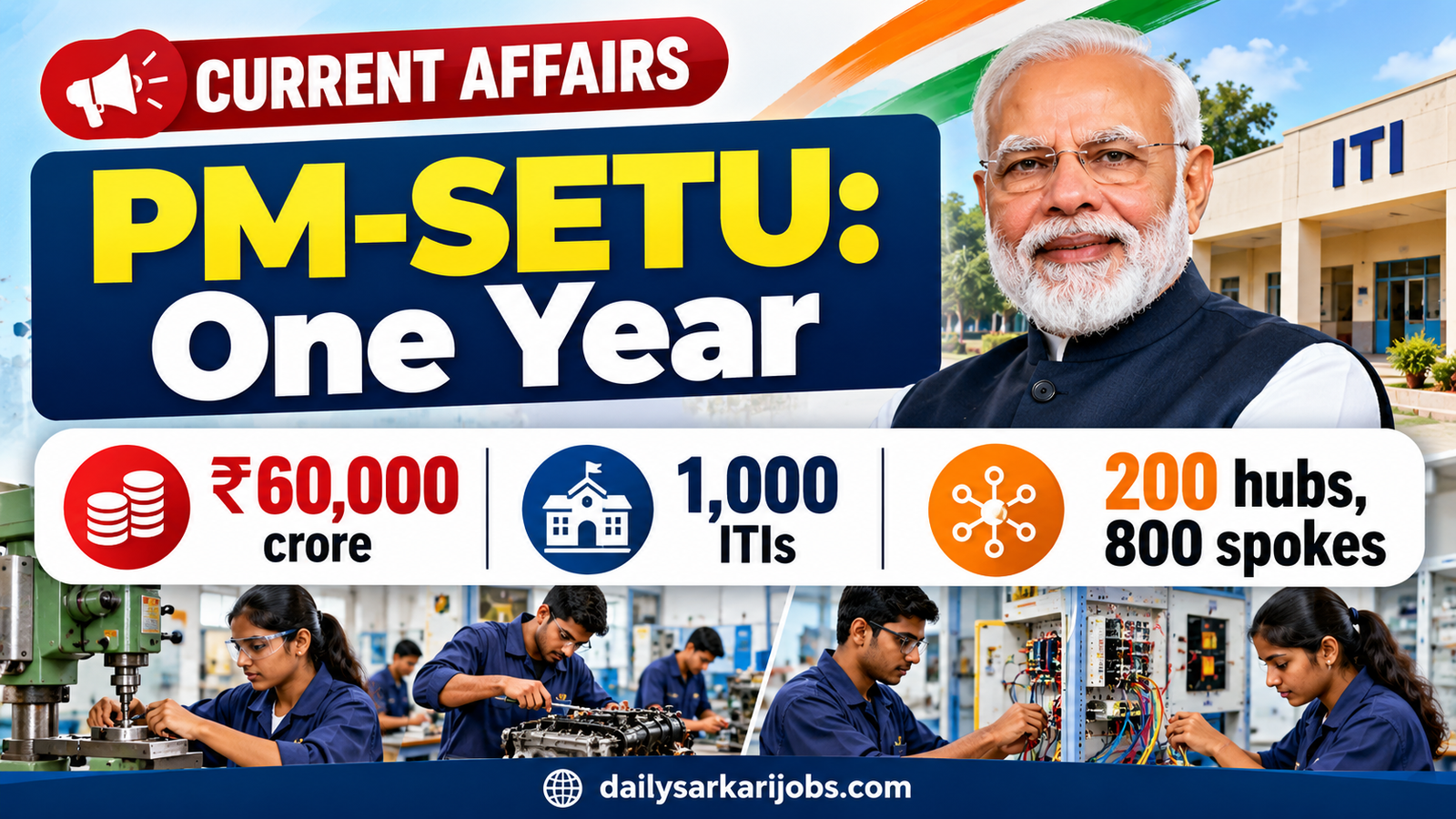
The 1,000 ITIs are not upgraded one by one. They are grouped.
| Part | How many | What it is |
|---|---|---|
| Hub ITI | 200 | The well-equipped centre of a cluster — new machinery, an innovation centre, a production unit, a placement cell |
| Spoke ITI | 800 | Roughly four smaller ITIs attached to each hub, which send students to the hub for the equipment and training they cannot afford themselves |
The point of a hub-and-spoke model is that expensive equipment is bought once and shared by five institutes instead of being bought five times or not at all. You will meet the same model in health, in banking and in logistics; the phrase means the same thing everywhere.
Alongside the 1,000 ITIs, five National Skill Training Institutes — at Bhubaneswar, Chennai, Hyderabad, Kanpur and Ludhiana — are being raised into National Centres of Excellence, which train the trainers.
Where the Money Comes From
| Source | Amount |
|---|---|
| The Union Government | ₹30,000 crore |
| The State Governments | ₹20,000 crore |
| Industry | ₹10,000 crore |
| Total | ₹60,000 crore |
One detail that is asked and almost never taught: half of the Union’s share is co-financed by the World Bank and the Asian Development Bank. These are multilateral development banks — institutions owned by many countries that lend to governments for development projects. So roughly ₹15,000 crore of the central share is borrowed abroad, which is why the scheme has hard targets and reporting deadlines attached to it.
Now apply the sorting device from our Make in India capsule: does it have its own money? Make in India does not — it is a label over schemes that do. PM-SETU does, and a very large sum of it. So PM-SETU is a scheme and will be asked about by its figures: outlay, split, number of ITIs, number of hubs. Make in India is an initiative and is asked about by launch date and ministry. Sorting a programme into the right box tells you which kind of question is coming.
The Date Trap: Approved in May, Launched in October
| The question says | The answer is |
|---|---|
| The Union Cabinet approved it | 7 May 2025, as the National Scheme for ITI Upgradation and Setting up of National Centres of Excellence for Skilling |
| The Prime Minister launched it | 4 October 2025, at Vigyan Bhawan, New Delhi, under the name PM-SETU |
| It completes one year | 4 October 2026 |
Note that the name changed between the two dates. The Cabinet approved a scheme with a long descriptive title; the brand name arrived at the launch. This catches people out, because a question using the formal name and a question using PM-SETU can want two different months of the same year. Read the verb — approved, launched, completes — before you read the options.
One Year On: the Honest Score
The Ministry’s own one-year figures, from the backgrounder of 3 October 2026:
| What | Where it has reached |
|---|---|
| ITIs identified | 850 — 172 hubs and 678 spokes, against a target of 1,000 |
| Clusters with an approved investment plan | 14, carrying Strategic Investment Plans worth ₹3,446 crore |
| States and UTs with a State Steering Committee | 35 |
| New-age courses introduced | 32, including artificial intelligence and cyber security |
Read those four rows in order and the shape of the first year appears. The administrative work has moved fast and the commercial work has moved slowly. Identifying 850 institutes and getting 35 States to form committees is government work, and it is largely done. Signing up a company willing to take 51 per cent of a training business and put its own money in is not government work at all, and only 14 clusters have got there.
That is not a scandal and it should not be written up as one. It is the predictable cost of the design: the very thing that makes the scheme interesting — handing control to industry — is also the thing that cannot be ordered into existence. A ministry can issue a circular to a State. It cannot issue one to a company. One fair sentence of this in a descriptive answer is worth more than all the figures above.
Where It Connects
A skilling scheme is never a story on its own. It is the supply side of whatever the country has decided to build.
- Twelve high-demand sectors are named, including electronics, automotive, agriculture, logistics and tourism. The electronics one links straight to our semiconductor capsule: a fabrication plant needs thousands of trained technicians, and they have to come from somewhere.
- The whole point is a formal job at the end, which is where our capsule on the EPFO wage ceiling picks the story up — what changes for a young worker the day the job comes with provident fund and insurance attached.
What Is Likely to Be Asked
- PM-SETU = Pradhan Mantri Skilling and Employability Transformation through Upgraded ITIs.
- Cabinet approval 7 May 2025; launched 4 October 2025.
- Outlay ₹60,000 crore — Centre ₹30,000 crore, States ₹20,000 crore, industry ₹10,000 crore.
- Half the central share is co-financed by the World Bank and the Asian Development Bank.
- 1,000 ITIs — 200 hubs and 800 spokes, about four spokes per hub.
- Five NSTIs raised to National Centres of Excellence: Bhubaneswar, Chennai, Hyderabad, Kanpur, Ludhiana.
- SPV shareholding: Anchor Industry Partner 51%, Centre 24.5%, State 24.5%.
- Model: government-owned, industry-managed. Target: over 20 lakh youth in five years.
- Ministry: Skill Development and Entrepreneurship.
Five Practice Questions
Q1. Under PM-SETU, the Anchor Industry Partner holds what share in the Special Purpose Vehicle that runs an ITI cluster?
(a) 24.5 per cent (b) 49 per cent (c) 51 per cent (d) 74 per cent
Answer: (c) 51 per cent Twenty-four and a half is what each government holds, and the two of them together make 49. The private partner has been given the larger half deliberately, because the scheme is trying to buy judgement about jobs rather than money.
Q2. PM-SETU covers how many Government ITIs?
(a) 200 (b) 800 (c) 1,200 (d) 1,000
Answer: (d) 1,000 Two hundred is the number of hubs and 800 the number of spokes, so two of these options are real figures from the same scheme. Add them and you have the answer.
Q3. Half of the Union Government’s share in PM-SETU is co-financed by…
(a) The World Bank and the Asian Development Bank (b) The International Monetary Fund (c) The New Development Bank (d) The Asian Infrastructure Investment Bank
Answer: (a) The World Bank and the Asian Development Bank All four are real institutions and three of them lend to India for something. The pair behind this scheme are the two oldest multilateral lenders working in Indian skilling, and between them they carry about ₹15,000 crore of it.
Q4. PM-SETU was launched by the Prime Minister on…
(a) 7 May 2025 (b) 15 August 2025 (c) 4 October 2025 (d) 4 October 2026
Answer: (c) 4 October 2025 Seven May 2025 is when the Union Cabinet approved the scheme under its formal name, and 4 October 2026 is when it completes a year. Read whether the question says approved, launched or completed.
Q5. In PM-SETU’s hub-and-spoke model, roughly how many spoke ITIs are attached to each hub?
(a) Two (b) Four (c) Eight (d) Ten
Answer: (b) Four Divide 800 spokes among 200 hubs and the answer falls out, which is the quickest way to get it right under time pressure. The purpose is to buy expensive equipment once and share it across a cluster.
Ten more questions on this and today’s Static GK capsule are waiting on our Test Your Knowledge page, with a free PDF. Today’s capsule is on the Inter-State Council — another body built so that the Union and the States would work together, and a study in what happens when the Constitution says ‘may’.
Sources: the Press Information Bureau backgrounder of 3 October 2026 on one year of PM-SETU, which gives the hub-and-spoke numbers, the Special Purpose Vehicle shareholding, the five National Centres of Excellence and all four one-year progress figures; the Prime Minister’s Office release of 3 October 2025 announcing the launch at Vigyan Bhawan, which gives the World Bank and Asian Development Bank co-financing, the twelve sectors and the government-owned, industry-managed model; and published reports of the Union Cabinet decision of 7 May 2025 approving the scheme under its formal name, which give the ₹60,000 crore split and the twenty-lakh training target.