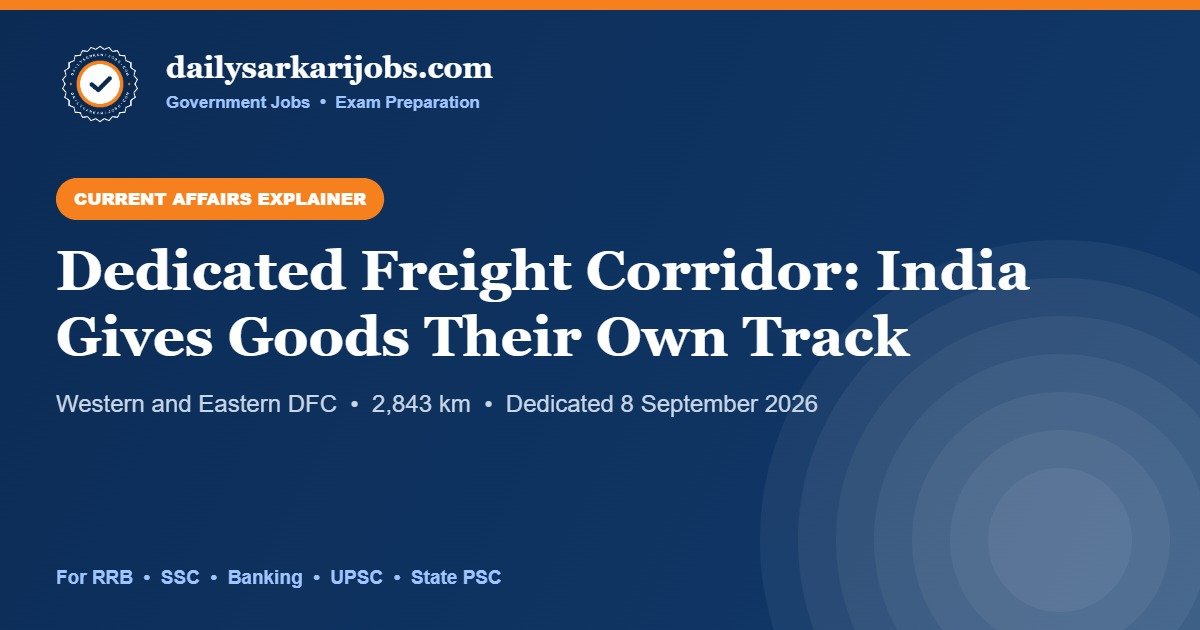
On 8 September 2026, at Vadodara in Gujarat, the Prime Minister dedicated the completed Western Dedicated Freight Corridor to the nation, along with railway projects worth more than ₹35,000 crore. With it, India’s freight corridor network of 2,843 km is finished end to end. This explainer tells you, in plain words, what a dedicated freight corridor actually is, why it changes so much, and the facts most likely to be asked in RRB NTPC and Group D, SSC CGL, banking general awareness, UPSC and State PSC.
⚡ QUICK FACTS
🚂 Network
2,843 km, complete
📅 Dedicated
8 September 2026, Vadodara
🏗️ Built by
DFCCIL, set up 30 Oct 2006
⏱️ Transit cut
About 30 hours to 10–12
First, the Problem Nobody Explains
Here is the thing to understand before any fact, because everything else follows from it.
For most of its history, Indian Railways ran goods trains and passenger trains on the same tracks. That sounds harmless. It is not.
A passenger train is light and fast and runs to a timetable people notice. A goods train is heavy, slow and nobody complains if it is late. So whenever the two meet on a shared line, the goods train is the one told to wait. It pulls into a loop line, stops, and lets the passenger train pass. Then it starts again — and a loaded freight train takes a long time to get back up to speed.
Do that a few dozen times between Mumbai and Delhi and you get the real number: a goods train on the ordinary network averages roughly 25 km an hour over a long haul. Not because the engine is weak. Because it spends much of its life standing still, waiting.
So India did not build a faster freight train. It built freight its own road. That is the whole idea of a Dedicated Freight Corridor, and it is the sentence to carry into the exam. It is the same logic as a bus lane, or a separate goods entrance at the back of a shop — you do not speed anything up, you simply stop the two kinds of traffic from getting in each other’s way, and both get faster.
The Two Corridors
Corridor
Length and Route
Key Points
Western DFC
About 1,506 km, from Jawaharlal Nehru Port (JNPT), Navi Mumbai to Dadri, Uttar Pradesh. Runs through Maharashtra, Gujarat, Rajasthan, Haryana and UP.
Funded with a loan from JICA, Japan. Carries double-stack container trains — containers stacked two high, which the ordinary network cannot do.
Eastern DFC
About 1,337 km, from Ludhiana, Punjab to Sonnagar, Bihar, with an extension onward towards Dankuni in West Bengal. Runs through Punjab, Haryana, UP, Bihar, Jharkhand and West Bengal.
Funded largely by the World Bank. Built mainly for bulk cargo — above all coal moving to power plants.
The pairing examiners ask for is the funder:Western is Japanese money, Eastern is World Bank money. A memory hook — W for Western, W for World Bank is the wrong one; Western goes with Japan. Getting that deliberately backwards once tends to fix it.
Who Built It, and What Makes the Track Different
The corridors were built by DFCCIL — the Dedicated Freight Corridor Corporation of India Limited, a special purpose vehicle under the Ministry of Railways, incorporated on 30 October 2006. A special purpose vehicle simply means a separate company set up to do one job, so that the job is not slowed down by the parent organisation’s other work.
Heavier loads. The track is designed for a 25-tonne axle load, with bridges and structures built to take 32.5 tonnes. Axle load is the weight pressing down through one axle — raise it and each wagon can legally carry more.
Taller trains. On the Western corridor the overhead electric wire is strung high enough to allow double-stacked containers. One such train can carry what it would take over 250 trucks to move.
Higher design speed. The corridors are designed for 100 km an hour against the ordinary network’s long-haul freight average of roughly 25.
Fully electrified, with modern signalling, so trains can follow each other more closely.
What Actually Changed
Measure
The Change
Transit time
A run that took around 30 hours now takes about 10 to 12 hours on the corridor.
Trains per day
More than 430 freight trains now run daily across the network.
Share of freight
The corridors already carry over 10 per cent of Indian Railways’ total freight volume, on a small fraction of its track length.
Global rank
India became the world’s second-largest rail freight carrier in 2024-25, moving about 1.6 billion tonnes and passing both the United States and Russia. Only China carries more.
Read that last row carefully, because it is the one that will appear in a paper. India is second, behind China. It overtook the United States and Russia. A question will offer you “first” as an option, and it will be wrong.
The Part That Matters Beyond the Railways
Freed-up track is the quiet second benefit, and it is worth more than it sounds. Every goods train moved onto a corridor is a slot released on the old line — which can now carry more passenger trains, running more punctually. The corridor helps people who will never see it.
There is an economic argument too. Logistics cost — the cost of physically moving goods — has long been higher in India than in competing economies, and that cost is buried inside the price of everything on a shelf. Rail is cheaper per tonne-kilometre than road and produces far less carbon, but only if it is reliable. Speed is useful; predictability is what makes a factory choose rail. A plant can plan around a train that always takes twelve hours. It cannot plan around one that takes anywhere between thirty and fifty.
Three further corridors have been announced and await sanction. Learn the names and the end points; that is the level at which they are asked.
East Coast Corridor — Kharagpur to Vijayawada, about 1,115 km.
East–West Corridor — Dankuni to Bhusawal.
North–South Corridor — Vijayawada to Itarsi.
One Honest Caveat
Reported average speeds on the corridors vary a great deal between sources — some quote around 40 km an hour, others 50 to 60, and official statements have cited figures approaching the design speed on particular stretches. The differences come from measuring different things: one section against the whole network, a light run against a loaded one, a peak figure against an annual average.
So quote the design speed of 100 km an hour, which is a fixed engineering fact, and quote the transit-time saving, which is concrete. Treat any single average-speed figure with care, and check the latest DFCCIL or Railway Ministry release before an exam. A number you can defend is worth more than an impressive one you cannot.
Practice Questions
Q1. The Western Dedicated Freight Corridor runs between: (a) Ludhiana and Sonnagar (b) JNPT and Dadri (c) Kharagpur and Vijayawada (d) Dankuni and Bhusawal Answer: (b) JNPT and Dadri JNPT in Navi Mumbai to Dadri in Uttar Pradesh, about 1,506 km. Ludhiana to Sonnagar is the Eastern corridor, and the other two are proposed corridors awaiting sanction.
Q2. The Eastern Dedicated Freight Corridor was funded largely by: (a) Japan International Cooperation Agency (b) Asian Development Bank (c) World Bank (d) New Development Bank Answer: (c) World Bank The World Bank funded the Eastern corridor; JICA of Japan funded the Western one. This exact pairing is the most common question on the topic.
Q3. DFCCIL, which built the corridors, was incorporated in: (a) 2004 (b) 2006 (c) 2010 (d) 2014 Answer: (b) 2006 30 October 2006, as a special purpose vehicle under the Ministry of Railways.
Q4. As of 2024-25, India is the world’s ___ largest rail freight carrier: (a) First (b) Second (c) Third (d) Fourth Answer: (b) Second Second, behind China, having overtaken the United States and Russia with about 1.6 billion tonnes. “First” is the deliberate trap.
Q5. Double-stack container trains run mainly on which corridor, and why? (a) Eastern, because it carries coal (b) Western, because its overhead wire is strung higher (c) Both equally (d) Neither, double stacking is not used in India Answer: (b) Western, because its overhead wire is strung higher Stacking containers two high needs clearance under the overhead electric wire, and the Western corridor was built with that height. The Eastern corridor is built for bulk cargo such as coal instead.
Common Mistakes to Avoid
Saying the corridor was “opened” on 8 September 2026. The final section was completed and commissioned on 31 March 2026; 8 September was the formal dedication to the nation. Aggregators blur the two — read which one a question asks for.
Swapping the funders. Western is Japan (JICA); Eastern is the World Bank.
Calling India the largest rail freight carrier. It is second. China is first.
Thinking the corridors carry passengers. They are for freight. The benefit to passengers is indirect — space freed on the old lines.
Quoting one average-speed figure as settled. Sources differ. The design speed of 100 km an hour is the safe number.
Test Yourself
Reading an explainer is not the same as recalling it under time pressure. Our Test Your Knowledge page carries free current affairs and Static GK quizzes, each with an explanation for every answer and a downloadable PDF for offline revision. For the fortnight’s other headlines, see our weekly current affairs digest.
Sources: Dedicated Freight Corridor Corporation of India Limited and Ministry of Railways material on corridor length, routes, funding and specifications; contemporaneous reporting of the dedication at Vadodara on 8 September 2026 and of the commissioning of the final New Saphale–JNPT section on 31 March 2026; and rail freight tonnage figures for 2024-25. Reported average operating speeds differ between sources and have been flagged as such above rather than presented as settled. Check the latest official release before an exam.