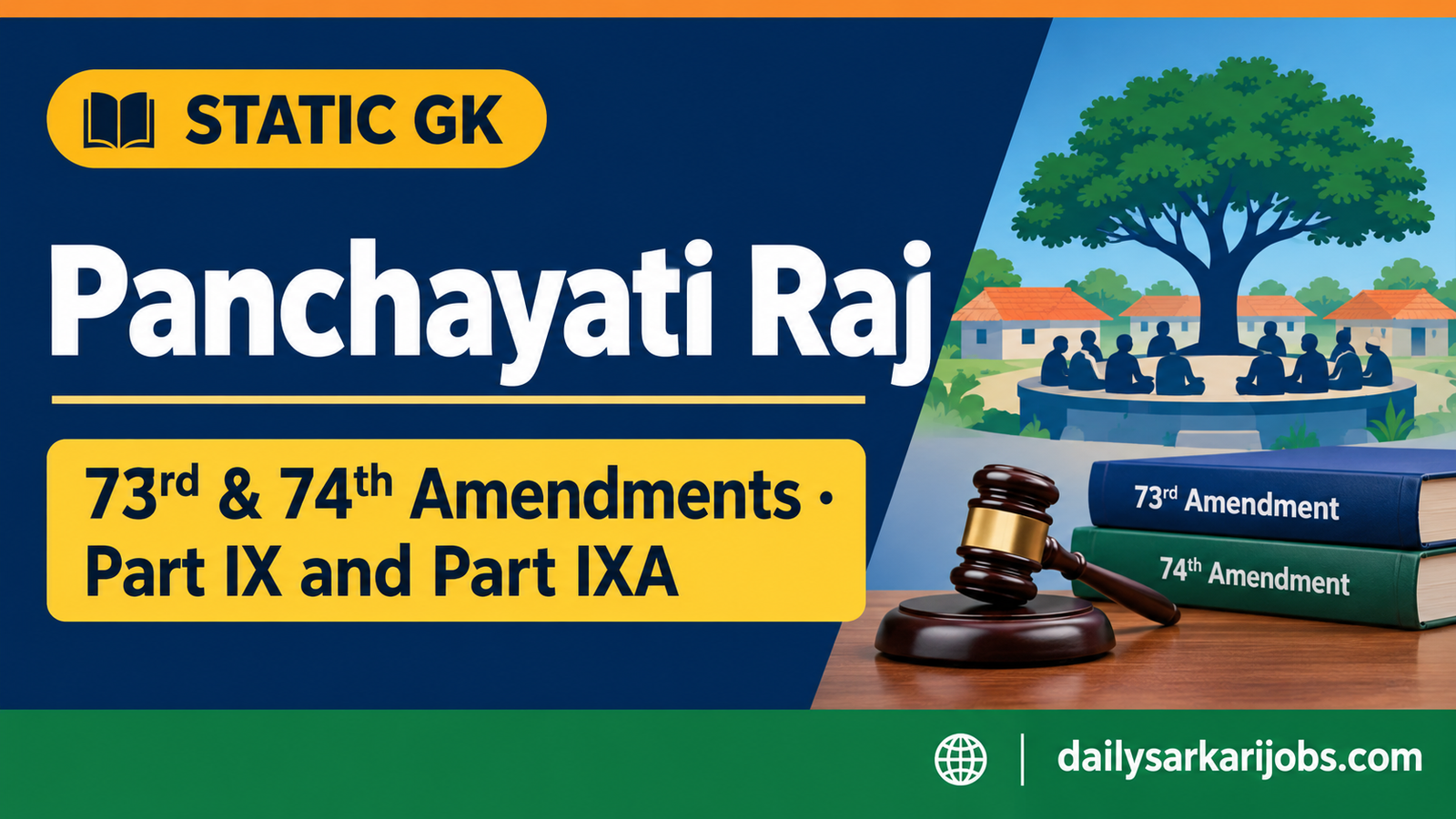
The 73rd Amendment did not create panchayats. India already had them. What it did was take away the State government’s freedom to not have them — and once you read the chapter that way, every provision in it falls into place.
This is the tenth capsule in our polity depth series, going a level below the Constitution capsule, for SSC CGL and CHSL, RRB NTPC, State PSC, banking general awareness and UPSC Prelims.
The Hinge: Two Words, and the Whole Chapter
Open Part IX and compare the opening words of two articles. The Constitution’s own language does the teaching here.
| Article | How it begins | So it is… |
|---|---|---|
| 243B — setting up panchayats | ‘There shall be constituted in every State, Panchayats at the village, intermediate and district levels…’ | Compulsory. A State has no choice |
| 243G — giving them powers | ‘Subject to the provisions of this Constitution, the Legislature of a State may, by law, endow the Panchayats with such powers and authority…’ | Voluntary. A State may, or may not |
That contrast is the whole chapter. The 73rd Amendment made panchayats compulsory to have, and left it entirely to each State whether they are given anything to do. Panchayats got constitutional status. They did not get constitutional powers.
Now use it as a decoder. For any provision in Part IX or Part IXA, ask: is this something the State must do, or something it may do? Almost every question in this chapter is testing that line, and the line is visible in the wording.
The Compulsory List and the Voluntary List
| A State must | A State may |
|---|---|
| Constitute panchayats at three levels (243B) | Endow them with powers and functions (243G) |
| Hold elections every five years (243E) | Devolve any of the 29 subjects in the Eleventh Schedule |
| Set up a State Election Commission (243K) | Authorise them to levy taxes, duties and tolls (243H) |
| Set up a State Finance Commission every five years (243I) | Decide the powers of the Gram Sabha (243A) |
| Reserve seats for SCs, STs and women (243D) | Choose how members of the intermediate and district levels are picked (243C) |
The Eleventh Schedule is the classic trap. Its 29 subjects — agriculture, drinking water, rural housing, primary schools, health, women and child development and the rest — are a menu, not a transfer. Nothing in the Constitution moves a single one of them to a panchayat. Article 243G merely permits a State legislature to do it. The gap between the 29 subjects on paper and what panchayats actually run is the entire debate about local government in India, and one sentence of that in a descriptive answer is worth more than the list itself.
Part IX, Article by Article
| Article | What it provides |
|---|---|
| 243A | The Gram Sabha — every registered voter in a village. Its powers are whatever the State legislature gives it |
| 243B | Panchayats at village, intermediate and district levels. A State with a population not exceeding twenty lakh need not have the intermediate level |
| 243C | Composition. All seats at every level are filled by direct election from territorial constituencies |
| 243D | Reservation. SCs and STs in proportion to their population; not less than one-third of the total seats for women, including the women’s share within the SC and ST seats. Chairperson posts are reserved too |
| 243E | Five-year term. If a panchayat is dissolved early, the one elected in its place serves only the remainder of the original term |
| 243F | Disqualifications. The minimum age to contest is 21 |
| 243G | Powers and responsibilities — as the State legislature may provide |
| 243H | Taxes and funds — again, as the State legislature may authorise |
| 243I | A State Finance Commission, constituted by the Governor every five years |
| 243J | Accounts and audit, as the State legislature provides |
| 243K | A State Election Commission — a State Election Commissioner appointed by the Governor |
| 243M | Part IX does not automatically apply to the Scheduled Areas and tribal areas |
| 243-O | Courts may not interfere in delimitation or in an election, except through an election petition |
Three of those repay a second look. The 21-year age in 243F is lower than the 25 needed for a State legislature, and it is asked constantly. The remainder rule in 243E is what stops a State gaining time by dissolving a panchayat. And 243M is why Parliament had to pass a separate law, the Panchayats (Extension to the Scheduled Areas) Act, 1996 — PESA — to carry Part IX into the Fifth Schedule areas with changes.
Part IXA Is Part IX Again, for Towns
This is the single most useful thing in the chapter and almost nobody says it. The 74th Amendment did not invent a new design. It copied Part IX article for article and changed the nouns. Learn one column and you have learned both.
| Provision | Panchayats | Municipalities |
|---|---|---|
| Setting the body up | 243B | 243Q |
| Composition | 243C | 243R |
| Reservation of seats | 243D | 243T |
| Five-year duration | 243E | 243U |
| Disqualifications | 243F | 243V |
| Powers and responsibilities | 243G | 243W |
| Taxes and funds | 243H | 243X |
| State Finance Commission | 243I | 243Y |
| Accounts and audit | 243J | 243Z |
| Elections | 243K | 243ZA |
| Bar on court interference | 243-O | 243ZG |
Only three things in Part IXA have no twin, and those are the ones worth memorising separately:
- 243Q defines three kinds of municipality — a Nagar Panchayat for an area in transition from rural to urban, a Municipal Council for a smaller urban area, and a Municipal Corporation for a larger one.
- 243S requires a Wards Committee in every municipality with a population of three lakh or more.
- 243ZD sets up a District Planning Committee to combine the plans of the panchayats and the municipalities in a district, and 243ZE a Metropolitan Planning Committee for an area of ten lakh or more.
Those last two are the quiet answer to the criticism above. Whatever a State chooses not to devolve, the Constitution still forces rural and urban plans to be added together at the district level. It is a small compulsion, and it is one of the few.
Where the Money Comes From
Panchayats are given very little power to raise money of their own, so most of what they spend arrives from above — and that is the thread back to yesterday’s capsule. Article 280(3)(bb) and (c) of the Constitution were inserted by these very two Amendments, adding to the Union Finance Commission’s duties the job of recommending measures to top up a State’s fund for its panchayats and municipalities.
The 16th Finance Commission, whose award runs from 1 April 2026, put ₹4.35 lakh crore behind rural local bodies and ₹3.56 lakh crore behind urban ones over five years. So the money route is: Union Finance Commission to the State, State Finance Commission under 243I deciding the split within the State, and the panchayat at the end of it. Two Finance Commissions, one chain — and mixing them up is a standard error.
The State Election Commission Is Not the Election Commission of India
A State Election Commission under 243K runs panchayat and municipal elections. The Election Commission of India under Article 324, covered in our Election Commission capsule, does not touch them. Different body, different appointing authority, different work.
| Election Commission of India | State Election Commission | |
|---|---|---|
| Article | 324 | 243K and 243ZA |
| Appointed by | The President | The Governor |
| Conducts | Parliament, State legislatures, President and Vice-President | Panchayat and municipal elections |
How It Took Thirty-Five Years to Get Here
| Year | What happened |
|---|---|
| 1957 | The Balwant Rai Mehta Committee recommends a three-tier system — Gram Panchayat, Panchayat Samiti, Zila Parishad |
| 2 October 1959 | Panchayati Raj is inaugurated at Nagaur, Rajasthan — the first State to adopt it |
| 1977 | The Ashok Mehta Committee recommends a two-tier system instead |
| 1985 | The G. V. K. Rao Committee looks at reviving the institutions |
| 1986 | The L. M. Singhvi Committee recommends constitutional status — the idea that finally won |
| 1989 | The 64th Amendment Bill, moved by Prime Minister Rajiv Gandhi, is defeated in the Rajya Sabha |
| 1992 | The 73rd and 74th Amendments pass under Prime Minister P. V. Narasimha Rao |
Do not skip the 1989 line. A constitutional amendment must clear both Houses by the two-part special majority set out in our amendments capsule. The 64th Bill got through the Lok Sabha and died in the Rajya Sabha — and three years later the same idea passed. That is the clearest proof in the Constitution’s history that the second chamber is not a formality.
Behind all of it sits Article 40, a Directive Principle asking the State to organise village panchayats. It sat unenforceable for forty-two years before Part IX gave it teeth, which is as good an illustration of what a Directive Principle is worth as the Constitution provides.
Traps Worth Marking
- The 73rd and 74th Amendment Acts are both of 1992, but they came into force on different dates — 24 April 1993 and 1 June 1993.
- The Eleventh Schedule has 29 subjects, the Twelfth has 18. Eleven is the rural one; the bigger number goes with it.
- Both Schedules are permissive. Nothing is transferred by the Constitution itself.
- The intermediate tier may be skipped only by a State with a population not exceeding twenty lakh.
- Women get not less than one-third — that is a floor, not a ceiling, and many States have legislated more.
- The minimum age is 21, against 25 for a State legislature.
- A panchayat elected after early dissolution serves only the rest of the old term, not a fresh five years.
- Part IX does not extend to Scheduled Areas by itself — PESA, 1996 does that.
- Panchayat elections are run by the State Election Commission, not the Election Commission of India.
Five Practice Questions
Q1. The 73rd Amendment made which of these compulsory for a State?
(a) Transferring the 29 subjects in the Eleventh Schedule (b) Constituting panchayats at the village, intermediate and district levels (c) Allowing panchayats to levy taxes (d) Fixing the powers of the Gram Sabha
Answer: (b) Constituting panchayats at the village, intermediate and district levels The other three are all worded as things a State legislature may do, which is exactly the distinction the chapter turns on. Only the setting up of the bodies is written as a command.
Q2. A State need not have panchayats at the intermediate level if its population does not exceed…
(a) Ten lakh (b) Twenty lakh (c) Fifty lakh (d) One crore
Answer: (b) Twenty lakh Below that figure a two-tier structure is allowed. Note that the threshold is about the State’s population, not the district’s.
Q3. The minimum age to contest a panchayat election is…
(a) 18 years (b) 25 years (c) 21 years (d) 30 years
Answer: (c) 21 years Eighteen is the voting age and 25 is the minimum for a State legislative assembly, so all three numbers are real and belong to different things. Article 243F sets the panchayat figure lower than the assembly one.
Q4. Which Committee first recommended constitutional status for panchayats?
(a) Balwant Rai Mehta Committee (b) Ashok Mehta Committee (c) G. V. K. Rao Committee (d) L. M. Singhvi Committee
Answer: (d) L. M. Singhvi Committee Balwant Rai Mehta in 1957 proposed the three-tier structure and Ashok Mehta in 1977 proposed cutting it to two, but neither asked for the Constitution to be amended. That came in 1986, and became law six years later.
Q5. Elections to panchayats are conducted by…
(a) The Election Commission of India (b) The State Election Commission (c) The District Collector (d) The State Finance Commission
Answer: (b) The State Election Commission Article 324 gives the national body charge of parliamentary and assembly elections only. Local elections were given their own authority under Article 243K, appointed by the Governor rather than the President.
Ten more questions on this and today’s Current Affairs explainer are waiting on our Test Your Knowledge page, with a free PDF. Today’s explainer is on the UPSC turning 100.
Sources: the Constitution of India, Part IX (Articles 243 to 243-O) and Part IXA (Articles 243P to 243ZG), read from the text published by a State Election Commission; the Ministry of Home Affairs’ own summary of the 74th Amendment for the municipal articles and the Wards Committee and planning committee thresholds; the 16th Finance Commission’s grants to local bodies as summarised by PRS India; and standard published accounts of the Balwant Rai Mehta, Ashok Mehta, G. V. K. Rao and L. M. Singhvi Committees and of the 64th Amendment Bill of 1989.