The body that will select India’s civil servants tomorrow was set up by the British, twenty-one years before the British left. It is one of the very few institutions India kept without argument in 1947 — and the reason why is the most useful thing in this topic.
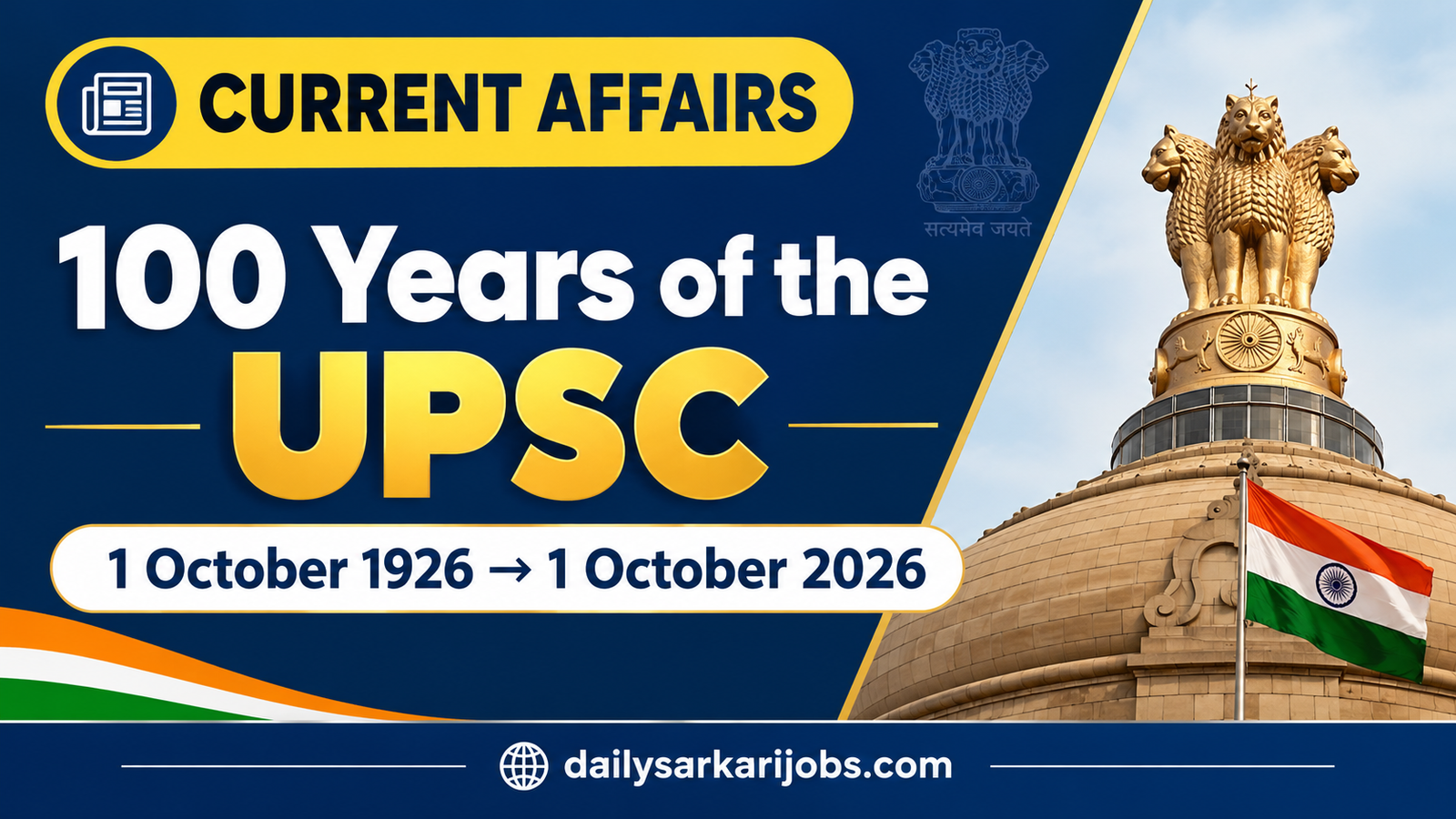
On 1 October 2026 the Union Public Service Commission completes 100 years. That day is today, and it closes a centenary year that began on 1 October 2025. Explained in plain language for SSC, RRB NTPC, State PSC, banking general awareness and UPSC Prelims.
⚡ QUICK FACTS
📅 Set up
1 October 1926
📜 Under
The Government of India Act, 1919
👥 On the advice of
The Lee Commission, 1924
🏛️ First Chairman
Sir Ross Barker
⚖️ Articles today
315 to 323, Part XIV
📍 Headquarters
Dholpur House, New Delhi
The Hinge: Ask Why the British Built It
It is tempting to read the 1926 Commission as a piece of colonial machinery that India happened to inherit. That gets the story exactly backwards.
By the 1920s Indians were pressing hard for a real share of the higher civil services. The obstacle was not a rule that said no — it was the method. The competitive examination for the Indian Civil Service was held in London, which in practice settled who could sit it. Indians who did get in complained that promotion and posting still ran on patronage.
So the Government appointed the Royal Commission on the Superior Civil Services in India — universally called the Lee Commission, after its chairman Lord Lee of Fareham. It reported in 1924, and among its recommendations was a Public Service Commission: a standing, independent body to conduct recruitment and to advise on service matters.
Read that as an answer, not as a gift. The Commission was created because a political demand had to be met in a way that looked credible. An independent examining body was the instrument that made Indianisation believable — to Indians, who could see selection was by merit, and to the British, who could concede numbers without conceding control of quality.
And that is why it survived 1947 untouched. A body built to answer an Indian demand did not need to be dismantled when Indians took charge; it needed to be renamed. This is the same shape as our Indian National Movement capsule, where almost every British move turns out to be a response to a specific Indian action. Whenever an institution outlives the regime that made it, ask what demand it was built to answer.
Three Names, One Job
The Commission has been renamed twice in a hundred years. Neither renaming changed what it does. What changed each time was the shape of the state around it.
From
Name
Created by
What had changed
1 Oct 1926
Public Service Commission
The Government of India Act, 1919
A single colonial government, so a single Commission
1937
Federal Public Service Commission
The Government of India Act, 1935
The 1935 Act built a federation, so the Commission became federal and the provinces got their own
26 Jan 1950
Union Public Service Commission
The Constitution of India
A Union of States, and for the first time the Commission had constitutional status
So here is a decoder worth keeping. When an institution is renamed, ask whether its job changed or only the state around it changed. For the Commission the answer is the same all three times: the job never moved. It examines, it selects, and it advises.
Note the small trap in the middle row. The word that changed was ‘Federal’, not the work. And it is the 1935 Act that first gave the provinces their own Public Service Commissions — which is where today’s State Public Service Commissions come from.
What the Lee Commission Actually Recommended
The Lee Commission is remembered in most notes only as ‘the committee that suggested the Public Service Commission’. Its other recommendation is the one that shows what the period was really about.
It proposed that the superior services be staffed in a fixed proportion: 40% British officers, 40% Indians recruited directly, and 20% Indians promoted from the provincial services.
Half the higher civil service was to be Indian, by formula. That single line tells you why a Public Service Commission was needed at all — once you fix a quota by nationality, you need a body whose selections nobody can call rigged.
The Centenary Year — and the Date Trap
The Commission did not wait until the hundredth birthday to mark it. Centenary year celebrations began on 1 October 2025 and run to 1 October 2026, announced by the Government in August 2025, with a centenary logo and tagline released for the year.
Statement
Correct year
The UPSC began its centenary year celebrations
1 October 2025
The UPSC completes 100 years
1 October 2026
Both sentences are true and they point at different years. A question that says ‘celebrations began’ wants 2025; a question that says ‘completes a century’ or ‘centenary’ wants 2026. Read the verb. This is the same discipline as telling ‘signed’ from ‘in force’, and it catches more candidates than any hard fact in this topic.
It is a constitutional body under Articles 315 to 323, in Part XIV of the Constitution — see our Constitution capsule for where that sits.
It conducts the Civil Services Examination, the Engineering Services Examination, the Combined Defence Services Examination, the Combined Medical Services Examination and others.
Its headquarters is Dholpur House, Shahjahan Road, New Delhi.
It has a Chairman and other members appointed by the President, and its strength is not fixed by the Constitution — the President decides it.
Its advice is not binding on the Government. That single fact is the heart of the capsule linked above, and it is the most misunderstood thing about the Commission.
The serving Chairman is Dr Ajay Kumar, who took office in May 2025. Office-holders change; recheck this one before an exam rather than trusting any note, including this one.
Why a Hundred Years Is Actually Interesting
Very little of the machinery of 1926 is still standing. The legislatures of that era are gone, the provinces were redrawn, the services themselves were renamed and restructured. The Public Service Commission is one of the few pieces that runs today under a new name with an unbroken thread back to its first meeting.
The reason is worth one line in a descriptive answer: an institution whose whole purpose is to decide fairly who gets in has no politics of its own to defend. It can change masters without changing method — which is exactly what it did in 1937 and again in 1950.
What Is Likely to Be Asked
Set up on 1 October 1926, under the Government of India Act, 1919.
On the recommendation of the Lee Commission — the Royal Commission on the Superior Civil Services in India — which reported in 1924.
First Chairman: Sir Ross Barker.
Renamed the Federal Public Service Commission under the Government of India Act, 1935, in 1937.
Became the Union Public Service Commission on 26 January 1950, with the Constitution.
Articles 315 to 323, Part XIV.
Centenary year: 1 October 2025 to 1 October 2026.
Lee Commission staffing formula: 40 : 40 : 20.
Five Practice Questions
Q1. The Public Service Commission in India was first set up on… (a) 1 October 1926 (b) 26 January 1950 (c) 1 April 1937 (d) 15 August 1947 Answer: (a) 1 October 1926 Nineteen thirty-seven is when it became the Federal Public Service Commission and 1950 is when it took its present name, so all three dates belong to the same body at different stages.
Q2. The creation of the Public Service Commission was recommended by… (a) The Simon Commission (b) The Hunter Commission (c) The Lee Commission (d) The Sapru Committee Answer: (c) The Lee Commission Its formal name was the Royal Commission on the Superior Civil Services in India, and it reported in 1924. The Simon Commission of 1927 dealt with constitutional reform, not the services.
Q3. Under which Act was the Commission first constituted? (a) The Indian Councils Act, 1909 (b) The Government of India Act, 1919 (c) The Government of India Act, 1935 (d) The Indian Independence Act, 1947 Answer: (b) The Government of India Act, 1919 The 1935 Act came later and only reconstituted it as a federal body. The 1909 Act introduced separate electorates and had nothing to do with recruitment.
Q4. The Union Public Service Commission is dealt with in which Articles? (a) Articles 280 to 281 (b) Articles 148 to 151 (c) Articles 324 to 329 (d) Articles 315 to 323 Answer: (d) Articles 315 to 323 Two-eighty is the Finance Commission, 148 the Comptroller and Auditor General, and 324 the Election Commission. The Public Service Commissions sit in Part XIV, on services under the Union and the States.
Q5. The UPSC completes one hundred years on… (a) 1 October 2025 (b) 26 January 2026 (c) 1 October 2026 (d) 1 April 2037 Answer: (c) 1 October 2026 The centenary year ran from October 2025, which is the year most headlines carried, but the hundredth anniversary of the 1926 founding falls a full year after that. Read whether a question says ‘began celebrating’ or ‘completes’.
Ten more questions on this and today’s Static GK capsule are waiting on our Test Your Knowledge page, with a free PDF. Today’s capsule is on Panchayati Raj and the 73rd and 74th Amendments — the other great question of who gets to decide, asked at the opposite end of the system.
Sources: the Press Information Bureau release of 12 August 2025 announcing the centenary year, which gives the 1926 founding, the 1919 Act, the Lee Commission of 1924 and the 1937 and 1950 changes of name; published records of the Commission for the first chairman, the Lee Commission’s staffing formula and the present headquarters; and the Constitution of India, Articles 315 to 323.