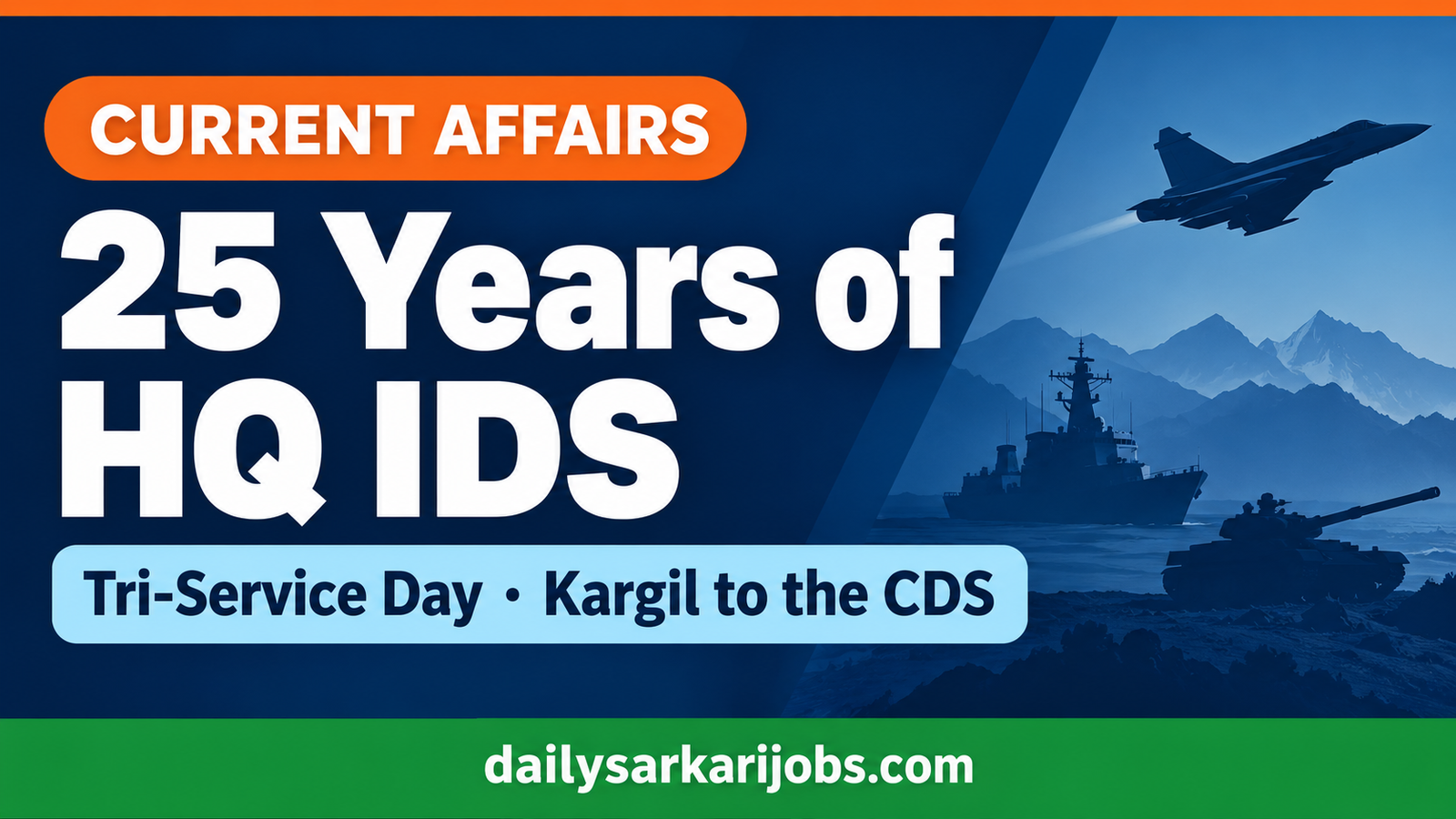
In 2001 India built a headquarters for a commander who would not arrive for eighteen years. That one sentence explains most of what is confusing about Indian defence reform, and it is why the organisation that turned 25 yesterday is worth an hour of your time.
On 1 October 2026, Headquarters Integrated Defence Staff completed 25 years. The armed forces mark the date as Tri-Service Day. Explained in plain language for SSC, RRB NTPC, CDS, NDA, State PSC, banking general awareness and UPSC Prelims.
⚡ QUICK FACTS
Raised
1 October 2001
Marked as
Tri-Service Day
Came out of
The Kargil Review Committee, 1999
Recommended by
The Group of Ministers, 2001
Headed by
The CISC, a three-star officer
Serves
The Chiefs of Staff Committee and the CDS
The Hinge: the Staff Came First, the Chief Came Last
Read the name slowly. Integrated Defence Staff. In every army in the world, a staff exists to serve a commander — it drafts his plans, moves his paperwork and turns his decisions into orders. So the obvious question is: whose staff is this?
The answer, in 2001, was nobody’s. The Group of Ministers that recommended this headquarters recommended two things: a Chief of Defence Staff to command all three services jointly, and an Integrated Defence Staff to work for him. The Government accepted the staff and quietly shelved the chief. HQ IDS was raised on 1 October 2001. The first Chief of Defence Staff took charge on 1 January 2020.
Eighteen years and three months. For all of that time the Integrated Defence Staff worked for a committee instead — the Chiefs of Staff Committee, whose chairman was simply whichever of the three service chiefs happened to be senior-most, often for a few months before he retired.
Keep that picture, because it is the decoder for this whole subject. Every Indian defence reform since Kargil is an answer to one question: who makes the three services act as one? India has tried three answers, in order — a committee, then a staff, then a chief — and is now trying a fourth. Place any reform you read about on that line and it will make sense.
This is the same move we made yesterday in our capsule on the UPSC turning 100: when an institution looks odd, ask what demand it was built to answer. The UPSC looks odd until you learn it answered an Indian demand; HQ IDS looks odd until you learn it was built for a post that did not exist.
Where It Came From: Kargil, and Four Task Forces
Nothing here starts in 2001. It starts with a war that India won while discovering how badly its own system worked.
When
What happened
29 July 1999
The Kargil Review Committee is set up, three days after the war ends. Chairman: K. Subrahmanyam. Members: Lt Gen K. K. Hazari, B. G. Verghese, and Satish Chandra as member-secretary
7 January 2000
The Committee submits its report to Prime Minister Vajpayee. It is tabled in Parliament on 23 February 2000
17 April 2000
A Group of Ministers on National Security is set up to act on the report, chaired by L. K. Advani, the Home Minister
26 February 2001
The Group of Ministers submits Reforming the National Security System
1 October 2001
Headquarters Integrated Defence Staff is raised
The Group of Ministers did its work through four task forces, and this table is asked about directly — the names are distinctive enough to be examinable and short enough to learn in one sitting.
Task force
Headed by
Intelligence apparatus
G. C. Saxena
Internal security
N. N. Vohra
Border management
Madhav Godbole
Management of defence
Arun Singh
It was the fourth one, on management of defence, that produced the recommendations we are talking about — the Chief of Defence Staff, the Integrated Defence Staff, and a Defence Intelligence Agency to end the intelligence gaps the Kargil Review Committee had found.
Three Answers to One Question
Here is the decoder laid out. Learn the three rows and you can place almost any defence reform question.
The answer tried
From
How it works
Its weakness
A committee — the Chiefs of Staff Committee
1947 onwards
The three service chiefs meet; the senior-most chairs it in addition to running his own service
A part-time chairman with no staff and no authority over the other two, sometimes for only a few months
A staff — Headquarters Integrated Defence Staff
1 October 2001
A permanent tri-service headquarters that writes joint doctrine, plans joint training and runs joint exercises
A staff can prepare a decision; it cannot take one
A chief — the Chief of Defence Staff
1 January 2020
A four-star officer who is permanent chairman of the Committee, heads a new department of the Ministry, and advises the Government
He commands no troops of his own; the three service chiefs still command their services
Theatre commands
Under examination
One commander in a given geography commanding army, navy and air force elements together
Not yet in place; the debate on their shape is live
Notice what the last column is doing. Each answer fixes the weakness of the one before it, and creates a new one. That is not a failure of Indian planning — it is what institutional reform looks like everywhere, and saying so in a descriptive answer is worth more than any date on this page.
What HQ IDS Actually Does
It is a headquarters, not a command. The difference matters: it does not have troops. What it has is the paperwork, the plans and the doctrine that make three separate services fit together.
Joint doctrine — the written agreement on how the three services will fight the same battle.
Joint training and joint exercises, including the large tri-service exercises.
Long-term planning — the integrated capability plans that decide what the forces should buy over the next decade.
Humanitarian Assistance and Disaster Relief, which in practice is the thing the Indian armed forces do most often and the thing jointness helps most obviously.
The newer domains — cyber, space and now artificial intelligence, none of which belongs to any single service.
Three tri-service agencies sit under it, and they are the ones worth learning by name because they match the new domains:
Agency
What it covers
Defence Cyber Agency
Cyber operations and defence of military networks
Defence Space Agency
Military use of space
Armed Forces Special Operations Division
Tri-service special operations
Separately, India has two tri-service commands, and these do have forces. The Andaman and Nicobar Command, raised in 2001, is India’s first and only geographical tri-service command — a working preview of what a theatre command would look like. The Strategic Forces Command, raised in 2003, handles the nuclear arsenal. Commands have forces; agencies and headquarters do not. Questions play on exactly that distinction.
The Chief of Defence Staff, and Why He Is Three People
The CDS wears three hats, and every one of them is a separate examinable fact.
Hat
What it means
Permanent Chairman, Chiefs of Staff Committee
The committee finally has a full-time head instead of the senior-most chief by rotation
Secretary, Department of Military Affairs
A serving military officer heading a department of the Government of India — which had never happened before
Principal Military Adviser to the Defence Minister
A single military voice to the Government on matters involving more than one service
That second hat is the genuinely new thing. The Department of Military Affairs was created alongside the post in January 2020 as the fifth department of the Ministry of Defence, and a uniformed officer was put in charge of it. Note the limit, because it is asked: capital acquisition stays with the Department of Defence, not with the new department.
And now the point that ties this post to our Election Commission capsule and everything in that series: where does this post come from? Not from the Constitution, and not from an Act of Parliament. The Cabinet Committee on Security approved it by decision on 24 December 2019. The Chief of Defence Staff of India exists because the Cabinet said so — which makes it powerful, flexible, and easier to change than almost any office we have covered.
The Date Traps
This topic has more of them than any recent one, so mark them now.
The question says
The answer is
HQ IDS was raised
1 October 2001 — the date the forces observe as Tri-Service Day
HQ IDS was formally notified
23 November 2001, by government order. Some reference pages give only this date
The CDS post was announced
15 August 2019, from the Red Fort
The CDS post was approved
24 December 2019, by the Cabinet Committee on Security
The first CDS took charge
1 January 2020 — General Bipin Rawat
Read the verb. This is the same discipline that caught people out in yesterday’s UPSC post, where ‘began celebrating’ and ‘completes a century’ pointed at two different years. Announced, approved and took charge are three different events here, spread over four and a half months.
Who Holds the Posts Today
Chief of Defence Staff: General N. S. Raja Subramani, in office since 31 May 2026. He is the third CDS. General Bipin Rawat held the post from 1 January 2020 until his death in a helicopter crash in December 2021; the post then lay vacant for over nine months before General Anil Chauhan took it up in September 2022.
Chief of Integrated Defence Staff to the Chairman, Chiefs of Staff Committee — the CISC — heads HQ IDS. The post is held by Air Marshal Tejinder Singh, who also serves as Vice Chief of Defence Staff.
Office-holders change. Recheck both of these before an exam rather than trusting any note, including this one.
The Money Side, in One Paragraph
Jointness is not only about commanders. The other half of defence reform is making things in India instead of buying them abroad, which is where this meets our Make in India capsule: defence production rose from about ₹46,400 crore in 2014-15 to roughly ₹1.78 lakh crore in 2025-26 on the Government’s own twelve-year figures. Integration decides how the forces fight; indigenisation decides what they fight with. Questions on defence reform come from both halves, so do not learn one and ignore the other.
What Is Likely to Be Asked
HQ IDS raised 1 October 2001; the date is observed as Tri-Service Day.
It came from the Kargil Review Committee (1999, K. Subrahmanyam) through the Group of Ministers (2000-01, L. K. Advani).
The Group of Ministers report was titled Reforming the National Security System, 26 February 2001.
The four task forces: Saxena (intelligence), Vohra (internal security), Godbole (border management), Arun Singh (management of defence).
HQ IDS is headed by the CISC; the CDS is a separate and later four-star post.
CDS announced 15 August 2019, approved 24 December 2019, first holder General Bipin Rawat from 1 January 2020.
The CDS is Secretary, Department of Military Affairs — the fifth department of the Ministry of Defence, created 2020.
Tri-service commands: Andaman and Nicobar (2001) and Strategic Forces (2003). Tri-service agencies under HQ IDS: Cyber, Space, Special Operations.
Five Practice Questions
Q1. Headquarters Integrated Defence Staff was raised on… (a) 1 October 2001 (b) 24 December 2019 (c) 1 January 2020 (d) 26 February 2001 Answer: (a) 1 October 2001 Twenty-four December 2019 is when the Cabinet Committee on Security approved the Chief of Defence Staff, 1 January 2020 is when the first CDS took charge, and 26 February 2001 is the date of the Group of Ministers report. All four dates belong to the same story at different stages.
Q2. The creation of HQ Integrated Defence Staff followed the recommendations of… (a) The Shekatkar Committee (b) The Group of Ministers set up after the Kargil Review Committee (c) The Naresh Chandra Task Force (d) The Arun Singh Committee of 1990 Answer: (b) The Group of Ministers set up after the Kargil Review Committee Later committees did look again at defence reform, but the chain that produced this headquarters runs from the 1999 war to a review committee to a ministerial group, and ends in October 2001.
Q3. The Kargil Review Committee was chaired by… (a) L. K. Advani (b) Lt Gen K. K. Hazari (c) K. Subrahmanyam (d) N. N. Vohra Answer: (c) K. Subrahmanyam Advani chaired the Group of Ministers that acted on the report, Hazari was a member of the Committee, and Vohra headed one of the four task forces. The chairman was a strategic affairs analyst and former civil servant, not a soldier.
Q4. The Chief of Defence Staff is not… (a) Permanent Chairman of the Chiefs of Staff Committee (b) Secretary of the Department of Military Affairs (c) Principal Military Adviser to the Defence Minister (d) The operational commander of the three services Answer: (d) The operational commander of the three services He wears the first three hats, and that is the whole design. What he does not do is command: each service chief still commands his own service, which is the single most common misunderstanding about the post.
Q5. Which of these is a tri-service command rather than an agency or a headquarters? (a) Defence Cyber Agency (b) Defence Space Agency (c) Headquarters Integrated Defence Staff (d) Andaman and Nicobar Command Answer: (d) Andaman and Nicobar Command Only one of these has forces under it. The two agencies and the headquarters plan, advise and coordinate; a command fights. Learning that one distinction answers a surprising number of questions.
Ten more questions on this and today’s Static GK capsule are waiting on our Test Your Knowledge page, with a free PDF. Today’s capsule is on the GST Council — the other great question of how a country with many governments decides one thing.
Sources: the Press Information Bureau release of 1 October 2026 on HQ IDS completing 25 years, which gives the 1 October 2001 raising date, the Tri-Service Day observance and the present office-holders; published records of the Kargil Review Committee and of the Group of Ministers report of 26 February 2001, including a contemporaneous newspaper report naming the chairman and the four task force heads; and the Press Information Bureau factsheet on the Chief of Defence Staff for the 2019 announcement, the Cabinet Committee on Security approval and the Department of Military Affairs. Note that one widely used reference page gives 23 November 2001 as the date HQ IDS was constituted and names the National Security Adviser rather than the Home Minister as chairman of the Group of Ministers; both points are flagged in the post.