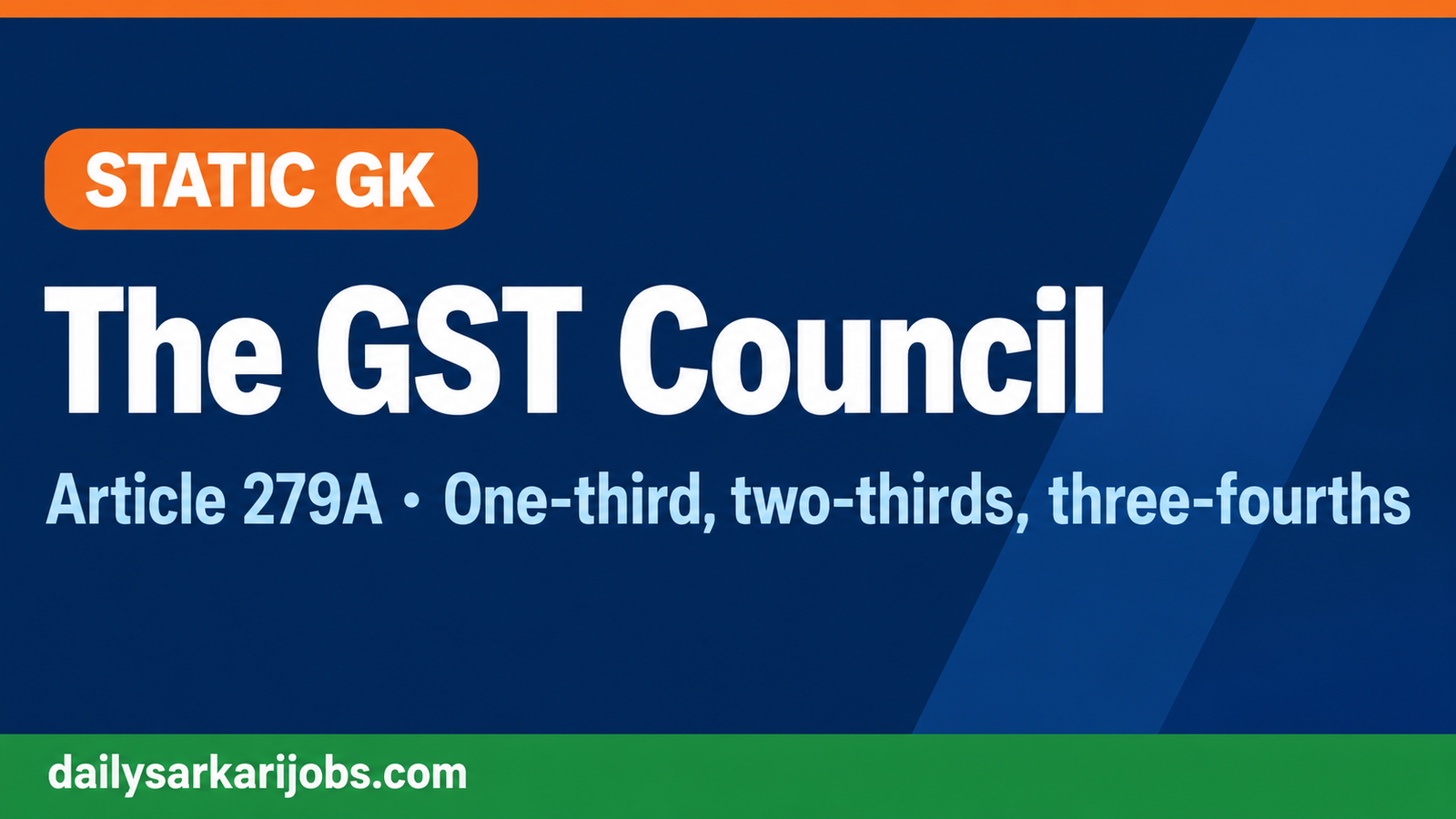
Do one piece of arithmetic and this entire chapter opens. In the GST Council the Union gets one-third of the votes and all the States together get two-thirds, and a decision needs three-quarters. One-third is less than three-quarters. So is two-thirds. Neither side can carry a single decision on its own. That is not an accident; it is the design.
This is the eleventh capsule in our polity depth series, going a level below the Constitution capsule, for SSC CGL and CHSL, RRB NTPC, State PSC, banking general awareness and UPSC Prelims.
The Hinge: Do the Arithmetic Yourself
Article 279A(9) says a decision needs not less than three-fourths of the weighted votes of the members present and voting, and it fixes the weights: the Union gets one-third of the total votes cast, and all the State Governments taken together get two-thirds. Work out what that means before reading on.
| Who is voting together | Their weight | Needed | Result |
|---|---|---|---|
| The Union alone | 1/3, about 33 per cent | 3/4, 75 per cent | Fails. The Union cannot pass anything by itself |
| Every State together, without the Union | 2/3, about 67 per cent | 3/4, 75 per cent | Fails. All the States together cannot pass anything either |
| The Union plus most of the States | 1/3 plus a large share of 2/3 | 3/4, 75 per cent | Passes — and this is the only way anything passes |
Now push the arithmetic one step further, because this is where the real exam questions live. If the Union is on board, how many States does it still need? Three-quarters minus one-third leaves five-twelfths to be found from a States’ pool worth two-thirds — which works out at five-eighths, or 62.5 per cent, of the States present and voting.
Turn it around and you get the two facts worth memorising:
- The Union has a veto. Without it, the maximum possible vote is two-thirds, which can never reach three-quarters. Nothing passes over the Union’s objection.
- So do the States, if enough of them agree. States holding more than three-eighths — 37.5 per cent — of the States’ weight can block anything, however much the Union wants it.
That single calculation is the hinge. Every description of the GST Council as a model of ‘cooperative federalism’ is really just a description of these fractions. The Council was built so that neither Delhi nor the States could act alone, and the arithmetic enforces it without anyone having to be reasonable.
Where It Came From, and Why the States Had to Agree
GST replaced a tangle of Union taxes and State taxes with one tax. But a State cannot be stripped of its taxing power by Parliament alone, so the change had to be made in the Constitution itself — and not by the ordinary amendment route.
| Step | Detail |
|---|---|
| The Amendment | The Constitution (One Hundred and First Amendment) Act, 2016 |
| Assent | 8 September 2016 |
| Article 279A in force | 12 September 2016 — the same day the Cabinet approved the Council and its Secretariat |
| First meeting | 22 and 23 September 2016, in New Delhi |
| Chairperson at the first meeting | The Union Finance Minister, then Arun Jaitley |
The part most notes skip is the hardest part. Because the amendment changed the distribution of legislative powers between the Union and the States, it fell under the proviso to Article 368(2) and needed ratification by the legislatures of not less than one-half of the States on top of the special majority in both Houses. Our capsule on constitutional amendments explains that two-part test; this is the clearest modern example of it. The States were not consulted about GST as a courtesy. They had a legal veto, and the Government had to go and win it.
Article 279A(1) also set a clock: the President had to constitute the Council within sixty days of the amendment commencing. It took four.
Who Sits on It
| Seat | Who | Under |
|---|---|---|
| Chairperson | The Union Finance Minister | Article 279A(2)(a) |
| Member | The Union Minister of State in charge of Revenue or Finance | Article 279A(2)(b) |
| Members | The Minister in charge of finance or taxation, or any other Minister nominated, from each State | Article 279A(2)(c) |
| Vice-Chairperson | Chosen by the State ministers from among themselves, for a period they decide | Article 279A(3) |
| Ex-officio Secretary | The Revenue Secretary of the Union Government | By the Cabinet decision setting up the Secretariat |
Read the fourth row again. The Union Finance Minister chairs it, but the Vice-Chairperson is chosen by the States, from among the States, for as long as they like. The Union has no say in that choice at all. It is a small provision and it tells you what the whole chapter is trying to do.
Quorum is one-half of the total number of members, under Article 279A(7). And Article 279A(10) protects the Council from technicalities: its proceedings stay valid even if there is a vacancy, a defect in its constitution, or an irregularity in procedure that does not touch the merits.
What It Recommends
Article 279A(4) is a list, and the list itself is examinable. The Council makes recommendations to the Union and the States on:
- the taxes, cesses and surcharges that are to be subsumed into GST;
- the goods and services that are subjected to or exempted from GST;
- model GST laws, principles of levy, apportionment of integrated GST, and the principles that govern place of supply;
- the turnover threshold below which goods and services may be exempted;
- the rates, including floor rates with bands;
- special rates for a specified period to raise resources during a natural calamity or disaster;
- special provisions for the North-Eastern States, Jammu and Kashmir, Himachal Pradesh and Uttarakhand.
Two more clauses are quietly important. Article 279A(5) says the Council shall recommend the date on which GST is to be levied on petroleum crude, high speed diesel, petrol, natural gas and aviation turbine fuel — so those five are not outside GST, they are inside it and switched off, waiting for a date the Council has not yet named. And Article 279A(11) requires the Council to set up a mechanism to adjudicate disputes between the Union and States, or between States.
The Three Articles, and the One That Is Genuinely Odd
| Article | What it does |
|---|---|
| 246A | Gives Parliament and every State legislature power to make laws on GST. Parliament has exclusive power where the supply is inter-State |
| 269A | Integrated GST on inter-State supply is levied and collected by the Union and apportioned between the Union and the States |
| 279A | The GST Council |
Article 246A is the odd one. Everywhere else in the Constitution, a subject sits in the Union List, the State List or the Concurrent List, and if it is Concurrent then Union law prevails over State law in a conflict. GST sits in none of the three Lists. Article 246A hands the same power to both levels directly, and the Supreme Court has described that power as simultaneous rather than concurrent. If a question offers you ‘the Concurrent List’ as the source of the GST power, it is wrong.
What Is In, and What Stayed Out
| Subsumed into GST | Stayed outside GST |
|---|---|
| Central Excise Duty | Alcohol for human consumption — excluded by the Constitution itself |
| Service Tax | The five petroleum products — inside, but switched off until the Council names a date |
| Additional customs duties, often called CVD and SAD | Electricity duty |
| State VAT and Sales Tax | Stamp duty on property |
| Entry tax, octroi and purchase tax | Property tax and other local body taxes |
| Luxury tax and entertainment tax levied by States | Basic Customs Duty on imports |
The alcohol line is the one to be precise about. It is not that the Council decided to leave alcohol out. The definition in Article 366(12A) excludes it, so bringing alcohol into GST would need another constitutional amendment, not a Council decision. Petrol is the opposite case: no amendment is needed, only a recommendation the Council has never made.
The Twist: After All That, It Only Recommends
Article 279A uses one verb throughout: the Council shall make recommendations. For six years everyone assumed this was a formality, since the Union and the States were all sitting in the room agreeing.
Then on 19 May 2022, in Union of India v. Mohit Minerals, the Supreme Court held that the Council’s recommendations do not bind Parliament or the State legislatures. They have persuasive value. The reasoning is straightforward once you have read Article 246A: the power to make GST law belongs to the legislatures, and nothing in the Constitution says a legislature must accept what the Council recommends.
If that feels familiar, it should. The Finance Commission recommends and the Union may decline; the Union Public Service Commission advises and the Government need not follow; the Comptroller and Auditor General reports and can compel nothing. The most carefully designed bodies in the Indian constitutional system very often have no power to force anybody to do anything. What they have is a position from which refusing them is expensive. Write that sentence in a descriptive answer and it will carry more weight than any list.
Where the Rates Stand Now
At its 56th meeting on 3 September 2025 the Council recommended the biggest rate change since GST began — the reform widely called GST 2.0.
| Rate | What it is for |
|---|---|
| 5 per cent | The merit rate |
| 18 per cent | The standard rate |
| 40 per cent | A special de-merit rate for a short list of goods |
Most of the changes took effect on 22 September 2025. Tobacco products were deliberately held back at their old rates until the loan and interest obligations under the compensation cess account are fully discharged — a reminder that the cess created to compensate States for their GST losses outlived the compensation period and is still being repaid.
The same meeting set the GST Appellate Tribunal running, with appeals accepted from the end of September 2025 and hearings from the end of December 2025. Rates and tribunal timelines move; recheck them before an exam rather than trusting any note, including this one.
The Money Chain, Completed
Put the last three capsules side by side and you have the whole route a rupee of tax takes in India.
| Stage | Who decides | Covered in |
|---|---|---|
| What the tax is, and at what rate | The GST Council, by weighted vote | This capsule |
| How the pool is split between the Union and the States | The Union Finance Commission, by recommendation | Our Finance Commission capsule |
| How a State’s share is split with its local bodies | The State Finance Commission under Article 243I | Our Panchayati Raj capsule |
Three bodies, three stages, and a different kind of authority at each one. The Finance Commission is temporary and advisory; the State Finance Commission is constitutional but routinely ignored; the GST Council is permanent and votes. Confusing the three is the single most common mistake in this part of the syllabus, and the fix is to ask what stage of the journey the question is about.
Traps Worth Marking
- One-third, two-thirds, three-fourths. Union weight, States’ weight, majority needed. Mixing these up is the commonest error in the topic.
- The majority is of members present and voting, not of total members.
- Quorum is one-half of total members — a different fraction from everything else here.
- GST power comes from Article 246A, not from the Concurrent List.
- Alcohol is excluded by the Constitution; petrol is not. The five petroleum products are inside GST at a date the Council has not yet recommended.
- The Council’s decisions are recommendations and, since May 2022, expressly not binding.
- The Vice-Chairperson is chosen by the States, not by the Union.
- The 101st Amendment needed ratification by half the States, because it changed the distribution of legislative powers.
Five Practice Questions
Q1. A decision of the GST Council requires a majority of…
(a) Two-thirds of the members present and voting (b) One-half of the total membership (c) Three-fourths of the weighted votes of the members present and voting (d) A simple majority of those present
Answer: (c) Three-fourths of the weighted votes of the members present and voting One-half is the quorum, not the majority, and two-thirds is the weight of the States rather than any threshold. The number you want is higher than both, which is exactly why neither side can act alone.
Q2. In the GST Council, the vote of the Central Government has a weightage of…
(a) One-half of the total votes cast (b) One-third of the total votes cast (c) Two-thirds of the total votes cast (d) One-fourth of the total votes cast
Answer: (b) One-third of the total votes cast Two-thirds belongs to all the States taken together, and the remaining share is the Union’s. Note that this is a share of the votes actually cast, not of the full membership.
Q3. The GST Council was created by which Constitutional Amendment?
(a) The 100th Amendment (b) The 102nd Amendment (c) The 103rd Amendment (d) The 101st Amendment
Answer: (d) The 101st Amendment Numbers on either side of it are busy with other things — the land boundary agreement with Bangladesh, the National Commission for Backward Classes, and the economically weaker sections quota. The GST one sits between them and carries the year 2016 in its name.
Q4. The power of Parliament and State legislatures to make laws on GST comes from…
(a) Article 246A (b) Entry 92C of the Union List (c) The Concurrent List (d) Article 279A
Answer: (a) Article 246A Two-seven-nine-A creates the Council rather than the power, and GST sits in none of the three Lists at all. The Constitution gives both levels the power directly, through an article inserted for that single purpose.
Q5. In Union of India v. Mohit Minerals (2022), the Supreme Court held that the GST Council’s recommendations are…
(a) Binding on Parliament but not on the States (b) Binding on the States but not on Parliament (c) Binding on both, once notified (d) Not binding on either, and of persuasive value only
Answer: (d) Not binding on either, and of persuasive value only Neither legislature is required even to table them. The judgment turns on who holds the power to make the law, and the answer in Article 246A is the legislatures themselves.
Ten more questions on this and today’s Current Affairs explainer are waiting on our Test Your Knowledge page, with a free PDF. Today’s explainer is on HQ Integrated Defence Staff turning 25 — the same question of how separate powers are made to act as one, asked of the armed forces instead of the treasury.
Sources: the Constitution of India, Article 279A, read clause by clause, together with Articles 246A, 269A and 366(12A); the GST Council’s own pages on its constitution, composition, voting and Secretariat; the Press Information Bureau release of 12 September 2016 announcing Cabinet approval of the Council and its Secretariat and fixing the first meeting for 22 and 23 September 2016; the Press Information Bureau release on the 56th GST Council meeting of 3 September 2025 for the rate structure, the 22 September 2025 effective date, the treatment of tobacco and the GST Appellate Tribunal timeline; and published reports of Union of India v. Mohit Minerals, decided 19 May 2022.