
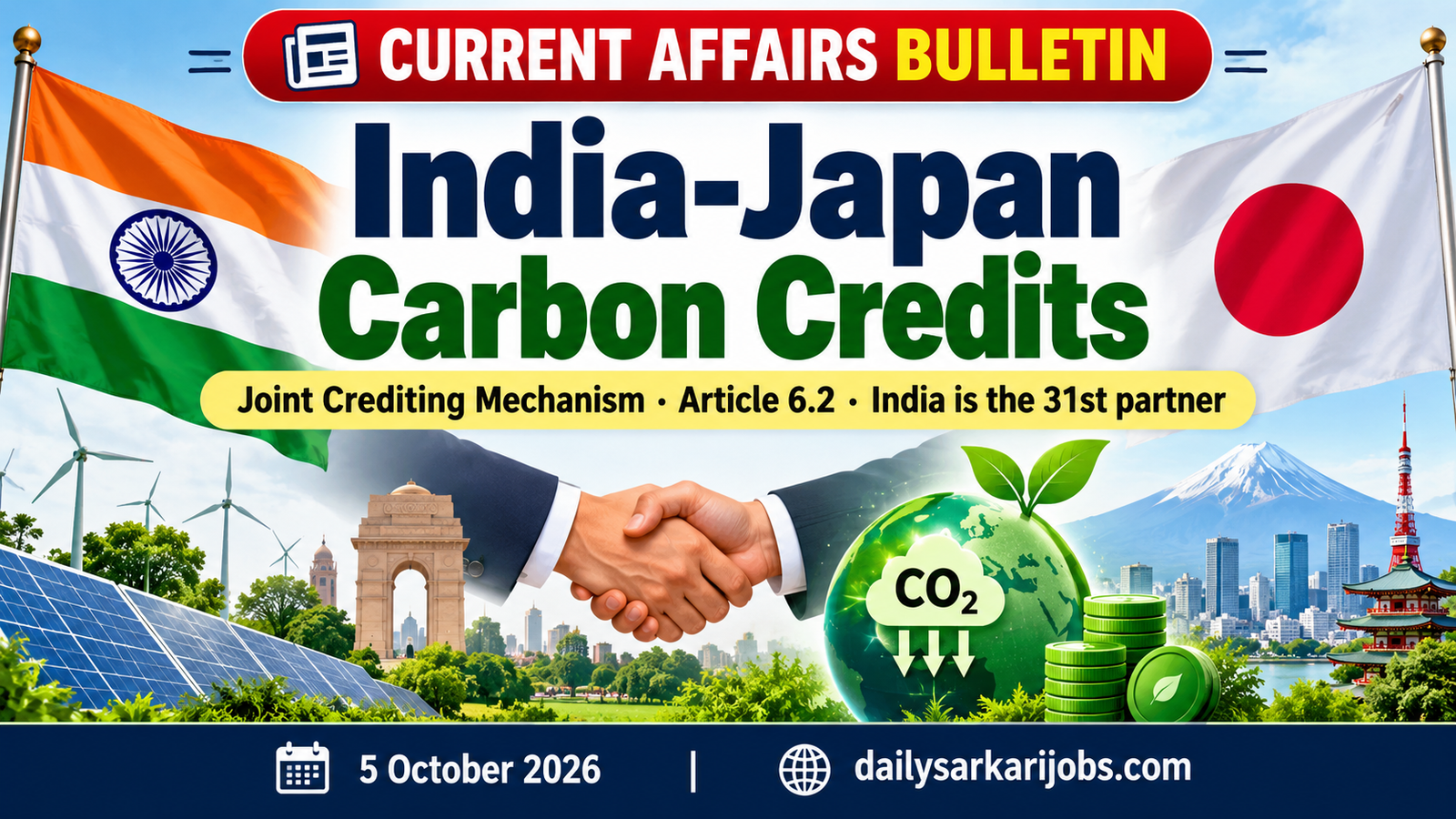
A Japanese company pays for a new, cleaner factory boiler in India. The boiler saves a thousand tonnes of carbon a year. Now answer one question: whose saving is it? India built it and runs it. Japan paid for it. Both countries have promised the world they will cut emissions. If both of them count the same thousand tonnes, the world has been told a lie twice. Everything in this post exists to stop that happening.
On 5 October 2026 the Government announced the launch of the Operational Manual of the India-Japan Joint Crediting Mechanism, the last piece needed before real projects can start. Explained in plain language for SSC, RRB NTPC, State PSC, banking general awareness and UPSC Prelims.
The Hinge: Only One Country May Count It
Every country that signed the Paris Agreement promised a Nationally Determined Contribution — its own pledge of how much it will cut, reported to the United Nations. Call it the country’s homework.
Now suppose Japan pays for a clean project in India. The carbon saved is real; it happened once. But two countries would like to write it on their homework. If India counts it and Japan counts it, the United Nations adds the two up and believes two thousand tonnes were saved when only one thousand were. That is called double counting, and it is the single thing international carbon markets are built to prevent.
The fix has an ugly name and a simple idea: the corresponding adjustment.
| Step | What happens |
|---|---|
| 1 | The project saves 1,000 tonnes in India |
| 2 | India authorises the transfer of that saving to Japan. Once authorised and transferred it is called an ITMO — an Internationally Transferred Mitigation Outcome |
| 3 | Japan writes the 1,000 tonnes on its own homework |
| 4 | India adds the 1,000 tonnes back to its own emissions in its reporting, as if the saving had never happened on its books. That is the corresponding adjustment |
| 5 | The world’s books balance. One saving, counted once |
Keep that as a decoder, because it answers questions you have not seen yet. Whenever two parties share a single environmental gain, ask who is allowed to count it — and what the other one gives up in exchange. It is the same logic as a receipt: the shop records a sale, you record a purchase, and nobody gets to record both.
And it explains the obvious follow-up question. If India has to add the saving back, what does India actually get? Not the carbon. India gets the money and the machine — Japanese capital that bridges the high upfront cost of clean technology, and the technology itself, installed and running in India. India sells the credit and keeps the factory. That is the bargain, and a good answer says it in one line rather than calling the scheme simply good or bad.
What the Joint Crediting Mechanism Is
The JCM is Japan’s own bilateral carbon scheme. Japan funds low-carbon projects in a partner country, the emission reductions are measured and verified, and the resulting credits are shared between the two governments under rules the two of them agree.
India is the 31st country to join it. That number is worth remembering, because it tells you the shape of the thing: this is not a treaty India negotiated, it is a standing Japanese programme India has joined, on terms Japan has already used thirty times.
| When | What happened |
|---|---|
| 7 August 2025 | India and Japan sign the Memorandum of Cooperation on the JCM |
| 8 June 2026 | The two sides adopt the Rules of Implementation |
| 30 September 2026 | The Operational Manual is launched in New Delhi by Japan’s Ambassador and India’s Environment Secretary |
Read those three rows as a lesson in how international agreements actually work. Signing is the beginning, not the end. The Memorandum said the two countries would cooperate; the Rules said how; and the Manual sets out the whole project cycle, from the first Project Idea Note to the issuing of credits. More than a year passed between the handshake and the point where a company could actually apply. This is the same discipline as telling ‘signed’ from ‘in force’, and it is asked.
Article 6, in One Table
Article 6 of the Paris Agreement is the part that lets countries help each other and share the credit. It has three doors, and mixing them up is the commonest mistake in this topic.
| Article | What it allows | Who runs it |
|---|---|---|
| 6.2 | Cooperative approaches — two or more countries agree their own arrangement and transfer ITMOs between them. This is where the JCM sits | The countries themselves. There is no central approval body |
| 6.4 | A single, centralised crediting mechanism — the Paris Agreement Crediting Mechanism, which replaced the Kyoto Protocol’s Clean Development Mechanism | A United Nations supervisory body, with one set of rules for everybody |
| 6.8 | Non-market approaches — finance, capacity building and technology transfer with no credits traded at all | No trading, so no corresponding adjustment is needed |
The quickest way to keep them apart: 6.2 is a private deal between governments, 6.4 is a public market run by the United Nations, and 6.8 is help with no scorekeeping. The 6.4 mechanism became operational in 2026, with its first credits issued in February that year — so both doors are now open at once, which is new.
Why India Is Doing This
India has told the United Nations three things it will do by 2030:
- cut the emission intensity of its GDP by 45 per cent from 2005 levels;
- reach 50 per cent of its electric power capacity from non-fossil sources;
- create an additional carbon sink of 2.5 to 3 billion tonnes of carbon dioxide equivalent through more forest and tree cover.
And beyond that, net zero by 2070.
That first target deserves a second look, because it is the one most often misread. Emission intensity of GDP is emissions divided by output — how much carbon it takes to produce one rupee of economic activity. It is not a promise to emit less in total. A country whose economy is growing fast can cut its intensity sharply while its absolute emissions still rise. Our capsule on India’s GDP growth explains the denominator; this target is the numerator divided by it, and the distinction is exactly the kind of thing a Prelims question is built on.
Where This Fits With Everything Else
- Carbon credits are not only an industrial story. Our post on India’s first soil carbon payments to farmers is the same idea at the other end of the scale — a farmer paid for carbon left in the soil rather than a factory paid for a cleaner boiler.
- Clean energy is not free of cost on the ground. Yesterday’s explainer on the Great Indian Bustard is the other half of this argument: the transmission lines that carry solar power across the Thar are the same lines that kill a critically endangered bird. Money for decarbonisation and the local cost of decarbonisation are two sides of one page.
What Is Likely to Be Asked
- The Joint Crediting Mechanism is Japan’s bilateral carbon crediting scheme. India is its 31st partner country.
- It operates under Article 6.2 of the Paris Agreement.
- Memorandum of Cooperation 7 August 2025; Rules of Implementation 8 June 2026; Operational Manual 30 September 2026.
- ITMO = Internationally Transferred Mitigation Outcome.
- A corresponding adjustment is the host country adding the transferred saving back to its own books, so it is counted once.
- 6.2 bilateral, 6.4 the UN-run Paris Agreement Crediting Mechanism which replaced the CDM, 6.8 non-market.
- India’s 2030 targets: 45 per cent cut in emission intensity of GDP from 2005, 50 per cent non-fossil electric capacity, 2.5 to 3 billion tonnes of extra carbon sink. Net zero by 2070.
- The nodal ministry is the Ministry of Environment, Forest and Climate Change.
Five Practice Questions
Q1. The Joint Crediting Mechanism that India has joined is an initiative of…
(a) The United Nations (b) Japan (c) The European Union (d) The World Bank
Answer: (b) Japan It is a bilateral programme rather than a multilateral one, which is why India is the thirty-first country to sign up to something that already existed rather than a founder of something new. The United Nations runs the other mechanism, under Article 6.4.
Q2. The Joint Crediting Mechanism operates under which Article of the Paris Agreement?
(a) Article 4 (b) Article 6.4 (c) Article 6.2 (d) Article 9
Answer: (c) Article 6.2 Six point four is the centralised, UN-supervised mechanism with one rulebook for everyone. The JCM is a deal between two governments who write their own rules, which is the other kind of cooperation Article 6 allows.
Q3. A corresponding adjustment means that…
(a) The buyer country pays a fee to the United Nations (b) The host country adds the transferred reduction back to its own emissions (c) The credit price is adjusted for inflation (d) The project must be re-verified every year
Answer: (b) The host country adds the transferred reduction back to its own emissions Think about what must happen for one saving to be counted exactly once. If the buyer puts it on their books, somebody has to take it off theirs, and that somebody is the country where the project actually sits.
Q4. India is Japan’s how-manyth partner country under the Joint Crediting Mechanism?
(a) 11th (b) 21st (c) 41st (d) 31st
Answer: (d) 31st Japan has been running this programme with developing countries for over a decade, so the answer is a large number rather than a small one, but the scheme has not yet reached forty partners. India joined in August 2025.
Q5. India’s 2030 target of a 45 per cent reduction relates to…
(a) Total greenhouse gas emissions (b) Emissions from the power sector only (c) The emission intensity of GDP (d) Per capita emissions
Answer: (c) The emission intensity of GDP The promise is about efficiency rather than quantity: how much carbon it takes to produce one rupee of output. A fast-growing economy can meet it while its absolute emissions still rise, and that distinction is the whole point of the question.
Ten more questions on this and today’s Static GK capsule are waiting on our Test Your Knowledge page, with a free PDF. Today’s capsule is on the Attorney-General for India — the one constitutional office the Constitution deliberately refuses to protect.
Sources: the Press Information Bureau release of 5 October 2026 announcing the launch of the India-Japan Joint Crediting Mechanism Operational Manual, which gives the 30 September 2026 launch, the names of the officials, the 7 August 2025 Memorandum of Cooperation and the 8 June 2026 Rules of Implementation; the Press Information Bureau release of August 2025 on the signing of the Memorandum; Japan’s Ministry of the Environment announcement confirming that India is the 31st JCM partner country; and published explanations of Article 6 of the Paris Agreement for ITMOs, corresponding adjustments and the difference between Articles 6.2, 6.4 and 6.8. India’s Nationally Determined Contribution targets are as submitted for 2030, with net zero by 2070; NDC figures are revised from time to time, so recheck them before an exam rather than trusting any note, including this one.