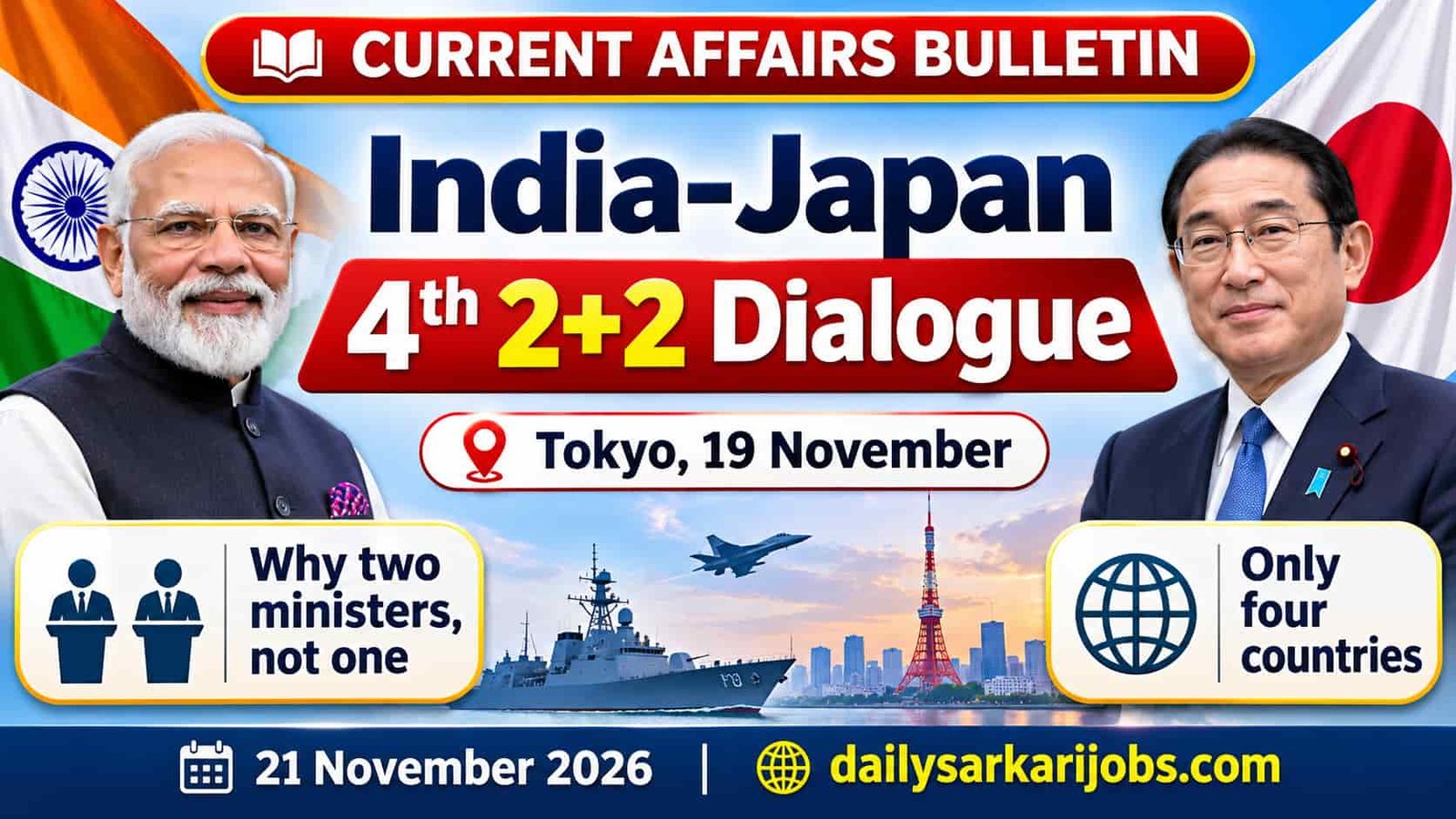
On 19 November 2026, India and Japan held their fourth 2+2 Foreign and Defence Ministerial Dialogue in Tokyo. Before the outcomes, understand why the format exists, because that is what examiners actually ask. A 2+2 puts the foreign minister and the defence minister of each country in the same room at the same time. The reason is simple and slightly ruthless: neither one can promise something the other will not back. A diplomat cannot offer what the military cannot deliver, and a defence ministry cannot sign what foreign policy will not defend. India holds this format with only four countries — and that very short list is the most honest map there is of whom India plans with, rather than merely talks to.
⚡ QUICK FACTS
Dialogue
4th India-Japan 2+2
Date and venue
19 November 2026, Tokyo
India’s side
Rajnath Singh and S. Jaishankar
Japan’s side
Shinjiro Koizumi and Toshimitsu Motegi
Who sat at the table
A 2+2 is co-chaired, not led by one minister. That is part of the design.
Country
Defence Minister
Foreign Minister
India
Rajnath Singh
Dr S. Jaishankar
Japan
Shinjiro Koizumi
Toshimitsu Motegi
The Ministry of Defence announced on 17 November 2026 that Rajnath Singh would visit Japan from 18 to 19 November. The release said the dialogue would review the full spectrum of bilateral strategic and defence cooperation and reaffirm a free, open, inclusive and rule-based Indo-Pacific. It also noted that this was the third meeting between the two defence ministers in 2026 alone — after talks in New Delhi in August and on the margins of the ASEAN Defence Ministers’ Meeting-Plus in Cebu in October. For the regional setting, see our explainer on the ASEAN-India Summit 2026.
What a 2+2 actually is
The name is arithmetic, not jargon: two ministers from each side equals 2+2. In an ordinary bilateral meeting, foreign ministers meet foreign ministers and defence ministers meet defence ministers, on separate days and often in separate countries. The result is familiar to anyone who has worked in a large organisation: two departments agree to slightly different things.
The 2+2 removes that gap. Because all four ministers hear the same sentence at the same moment, the commitment that emerges is one commitment, not two. That is why countries reserve the format for partnerships they take seriously — it is expensive in ministerial time and it removes wriggle room. Treat the format itself as the answer when a question asks about the significance of a 2+2.
The four countries India does this with
This is the single most examinable table on the topic.
Country
First 2+2 held
Where
United States
6 September 2018
New Delhi
Japan
30 November 2019
New Delhi
Australia
September 2021
New Delhi
Russia
6 December 2021
New Delhi
Two traps live in that table. First, every one of these dialogues began in New Delhi. Second, the United Kingdom is not on the list at ministerial level — India and the UK held an inaugural Foreign and Defence Dialogue on 16 October 2023, but at official level, with senior civil servants rather than ministers in the chair. A question that slips the UK into the ministerial list is wrong, and a question that says India has no 2+2 with the UK at all is also wrong.
Note the company Japan keeps there. The same four names turn up across India’s defence architecture, and three of them are Quad members. For how India’s own forces are organised to use these partnerships, see the structure of the Indian armed forces.
What came out of Tokyo
Press reporting on 19 and 20 November, including The Hindu, described a set of outcomes. Treat these as reported outcomes rather than treaty text.
Indian firing ranges opened to Japan. A Letter of Intent was welcomed allowing Japan’s Self-Defense Forces to use Indian ranges for live-fire training, including surface-to-ship missile firing. Reported as a first for the two countries.
UNICORN. The two sides looked to an early arrangement on the Unified Complex Radio Antenna, a Japanese integrated mast that combines a warship’s many aerials into one stealthy structure, with Acceptance of Necessity expected by February 2027.
Design with Japan, Make in India. The phrase used for the defence-industry track — Japanese design paired with Indian manufacturing.
Maritime security. Mine countermeasures, possible joint work in naval shipbuilding and design, closer information-sharing between the Japan Maritime Self-Defense Force and the Indian Navy, and wider coast guard cooperation.
Technology. India’s DRDO and Japan’s ATLA, its defence procurement and technology agency, to take forward advanced missile and defence technologies.
The manufacturing half of that list connects directly to yesterday’s capsule on India’s defence production and the DPSUs — a foreign partner is only useful to Indian industry if Indian industry can absorb the work, which is exactly what the indigenisation lists and the corridors exist to make possible. See also twelve years of Make in India.
Where this sits in the bigger machine
Here is the part that turns a news item into understanding. This dialogue did not simply happen — it was scheduled by a summit. When Japanese Prime Minister Takaichi Sanae visited India from 1 to 3 July 2026 for the 16th India-Japan Annual Summit, the joint statement recorded that the fourth 2+2 would be held in Tokyo by the end of the year.
That is the architecture in one line: the summit sets the tasks, the 2+2 carries them out, and the working groups do the paperwork. Leaders decide direction once a year; ministers convert direction into commitments; officials convert commitments into documents. If you can describe that ladder, you can answer almost any question about any bilateral relationship, not just this one.
Year
Agreement or step
2008
Joint Declaration on Security Cooperation
2014
MoU on Defence Cooperation and Exchanges
2015
Information Protection Agreement
2020
Reciprocal Provision of Supplies and Services Agreement
2024
Co-development of the UNICORN naval mast
2026
4th 2+2 in Tokyo, 19 November
The relationship is formally a Special Strategic and Global Partnership. The July 2026 summit also carried a 10 trillion yen Japanese investment target set at the previous summit, joint statements on economic security, energy resilience and artificial intelligence, and a goal of a 7,000 km high-speed rail network.
Exam Alert
2+2 means foreign minister plus defence minister, from each side. Not two countries, not two days — two ministers each.
India has ministerial 2+2 dialogues with four countries: the United States, Japan, Australia and Russia. The UK dialogue is at official level, not ministerial.
First rounds: US 2018, Japan 2019, Australia 2021, Russia 2021 — and all four were first held in New Delhi.
The Tokyo round was the fourth India-Japan 2+2, held on 19 November 2026; the first was in New Delhi on 30 November 2019.
UNICORN is the Unified Complex Radio Antenna, an integrated warship mast; ATLA is Japan’s defence technology agency, the counterpart to India’s DRDO.
India-Japan ties are a Special Strategic and Global Partnership; the 16th Annual Summit was held in India from 1 to 3 July 2026.
The 2020 agreement with Japan is the Reciprocal Provision of Supplies and Services Agreement — a logistics-sharing pact, often confused with the India-US LEMOA.
Did You Know?
The dialogue was ordered four months in advance, in writing. The joint statement of the July 2026 summit recorded that the fourth 2+2 would be held in Tokyo before the end of the year — so the November meeting was a scheduled deliverable, not a reaction to events.
UNICORN hides a warship by tidying it up. A modern warship bristles with separate aerials, and every one of them reflects radar. Folding them into a single smooth mast makes the ship harder to see — stealth by subtraction.
The two defence ministers met three times in 2026 — New Delhi in August, Cebu in October and Tokyo in November. Frequency is itself a signal in diplomacy.
30-Second Quick Revision
What: 4th India-Japan 2+2 Foreign and Defence Ministerial Dialogue.
When and where: 19 November 2026, Tokyo.
Who: Rajnath Singh and S. Jaishankar; Shinjiro Koizumi and Toshimitsu Motegi.
Why the format: both ministers in one room, so words and weapons say the same thing.
The list: India holds ministerial 2+2s with the US, Japan, Australia and Russia only.
Reported outcomes: Japanese live-fire training on Indian ranges, UNICORN mast progress, DRDO-ATLA technology work.
Test Your Knowledge
Q1. In a 2+2 ministerial dialogue, which two ministers represent each country? (a) Finance and commerce (b) Foreign affairs and defence (c) Home and defence (d) Foreign affairs and commerce Answer: (b) Foreign affairs and defence Having both in the room means a diplomatic promise and a military commitment cannot drift apart.
Q2. The 4th India-Japan 2+2 Ministerial Dialogue was held in (a) New Delhi (b) Osaka (c) Tokyo (d) Yokosuka Answer: (c) Tokyo It took place on 19 November 2026; the first round was held in New Delhi in November 2019.
Q3. India holds ministerial-level 2+2 dialogues with which group of countries? (a) United States, Japan, France and Russia (b) United States, Japan, Australia and the United Kingdom (c) Japan, Australia, Russia and Germany (d) United States, Japan, Australia and Russia Answer: (d) United States, Japan, Australia and Russia The India-UK Foreign and Defence Dialogue, begun in October 2023, is at official level rather than ministerial.
Q4. UNICORN, discussed at the Tokyo dialogue, is (a) A joint military exercise (b) An integrated warship antenna mast (c) A Japanese investment fund (d) A submarine class Answer: (b) An integrated warship antenna mast Its full form is Unified Complex Radio Antenna; combining separate aerials into one mast reduces a ship’s radar signature.
Q5. The 16th India-Japan Annual Summit, held from 1 to 3 July 2026, saw the visit to India of (a) Fumio Kishida (b) Shinjiro Koizumi (c) Toshimitsu Motegi (d) Takaichi Sanae Answer: (d) Takaichi Sanae That summit’s joint statement is also where the fourth 2+2 in Tokyo was scheduled.
Want the full ten-question set as a PDF? Head to our Test Your Knowledge page.
Verified on 21 November 2026 against the Ministry of Defence release of 17 November 2026 on the Raksha Mantri’s Japan visit, the Press Information Bureau text of the 16th India-Japan Annual Summit Joint Statement of 2 July 2026, and press reporting of the Tokyo dialogue on 19 and 20 November 2026.