
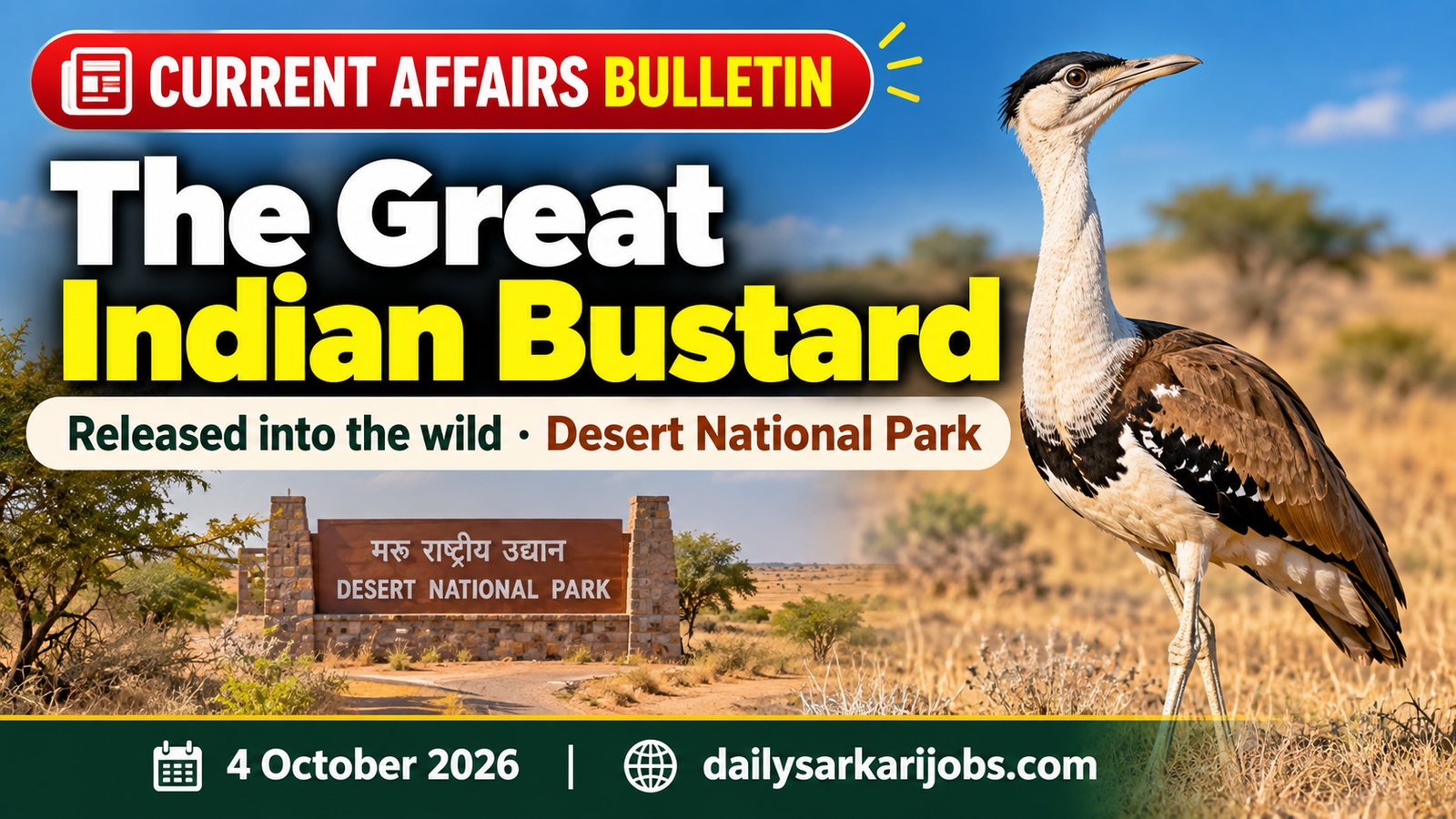
The Great Indian Bustard cannot see what is killing it. Its eyes sit on the sides of its head, not the front — perfect for a bird that must watch a whole flat horizon for predators, and useless for spotting a power line straight ahead. At around 15 kilograms it is also far too heavy to swerve at the last second. That single piece of anatomy explains the court cases, the breeding centres and today’s news.
On 4 October 2026 two captive-bred Great Indian Bustards were released into the wild at Desert National Park, Jaisalmer — the first birds to leave the breeding programme after nearly ten years of work. Explained in plain language for SSC, RRB NTPC, State PSC, banking general awareness and UPSC Prelims.
The Hinge: What a Bird Was Built For
Start with the eyes, because everything else follows from them.
A bustard lives on open grassland and dry scrub. It does not perch, it does not weave through trees, and it has no predator above it to dodge. What it needs is to see sideways and behind — to catch a fox or a dog moving in the grass while its head is down feeding. So evolution put its eyes on the sides of its skull, giving it an enormous field of view all around and very little straight in front.
For a few million years that was the right design. Then people strung cables across the same grassland.
The Ministry of Power told the Supreme Court exactly this in 2021: the bird has no useful frontal vision, so it does not detect a power line ahead of it until it is too close, and being heavy it cannot change course in the distance it has left. Low-voltage lines kill it by electrocution and high-voltage lines kill it by collision. A study cited to the Court estimated around 18 bustards a year lost to transmission lines.
Keep this as a device, because it works far beyond one bird. Ask what a species was built for, and you can usually predict what will kill it when the world changes. The trait that made the bustard fit for open grassland is the exact trait that fails the moment the grassland has wires over it. The same reasoning explains why slow-breeding animals collapse under hunting pressure, and why specialists die out faster than generalists.
What Actually Happened Today
| What | Detail |
|---|---|
| The release | Two male Great Indian Bustards, released into the wild at Desert National Park, Jaisalmer |
| Who released them | The Union Minister for Environment, Forest and Climate Change, Bhupender Yadav, with Rajasthan’s Forest and Environment Minister, Sanjay Sharma |
| Where they came from | The conservation breeding centres at Sam and Ramdevra in Rajasthan |
| Why it matters | These are the first birds to go from the breeding programme back into the wild, after nearly a decade of work |
The programme behind it is run by the Ministry of Environment, Forest and Climate Change with the Rajasthan Forest Department and the Wildlife Institute of India, with technical support from the International Fund for Houbara Conservation and money from National CAMPA.
CAMPA is worth a line, because it is asked. It stands for the Compensatory Afforestation Fund Management and Planning Authority, and the fund it manages is money paid by anybody who takes forest land for a road, a mine or a factory — paid so that an equivalent forest can be grown somewhere else. So the bustard programme is partly paid for by the very development that shrank its habitat.
The Numbers at the Breeding Centres
| Figure | What it means |
|---|---|
| 97 birds | The total held at Sam and Ramdevra |
| 40 and 57 | Forty hatched from eggs collected in the wild; fifty-seven bred in captivity |
| 86 and 11 | Eighty-six kept for breeding; eleven earmarked for release |
| 24 and 29 | Live chicks produced in 2025 and in 2026 |
| ₹9.25 crore | Cost of the Rewilding Aviary at Ramdevra, 160 × 64 × 14 metres, where a captive bird builds flight muscle and learns to behave like a wild one before release |
Read the last row carefully, because it carries the second idea in this story. Breeding a bird is not the same as saving a species. A chick raised behind wire has never flown a kilometre, never found its own food and never seen a predator. The aviary exists to close that gap, and the release of two males is the first real test of whether it worked. Ninety-seven birds in captivity is an insurance policy. Birds breeding in the open is a recovery. Those are different claims, and a careful answer says which one today’s news is.
Where the Bird Still Lives
- Fewer than 150 Great Indian Bustards are thought to survive in the wild.
- More than 90 per cent of them are in the Thar Desert of Rajasthan, and the last viable population is around Desert National Park and the Pokhran Field Firing Range in Jaisalmer.
- Small, scattered birds remain in Gujarat (the Kutch Bustard Sanctuary), and historically in Maharashtra, Madhya Pradesh, Karnataka and Andhra Pradesh.
- The bird has vanished from roughly 90 per cent of its historical range.
That concentration is itself a danger and a useful exam point: our capsule on National Parks and Protected Areas makes the general version of it. A species squeezed into one landscape can be wiped out by one bad year — a drought, a disease, a new road — no matter how well that landscape is protected.
The Court Case You Will Be Asked About
The bustard has produced one of the most important environmental judgments of the decade, and the reason is a genuine clash between two good things.
| When | What the Supreme Court did |
|---|---|
| 19 April 2021 | In M. K. Ranjitsinh v. Union of India, directed that power lines across roughly 99,000 square kilometres of bustard habitat in Rajasthan and Gujarat be put underground or fitted with bird diverters. Low-voltage lines were to go underground; high-voltage lines were to be assessed case by case by a committee |
| 21 March 2024 | Modified that order. The Court accepted that undergrounding high-voltage lines across a desert on that scale was extremely costly and difficult, and that blocking transmission would hold back India’s solar capacity and push it back towards coal. It set up a fresh expert committee instead |
Now the part that makes it a polity question as much as an environment one. In the 2024 judgment, the bench of Chief Justice D. Y. Chandrachud, Justice J. B. Pardiwala and Justice Manoj Misra recognised a right to be free from the adverse effects of climate change, drawn from Article 14 (equality) and Article 21 (life and personal liberty).
That is the first time an Indian court located climate harm inside the Fundamental Rights chapter, and it belongs with everything in our Fundamental Rights capsule about Article 21 being read widely — the same article that has already been held to contain a right to a clean environment, to privacy and to livelihood. Article 21 keeps growing, and this is the newest room added to it.
There is one more thing worth noticing, and it is the kind of observation that lifts a descriptive answer. The Court used a climate right to justify cutting back a wildlife protection. Solar power in the Thar serves the climate; the 2021 order served the bustard; and the Court decided the first mattered more. Environmental cases are not always environment against development. Sometimes they are environment against environment, and the Court has to choose. Our Supreme Court capsule explains how a court can revisit its own order to do that.
The Other Threats, Briefly
- Wind turbines, for the same reason as power lines.
- Feral dogs, which take eggs and chicks. The bustard nests on bare ground and lays a single egg, so one lost nest is an entire year lost.
- Pesticides in the fields that have replaced grassland.
- Prosopis juliflora, an invasive thorny shrub that turns open grassland into scrub the bird will not use.
- Habitat fragmentation from roads, canals and solar parks.
Notice how many of those are not hunting. This is a species being lost to infrastructure rather than to poachers, which is why the remedies are court orders about cables rather than anti-poaching patrols.
What Is Likely to Be Asked
- Ardeotis nigriceps; locally Godawan; state bird of Rajasthan.
- Critically Endangered on the IUCN Red List; Schedule I of the Wild Life (Protection) Act, 1972.
- Fewer than 150 in the wild; over 90 per cent in the Thar Desert.
- Last viable population: Desert National Park and the Pokhran Field Firing Range, Jaisalmer. Also the Kutch Bustard Sanctuary, Gujarat.
- Breeding centres at Sam and Ramdevra, Rajasthan; 97 birds held; Rewilding Aviary at Ramdevra.
- Run by MoEFCC with the Rajasthan Forest Department and the Wildlife Institute of India; funded by National CAMPA.
- M. K. Ranjitsinh v. Union of India: 2021 order on undergrounding and bird diverters; 2024 judgment modifying it and recognising a right against the adverse effects of climate change under Articles 14 and 21.
- The bird dies on power lines because it has no frontal vision and is too heavy to turn.
Five Practice Questions
Q1. The Great Indian Bustard is the state bird of…
(a) Gujarat (b) Rajasthan (c) Madhya Pradesh (d) Karnataka
Answer: (b) Rajasthan All four States have held bustards at some point and three of them still have scattered birds. The one you want is where more than ninety per cent of the surviving population now lives, in and around Desert National Park.
Q2. Why is the Great Indian Bustard particularly vulnerable to power lines?
(a) It flies only at night (b) It is attracted to the electric field (c) It has poor frontal vision and is too heavy to swerve (d) It nests on pylons
Answer: (c) It has poor frontal vision and is too heavy to swerve Think about where the eyes of a grassland bird would usefully sit: on the sides of the head, watching for predators across a flat horizon. That design leaves almost nothing straight ahead, and a 15-kilogram bird cannot correct its course in a few metres.
Q3. The conservation breeding centres for the Great Indian Bustard are at…
(a) Bharatpur and Ranthambhore (b) Sam and Ramdevra (c) Kutch and Naliya (d) Rollapadu and Nannaj
Answer: (b) Sam and Ramdevra Three of these options are real bustard or bird sites in India, which is what makes the question hard. The two breeding centres are both in Jaisalmer district, close to the last viable wild population.
Q4. In M. K. Ranjitsinh v. Union of India (2024), the Supreme Court recognised a right to be free from the adverse effects of climate change under…
(a) Articles 19 and 21 (b) Articles 21 and 48A (c) Articles 14 and 21 (d) Articles 48A and 51A(g)
Answer: (c) Articles 14 and 21 Forty-eight A and 51A(g) are the environmental Directive Principle and the environmental Fundamental Duty, and neither is enforceable in a court by itself, which is exactly why the Court had to reach for two Fundamental Rights instead. One of them is equality and the other is life.
Q5. The Great Indian Bustard’s status on the IUCN Red List is…
(a) Vulnerable (b) Endangered (c) Near Threatened (d) Critically Endangered
Answer: (d) Critically Endangered With fewer than 150 birds left and a range that has shrunk by about ninety per cent, no lower category would fit. This is the highest level of risk before a species is recorded as extinct in the wild.
Ten more questions on this and today’s Static GK capsule are waiting on our Test Your Knowledge page, with a free PDF. Today’s capsule is on inter-State river water disputes — another fight over a scarce resource in the same dry part of India, settled by a very different machinery.
Sources: the Press Information Bureau releases of 3 and 4 October 2026 on the release of captive-bred Great Indian Bustards at Desert National Park, which give the number of birds released, the breeding-centre figures, the Rewilding Aviary dimensions and cost, and the partner organisations; the Supreme Court’s judgment of 19 April 2021 in M. K. Ranjitsinh v. Union of India for the Ministry of Power’s explanation of why the bird collides with cables and for the directions on undergrounding and bird diverters; published analysis of the judgment of 21 March 2024 for the modification, the expert committee and the climate right under Articles 14 and 21; and published conservation accounts for the population estimate, the 18-birds-a-year collision figure and the list of other threats. Population figures for a critically endangered species move; recheck them before an exam rather than trusting any note, including this one.