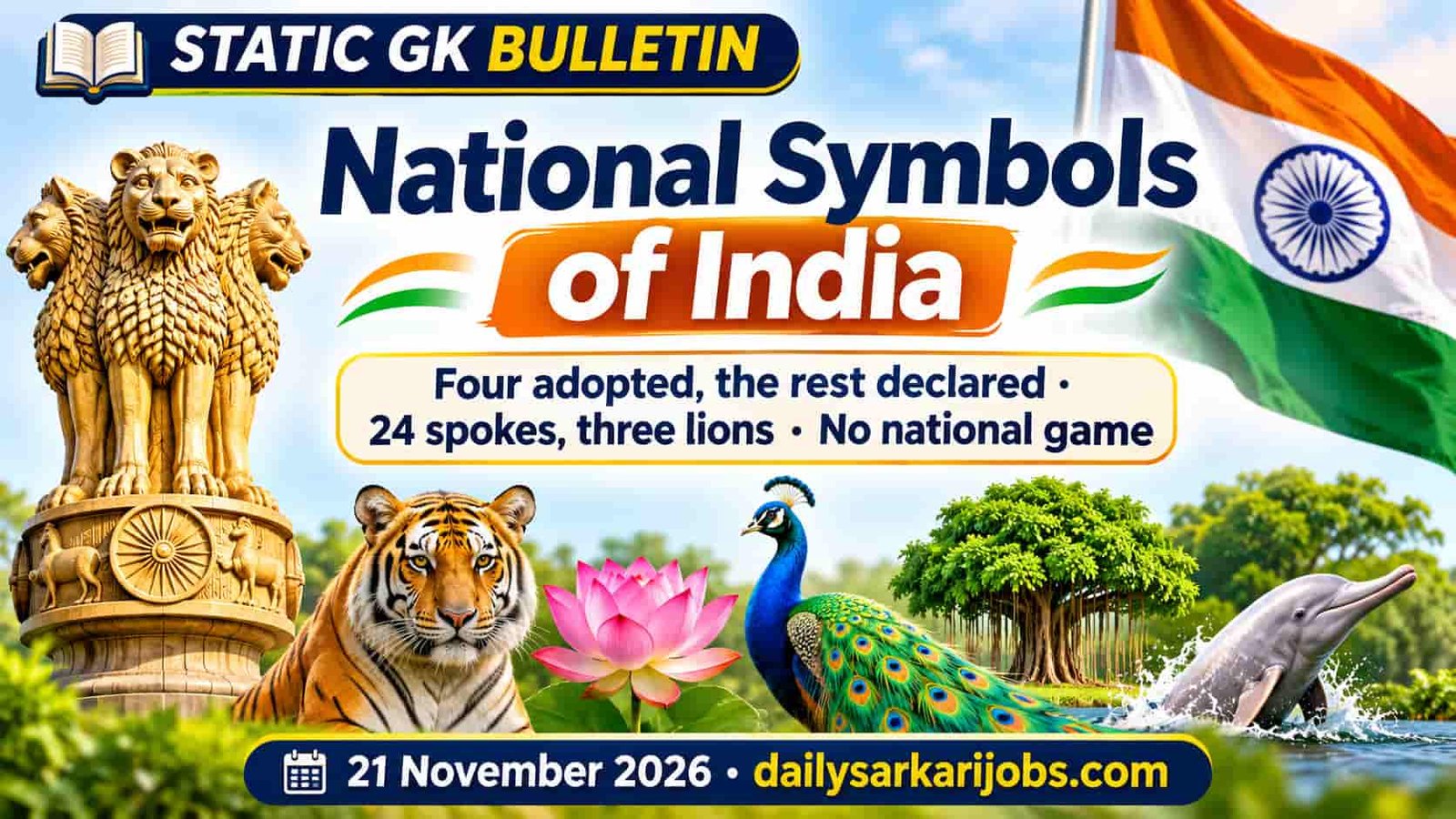
Here is the fact that organises this entire topic, and almost no list mentions it. Only four of India’s national symbols were adopted by a deliberate decision of the Constituent Assembly — the flag, the state emblem, the national anthem and the national song. Every other item on the familiar list was designated, declared or announced by a government decision at some later date. And one of the most famous entries of all turns out not to exist: India has no officially declared national game. Learn the list as two lists — the four with constitutional pedigree, and the rest — and the dates stop sliding around in your memory.
⚡ QUICK FACTS
Adopted by the Assembly
Flag, emblem, anthem, song
National animal
Bengal tiger, from 1973
National calendar
Saka era, 22 March 1957
National game
None officially declared
List one: the four with a decision behind them
Symbol
Adopted
By whom
National Flag
22 July 1947
Constituent Assembly
State Emblem
26 January 1950
Republic; Dominion version 1947
National Anthem
24 January 1950
Constituent Assembly
National Song
24 January 1950
Constituent Assembly
Notice the gap. The flag came three weeks before Independence; the anthem and song came two days before the Constitution. The Assembly settled the symbols of the state at the same time as it settled the state.
The National Flag
Adopted by the Constituent Assembly on 22 July 1947 and unfurled on 15 August 1947. Its design grew out of the Swaraj flag associated with Pingali Venkayya. The horizontal tricolour carries deep saffron at the top, white in the middle and India green at the bottom, with the Ashoka Chakra in navy blue at the centre of the white band.
The single most-asked flag fact is the wheel. It is the Dharma Chakra of Ashoka, with 24 spokes, and it replaced the spinning wheel of the earlier Swaraj flag. For the movement that produced that flag, see our capsule on the Indian National Movement.
The State Emblem
The emblem is an adaptation of the Lion Capital of Ashoka, a sculpture of about 280 BCE that stood at Sarnath, where the Buddha first taught the Dharma. The original has four Asiatic lions standing back to back; in the emblem, only three are visible, because the fourth is hidden behind them.
Feature
Detail
Source
Lion Capital of Ashoka at Sarnath, c. 280 BCE
Lions
Four in the original, three visible in the emblem
Wheel
Dharma Chakra with 24 spokes
Animals shown
Bull on the right, galloping horse on the left
Motto
Satyameva Jayate, Truth Alone Triumphs
Motto source
Mundaka Upanishad, in Devanagari script
Protecting law
Prohibition of Improper Use Act, 2005
Two traps sit in that table. First, the motto is not on the original sculpture — Ashoka’s capital carries no inscription of Satyameva Jayate; the words were added below the abacus when the emblem was designed. Second, the original frieze showed four animals — lion, horse, bull and elephant — but the elephant does not appear on the emblem, and nor does the bell-shaped lotus beneath. Ashoka’s pillars are covered in our capsule on the Mauryan Empire.
The National Anthem and the National Song
These two are confused more often than any other pair in general knowledge, so hold them side by side.
National Anthem
National Song
Name
Jana Gana Mana
Vande Mataram
Written by
Rabindranath Tagore
Bankim Chandra Chattopadhyay
Source
Composed 11 December 1911
From the novel Anandamath, 1882
First sung
27 December 1911, Calcutta
1896, Calcutta Congress session
Adopted
24 January 1950
24 January 1950
How much is official
First stanza of five
First two of six verses
The anthem’s full rendition takes about 52 seconds, and a short version of the first and last lines takes about 20 seconds. The original poem was composed in Sadhu Bhasha, a Sanskritised literary register of Bengali, which is why the words sound Sanskrit to many ears without being Sanskrit.
On that same day, Rajendra Prasad, presiding over the Constituent Assembly, made the statement every examiner loves: Jana Gana Mana is the national anthem, and Vande Mataram shall have equal status with it. So the song is not a lesser anthem — it is formally its equal in honour, which is why both appear in official ceremonies. The Union Cabinet approved adding Vande Mataram to the Prevention of Insults to National Honour Act, 1971 in May 2026.
The trap: both were adopted on the same day, 24 January 1950. A question offering 26 January 1950 for either is wrong, and so is one that puts them on different dates.
List two: the symbols that were simply declared
Symbol
Name
Since
National Animal
Bengal tiger
April 1973
National Bird
Indian peafowl
February 1963
National Tree
Indian banyan
1950
National Flower
Lotus
1950
National Fruit
Mango
1950
National River
Ganga
November 2008
National Aquatic Animal
Ganges river dolphin
May 2010
National Heritage Animal
Indian elephant
22 October 2010
National Calendar
Saka era calendar
22 March 1957
Currency symbol
Rupee sign
July 2010
The tiger has the best story. It was chosen at a meeting of the National Board for Wildlife in 1972 and officially adopted in April 1973 — the same moment Project Tiger began — and it was chosen over the Asiatic lion. The reasoning was reach: the lion survives in one forest in Gujarat, while the tiger is found across the country. For where these animals actually live, see national parks and protected areas and India’s four biodiversity hotspots.
The Ganges river dolphin is the aquatic animal and the elephant the heritage animal — a separate category that trips people who assume there is only one animal slot. The Ganga was declared the national river in November 2008; see our capsule on rivers, dams and lakes and on India’s Ramsar sites.
The calendar nobody remembers
India has a national calendar based on the Saka era, adopted on 22 March 1957. It runs alongside the Gregorian calendar in the Gazette of India, in All India Radio news bulletins and in government communications. Its first month is Chaitra, which normally begins on 22 March, and on a leap year on 21 March. This is a reliable one-mark question precisely because so few candidates prepare it.
What India does not have
India has no officially declared national game. A Right to Information reply from the Ministry of Youth Affairs and Sports in 2012 confirmed that no sport has been given that status. Field hockey has been listed as the national game on government websites and in school textbooks for decades, which is exactly why the question is set. If an option says hockey is the officially declared national game, it is wrong; if a statement says hockey is commonly referred to as the national game, it is right. Read the wording, not the sport.
A second category worth knowing: the National Pledge, directed to be recited in schools from 26 January 1965, was originally written in Telugu by Pydimarri Venkata Subba Rao in 1962.
Exam Alert
Flag: 22 July 1947. Anthem and song: both on 24 January 1950. Emblem: 26 January 1950. These four dates carry most of the marks.
The Ashoka Chakra has 24 spokes, and so does the wheel on the state emblem.
Three lions are visible, four exist. The elephant from the original frieze is not on the emblem.
Satyameva Jayate comes from the Mundaka Upanishad and is written in Devanagari; the governing law is the State Emblem of India (Prohibition of Improper Use) Act, 2005.
Only the first stanza of Jana Gana Mana, of five, is the anthem; only the first two verses, of six, of Vande Mataram are the national song.
Rajendra Prasad told the Constituent Assembly on 24 January 1950 that Vande Mataram shall have equal status with the anthem — a very frequent question.
Tiger from 1973, over the Asiatic lion; peacock from 1963; Ganga from 2008; dolphin 2010; elephant as heritage animal, 22 October 2010.
National calendar: Saka era, 22 March 1957, first month Chaitra.
There is no official national game — confirmed by a 2012 RTI reply.
Did You Know?
One man links both songs. Rabindranath Tagore wrote Jana Gana Mana in 1911 — and it was Tagore who first sang Vande Mataram at a Congress session, in Calcutta in 1896. The anthem’s author was the national song’s first singer.
The national animal changed. The Asiatic lion was passed over in favour of the Bengal tiger in the early 1970s, largely because the lion survives in only one part of the country.
Satyameva Jayate was never carved by Ashoka. The words were added below the sculpture when the emblem was designed; the original Lion Capital carries no such inscription.
The elephant has its own slot. It is the national heritage animal, declared on 22 October 2010 — a separate category from the national animal.
30-Second Quick Revision
The hinge: four symbols were adopted by the Constituent Assembly; the rest were declared later by government decision.
The four: flag 22 July 1947, emblem 26 January 1950, anthem and song both 24 January 1950.
Emblem: Lion Capital of Ashoka at Sarnath, four lions with three visible, 24-spoke wheel, Satyameva Jayate from the Mundaka Upanishad.
Anthem and song: Tagore’s Jana Gana Mana, first stanza, about 52 seconds; Bankim Chandra’s Vande Mataram from Anandamath, first two verses.
Living symbols: tiger 1973, peacock 1963, banyan, lotus, mango; Ganga 2008, dolphin 2010, elephant 2010.
The trap: no officially declared national game, per a 2012 RTI reply.
Test Your Knowledge
Q1. On which date did the Constituent Assembly adopt the National Flag of India? (a) 15 August 1947 (b) 22 July 1947 (c) 26 January 1950 (d) 26 November 1949 Answer: (b) 22 July 1947 It was formally unfurled on 15 August 1947, which is the date most often confused with its adoption.
Q2. Jana Gana Mana and Vande Mataram were adopted on (a) Different dates in 1950 (b) 26 January 1950 (c) 24 January 1950 (d) 15 August 1947 Answer: (c) 24 January 1950 Both were adopted on the same day, two days before the Constitution came into effect.
Q3. The motto Satyameva Jayate is taken from the (a) Rigveda (b) Bhagavad Gita (c) Arthashastra (d) Mundaka Upanishad Answer: (d) Mundaka Upanishad It is inscribed in Devanagari script below the abacus and does not appear on Ashoka’s original sculpture.
Q4. Which animal from the original Lion Capital frieze is absent from the State Emblem? (a) The elephant (b) The bull (c) The horse (d) The lion Answer: (a) The elephant The emblem shows a bull on the right and a galloping horse on the left; the elephant and the bell-shaped lotus were left out.
Q5. Which sport is India’s officially declared national game? (a) Field hockey (b) Kabaddi (c) India has no officially declared national game (d) Cricket Answer: (c) India has no officially declared national game A 2012 Right to Information reply from the Ministry of Youth Affairs and Sports confirmed that no sport holds that status.
Want the full ten-question set as a PDF? Head to our Test Your Knowledge page.
Verified on 21 November 2026 against reference material on India’s national symbols, the State Emblem of India and the national anthem, including the adoption dates recorded for each symbol and the 2012 Right to Information reply of the Ministry of Youth Affairs and Sports on the national game.