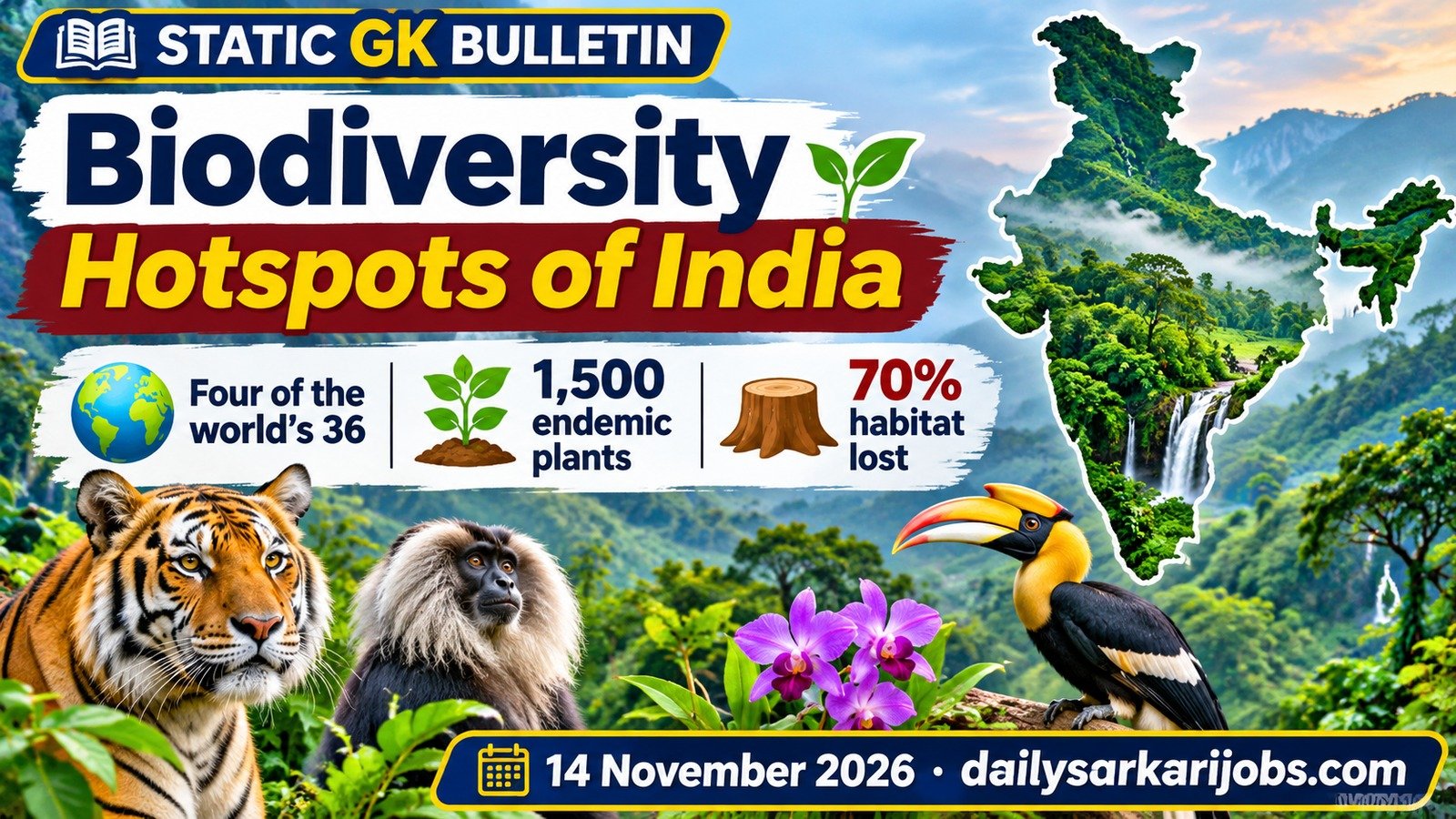
A biodiversity hotspot sounds like a compliment.It is half a compliment and half an alarm, and the definition says so in plain numbers.
A Hotspot Is Defined by What It Has Lost, Not Only by What It Has
To qualify, a region must meet two conditions, and both must be true.
Criterion
The threshold
What it measures
Irreplaceability
At least 1,500 endemic vascular plant species — about 0.5 per cent of the world’s total
How special it is
Threat
At least 70 per cent of its original natural vegetation lost
How damaged it is
Read the second row again.A region cannot become a hotspot by being rich and well-preserved. If a forest is full of species found nowhere else and is still largely intact, it does not qualify. Seventy per cent of it has to be gone first.
That is the hinge, and it explains the whole concept.The list was never meant to celebrate the world’s best places. It was built to answer a harder question: if conservation money is limited, where will one rupee save the most species that are about to disappear? The answer is wherever irreplaceability and danger meet.A hotspot is a triage list.
Jargon, Defined Once
Endemic means found naturally in one place and nowhere else on Earth. Not merely rare — exclusive.
Vascular plants are plants with internal tubes for carrying water and food — trees, shrubs, grasses, ferns. Mosses and algae are excluded, which is why the criterion says vascular.
Original natural vegetation is what grew there before large-scale human clearing.
Irreplaceability is how much would be lost for ever if a place were destroyed; threat is how likely that is to happen. A hotspot scores high on both.
Conservation International is the organisation that maintains and expanded the list. It is not a United Nations body.
India’s Four Hotspots
Hotspot
Where it runs in India
Worth noting
The Himalaya
Jammu & Kashmir, Ladakh, Himachal Pradesh, Uttarakhand, Sikkim, Arunachal Pradesh and northern West Bengal
Extends well beyond India, into Nepal and Bhutan
Indo-Burma
Assam, Meghalaya, Manipur, Mizoram, Nagaland, Tripura, parts of Arunachal Pradesh — and the Andaman Islands
One of the largest hotspots in the world
The Western Ghats and Sri Lanka
Maharashtra, Goa, Karnataka, Kerala and Tamil Nadu
Crosses an international border — the name itself tells you so
Sundaland
The Nicobar Islands only
Mostly Indonesia and Malaysia; India’s share is small
Two of the four are not Indian hotspots at all, strictly speaking.The Himalaya runs across several countries, the Western Ghats hotspot is shared with Sri Lanka, and Sundaland is overwhelmingly Southeast Asian. India has four hotspots within its territory; it does not own any of them outright.
Exam Alert: Five Traps
Both criteria must be met.Endemic plants alone is not enough; habitat loss alone is not enough. A question offering only one of them is wrong.
The threshold is 1,500 endemic VASCULAR PLANTS, not animals, not total species.
Norman Myers in 1988; Conservation International maintains the list.Two separate facts, often merged.
India has four of the world’s 36.Four and thirty-six.
The Andaman Islands and the Nicobar Islands are in DIFFERENT hotspots.Andaman is Indo-Burma; Nicobar is Sundaland. This is the sharpest trap on the topic.
Did You Know: One Union Territory Sits in Two Different Hotspots
The Andaman and Nicobar Islands are a single union territory with one administration, one capital and one name — and they belong to two separate biodiversity hotspots.The Andamans fall under Indo-Burma. The Nicobars fall under Sundaland.
The reason is older than any map India has drawn.The two groups sit on different undersea shelves, and the deep channel between them has kept their plants and animals apart for a very long time. The species on either side are each other’s distant relatives rather than neighbours.The administrative border runs around both; the biological border runs between them.
Today’s Current Affairs explainer is on India’s fall to 28th in the Climate Change Performance Index, and the two share a quality worth noticing. Neither measure is a prize. The index leaves its first three places empty because no country has earned them; a hotspot is a status a region reaches partly by losing most of itself. Both were designed by people who wanted the number to be uncomfortable.
Practice Questions
Q1. To qualify as a biodiversity hotspot, a region must have at least (a) 500 endemic vascular plant species (b) 1,000 endemic animal species (c) 1,500 endemic vascular plant species (d) 2,500 endemic species of any kind Answer: (c) 1,500 endemic vascular plant species That is roughly 0.5 per cent of the world total, and it is only the first of two conditions.
Q2. The second condition for hotspot status is that the region must have lost at least (a) 70 per cent of its original natural vegetation (b) 30 per cent of its original natural vegetation (c) 50 per cent of its animal species (d) 90 per cent of its forest cover Answer: (a) 70 per cent of its original natural vegetation This is why a rich but well-preserved region does not qualify, however many endemic species it holds.
Q3. The concept of biodiversity hotspots was introduced in 1988 by (a) Conservation International (b) Norman Myers (c) The IUCN (d) Edward O. Wilson Answer: (b) Norman Myers The organisation listed first later expanded the concept and now maintains the list.
Q4. How many biodiversity hotspots are located in India? (a) Two (b) Six (c) Eight (d) Four Answer: (d) Four They are the Himalaya, Indo-Burma, the Western Ghats and Sri Lanka, and Sundaland, out of 36 worldwide.
Q5. The Nicobar Islands fall within which biodiversity hotspot? (a) Indo-Burma (b) Sundaland (c) The Himalaya (d) The Western Ghats and Sri Lanka Answer: (b) Sundaland The Andaman Islands, in the same union territory, belong to a different hotspot altogether.
30-Second Revision
The hinge:a hotspot is defined by damage as well as richness — at least 70 per cent of the original vegetation must already be gone.
The two criteria:1,500+ endemic vascular plantsand70%+ habitat lost. Both, never one.
The origin:Norman Myers, 1988; list maintained by Conservation International.
The count:four in India out of 36 worldwide — Himalaya, Indo-Burma, Western Ghats and Sri Lanka, Sundaland.
The trap:Andaman is Indo-Burma; Nicobar is Sundaland.One union territory, two hotspots.
What Is Not Settled
The global count has changed over time and will change again.Thirty-six is the figure in current use, but the number was 25 when the list was first drawn and has been revised upward as regions were added. Answer 36, and do not be surprised to meet an older paper that says 34 or 35.
Second, the state lists above are the broad extent, not a legal boundary.A hotspot is an ecological region drawn on vegetation and species, so its edges do not follow state lines. Gujarat, for instance, is sometimes included at the northern end of the Western Ghats and sometimes not. Learn the core states and treat the margins as approximate.
Sources
Standard environment and ecology reference material on biodiversity hotspots — the two qualifying criteria of at least 1,500 endemic vascular plant species (about 0.5 per cent of the world total) and the loss of at least 70 per cent of original natural vegetation, the introduction of the concept by Norman Myers in 1988, the maintenance and expansion of the list by Conservation International, and the figure of 36 hotspots worldwide.
The same material for India’s four hotspots and their extent — the Himalaya across Jammu and Kashmir, Ladakh, Himachal Pradesh, Uttarakhand, Sikkim, Arunachal Pradesh and northern West Bengal; Indo-Burma across Assam, Meghalaya, Manipur, Mizoram, Nagaland, Tripura, parts of Arunachal Pradesh and the Andaman Islands; the Western Ghats and Sri Lanka across Maharashtra, Goa, Karnataka, Kerala and Tamil Nadu; and Sundaland covering the Nicobar Islands.
Where a source includes Gujarat in the Western Ghats hotspot and another does not, the disagreement is noted above rather than resolved silently.