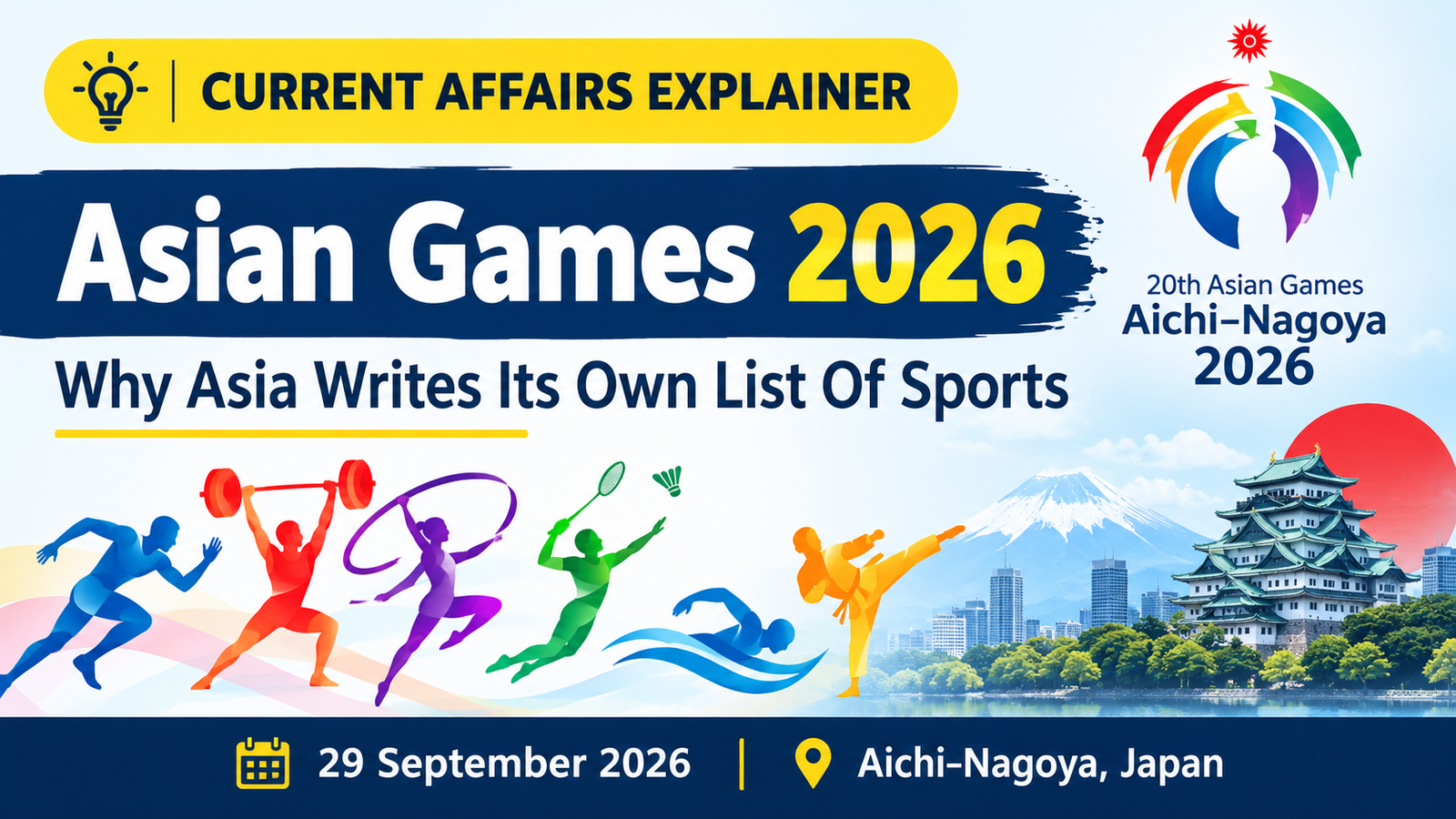
The Asian Games have sports the Olympics does not, and that is not an accident. It is the single fact that explains almost everything odd about this competition — including why three of India’s first four gold medals in Japan came in events an Olympic athlete cannot enter.
The 20th Asian Games are being held in Aichi–Nagoya, Japan, from 19 September to 4 October 2026. They are still running as this is published, so the medal table below is a snapshot and not a final result. Explained in plain language for SSC, RRB NTPC, State PSC, banking general awareness and UPSC Prelims.
⚡ QUICK FACTS
📅 Dates
19 September to 4 October 2026
🏛️ Host
Aichi Prefecture and Nagoya, Japan
🔢 Edition
20th Asian Games
🏅 Programme
43 sports, 469 medal events
🌏 Delegations
46, including a first-ever Refugee Team
⚙️ Run by
The Olympic Council of Asia
The Hinge: Ask Who Writes the Programme
The list of sports at the Olympic Games is decided by the International Olympic Committee — a single global body choosing one programme for the whole world. The list of sports at the Asian Games is decided by the Olympic Council of Asia, a body made up of Asia’s own national committees.
A programme written by one continent for itself can carry sports that matter enormously in that continent and nowhere else. That is why you will find kabaddi, wushu, sepaktakraw and kurash at an Asian Games and not at an Olympic Games. It is also why the Asian Games can add new sports far faster than the Olympics can.
Olympic Games
Asian Games
Who decides the sports?
The International Olympic Committee, for the whole world
The Olympic Council of Asia, for Asia
Who can take part?
Every national committee on earth
Only Asia’s national committees
So the programme…
Must suit every region, so it changes slowly
Can carry an Asia-only sport, and changes quickly
Now use it as a decoder. Any question of the form ‘which of these is an Asian Games sport but not an Olympic sport?’ is really asking which of these is popular in Asia and nowhere else. Kabaddi, wushu, sepaktakraw and kurash all pass that test. Swimming and athletics do not.
And this is the same shape we used on the National Film Awards, where the hinge was that they are State awards rather than industry awards. In both cases the answer came from asking who designed the thing, and for whom. That question is worth carrying into any topic about a list, a prize or a programme.
Why This Matters for India, Right Now
India’s first four gold medals at these Games came in women’s cricket, shooting, and kabaddi — both the men’s and the women’s teams, who beat Iran in their finals on the same day.
Look at that list again. Kabaddi is not an Olympic sport at all. Cricket is not on the current Olympic programme either; it returns only at Los Angeles 2028. Three of India’s four golds came in events an Olympic athlete cannot enter. That is the hinge doing real work: India’s medal profile at an Asian Games looks different from its Olympic profile because the programme itself is different.
A Medal Is Not a Gold — and the Table Knows It
This is the second idea worth taking away, and it explains the headlines.
A medal table is not ordered by how many medals you win. It is ordered by gold medals first. Only when two countries have the same number of golds does the silver count decide, and only then the bronze. So a country with 4 golds and 32 medals sits below a country with 6 golds and 10 medals.
India at Aichi–Nagoya
Figure
Gold
4
Silver
14
Bronze
14
Total
32
Position at the end of Day 9, 28 September 2026. The Games close on 4 October, so these numbers will change. Check the final table before quoting it.
The comparison that matters is India’s own record. At the previous edition — Hangzhou, held in 2023 — India won 106 medals: 28 gold, 38 silver and 40 bronze, finishing fourth. That was India’s best ever, well past the 70 medals of 2018, and it made India only the fourth country after China, Japan and South Korea to cross 100 medals at a single Asian Games. The Sports Ministry said before these Games that the aim was to beat that 106.
The Compact Games: Why Nobody Wants to Host Any More
Aichi–Nagoya tried something unusual, and the reason is worth a paragraph in any descriptive answer.
A host city normally builds an athletes’ village — a permanent housing complex for the competitors. Aichi–Nagoya built none. Athletes were housed in hotels, in a cruise ship berthed at the port, and in temporary container-style wooden units that can be taken apart afterwards and reused for disaster relief and tourism. The Games leaned on stadiums that already existed rather than new ones.
And the budget still rose from about ¥85 billion to about ¥370 billion. That is the honest lesson: even a deliberately cheap Games is expensive. It is why the field of cities willing to bid has shrunk, why Aichi–Nagoya was awarded unopposed at the Olympic Council of Asia’s meeting in Danang, Vietnam on 25 September 2016, and why the next two editions — Doha 2030 and Riyadh 2034 — were handed out years in advance to countries that could pay.
The Body Behind It: the Olympic Council of Asia
Item
Detail
What it is
The continental body that runs the Asian Games and Asia’s other multi-sport events
Founded
16 November 1982, at New Delhi, during the ninth Asian Games
Headquarters
Kuwait City, Kuwait
Replaced
The Asian Games Federation, set up in 1949
Members
45 National Olympic Committees
Also organises
The Asian Winter Games, Asian Youth Games, Asian Beach Games and Asian Indoor and Martial Arts Games
A National Olympic Committee, or NOC, is the single body a country recognises to send its team to the Olympics and to continental games. India’s is the Indian Olympic Association. Note the small mismatch worth remembering: the Council has 45 members but 46 delegations are competing in Japan, because an Asian Refugee Team is taking part for the first time and it is not a member country.
The Council being founded in New Delhi is the kind of detail that turns up in papers, and it sits neatly beside the headquarters lists in our International Organisations and Headquarters capsule. One caution: a few sources date the Council’s founding to 1981 rather than 1982. The Council’s own record gives 1982.
India and the Asian Games: the Facts That Repeat
The first Asian Games were held in New Delhi in 1951, from 4 to 11 March.
They were proposed by Guru Dutt Sondhi, India’s representative on the International Olympic Committee.
India has hosted twice — New Delhi in 1951 and New Delhi again in 1982. No other Indian city has hosted.
The Games are held every four years.
The motto of the Asian Games is ‘Ever Onward’. The slogan of this edition is ‘Imagine One Asia’.
India’s best performance remains Hangzhou 2023: 106 medals, fourth place.
Athletes who win at these Games are the pool from which India’s national sports honours are picked, so this post pairs with our Awards and Honours capsule, where the Khel Ratna and the Arjuna Award sit alongside the civilian awards.
Two Traps in This Topic
First, the year in the name is not always the year it happened. The previous edition is called the 2022 Asian Games and is counted as the 19th, but it was actually held in September and October 2023, having been postponed by a year. Aichi–Nagoya is therefore the 20th edition even though only three years separate the two. If a question gives you a year, check whether it means the edition’s name or the date it was held.
Second, ‘contingent size’ means two different things. The Sports Ministry approved roughly 490 to 500 athletes; the full party, once coaches, officials and support staff are counted, is reported at around 768; and a Ministry review in March 2026, before qualification had finished, spoke of ‘over 700 athletes’. All three numbers are real and none contradicts the others. Read whether the question asks for athletes or for the whole contingent, and treat any pre-qualification estimate as an estimate.
New Sports at This Edition
Six sports are new to the Asian Games programme at Aichi–Nagoya: freestyle BMX, mixed martial arts, padel, surfing, teqball and virtual taekwondo. That list is itself the hinge in miniature — a continental body can put a new sport on its programme without persuading the whole world first.
What Is Likely to Be Asked
Host and dates: Aichi–Nagoya, Japan, 19 September to 4 October 2026.
Edition: the 20th Asian Games.
Programme: 43 sports and 469 medal events; 46 delegations.
Governing body: the Olympic Council of Asia, founded at New Delhi in 1982, headquartered at Kuwait City.
First Games: New Delhi, 1951; proposed by Guru Dutt Sondhi.
India has hosted twice: 1951 and 1982, both New Delhi.
Previous edition: Hangzhou, named 2022 but held in 2023; India won 106 medals and finished fourth.
Q1. The Asian Games 2026 are being held in… (a) Hangzhou, China (b) Aichi–Nagoya, Japan (c) Doha, Qatar (d) Riyadh, Saudi Arabia Answer: (b) Aichi–Nagoya, Japan Doha hosts the next edition in 2030 and Riyadh the one after in 2034. Hangzhou hosted the previous edition.
Q2. Which body decides the list of sports at the Asian Games? (a) The International Olympic Committee (b) The Asian Games Federation (c) The Olympic Council of Asia (d) The Indian Olympic Association Answer: (c) The Olympic Council of Asia The Asian Games Federation did this job until it was replaced in 1982, and the International Olympic Committee decides only the Olympic programme. Because Asia writes its own list, kabaddi and wushu can appear on it.
Q3. The first Asian Games were held in… (a) Manila, 1954 (b) Tokyo, 1958 (c) New Delhi, 1951 (d) Jakarta, 1962 Answer: (c) New Delhi, 1951 Manila, Tokyo and Jakarta hosted the second, third and fourth editions. The idea was proposed by Guru Dutt Sondhi, India’s member on the International Olympic Committee.
Q4. At the previous Asian Games India won 106 medals. Where were those Games held? (a) Incheon (b) Jakarta and Palembang (c) Guangzhou (d) Hangzhou Answer: (d) Hangzhou Incheon 2014, Jakarta–Palembang 2018 and Guangzhou 2010 are earlier editions. The 106-medal haul came at an edition named after 2022 but actually held in 2023, which is the trap in this question.
Q5. The headquarters of the Olympic Council of Asia is at… (a) Lausanne (b) Kuwait City (c) New Delhi (d) Tokyo Answer: (b) Kuwait City Lausanne houses the International Olympic Committee, which is a different body. New Delhi is where the Council was founded in 1982, not where it sits.
Ten more questions on this and today’s Static GK capsule are waiting on our Test Your Knowledge page, with a free PDF. Today’s capsule is on the Finance Commission, which decides how public money is divided — including the money that pays for sport.
Sources: the Olympic Council of Asia and published records of the 2026 Asian Games; the Ministry of Youth Affairs and Sports on India’s participation; a Press Information Bureau release of 5 March 2026 on the Ministry’s review of preparations, which states the aim of surpassing the 106-medal haul of Hangzhou; and match-by-match reports for the medal position at the end of Day 9. The Games close on 4 October 2026 and the final tally should be rechecked then.