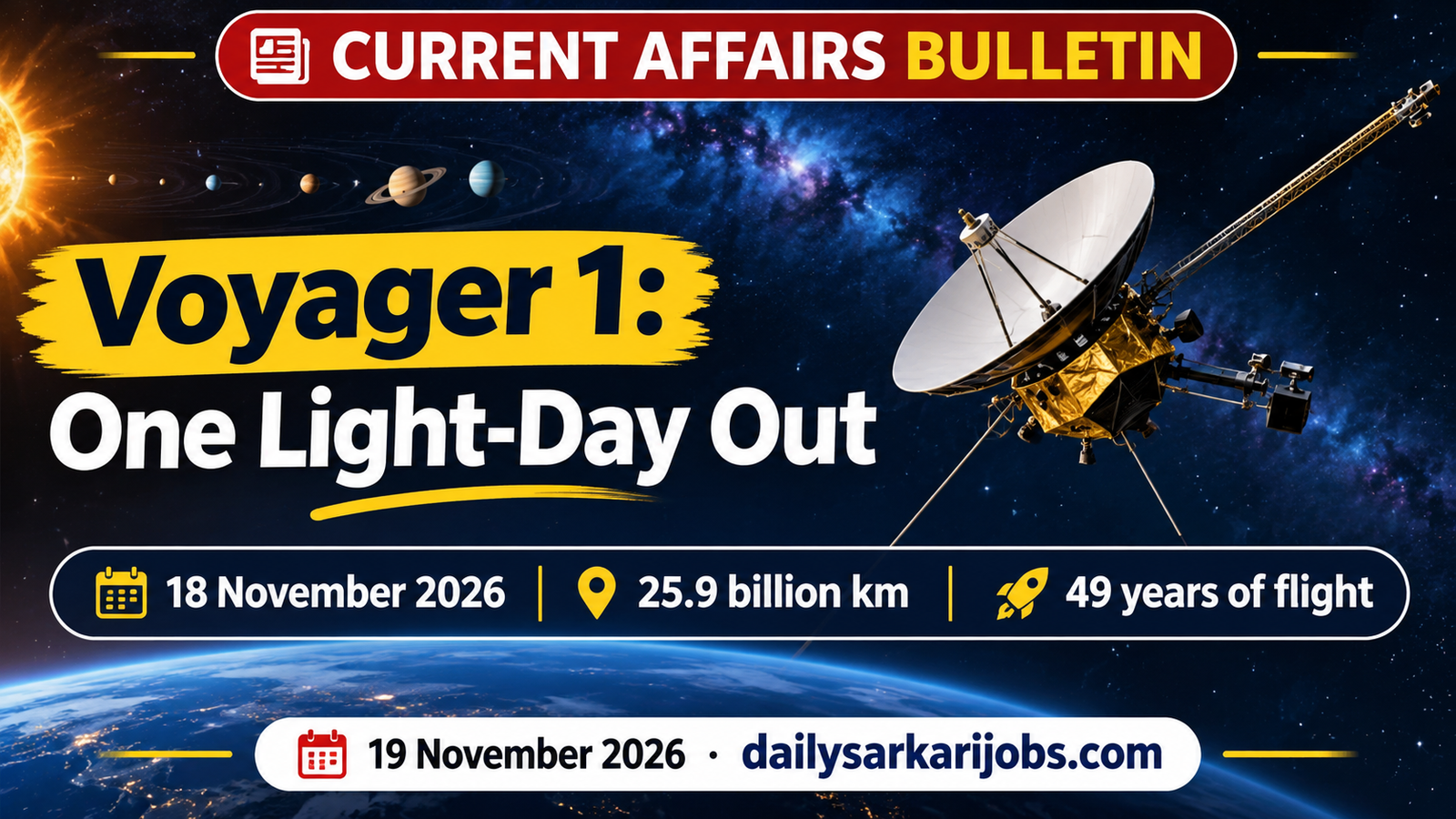
On 18 November 2026, NASA’s Voyager 1 passed one light-day from Earth.It is a distance record, but that is not what makes it worth learning. The number is a lesson about scale, and it is a hard one.
Forty-Nine Years to Cover What Light Crosses in a Day
A light-day is simply the distance light travels in twenty-four hours — about 25.9 billion kilometres.Light does it in a day because light does everything in no time at all. Voyager 1 needed 49 years, 2 months and 11 days.
And Voyager 1 is not slow.It is moving at roughly 61,000 kilometres an hour, faster than any object humans have ever sent away from Earth. Half a century at that speed buys you one day of light.
That is the whole argument about interstellar travel in one statistic.The nearest star after the Sun is more than four light-years away. At Voyager’s speed that is tens of thousands of years. The problem is not engineering; it is that space is bigger than intuition allows.
Jargon, Defined Once
A light-day is the distance light covers in one day; a light-year is the distance it covers in one year. Both are measures of distance, not of time, despite the names.
An astronomical unit (AU) is the average distance from the Earth to the Sun. Voyager 1 is about 173 of them out.
The heliosphere is the bubble of charged particles blown outwards by the Sun; interstellar space begins where that bubble ends.
A radioisotope power source is a nuclear battery — it makes electricity from the heat of decaying material, with no sunlight needed. That is why the Voyagers still work this far out.
The Golden Record is the gold-plated disc each Voyager carries, holding images, greetings in over a hundred languages and music, in case anything ever finds it.
The Facts Worth Keeping
Question
Answer
Date of the milestone
18 November 2026
Distance
About 25.9 billion km, roughly 173 AU
Speed
About 61,000 km an hour
Launched
5 September 1977 — Voyager 2 went up a few weeks earlier
Entered interstellar space
Voyager 1 in 2012, Voyager 2 in 2018
Instruments still working
Two on Voyager 1, three on Voyager 2
Signal time
24 hours each way
A Conversation That Takes Two Days
Because the spacecraft is exactly one light-day away, a radio instruction sent now arrives tomorrow.If Voyager answers at once, the answer gets back the day after. Every exchange with it is a two-day round trip, and that gap will only grow.
The mission is also running out of power.The nuclear battery is fading, and NASA has been switching off instruments and even heaters one at a time to stretch what is left. Engineers expect it to last into roughly the early 2030s.After that the spacecraft keeps travelling, silently, more or less for ever.
Exam Alert: Five Traps
Voyager 2 was launched BEFORE Voyager 1, a few weeks earlier in 1977 — yet Voyager 1 is the farther of the two, because it took a faster route.This is the sharpest trap on the topic.
A light-day and a light-year are distances, not durations.
Voyager 1 entered interstellar space in 2012; Voyager 2 in 2018.Two spacecraft, two dates, six years apart.
The Voyagers run on a nuclear battery, not on solar panels.There is not enough sunlight that far out.
The milestone date is 18 November 2026 and the distance about 25.9 billion kilometres, or 173 astronomical units.
Did You Know: The Record On Board Will Outlive Everything That Made It
Each Voyager carries a gold-plated disc put together by a team led by Carl Sagan.It holds pictures of Earth, greetings spoken in more than a hundred languages, and a selection of music, together with instructions on how to play it and a map showing where it came from.
It is made of material that does not corrode, and it is travelling through near-vacuum at temperatures close to absolute zero.Nothing out there will wear it down. The disc is likely to be intact long after the spacecraft has gone dark, long after the mission is forgotten, and quite possibly long after the civilisation that built it.It was always more a message to ourselves than to anyone else.
Why a Reader Should Care
Space and astronomy milestones are standard current-affairs material, and this one carries a definition — the light-day — that papers like to test on its own. It sits with our capsule on light, reflection and refraction, where the behaviour of light is explained from the beginning, with the laws of motion, since a spacecraft coasting for forty-nine years with its engines off is the first law in its purest form, and with scientific instruments and inventions.
Today’s Static GK capsule is on the ozone layer, and the two meet in a straight line. Light takes a day to reach Voyager and about eight minutes to reach us. What it runs into on the way in is the ozone layer, which absorbs the ultraviolet part before it gets to the ground. One capsule is about how far light goes; the other is about what stops the dangerous part of it.
Practice Questions
Q1. On 18 November 2026, Voyager 1 became the first spacecraft to reach a distance of (a) One light-year from Earth (b) One light-day from Earth (c) One light-hour from Earth (d) One astronomical unit from Earth Answer: (b) One light-day from Earth The distance is about 25.9 billion kilometres, or roughly 173 astronomical units.
Q2. A light-day is a measure of (a) Time (b) Brightness (c) Distance (d) Energy Answer: (c) Distance It is the distance light travels in twenty-four hours, just as a light-year is the distance it travels in a year.
Q3. Which statement about the two Voyager spacecraft is correct? (a) Both were launched in 1980 (b) Voyager 2 was launched a few weeks before Voyager 1 (c) Voyager 1 was launched ten years before Voyager 2 (d) Only Voyager 1 was ever launched Answer: (b) Voyager 2 was launched a few weeks before Voyager 1 Despite going up first, it is the slower of the two and remains the nearer to Earth.
Q4. Voyager 1 entered interstellar space in (a) 1977 (b) 2018 (c) 2026 (d) 2012 Answer: (d) 2012 Its twin crossed the same boundary six years later, in 2018.
Q5. The Voyager spacecraft generate electricity using (a) A radioisotope power source (b) Solar panels (c) Fuel cells (d) Wind turbines Answer: (a) A radioisotope power source Sunlight is far too weak at that distance, and the power supply is expected to last into roughly the early 2030s.
30-Second Revision
The hinge:49 years to cover one light-day — what light crosses in a single day took the fastest object we ever launched half a century.
The milestone:18 November 2026; about 25.9 billion km; roughly 173 AU; speed about 61,000 km an hour.
The twins:Voyager 2 launched first, Voyager 1 on 5 September 1977 and is farther. Interstellar space: Voyager 1 in 2012, Voyager 2 in 2018.
The hardware: a nuclear battery, not solar; two instruments still live on Voyager 1 and three on Voyager 2; power expected to last into the early 2030s.
The extras: a 24-hour signal each way, so a two-day round trip; and the Golden Record, assembled under Carl Sagan.
What Is Not Settled
Whether Voyager 1 has left the solar system depends on what you mean by the solar system.It crossed into interstellar space in 2012, which means it left the Sun’s bubble of charged particles. But the Sun’s gravity is thought to hold a vast cloud of icy bodies far beyond that, and by that measure the spacecraft has thousands of years still to go. The safe phrasing is that it entered interstellar space in 2012, which is right either way.
Second, the exact distance and speed figures drift between reports, because they are constantly changing and because different sources round differently. About 25.9 billion kilometres, about 173 astronomical units and about 61,000 kilometres an hour are the figures quoted around the milestone; treat them as approximate rather than exact.
Sources
Reporting of 18 November 2026 on the Voyager 1 light-day milestone — for the date, the distance of about 25.9 billion kilometres and roughly 173 astronomical units, the time taken of 49 years, 2 months and 11 days, the launch of Voyager 1 on 5 September 1977 with Voyager 2 going up a few weeks earlier, and the description of Voyager 1 as the most distant human-made object.
The same reporting for the operational details — a speed of about 61,000 kilometres an hour, entry into interstellar space by Voyager 1 in 2012 and Voyager 2 in 2018, the dwindling nuclear battery with instruments and heaters switched off to conserve power, an expected life into roughly the early 2030s, two working instruments on Voyager 1 and three on Voyager 2, a one-way signal time of 24 hours, and the Golden Record co-created by Carl Sagan carrying greetings in over a hundred languages.
Where the definition of leaving the solar system and the precise distance and speed figures vary between sources, the post says so above rather than fixing on one.