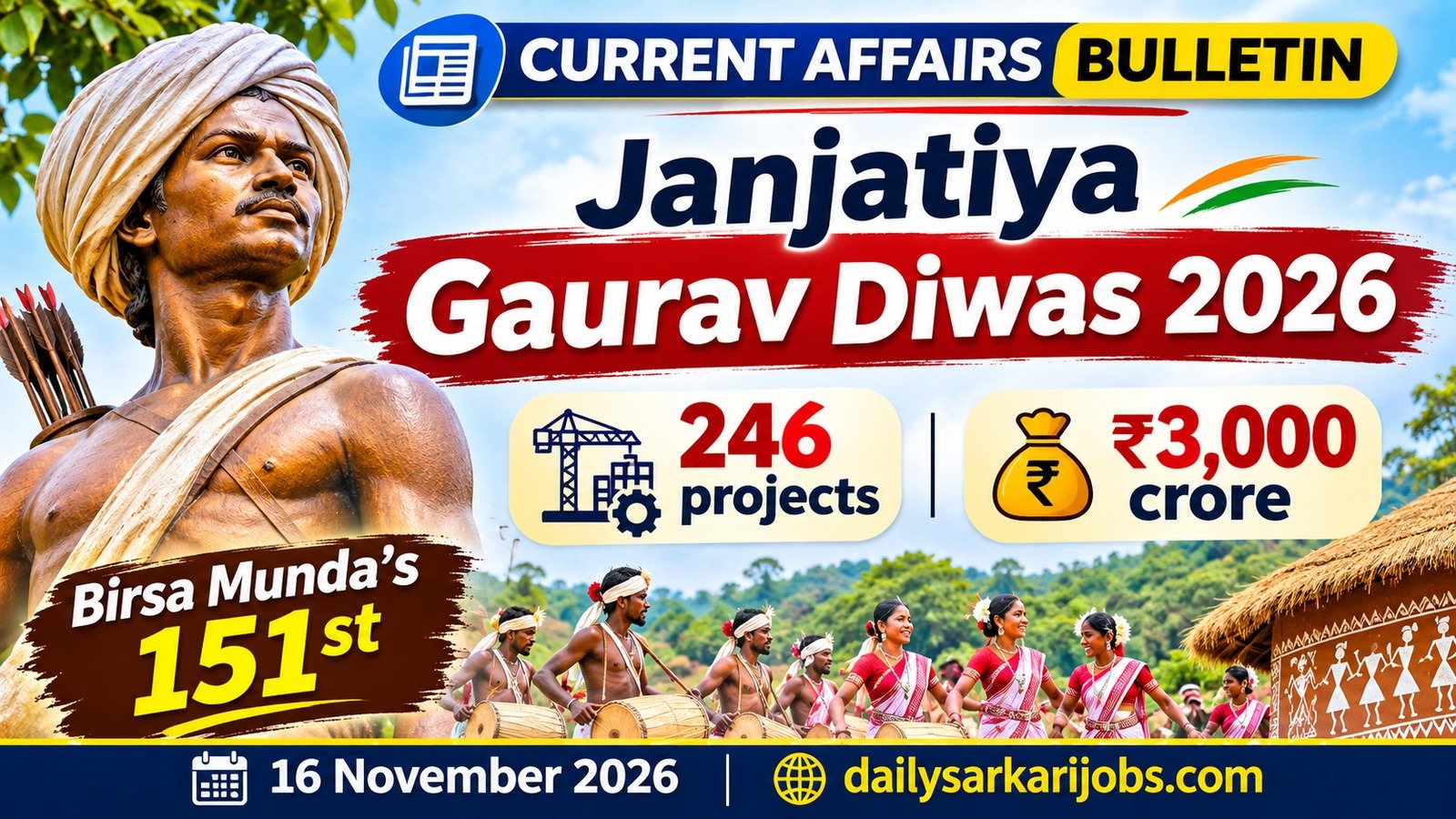
On 15 November 2026 the Prime Minister launched 246 tribal development projects worth about ₹3,000 crore, marking Janjatiya Gaurav Diwas.Before the schemes, learn the date. It is doing three jobs at once, and that is what gets asked.
One Date, Three Things
15 November
What happened
Year
A birth
Birsa Munda was born at Ulihatu, in what is now Khunti district, Jharkhand
1875
A state
Jharkhand came into being, carved out of Bihar
2000
A national day
Janjatiya Gaurav Diwas was approved by the Union Cabinet
2021
All three dates are the same day of the year, and one man is the reason.Learn the chain once — born 1875, state 2000, national day 2021 — and three separate questions collapse into one fact.
Jargon, Defined Once
Janjatiya is the Hindi word for tribal; Gaurav means pride; Diwas means day. A Pakhwada is a fortnight — here 1 to 15 November.
Dharti Aaba means Father of the Earth, the name by which Birsa Munda is remembered. It turns up inside scheme names, so it is worth recognising.
PM-JANMAN is the Pradhan Mantri Janjati Adivasi Nyaya Maha Abhiyan, aimed at the most vulnerable tribal groups.
DAJGUA is the Dharti Aaba Janjatiya Gram Utkarsh Abhiyan — a village-development mission named after Birsa Munda himself.
EMRS are Eklavya Model Residential Schools, government residential schools for tribal children.
PVTG means Particularly Vulnerable Tribal Group, an official category for the smallest and most at-risk communities.
What Was Launched on 15 November 2026
About ₹3,000 crore across 246 projects, from Gadchiroli in Maharashtra, by video conferencing.
173 inaugurations, including 38 Eklavya Model Residential Schools and 100 Multi-Purpose Centres under PM-JANMAN.
Foundation stones for 19 new Eklavya Model Residential Schools, 12 Tribal Multipurpose Marketing Centres and 42 other PM-JANMAN and DAJGUA projects.
The Tribal Research Institute building at Itanagar, Arunachal Pradesh, and the Ropuiliani Tribal Freedom Fighter Museum at Aizawl, Mizoram.
It was the 151st birth anniversary and the close of the Janjatiya Gaurav Pakhwada held from 1 to 15 November 2026.
Who Birsa Munda Was
He was born on 15 November 1875 at Ulihatu, in the Ranchi district of the old Bengal Presidency, now Khunti district in Jharkhand.He led a rising against colonial land policy and the moneylenders and landlords who came with it, and he founded a faith of his own, the Birsait faith.
His movement is remembered by its own name: the Ulgulan, meaning the Great Tumult.Attacks on targets loyal to the British began around Christmas 1899. He was captured, held for trial, and died in Ranchi jail on 9 June 1900.He was twenty-four.
Exam Alert: Five Traps
Janjatiya Gaurav Diwas is 15 November, and so is Jharkhand’s foundation day.Both, same date, different years.
The Union Cabinet approved the day on 10 November 2021, so the first observance was that same year.
Birsa Munda died in 1900, at twenty-four, in jail — not in battle.
DAJGUA and PM-JANMAN are two different missions.One is a village-development abhiyan named after Birsa Munda; the other targets particularly vulnerable tribal groups.
The 2026 programme was held at Gadchiroli, Maharashtra — not in Jharkhand, which is the answer most people would guess.
Did You Know: He Lost, and Eight Years Later the Law Changed Anyway
The Ulgulan was crushed and its leader died in custody before he was twenty-five.By any ordinary measure the rebellion failed completely.
Then in 1908 the colonial government passed the Chotanagpur Tenancy Act, which barred the transfer of tribal land to non-tribals.That was the core demand of the rising, written into statute by the same administration that had jailed him, eight years after he died.The law still stands in Jharkhand today.
Why a Reader Should Care
Tribal affairs sits across three sections at once — modern history for the revolts, polity for the Schedules, and current affairs for the schemes — which is why one capsule here earns marks in three places. It sits with our capsules on the Fifth Schedule and Scheduled Areas, where PESA and the Tribes Advisory Council are explained, on Panchayati Raj, and with our explainer on Bastar Dussehra.
Today’s Static GK capsule is on the Indian Coast Guard and India’s maritime zones, and the pair share a quiet theme. Birsa Munda fought over land the law did not protect until 1908. The Coast Guard was created for a stretch of sea nobody was policing until 1977. Both stories are about the gap between what a state claims on paper and what it actually guards.
Practice Questions
Q1. Janjatiya Gaurav Diwas is observed every year on (a) 9 June (b) 1 November (c) 15 November (d) 26 January Answer: (c) 15 November The date is Birsa Munda’s birth anniversary, and the Union Cabinet approved the observance on 10 November 2021.
Q2. Birsa Munda’s movement against colonial land policy is known as (a) The Ulgulan (b) The Santhal Hul (c) The Kol Uprising (d) The Bhil Revolt Answer: (a) The Ulgulan The word means the Great Tumult, and the attacks began around Christmas 1899.
Q3. The 2026 Janjatiya Gaurav Diwas programme, at which about ₹3,000 crore of projects were launched, was held at (a) Ranchi, Jharkhand (b) Bhubaneswar, Odisha (c) Raipur, Chhattisgarh (d) Gadchiroli, Maharashtra Answer: (d) Gadchiroli, Maharashtra There were 246 projects in all, with separate inaugurations at Itanagar in Arunachal Pradesh and Aizawl in Mizoram.
Q4. DAJGUA, one of the missions under which projects were launched, stands for (a) Dharti Aaba Janjatiya Gram Utkarsh Abhiyan (b) Deen Dayal Antyodaya Janjatiya Gram Udyam Abhiyan (c) Dharti Aaba Jan Jagran Gram Unnati Abhiyan (d) Development of Adivasi Janjatiya Gram Udyog Abhiyan Answer: (a) Dharti Aaba Janjatiya Gram Utkarsh Abhiyan The first two words mean Father of the Earth, and that is the name by which Birsa Munda himself is remembered.
Q5. Which state came into existence on 15 November 2000? (a) Chhattisgarh (b) Uttarakhand (c) Jharkhand (d) Telangana Answer: (c) Jharkhand Chhattisgarh was created on 1 November and Uttarakhand on 9 November of the same year, so all three fall within a fortnight.
30-Second Revision
The hinge:15 November carries three things — Birsa Munda’s birth (1875), Jharkhand’s creation (2000) and Janjatiya Gaurav Diwas (2021).
The man: born Ulihatu, now Khunti district, Jharkhand; led the Ulgulan; founded the Birsait faith; died in Ranchi jail on 9 June 1900, aged 24; called Dharti Aaba.
The 2026 event:Gadchiroli, Maharashtra; 246 projects, about ₹3,000 crore; 173 inaugurations including 38 EMRS and 100 Multi-Purpose Centres; his 151st birth anniversary.
The missions:PM-JANMAN for particularly vulnerable tribal groups and DAJGUA for tribal villages; plus EMRS schools and Tribal Multipurpose Marketing Centres.
The aftermath fact: the Chotanagpur Tenancy Act, 1908 barred transfer of tribal land to non-tribals — the rebellion’s demand, passed eight years after its leader died.
What Is Not Settled
His birth date is not agreed by every source.15 November 1875 is the official date and the one the national day is built on, but some accounts give 18 July 1872 instead, and folk tradition disagrees even about the village. Answer 15 November 1875 in an examination; the alternative is worth knowing about rather than quoting.
Second, it is widely said that Jharkhand’s foundation date was chosen deliberately to fall on his birth anniversary.The two dates do coincide, and that much is certain. The sources used here do not state the intention behind the choice, so the coincidence is the safe fact and the motive is not.
Sources
The Prime Minister’s Office release dated 14 November 2026 announcing participation in the Janjatiya Gaurav Diwas programme on 15 November 2026 — for the venue at Gadchiroli, Maharashtra, the figure of about ₹3,000 crore across 246 projects, the breakdown of 173 inaugurations (including 38 Eklavya Model Residential Schools and 100 Multi-Purpose Centres under PM-JANMAN) and foundation stones for 19 further EMRS, 12 Tribal Multipurpose Marketing Centres and 42 other PM-JANMAN and DAJGUA projects, the Tribal Research Institute building at Itanagar and the Ropuiliani Tribal Freedom Fighter Museum at Aizawl, the description of the occasion as the 151st birth anniversary of Birsa Munda, and the Janjatiya Gaurav Pakhwada of 1 to 15 November 2026.
News reporting of 15 November 2026 on the launch itself, used to confirm the project count and the amount.
Standard reference material on Birsa Munda — birth on 15 November 1875 at Ulihatu, death in Ranchi jail on 9 June 1900 at the age of 24, the Ulgulan beginning around Christmas 1899, the Birsait faith, the title Dharti Aaba, the Chotanagpur Tenancy Act of 1908 barring transfer of tribal land to non-tribals, and the Union Cabinet’s approval of the observance on 10 November 2021.
Reference material on the 2000 state reorganisation — Chhattisgarh on 1 November, Uttarakhand on 9 November and Jharkhand on 15 November 2000 under the Bihar Reorganisation Act.
Where the birth date and the reason for Jharkhand’s foundation date are disputed or unstated, the post says so above rather than resolving them silently.