Last updated: September 25, 2026 at 12:52 AM
The Madhya Pradesh Employees Selection Board (MPESB), Bhopal has released the Rule Book and detailed syllabus for the Eligibility Test 2026 for teachers already teaching primary and middle classes, conducted under the Supreme Court order dated 01.09.2025 in Civil Appeal Nos. 1385/2025 and 1386/2025. Serving teachers who have not yet cleared a TET must qualify this examination before 31 August 2028 to continue in service and to be considered for promotion.
Quick Navigation
- Syllabus Overview
- Important Dates
- Examination Fee
- Exam Pattern — Primary Level (Classes 1 to 5)
- Exam Pattern — Middle Level (Classes 6 to 8)
- Qualifying Marks
- Who Can Appear in This Examination
- Topic-wise Syllabus — Primary Level
- Topic-wise Syllabus — Middle Level, Part A (Compulsory)
- Topic-wise Syllabus — Middle Level, Part B (Choose One Subject)
- Exam Day Timings
- How to Apply
- Important Links
- Common Mistakes to Avoid
- Frequently Asked Questions
Syllabus Overview
| Exam Name | Pariksha 2026 for teachers teaching primary and middle classes (प्राथमिक एवं माध्यमिक कक्षाओं में अध्यापन कर रहे शिक्षकों के लिए पात्रता परीक्षा 2026) |
| Conducting Body | Madhya Pradesh Employees Selection Board (MPESB / ESB), Chayan Bhawan, Bhopal |
| Notification / Advertisement No. | Pariksha Sanchalan Niyam Pustika (Rule Book) dated 17.08.2026 — no advertisement number is stated in the notification; issued under DPI, M.P. letter No. UR/C/85/TET/2026/1305 dated 04.07.2026 |
| Location | Madhya Pradesh (exam centres decided by MPESB, Bhopal) |
| Levels | Primary Teacher Eligibility Test and Middle Teacher Eligibility Test (both for in-service teachers only) |
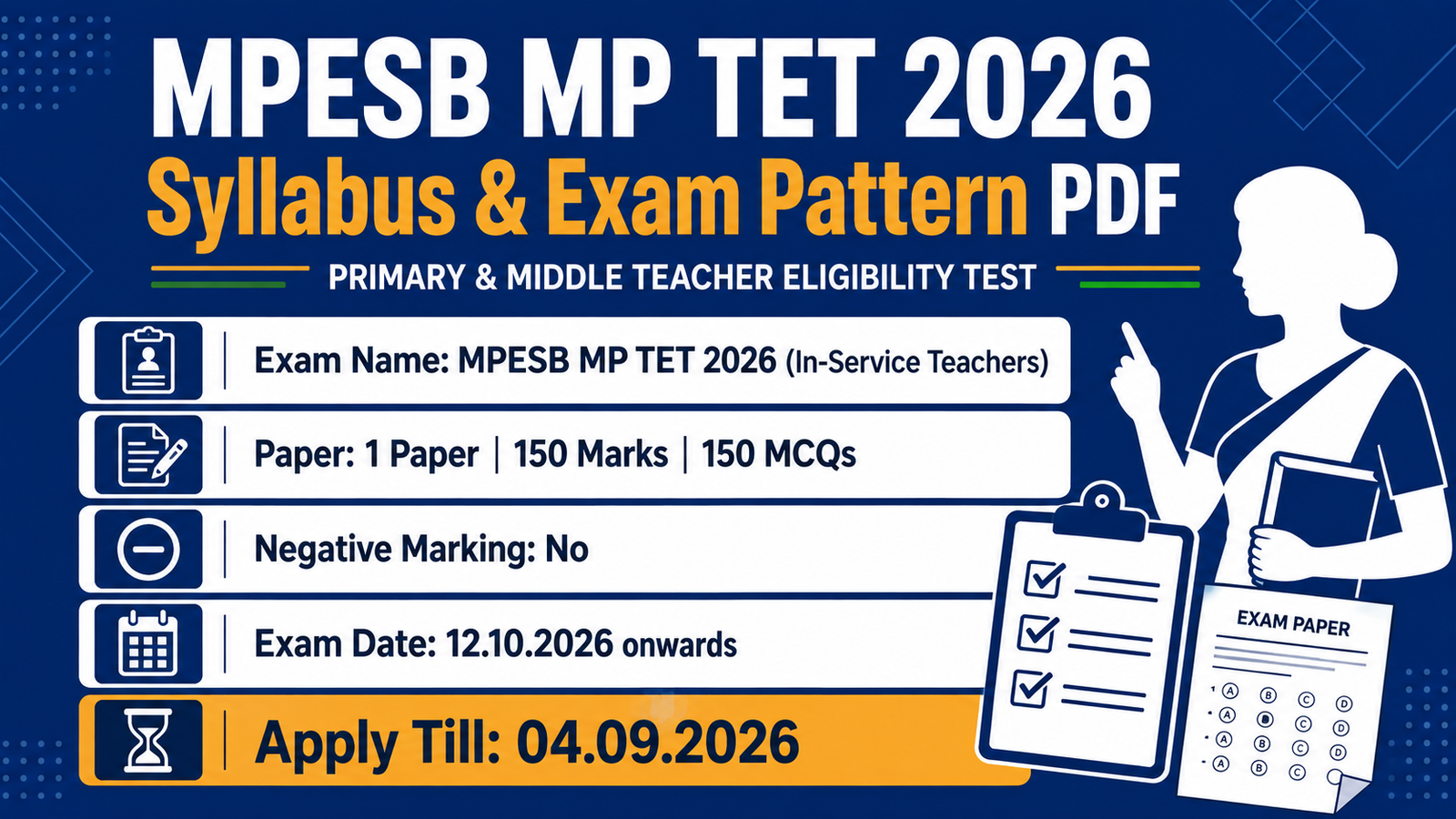
| Total Questions / Marks | 150 MCQs, 150 marks (1 mark per question) |
| Exam Duration | 2 hours 30 minutes |
| Negative Marking | No negative marking |
| Exam Mode | Computer-based online examination |
| Exam Date | 12.10.2026 (Monday) onwards, in two shifts |
| Qualifying Marks | 60% for Others; 50% for SC / ST / OBC / PwD / EWS |
| Application Window | 21.08.2026 to 04.09.2026 (correction till 09.09.2026) |
| Official Notification | Download Rule Book and Syllabus PDF |
| Official Website | esb.mp.gov.in |
Important Dates
| Event | Date |
|---|---|
| Rule Book / Syllabus released | 17.08.2026 |
| Online application starts | 21.08.2026 |
| Last date to submit online application | 04.09.2026 |
| Application correction window starts | 21.08.2026 |
| Last date for application correction | 09.09.2026 |
| Examination date | 12.10.2026 (Monday) onwards |
| Deadline to qualify TET (as per Supreme Court order) | 31 August 2028 |
Examination Fee
| Category / Charge | Amount |
|---|---|
| Candidates of all categories (per question paper) | Rs. 1,000/- |
| MP Online portal charge — applying through a kiosk | Rs. 60/- |
| MP Online portal charge — applying as a registered citizen user | Rs. 20/- |
Exam Pattern — Primary Level (Classes 1 to 5)
| Part | Subject | Questions | Marks |
|---|---|---|---|
| i | Child Development and Pedagogy | 30 | 30 |
| ii | Language-1 | 30 | 30 |
| iii | Language-2 | 30 | 30 |
| iv | Mathematics | 30 | 30 |
| v | Environmental Study | 30 | 30 |
| Total | All parts compulsory | 150 | 150 |
| Duration | 2 hours 30 minutes |
| Question type | Multiple choice, four options, one correct answer |
| Marking | 1 mark per question, no negative marking |
| Language choice | Language-2 must be different from Language-1. Candidates choose from Hindi, English, Sanskrit and Urdu on the application form and can attempt questions only in the chosen language. |
| Standard of questions | Topics from the current M.P. State Classes 1 to 5 curriculum and textbooks, but the difficulty level and linkage may go up to high school level. Child Development questions relate to the 6 to 11 year age group. |
Exam Pattern — Middle Level (Classes 6 to 8)
The middle level paper has two parts. Part A is compulsory for everyone, and in Part B the candidate must choose one subject — and it has to be the main subject of their graduation degree.
| Part A — Compulsory | Questions | Marks |
|---|---|---|
| Language-1 (Hindi or Sanskrit) | 08 | 08 |
| Language-2 (General English) | 05 | 05 |
| General Knowledge and Current Affairs, Reasoning and Numerical Ability | 07 | 07 |
| Pedagogy | 10 | 10 |
| Part A Total | 30 | 30 |
| Part B — Choose any ONE subject | Questions | Marks |
|---|---|---|
| 1. Hindi Language | 120 | 120 |
| 2. English Language | 120 | 120 |
| 3. Sanskrit Language | 120 | 120 |
| 4. Urdu Language | 120 | 120 |
| 5. Mathematics | 120 | 120 |
| 6. Science | 120 | 120 |
| 7. Social Science | 120 | 120 |
| Part A + Part B Total | 150 | 150 |
| Duration | 2 hours 30 minutes |
| Marking | 1 mark per question, no negative marking, all questions compulsory |
| Standard — Part A | General Knowledge, Current Affairs, Reasoning, Numerical Ability and Pedagogy are set at the mental level of a higher secondary school student. Hindi and English are at higher secondary examination level. |
| Standard — Part B | Graduate level. Questions are drawn from the current M.P. State Classes 9 and 10 curriculum content, but the difficulty and linkage are of graduate standard, testing concepts, problem solving and pedagogy. |
Qualifying Marks
| Category | Minimum Qualifying Percentage |
|---|---|
| Scheduled Caste / Scheduled Tribe / Other Backward Class / Divyang (PwD) / Economically Weaker Section | 50% |
| Others | 60% |
Note: The same qualifying percentages apply to both the primary level and the middle level examination.
Who Can Appear in This Examination
| Level | Eligible Serving Teachers |
|---|---|
| Primary Level | All primary-level teachers of government schools — Assistant Teacher, Primary Teacher, Sahayak Adhyapak, Samvida Shala Shikshak Varg 3, Prayogshala Sahayak, Primary Teacher (Science) and Assistant Teacher (Science) — who have not passed the eligibility test held under the Right to Education Act. Teachers of non-government schools teaching primary classes who have not passed the eligibility test may also appear. |
| Middle Level | All middle-level teachers of government schools — Shikshak, Madhyamik Shikshak, Adhyapak and Samvida Shala Shikshak Varg 2 — who have not passed the eligibility test held under the Right to Education Act. Teachers of non-government schools teaching middle classes who have not passed the eligibility test may also appear. |
| Important restriction | This is a special eligibility examination held for in-service teachers under the Supreme Court order. Its result will not be valid for future direct recruitment to government teacher posts. |
Topic-wise Syllabus — Primary Level
| Subject | Topics |
|---|---|
| Child Development and Pedagogy — (a) Child Development (15 questions) | Concept of child development and its relationship with learning; factors affecting development; principles of child development; mental health and behavioural problems of children; influence of heredity and environment; socialisation processes — society and the child (teacher, parents, peers); Piaget, Pavlov, Kohler and Thorndike — construct and critical perspective; concept of child-centred and progressive education; critical perspective on the construct of intelligence and its measurement, multi-dimensional intelligence; personality and its measurement; language and thought; gender as a social construct, gender roles, gender bias and educational practice; individual differences among learners, understanding differences based on language, caste, gender, community and religion; assessment for learning versus assessment of learning, school-based assessment, continuous and periodic assessment; framing appropriate questions to assess readiness levels, enhance learning and critical thinking, and assess learner achievement |
| Child Development and Pedagogy — (b) Concept of Inclusive Education and Understanding Children with Special Needs (5 questions) | Identification of learners from diverse backgrounds including disadvantaged and deprived groups; identifying the needs of children with learning difficulties and impairments; identifying gifted, creative and specially-abled learners; problem children — identification and diagnostic aspects; juvenile delinquency — causes and types |
| Child Development and Pedagogy — (c) Learning and Pedagogy (10 questions) | How children think and learn, why and how children fail to achieve success in school; basic processes of teaching and learning, children’s learning strategies, learning as a social activity, social context of learning; child as a problem solver and scientific investigator; alternative conceptions of learning in children, understanding children’s errors as meaningful steps in learning; factors affecting learning — attention and interest; cognition and emotion; motivation and learning; factors contributing to learning — personal and environmental; guidance and counselling; aptitude and its measurement; memory and forgetting |
| Hindi Language (30 questions) | (a) Language comprehension, 15 questions — two unseen passages, one prose (drama, one-act play, incident, essay, story etc.) and one poetry, with questions on comprehension, interpretation, grammar and verbal ability; passages may be literary, scientific, social or based on current events. (b) Pedagogy of language development, 15 questions — learning and acquisition of language; principles of language teaching; role of listening and speaking, functions of language and how children use language; role of grammar in oral and written expression; challenges, difficulties and errors of children at different levels in language teaching; evaluation of the four language skills (listening, speaking, reading, writing); teaching learning materials, textbooks, multimedia and multi-class resources in the classroom; remedial teaching |
| English Language (30 questions) | (a) Comprehension, 15 questions — two unseen prose passages (discursive, literary, narrative or scientific) with questions on comprehension, grammar and verbal ability. (b) Pedagogy of language development, 15 questions — learning and acquisition of language; principles of second language teaching; language skills — listening, speaking, reading and writing; role of listening and speaking, function of language and how children use it as a tool; role of grammar in learning a language for communicating ideas verbally and in written form; challenges of teaching language in a diverse classroom, language difficulties; teaching learning materials, textbook, multi-media and multi-lingual resources of the classroom; evaluating language comprehension and proficiency; remedial teaching (re-teaching) |
| Sanskrit Language (30 questions) | (a) Language comprehension, 15 questions — two unseen passages, one prose (drama excerpt, essay, story etc.) and one poetry, with questions on comprehension, interpretation, grammar and verbal ability; passages may be literary, social or based on current events. (b) Pedagogy of language development, 15 questions — learning and acquisition of language; principles of language teaching; role of listening and speaking and how children use language; role of grammar in oral and written expression; challenges, difficulties and errors of children at different levels; evaluation of the four language skills; teaching learning materials, textbooks, multimedia and multi-class resources; remedial teaching |
| Urdu Language (30 questions) | (1) Comprehension-based questions, 15 questions — two unseen passages (informative, literary, narrative or scientific), comprehension questions, grammar and verbal ability. (2) Pedagogy and methods of language development, 15 questions — learning and memorisation; principles of language teaching; importance of listening and speaking, function of language and use of language skills by children; role of grammar in oral and written expression; teaching language in a diverse classroom accepting children’s difficulties, errors and mistakes; language skills; speaking, listening, reading and writing for evaluating proficiency and command; teaching learning materials (TLM), textbooks and multimedia material, multilingual content in the classroom; remedial teaching. Syllabus content: prose forms — story, informative text, drama, dialogue; poetry forms — nazm, geet; grammar — noun, pronoun, verb, adjective, gender, number, idioms and phrases, singular-plural, compound, feminine, comparison, appreciation of nazm and geet; letters and applications; unseen passage; essay writing |
| Mathematics — (a) Content (15 questions) | Number system — reading and writing numbers larger than 1000, place value understanding and the four fundamental operations on numbers above 1000; addition and subtraction of numbers up to five digits; multiplication of 2 and 3 digit numbers; division of a four-digit number by a two-digit number; concept of fractions — simplest form, like, unlike and other fractions, addition, subtraction, multiplication and division of fractions, equivalent fractions, converting fractions to decimals and decimals to fractions; relation between larger and smaller units of length, weight and volume in common use; converting larger units to smaller units and vice versa; finding the volume of a solid object in known units; using the four operations in problems on money, length, weight, volume and time intervals; converting metre to centimetre and centimetre to metre; patterns — understanding and extending number patterns, generalising patterns through operations, recognising triangular numbers and square numbers; geometry — basic geometrical concepts, ray, line segment, angle (classification of angles), triangle, classification of triangles by sides and by angles, the angle sum property of 180°; identification and understanding of the centre, radius and diameter of a circle; relation between circle, radius and diameter, symmetrical shapes, parallel and perpendicular lines in the environment; area and perimeter of simple geometrical shapes (triangle, rectangle, square) using a given shape as a unit; identification of 2D shapes in the environment; collecting different data from daily life; expressing clock time in hours and minutes and as AM and PM; relation between the 24-hour clock and the 12-hour clock; calculating time intervals in everyday events; recognising patterns in multiplication and division; geometric patterns based on symmetry; representing data through bar graphs and drawing conclusions from them |
| Mathematics — (b) Pedagogical Issues (15 questions) | Developing thinking and reasoning power through mathematics teaching; place of mathematics in the curriculum; language of mathematics; developing the ability to create and use suitable environment-based teaching aids for effective teaching; developing the ability to use new methods of evaluation, diagnostic testing and re-teaching; ability to use new methods of mathematics teaching in classroom instruction |
| Environmental Study — (a) Content (20 questions) | 1. Our family, our friends — interrelation with family and society, care of and sensitivity towards elders, the sick, adolescents and children with special needs; our animals and birds — pets, birds, pack animals, effect of the surrounding environment on living beings and animals; our trees and plants — local trees and plants, interdependence of plants and humans, protection of forests, their need and importance, effect of pollution on trees and plants; our natural resources — major natural resources, their conservation, traditional and renewable and non-renewable sources of energy. 2. Sports and work — games, exercise and yoga; family festivals, means of entertainment, books, stories, puppet plays, fairs, cultural programmes and days celebrated in school; various occupations, industries and businesses. 3. Shelter — different habitats of animals, birds and humans, need for shelter and features of shelter for a healthy life; safety of local buildings, public property, national heritage and their upkeep; good shelter and calculation of the materials used in its construction; cleanliness of toilets, cleanliness of surroundings and good habits. 4. Our food and habits — need for food, components of food; importance of fruits and vegetables, fruits and vegetables according to parts of plants; health-promoting combinations of food items; food for different ages and the right time to consume it; cleanliness and safety measures for food for good health; security of food resources. 5. Water and air pollution and infection — need for clean water and clean air for life; local weather, water cycle, effects of climate change and our role in it; sources of water, its safe storage, conservation and nourishment; diseases caused by contaminated air and water, their treatment and prevention, other infectious diseases; pollution of air, water and land and protection from it, various waste materials and their management and proper disposal; protection and preventive measures from disasters such as earthquake, flood and drought, disaster management; sustainable management of natural resources, proper use of resources, diesel and petroleum consumption and conservation. 6. Natural things and produce — relation of soil, water, seed and crop, organic and chemical fertilisers; different crops and their producing regions; agricultural work and equipment needed for crop production. 7. Effect of man-made resources and their activities — deforestation and urbanisation, effect on ecological balance; scientific causes and remedies of ozone depletion, acid rain, global warming and the greenhouse effect; use of polythene and plastic and their harmful decomposition; effects of the use of fossil fuels; disaster management. 8. Space science — introduction to space scientists and their experience of living in space; scientific facts about life in space, possibilities of life; spacecraft, space exploration and predictions |
| Environmental Study — (b) Pedagogical Issues (10 questions) | Concept of environmental study and its need; importance of environmental study, integrated environmental education; principles and responsibilities of environmental education; relationship of environmental education with science and social science; techniques and activities for clarifying concepts; field trips, practical work, project work and their importance; learning through discussion, dialogue, presentation and group teaching arrangements; continuous and comprehensive evaluation — questioning during teaching, giving opportunities for oral and written expression, use of worksheets and anecdotal records, developing the child’s portfolio, case study and teaching arrangements based on individual profiles; teaching materials and aids in environmental education and their application; developing the ability to find environmental problems in the local environment and their solutions |
Topic-wise Syllabus — Middle Level, Part A (Compulsory)
| Section | Topics |
|---|---|
| Hindi Language / Sanskrit (8 questions) | Language comprehension — two unseen passages will be given, one prose (drama, one-act play, incident, essay, story etc.) and one poetry. Questions are asked on comprehension, interpretation, grammar and verbal ability. Passages may be literary, scientific, socially themed or based on current events. |
| English Language (5 questions) | 1. Reading comprehension — two short passages followed by short answer type questions. 2. Vocabulary (Level-X standard) — one word substitution, opposites, synonyms, phrases, idioms and proverbs. 3. Functional grammar (Level-X standard) — articles, modals, determiners, noun and pronoun, adjective and adverb, narration, prepositions, tenses, transformation of sentences, voices. |
| General Knowledge and Current Affairs (part of the 7-question section) | Current affairs and events of national and international importance; history of India and Indian national movements; Indian and world geography — physical, social and economic geography of India and the world; Indian polity and governance — Constitution, political system, Panchayati Raj, public issues, articles and rights; economic and social development — sustainable development, poverty, inclusion, demographics, social sector initiatives; general issues on environment, ecology, biodiversity and climate change; general science; Indian culture; national and international sports; history, geography and political science of Madhya Pradesh; economic and social development of Madhya Pradesh. |
| Reasoning and Numerical Ability (part of the 7-question section) | A) Reasoning ability — general mental, analytical and verbal or logical reasoning, relations and hierarchies, analogies, assertion, truth statements, coding and decoding, situational reasoning, series and patterns involving words and alphabets. B) Numerical ability — two and three dimensional and Venn diagram based questions, number patterns, series and sequences, basic numeracy (numbers and their relations, order of magnitude etc.), arithmetic aptitude, data interpretation (charts, graphs or tables, data sufficiency etc.), direction sense, analysis and interpretation in various contexts. |
| Child Development and Pedagogy (10 questions) | Concept of child development and its relationship with learning; factors affecting development; principles of child development; mental health and behavioural problems of children; influence of heredity and environment; socialisation processes — society and the child (teacher, parents, peers); Piaget, Pavlov, Kohler and Thorndike — construct and critical perspective; concept of child-centred and progressive education; critical perspective on the construct of intelligence and its measurement, multi-dimensional intelligence; personality and its measurement; language and thought; gender as a social construct, gender roles, gender bias and educational practice; individual differences among learners based on language, caste, gender, community and religion; assessment for learning versus assessment of learning, school-based assessment, continuous and periodic assessment. Learning and pedagogy — how children think and learn and why they fail to succeed in school; basic processes of teaching and learning, children’s learning strategies, learning as a social activity and its social context; child as a problem solver and scientific investigator, alternative conceptions of learning, understanding children’s errors as meaningful; factors affecting learning — attention and interest; cognition and emotion; motivation and learning; personal and environmental factors; guidance and counselling; aptitude and its measurement, memory and forgetting. Inclusive education — identification of learners from diverse and deprived backgrounds; identifying children with learning difficulties and impairments; identifying gifted, creative and specially-abled learners; problem children — identification and diagnosis; juvenile delinquency — causes and types. |
Topic-wise Syllabus — Middle Level, Part B (Choose One Subject)
| Subject (120 questions) | Topics |
|---|---|
| Mathematics | Content — 1. Number system: natural numbers, whole numbers and integers, understanding and the division algorithm, understanding rational numbers and operations on them, irrational numbers, exponents and application of the laws of exponents to rational exponents, polynomials and rational expressions. 2. Algebra: algebraic expressions and operations on them, ratio and proportion, unitary method, percentage, direct and inverse variation, compound interest, instalments, logarithms, one-variable quadratic equations, linear equations in two variables and algebraic methods of solving them. 3. Geometry: basic geometrical concepts and area, properties of triangles, Pythagoras theorem, angles, concept of symmetry, circle, similar triangles. 4. Trigonometry: introduction to trigonometry and its applications. 5. Constructions: construction of triangles, division of a line segment, construction of quadrilaterals. 6. Mensuration: area of a rectangular path, surface area and volume, area of a circle, quadratic equations, arithmetic progressions. 7. Statistics: bar graph, histogram, calculation of mean, median and mode, cumulative frequency, pie chart and frequency polygon. 8. Universe. 9. Measurement of time, temperature, length, area, volume and mass. 10. Matter — states of matter, properties of matter, methods of separation of matter, metals and non-metals, atom and molecule, element, compound and mixture, chemical symbols, formulae and equations, acids, bases, salts and their properties. 11. Force, motion and pressure. 12. Work, energy and machines. 13. Heat and temperature. Pedagogical issues — developing thinking and reasoning power through mathematics teaching; place of mathematics in the curriculum; language of mathematics; developing the ability to create and use suitable environment-based teaching aids for effective teaching; developing the ability to use new methods of evaluation, diagnostic testing and re-teaching. |
| Science | Content — 1. Universe. 2. Measurement of time, temperature, length, area, volume and mass. 3. Matter — states of matter, properties of matter, methods of separation, metals and non-metals, atom and molecule, element, compound and mixture, chemical symbols, formulae and equations, acids, bases, salts and their properties. 4. Food and health — sources of food, components of food, preservation of food items, food and health, structural organisation in plants and animals. 5. Living world — classification, structure, biological processes, adaptation, origin of life, human body science, body functioning, cell structure, heredity and development. 6. Force, motion and pressure. 7. Work, energy and machines. 8. Heat and temperature. 9. Our surrounding environment — physical and chemical changes, carbon and its allotropes, hydrocarbons. 10. Natural phenomena — light and sound. 11. How things work — magnet, electricity and electric current. 12. Natural resources. 13. Food production and management. 14. Environment. Pedagogical issues — objectives of science teaching; developing a scientific attitude; making learners aware of important scientific facts and principles; developing various science-related skills; observation, experimentation and exploration; providing the latest information about the subject of science; developing the ability to create and use suitable environment-based teaching aids for effective teaching; developing the ability to use new methods of evaluation, diagnostic testing and re-teaching. |
| Subject (120 questions) | Topics |
|---|---|
| Social Science | History — sources of knowing history, evolution of early man and the Stone Age, Harappan and Vedic civilisation, Jainism and Buddhism, Maurya, Gupta and Harsha periods, contact with foreign countries and its effect on social and economic life; medieval period — beginning of the medieval period and sources of history, invasions of Muhammad Ghori and Mahmud Ghaznavi, Delhi Sultanate in the context of the Khilji, Tughlaq and Lodi dynasties, social, religious and economic condition during the Sultanate, brief introduction to the Mughal period (major rulers, social, economic and religious life, music, painting and architecture), decline of the Mughals, Vijayanagara and Bahmani kingdoms, rise of Maratha and Sikh power; arrival of European trading companies in India, their mutual conflicts for power, success and general expansion of the British company, the freedom struggle of 1857, religious and social reawakening, founding of the Indian National Congress with its objectives, struggle and importance, liberalism and extremism, national movement, Non-Cooperation, Civil Disobedience and Quit India movements, contribution of revolutionaries to the national movement, attainment of independence and Partition, contribution of M.P. to the freedom movement; major events of post-independence India — the Kashmir problem, the 1962 China war, the 1965 and 1971 India-Pakistan wars, the Emergency in India, India’s rise as a major power. Civics — family, society, community, national symbols, local self-government (rural and urban institutions); features of the Indian Constitution, fundamental rights and duties of citizens, child and human rights, Human Rights Commission, Union legislature (Lok Sabha and Rajya Sabha), Union executive (President, Vice-President, Council of Ministers), constitution and powers of the Supreme Court and High Court, functions of the state government, Governor and State Council of Ministers, Election Commission and its functioning; working of democracy, importance and functions of political parties; major challenges of democracy — illiteracy, communalism, regionalism, unemployment, terrorism, constitutional protection for SC, ST and Backward Classes, India’s foreign policy and relations with neighbouring countries, the United Nations and India’s contribution. Geography — solar system, latitudes and longitudes, globe and maps; lithosphere, movements of the earth, change of seasons, external and internal transformative forces and their work, soil conservation; atmosphere — composition of the atmosphere, air pressure; hydrosphere — waves, currents, tides, rainfall, major oceans; India — location, extent, physical structure, climate, soil, natural vegetation, wildlife, minerals and industrial power resources, major crops, means of transport, population and its distribution; all continents — latitudinal and longitudinal extent, surface structure, climate, natural vegetation, wildlife, minerals and industrial power resources, major crops, means of transport, major countries, causes and remedies of environmental pollution, industrial waste and its management, disaster management. Economics — economic development, economic challenges before India, economic system and globalisation, currency and financial system, Five Year Plans and India’s agricultural development, rural economy, food security, service sector, consumer protection. Pedagogical issues — nature and concept of social science, classroom processes, activities and discourse, development of the critical thinking process. |
| Hindi (Main Language) | Language comprehension — 1. Sentence and language understanding: punctuation marks and their use; sentence construction, correct sentence formation, sentence transformation, types of sentences (by construction, by meaning, by voice), sentence comprehension; idioms, proverbs and their use in sentences, dialect, sub-dialect, mother tongue, official language, national language. 2. Poetics: definition of poetry, types of poetry (prabandh kavya, muktak kavya), qualities of poetry; word power (shabd shakti); chhand — matrik chhand, varnik chhand, kundaliyan, ghanakshari, mandakranta, chhappay, kavitt, savaiya (matgayand, durmil); alankar — yamak, shlesh, vyajastuti, vyajaninda, vibhavana, visheshokti, bhrantiman, sandeh, virodhabhas, apahnuti; introduction to ras, its components and types. 3. Unseen comprehension — prose or poetry passage (title, interpretation, summary). 4. Essay writing on social, cultural, contemporary, ideological, emotional and literary topics. 5. Letter writing — formal, informal, letters for solving contemporary problems and letters to the editor. 6. Hindi literature — development of Hindi poetry, general introduction to Adikal, Bhaktikal and Ritikal along with the literary introduction of poets (works, poetic characteristics, thematic and craft aspects); major trends of the modern era — Chhayavad, Rahasyavad, Pragativad, Prayogvad and Nayi Kavita, with the literary introduction of poets. 7. Hindi prose and its development — various genres of prose literature (essay, drama, story) with a general introduction, introduction to authors (works, style). Pedagogy for language development — learning and acquisition of language; principles of language teaching; role of listening and speaking, functions of language and how children use language; role of grammar in oral and written expression; challenges, difficulties and errors of children at different levels; evaluation of the four language skills; teaching learning materials, textbooks, multimedia and multi-class resources; remedial teaching. |
| English (Main Language) | A) Understanding of language — 1. Reading comprehension: two passages (factual, literary or discursive) of about 200 words each followed by short answer type questions; a poem of about 15 lines followed by short questions related to figures of speech and forms of poetry; interpretation of tabular and diagrammatic presentation of information. 2. Vocabulary: one word substitution, opposites, synonyms, phrases, idioms and proverbs, word formation. 3. Functional grammar: tenses, modals, determiners, articles, voices, narration, prepositions, clauses, transformation of sentences. 4. Writing: a factual description in about 40 to 50 words of any event or incident (a report or a process based on given input, advertisements and notices, designing or drafting posters); essay; writing letters or applications based on given inputs — business or official letters, letters to editors, personal or informal letters, application for a job. B) Pedagogy of language development — B.1 learning and acquisition, need for learning English, objectives of teaching English, qualities of a good language teacher, methods and approaches (grammar translation, direct, bilingual, communicative, structural, integrated); B.2 language skills — listening, speaking, reading and writing, importance of listening and reading, importance of speaking and writing; B.3 perspective and role of grammar in language learning, parts of speech, punctuation marks, framing questions, vocabulary and word formation (synonym and antonym, homophones, one word substitution, changing word category); B.4 challenges of teaching language, planning and implementation (teaching of prose, grammar, composition, poetry); B.5 evaluation, learning enhancement programme, active learning methodology, CCE, remedial teaching; B.6 teaching learning materials, textbook preparing exercises based on the textbooks, multimedia materials (charts, flash cards, models, newspaper cuttings, CD, radio, tape recorder). |
| Sanskrit (Main Language) | Language comprehension — 1. Grammar: (a) shabd roop — Ram, Kavi, Bhanu, Lata, Pitri, Nadi, Vadhu, Matri, Phal, Vari, Atman, Sarva, Tad, Etad, Yat, Idam, Asmad, Yushmad; (b) dhatu roop — lat, lrit, lot, lang and vidhiling (five lakars), parasmaipada and atmanepada; (c) sandhi — sandhi and its types, swar sandhi, vyanjan sandhi, visarga sandhi and their divisions, sandhi vichchhed and forming sandhi-joined words; (d) samas — definition of samas, types, samas vigraha, samasik pada; (e) pratyaya — krit pratyaya (ktva, lyap, tumun, kta, ktavatu, shatri, shanach, tavyat, aniyar); (f) taddhit pratyaya — an, thak, matup, itch, tal, thakasri pratyaya, tapu, deep; (g) avyaya — punah, api, pura, adhuna, hyah, shvah, adya, kutra, yatra, tatra, sarvatra, yada, kada, sarvada, upari, yatha, tatha, api. 2. Sanskrit essay writing and informal letter and application writing. 3. (a) General introduction to the Vedas, Vedanga, Purana and Upanishad; (b) general introduction to the Ramayana and the Mahabharata. 4. Introduction to the representative works of Sanskrit (introductory knowledge of the works of Bhasa, Kalidasa, Shudraka and Bhavabhuti). Along with the prescribed pedagogy for language development. |
| Urdu (Main Language) | Comprehension-based questions and pedagogy and methods of language development as prescribed in the Rule Book — comprehension of unseen passages (informative, literary, narrative and scientific), grammar and verbal ability; learning and memorisation, principles of language teaching, importance of listening and speaking, function of language and use of language skills by children, role of grammar in oral and written expression, teaching language in a diverse classroom accepting children’s difficulties and errors, language skills, speaking, listening, reading and writing for evaluating proficiency, teaching learning materials (TLM), textbooks and multimedia material, multilingual content in the classroom and remedial teaching. Syllabus content — prose forms (story, informative text, drama, dialogue), poetry forms (nazm, geet), grammar (noun, pronoun, verb, adjective, gender, number, idioms and phrases, singular-plural, compound, feminine, comparison, appreciation of nazm and geet), letters and applications, unseen passage and essay writing. |
Note: The Rule Book prints the complete syllabus for every Part B subject in Hindi. The tables above summarise each subject faithfully; candidates should also read the original Rule Book PDF (Chapter 2, pages 20 to 29) for the exact wording of their chosen subject.
Exam Day Timings
| Shift | Reporting Time | Reading Instructions | Answering Time |
|---|---|---|---|
| First shift | 8:00 AM to 9:00 AM | 9:50 AM to 10:00 AM (10 minutes) | 10:00 AM to 12:30 PM (2 hours 30 minutes) |
| Second shift | 1:00 PM to 2:00 PM | 2:50 PM to 3:00 PM (10 minutes) | 3:00 PM to 5:30 PM (2 hours 30 minutes) |
How to Apply
- Visit the MPESB official website esb.mp.gov.in and open the online application link for the 2026 eligibility examination for in-service teachers.
- Complete the MP Online registration. Aadhaar registration is compulsory for every candidate and the Aadhaar details must be verifiable through UIDAI.
- Fill in the application form with your personal, service and educational details, and select your level (primary or middle), your language options and — for the middle level — the Part B subject that matches the main subject of your graduation.
- Pay the examination fee of Rs. 1,000 per question paper online, along with the MP Online portal charge (Rs. 60 through a kiosk or Rs. 20 as a registered citizen user).
- Submit the form, save the application number carefully and take a printout. The application number is the only way to download your admit card and the candidate alone is responsible for keeping it safe. Corrections can be made until 09.09.2026.
Note: The Board does not verify any of the candidate’s certificates while the form is being filled — verification is done later by the concerned department during the appointment process. Eligibility for the computer-based online examination is therefore provisional.
Important Links
| Download Official Notification (PDF) | Download Rule Book and Syllabus PDF |
| Apply Online / Official Website | MPESB Official Website |
| Join Telegram Channel | Join Telegram Channel |
| Join WhatsApp Channel | Join WhatsApp Channel |
Common Mistakes to Avoid
- At the middle level, Part B must be the main subject of your graduation degree — picking a subject you did not graduate in makes you ineligible to sit that paper.
- In the primary paper, Language-2 has to be different from Language-1, and you can only attempt questions in the language you selected on the application form, so choose carefully before submitting.
- Do not treat this result as a general TET — the Board states clearly that it will not be valid for future direct recruitment to government teacher posts.
- Aadhaar registration is mandatory and multi-level biometric verification happens at the centre, so keep your Aadhaar unlocked before the exam day.
- Carry an original photo ID (voter card, PAN card, Aadhaar card, driving licence or passport) along with your printed admit card — without an original photo ID you will not be allowed to sit the exam.
- Reach within the reporting window; late arrivals are refused entry, and no candidate may leave the examination hall before the exam ends.
- The correction window closes on 09.09.2026 — after that no change to the application is possible.
Frequently Asked Questions
Q1. When will the MP eligibility examination 2026 for in-service teachers be held?
The examination begins on 12.10.2026 (Monday) and is conducted in two shifts.
Q2. How many papers are there and what is the total mark?
There is a single question paper of 150 marks with 150 multiple choice questions, to be completed in 2 hours 30 minutes.
Q3. Is there negative marking in this examination?
No, each question carries 1 mark and there is no negative marking.
Q4. What is the exam pattern for the primary level?
Five compulsory sections of 30 questions each — Child Development and Pedagogy, Language-1, Language-2, Mathematics and Environmental Study.
Q5. What is the exam pattern for the middle level?
Part A carries 30 marks and is compulsory for all, while Part B carries 120 marks in one subject chosen from Hindi, English, Sanskrit, Urdu, Mathematics, Science and Social Science.
Q6. What are the minimum qualifying marks?
60% for candidates in the Others category and 50% for SC, ST, OBC, Divyang (PwD) and EWS candidates.
Q7. What is the last date to apply and can I correct my form later?
The online application closes on 04.09.2026 and corrections can be made until 09.09.2026.
Q8. Can this result be used for direct recruitment as a government teacher?
No — the Rule Book states this is a special eligibility examination for serving teachers and its result will not be valid for future appointment through direct recruitment.
Disclaimer: The information above has been compiled from the official notification for the convenience of job seekers. Candidates are advised to verify all details from the official website before applying.