If you are aiming for a technician job at Uttarakhand’s power companies, you now have an official syllabus to study from. On 05.10.2026 the Uttarakhand Subordinate Services Selection Commission (UKSSSC) put up the exam plan and unit-wise topics for Technician Grade-II (Electrical) and Technician Grade-II (Mechanical, Fitter trade). The notice does not give vacancies, an age limit, a fee or an exam date, so watch for the full advertisement.
Quick Navigation
Syllabus Overview
| Field | Details |
|---|---|
| Post Name | Technician Grade-II (Electrical) and Technician Grade-II (Mechanical, Fitter trade) – Group C |
| Organization | Uttarakhand Subordinate Services Selection Commission (UKSSSC), Dehradun, for Uttarakhand Jal Vidyut Nigam Ltd (UJVNL) and Power Transmission Corporation of Uttarakhand Ltd (PTCUL) |
| Notification / Advertisement No. | Syllabus notice Ref. No. 2262 dated 05.10.2026 (no recruitment advertisement number is given) |
| Location | Uttarakhand |
| Exam Stages | 1 written exam (objective type) |
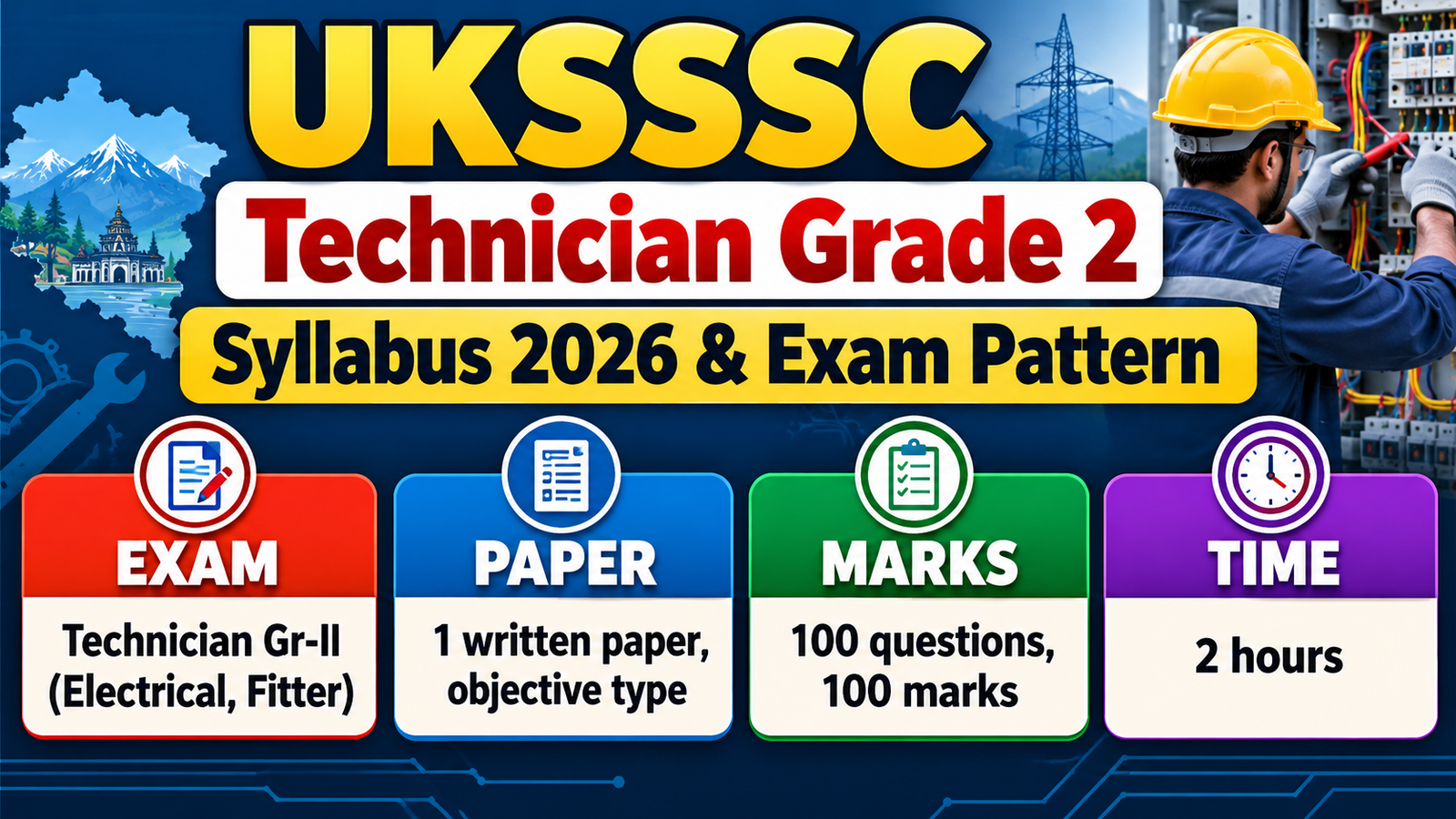
| Exam Pattern | 100 questions, 100 marks, 2 hours – one paper for each post |
| Syllabus Size | Electrical: 13 units. Mechanical (Fitter): 9 units |
| Exam Date | Not specified in notification |
| Official Notification | Download Syllabus Notice PDF |
| Official Website | UKSSSC (sssc.uk.gov.in) |
Important Dates
| Event | Date |
|---|---|
| Uttarakhand Government approves the Mechanical (Fitter) exam plan and syllabus | 13.08.2026 |
| Uttarakhand Government approves the Electrical exam plan and syllabus | 23.09.2026 |
| UKSSSC issues the syllabus notice | 05.10.2026 |
| Exam date | Not specified in notification |
Exam Pattern
| Stage | Details |
|---|---|
| Written exam – Technician Grade-II (Electrical) | One objective-type paper on Electrical. 100 questions, 100 marks, 2 hours. The syllabus for this post was approved for UJVNL and PTCUL. |
| Written exam – Technician Grade-II (Mechanical, Fitter) | One objective-type paper on the Fitter trade. 100 questions, 100 marks, 2 hours. The syllabus for this post was approved for UJVNL. |
| Total marks | 100 for each post |
| Other stages | The notice lists only the written exam. No interview or skill test is mentioned. |
| Negative marking | Not mentioned in the notice |
In short, each post has just one written paper, with 100 questions to finish in 2 hours. “Objective type” means you pick the right answer from the options given. The notice says nothing about wrong answers losing marks, so do not assume either way until the advertisement is out.
Topic-wise Syllabus: Technician Grade-II (Electrical) – 13 Units
| Unit | Topics |
|---|---|
| Unit 1 – Fundamentals of Electricity | Electrical charge, potential difference, voltage, current, electrical power, electrical energy, Ohm’s Law, Kirchhoff’s Law and their application, concept of resistor, inductor and capacitor, types of resistor, colour coding of resistor, equivalent resistance of series and parallel combination, RLC series and parallel circuits, Q-factor, resonance, concept of self and mutual inductance. |
| Unit 2 – Cells and Batteries | Introduction to cells, construction and types of primary and secondary cells, introduction to batteries, material used in batteries, series and parallel connection of batteries and the purpose of such connection, law of electrolysis, use of hygrometer. |
| Unit 3 – Electrical and Electronics Measuring Instruments | Introduction of electrical measuring instruments, error and correction in instruments, types of instruments, PMMC, MI and MC instruments, uses in AC and DC, extension of range of measuring instruments, multimeter, CRO and its applications. |
| Unit 4 – Fundamental Principles of AC | Average value, instantaneous value, peak value, R.M.S value, form factor, peak factor, concept of single and three phase system, star and delta connection, line voltage, phase voltage, line current, phase current, advantages of three phase over single phase, active, reactive and apparent power, power factor. |
| Unit 5 – Fundamental Principles of Electronics | Difference between insulator, semiconductor and conductor, types of semiconductors, PN junction, biasing and characteristics of diode, types of diode, transistor, number system, logic gates symbols and truth table. |
| Unit 6 – Cables and Protective Devices | Types of wire, conductors and cables, Standard Wire Gauge (SWG), types of insulation used in cables, concept of soldering, types of soldering, need of fuse, rating and types of fuse, circuit breakers, MCB, MCCB, ELCB, contactor, isolator, relays. |
| Unit 7 – Renewable and Non-Renewable Energy Sources | Need of renewable energy sources, difference between renewable and non-renewable sources of energy, solar energy as a renewable energy source, basics of PV cell, module and solar panel PV array, principle and working of PV cell. |
| Unit 8 – Inverter and UPS | Introduction of inverter and UPS, difference between inverters and UPS, types of UPS (offline UPS, on-line UPS, line interactive UPS) and their comparison, types of inverters. |
| Unit 9 – Electrical Machines | Introduction of DC motors and their types, methods of speed control of DC motors, principle and construction of DC generators, different types of DC generators, introduction and types of three phase induction motors, slip, no-load and blocked rotor test, stepper motors, working principle of synchronous motors. Working principle, construction and classification of single phase transformer, auto transformer, instrument transformers (CT and PT), various losses in transformer. |
| Unit 10 – Basic Knowledge of Computer and PLC | Basic knowledge of MS Word, MS Excel and PowerPoint presentation, parts of computer, basic knowledge of Programmable Logic Controller (PLC) and Supervisory Control and Data Acquisition (SCADA). |
| Unit 11 – Transmission and Distribution Network | Basics of transmission and distribution network, line, insulator, overhead poles and towers, method of joining conductors. |
| Unit 12 – Safety | Safety rules and safety signs, types of fire extinguishers, first aid, safety tools. |
| Unit 13 – Concept of Various Terms | Average load, maximum demand, demand factor, load factor, diversity factor, concept of earthing. |
Two terms from Unit 10: a PLC is a small industrial computer that runs machines automatically, and SCADA is software that lets operators watch and control a plant from a screen.
Topic-wise Syllabus: Technician Grade-II (Mechanical, Fitter) – 9 Units
| Unit | Topics |
|---|---|
| Unit I – Maintenance and Safety | Maintenance and its types (productive, routine, preventive), colour coding of lubrication, installation and overhauling of machinery and engineering equipment, soft skills, importance of safety and general precautions in the industry or shop floor. First aid, PPEs, response to emergencies such as power failure, fire and system failure. Importance of housekeeping and good shop floor practices, 5S concept and its application, occupational safety and health, material handling equipment. Safety of self, fire and machines (lathe, welding, electrical, sheet metal, hydraulic, pneumatic etc.), foundation and handling of heavy machinery. |
| Unit II – Measuring and Marking Tools | Linear and angular measurements: calipers, dividers, try square, surface plate, Vernier height gauge, Vernier calipers and micrometer, hermaphrodite, Vernier bevel protractor etc. General hand tools and marking equipment: centre punch, dot punch, prick punch, hammers, cold chisels (materials, types, cutting angles), use and care of V-blocks, angle plates, parallel block etc. Bench vice construction, types, uses, care and maintenance, vice clamps. Hacksaw frames and blades: specification, types, uses and method of using hacksaws. Files: specifications, materials, grades, cuts, file elements, uses, types of special files, care and maintenance of files, scraper and its uses. |
| Unit III – Metals and Metallurgy | Physical properties of engineering metal, ferrous metal (pig iron, cast iron, wrought iron, steel: plain carbon steels), non-ferrous metals (copper, aluminium, tin, lead, zinc etc. and their alloys), heat treatment and its methods (normalizing, annealing, hardening and tempering), case hardening and carburizing, metal coatings: chromium silver plating, nickel plating and galvanizing. |
| Unit IV – Welding and Sheet Metal Operations | Commercial sizes and types of metal sheets, shearing machine, sheet metal marking, measuring and cutting tools, types of joints (butt, lap and fillet), tolerance for various joints, their selection and application, wired edges, soldering and brazing, rivets and their types. Machine accessories and hand tools of electric arc and oxy-acetylene gas welding, carbon dioxide welding, H.P. and L.P. welding equipment, gases and gas cylinder description, selection of welding electrodes, oxygen-acetylene cutting machine. |
| Unit V – Machining Operations and Automation | Hole making operations: drilling (counter sink, counter bore and spot facing), boring and reaming, their types and uses, drill geometry, drilling machines and drill holding devices, drill types (fractional, metric, letters and numbers), screw threads, taps and types. Abrasive operations: grinding, lapping, honing and frosting. Lathe specification, types of lathe and its accessories, constructional features, operations, main parts, setting tool for cutting internal and external threads, lathe cutting tools, cutting speed and feed, use of coolants and lubricants, chuck mounting and dismounting. Computer Numerical Control (CNC): introduction, definition and concept, main components and types of CNC machines, comparison between conventional machine tools and CNC machines, advantages and limitations of CNC technology, fundamentals of CNC programming, overview of commonly used programming codes and machining operations. |
| Unit VI – Power Tools and Pipe Fittings | Power tools: constructional features, uses and maintenance. Locking devices: nuts (lock nut, castle nut, slotted nut, swam nut, grooved nut), description and uses. Various types of keys, allowable clearances and tapers, uses of key pullers. Pipes and pipe fittings: commonly used pipes, pipe schedule and standard sizes, pipe bending methods, use of bending fixture, pipe threads (standard pipe threads, die and tap), pipe vices, use of pipe cutters, pipe wrenches, pipe bending machine etc. Standard pipe fitting: methods of fitting or replacing fittings, repairs and erection on rain water drainage pipes and household taps and pipe work. Inspection and quality control: basic SPC, visual inspection. |
| Unit VII (a) – Hydraulics and Pneumatic System: Pneumatics | Difference, comparison, principle and uses of pneumatics and hydraulics systems, Boyle’s law, Pascal’s law, air compressors, air receiver, conductors and fittings, FRL unit, applications of pneumatics, hazards and safety precautions in pneumatic systems. Pneumatic actuators: types, basic operation, force, stroke length, single-acting and double-acting cylinders. Pneumatic valves: classification, symbols of pneumatic components, 3/2-way valves (NO and NC types, manually and pneumatically actuated), 5/2-way valves, check valves, flow control valves, one-way flow control valve, roller valve, shuttle valve, two-pressure valve. Electro-pneumatics: introduction, 3/2-way single solenoid valve, 5/2-way single solenoid valve, 5/2-way double solenoid valve, control components (pushbuttons NO and NC type, electromagnetic relay unit), logic controls. |
| Unit VII (b) – Hydraulics and Pneumatic System: Hydraulics | Symbols of hydraulic components, hydraulic oils (function, properties and types), contamination in oils and its control. Hydraulic filters: types, constructional features, typical installation locations, cavitation, hazards and safety precautions in hydraulic systems. Hydraulic reservoir and accessories: pumps, classification (gear, vane, piston types), pressure relief valves (direct acting and pilot-operated), pipes, tubing, hoses and fittings, constructional details, minimum bend radius, routing tips for hoses, hydraulic cylinder types. Hydraulic motors: types. Hydraulic valves: classification, directional control valves (2/2-, 3/2-, 4/2- and 4/3-way valves), centre positions of 4/3-way valves, check valves and pilot-operated check valves, load holding function. Flow control valves: types, speed control methods (meter-in and meter-out). Preventive maintenance and troubleshooting of pneumatic and hydraulic systems, system malfunctions due to contamination, leakage, friction, improper mountings and cavitation, and proper sampling of hydraulic oils. |
| Unit VIII – Power Transmission, Lubrication and Bearings | Screw threads (square, worm, buttress, Acme): uses and application, use of screw pitch gauge for checking screw thread, assembling techniques, dowel pins, screws (material, designation, specifications), tools for tightening or loosening screws and bolts. Bearings: classification (journal and thrust), types, method of fitting, bearing metals (types, composition and uses), dressing, creep and slipping, consideration of weather, load and tension. Power transmission: belts and their types, sizes and specifications, materials, methods of joining leather belts, V-belts, use of commercial belts, pulleys, chains, wires, ropes, clutch, gears (nomenclature, types, velocity ratio, maintenance), repair of gear teeth by building up and dovetail method. Method of lubrication, cutting lubricants and coolants, selection of lubricants, washers (types and calculation of washer sizes), joints and fitting packing. |
| Unit IX – Engineering Drawing, CAD and Workshop Calculation Science | Engineering drawing and CAD: fundamentals of engineering drawing, types of lines, orthographic projections, sectional and assembly views, and interpretation of engineering drawings related to nuts, bolts, screw threads, locking devices, riveted and welded joints, pipes and pipe fittings, foundation drawings and job drawings. Computer-Aided Design (CAD): introduction, basic concepts and applications, drawing commands, creation and modification of 2D drawings, simple geometric shapes, dimensioning, layer management, preparation of layouts for printing and plotting. Workshop calculation: friction, centre of gravity, area of cut-out regular surfaces (circle, segment and sector of circle) and irregular surfaces, application related to shop problems, stress-strain curve and its numericals, problems on estimation and costing. |
Unit V mentions CNC, short for Computer Numerical Control. These are machine tools that follow a computer program instead of a hand-operated control.
One more line applies to both syllabuses. The notice says current knowledge related to every unit, as covered in the NCVT (NSQF Level-4) syllabus for the Electrician or Electronics trade (Electrical) and the Fitter trade theory (Mechanical), is also counted as part of the syllabus. NCVT is the National Council for Vocational Training, and NSQF is the National Skills Qualifications Framework. So the unit lists above are the core, but not necessarily the full limit of what can be asked.
Important Links
| Link | Open |
|---|---|
| Download Syllabus Notice (PDF) | Download Notification PDF |
| Syllabus Page on UKSSSC Website | View on official site |
| Official Website | sssc.uk.gov.in |
| Telegram Channel | Join Telegram Channel |
| WhatsApp Channel | Join WhatsApp Channel |
Common Mistakes to Avoid
- Do not mix up the two syllabuses. Electrical has 13 units and Fitter has 9, and they are separate papers.
- Do not assume there is negative marking, or that there is none. The notice is silent on it.
- Do not study only the unit lists. The notice also counts current knowledge from the NCVT trade syllabus as included.
- Do not treat this as the job advertisement. It carries no vacancy count, age limit, fee or last date, so apply only after the advertisement is released.
- Check the posts before you plan around an employer. The Fitter syllabus was approved for UJVNL, while the Electrical syllabus was approved for both UJVNL and PTCUL.
- Open the commission site as sssc.uk.gov.in. The “www” address printed in the notice did not load when we tried it.
Frequently Asked Questions
Which posts does this syllabus cover?
It covers Technician Grade-II (Electrical) and Technician Grade-II (Mechanical, Fitter trade), both Group C posts.
Which companies will fill these posts?
The notice names Uttarakhand Jal Vidyut Nigam Ltd (UJVNL) for both posts and Power Transmission Corporation of Uttarakhand Ltd (PTCUL) for the Electrical post.
How many questions, marks and how much time does the paper have?
Each post has one written paper with 100 questions for 100 marks, and you get 2 hours to finish it.
Is there negative marking?
The notice does not say anything about negative marking, so wait for the official advertisement before you decide how to attempt the paper.
When is the exam?
No exam date is given in this notice; it has been announced only as a syllabus and exam plan.
How many units are in each syllabus?
The Electrical syllabus has 13 units and the Mechanical (Fitter) syllabus has 9 units.
Can questions come from outside the listed units?
Possibly, because the notice counts current knowledge from the NCVT (National Council for Vocational Training) NSQF Level-4 trade syllabus as part of every unit. So read your trade’s national syllabus as well as the unit lists.
Where can I read the official syllabus?
It is on the Syllabus page of the UKSSSC website, sssc.uk.gov.in, listed under the date 05/10/2026.
Disclaimer: The information above has been compiled from the official notification for the convenience of job seekers. Candidates are advised to verify all details from the official website before applying.
- UKSSSC Assistant Agriculture Officer, Chara Sahayak Admit Card 2026 Out05.10.2026
- UKSSSC Kalakar, Manchitrakar, Vidhi Sahayak Admit Card 2026 Out – 11.10.202605.10.2026
- UKSSSC Computer Programmer, Cameraman Answer Key 2026 Out – Objection till 05.10.202630.09.2026
- UKSSSC Boring Technician, Computer Programmer Admit Card 2026 Out – 27.09.2026 Exam21.09.2026
- UKSSSC Vahan Chalak Driver Result 2026 Declared – Check Selection List18.09.2026
- UKSSSC Scaler Recruitment 2026 – 200 Posts, Apply Before 22.10.202616.09.2026