
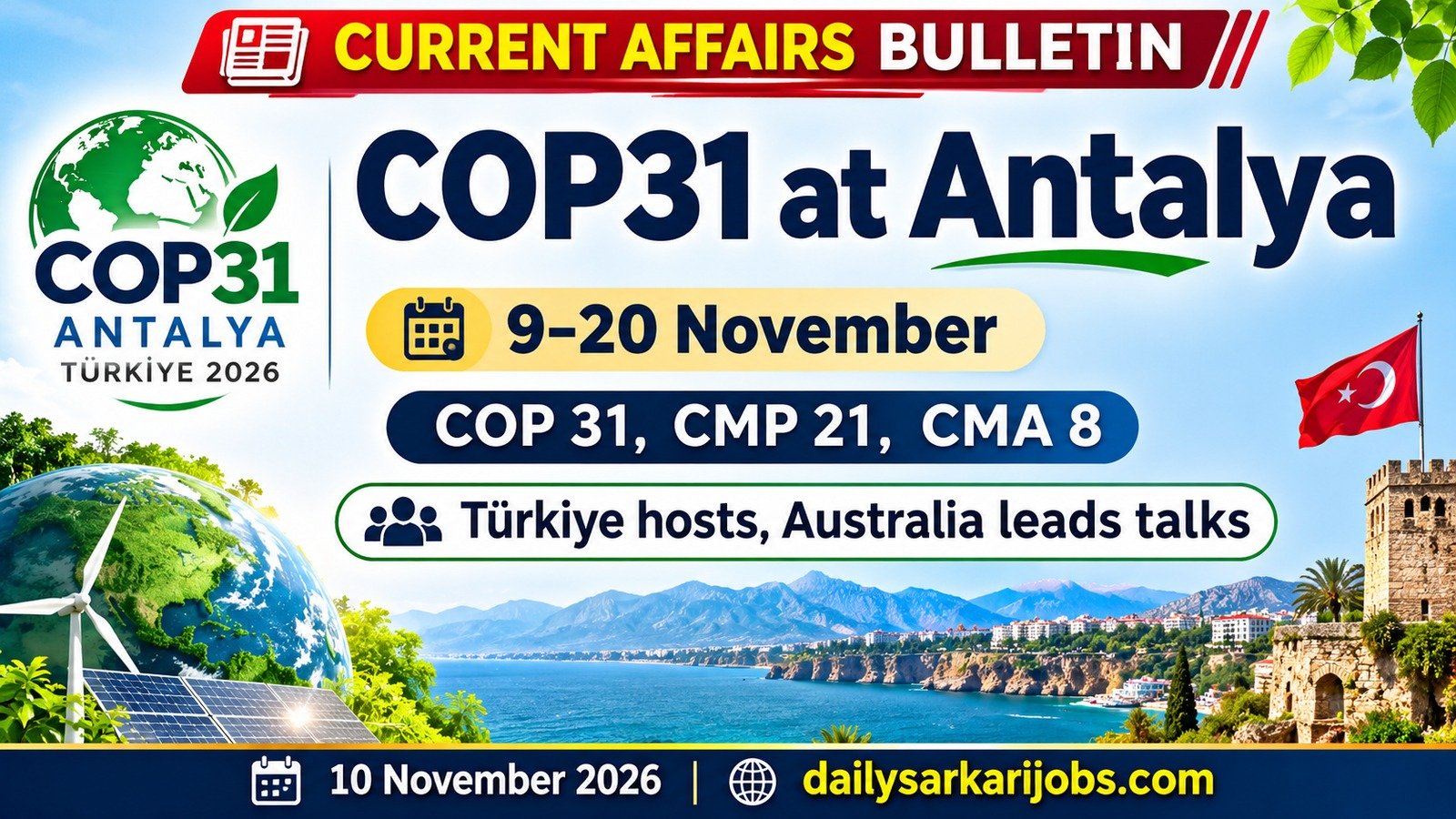
The UN climate conference opened at Antalya in Türkiye on 9 November 2026 and runs to the 20th. Almost every summary will call it one conference. It is three, and knowing why is the fastest way to stop confusing this topic with the other UN meetings that share its name.
COP31 Is Three Meetings in One Hall
The official name of the event is COP 31 / CMP 21 / CMA 8. Three names, three numbers, in one building, in the same fortnight. They are not three sessions of one body — they are the governing meetings of three separate treaties, stacked on top of one another over thirty-four years.
| Meeting | Governs which treaty | Treaty adopted |
|---|---|---|
| COP 31 | The UN Framework Convention on Climate Change | 1992, at the Rio Earth Summit |
| CMP 21 | The Kyoto Protocol | 1997 |
| CMA 8 | The Paris Agreement | 2015 |
Read the numbers and you can read the history. The oldest treaty has met thirty-one times; the newest has met eight. Each time the world wanted to do something the existing treaty could not do, it wrote a new agreement underneath the old one rather than replacing it — so all three are still alive, and all three still need a meeting.
And the word COP by itself means nothing in particular. It stands for Conference of the Parties, which is simply the name for the body where the members of any UN treaty meet. The biodiversity convention has its own COPs; so does the convention on desertification. We covered CBD COP-17 at Yerevan only two weeks ago — that was a different treaty with its own numbering, and putting the two on one list is a classic examination trap.
Jargon, Defined Once
- UNFCCC is the United Nations Framework Convention on Climate Change, agreed at Rio in 1992. A framework convention sets up the machinery and the principle; the actual targets come later, in separate agreements.
- A Party is a country that has formally joined a treaty. Not every UNFCCC member joined Kyoto, and that is exactly why the three meetings are separate.
- An NDC is a Nationally Determined Contribution — the climate plan each country writes for itself under the Paris Agreement. Determined nationally: nobody allots it to you.
- The Presidency is the country that chairs a COP and steers the bargaining for the year that follows it.
- The Action Agenda is the voluntary side of a COP — pledges by companies, cities and groups of countries. It is not the negotiation and it is not binding.
Who Is Actually in Charge, and Why That Is Odd
Türkiye and Australia both bid to host this COP, and neither withdrew. Australia had planned to hold it at Adelaide with its Pacific neighbours. After about a week of negotiation in November 2025 the two settled on a split that has no clean precedent.
- Türkiye hosts the conference and holds the Presidency. Murat Kurum, Türkiye’s Minister of Environment, Urbanisation and Climate Change, is COP President.
- Australia leads the negotiations. Chris Bowen is Vice-President and President of Negotiations.
- Türkiye runs the Action Agenda — the voluntary, non-negotiating side.
- A World Leaders’ Summit is set for 11 and 12 November 2026, early in the fortnight rather than at the end.
- The pre-COP was held in Fiji from 5 to 8 October 2026, which is how the Pacific stayed in the arrangement after Adelaide fell away.
Learn it as a split, not as a mistake. The host and the chair of the talks are usually the same country, and a question that asks who is presiding over COP31 is testing whether you noticed that this year they are not.
Where India Stands
India submitted its climate plan for 2031 to 2035 in April 2026, and these are the figures that travel with the country into this conference.
| Commitment | The number | Measured against |
|---|---|---|
| Emissions intensity of GDP | Cut by 47 per cent by 2035 | the 2005 level |
| Non-fossil electricity capacity | About 60 per cent by 2035 | cumulative installed capacity |
| Carbon sink | 3.5 to 4.0 billion tonnes of CO₂ equivalent | additional forest and tree cover |
| Net zero | 2070 | the long-term goal |
Emissions intensity is the one people misread. It is emissions per unit of GDP, not total emissions. A country can cut its intensity sharply while its total emissions still rise, because the economy is growing faster than the intensity is falling. India’s target is a promise about efficiency, not about a ceiling.
Exam Alert: Five Traps
- COP 31, CMP 21, CMA 8 — three treaties, three numbers. UNFCCC, Kyoto, Paris, in that order.
- The UNFCCC COP is not the CBD COP. Different convention, different numbering, different year of adoption. Both met in 2026.
- Türkiye presides; Australia leads the negotiations. The split is the fact being tested.
- Antalya in 2026 follows Belém in 2025. Host cities are asked year on year.
- NDCs are self-written. The Paris Agreement sets no national target; each country files its own, which is the whole difference from the Kyoto approach.
Did You Know: The Framework Convention Set No Targets at All
The 1992 convention that all of this rests on contains no emission limit for anybody. It states an objective, creates the Conference of the Parties, and sets out the principle that countries have common but differentiated responsibilities. That is nearly the whole of it.
That was deliberate, and it is why the structure looks the way it does. A convention that bound nobody could be agreed by almost everybody, and once the machinery existed the arguing could be done inside it rather than about whether to have it. Kyoto in 1997 and Paris in 2015 are both attempts to put numbers into that empty frame — the first by allotting targets, the second by asking countries to set their own. Thirty-one meetings later, the frame is still the same frame.
Why a Reader Should Care
Climate meetings are among the most reliably asked Current Affairs items there are, because they happen on a fixed calendar and the questions are always the same four: which COP, which city, which country, which year. Add the treaty-and-number table to that and you have covered most of what is likely to be asked. It sits beside our capsules on CBD COP-17, on the International Solar Alliance and on India’s first soil carbon payments to farmers.
Today’s Static GK capsule is on ecosystems and energy flow, and the pair belong together more closely than they look. The whole climate problem is a statement about the carbon cycle: carbon that had left circulation millions of years ago is being put back into it faster than the cycle can absorb. The capsule explains why matter cycles at all, and why energy — unlike carbon — never comes round again.
Practice Questions
Q1. COP31, being held at Antalya in November 2026, is a meeting of the Parties to
(a) The Convention on Biological Diversity (b) The UN Framework Convention on Climate Change (c) The Paris Agreement alone (d) The Kyoto Protocol alone
Answer: (b) The UN Framework Convention on Climate Change The Paris Agreement and the Kyoto Protocol have their own meetings, numbered CMA 8 and CMP 21, held alongside it.
Q2. COP31 is being hosted by Türkiye, but the negotiations are being presided over by
(a) Brazil (b) Fiji (c) Australia (d) the United Arab Emirates
Answer: (c) Australia Murat Kurum of Türkiye is COP President while Chris Bowen holds the post of President of Negotiations, an arrangement settled after both countries bid to host.
Q3. The United Nations Framework Convention on Climate Change was adopted in
(a) 1997 (b) 2015 (c) 2005 (d) 1992
Answer: (d) 1992 It was agreed at the Rio Earth Summit; the Kyoto Protocol followed in 1997 and the Paris Agreement in 2015.
Q4. Under India’s Nationally Determined Contribution for 2031 to 2035, emissions intensity of GDP is to be reduced by
(a) 33 to 35 per cent (b) 47 per cent (c) 60 per cent (d) 25 per cent
Answer: (b) 47 per cent The reduction is measured against the 2005 level, and the same plan sets a non-fossil installed capacity share of about 60 per cent by 2035.
Q5. Which statement about a Nationally Determined Contribution is correct?
(a) It is allotted to each country by the Conference of the Parties (b) It applies only to developed countries (c) It is decided and submitted by the country itself (d) It is legally enforceable before the International Court of Justice
Answer: (c) It is decided and submitted by the country itself That self-determined design is the central difference between the Paris Agreement and the Kyoto Protocol, which assigned targets to a listed group of countries.
30-Second Revision
- The hinge: COP31 is three meetings in one hall — COP 31 (UNFCCC, 1992), CMP 21 (Kyoto, 1997), CMA 8 (Paris, 2015).
- The event: Antalya, Türkiye, 9 to 20 November 2026; World Leaders’ Summit on 11 and 12 November; pre-COP at Fiji in October.
- The split: Türkiye hosts and presides (Murat Kurum) while Australia leads the negotiations (Chris Bowen). COP30 was Belém, 2025.
- India’s numbers: 47 per cent intensity cut by 2035 from 2005, about 60 per cent non-fossil capacity, a sink of 3.5 to 4.0 billion tonnes, net zero 2070.
- The trap: the UNFCCC COP and the CBD COP are different conventions. Both met in 2026.
What Is Not Settled
The outcome. This conference opened on 9 November and closes on the 20th. Nothing has been negotiated yet, and any list of decisions circulating before the end of the fortnight is a wish list rather than a result. If a question asks what COP31 decided, the answer will only exist after it closes.
Second, the agenda carries no single official theme. The Presidencies have spoken of transformative outcomes and of accelerating implementation of the Paris Agreement while keeping the 1.5°C goal in reach, but that is a stated aim rather than a formal agenda item. Do not treat a slogan from a news report as the conference’s theme.
Sources
- UNFCCC, The Road to Antalya — the official dates of 9 to 20 November 2026, the venue at Antalya, Türkiye, and the designation of the sessions as COP 31 / CMP 21 / CMA 8.
- Reference material on the 2026 United Nations Climate Change Conference — the venue at the Antalya Expo Center, Murat Kurum as COP President and Chris Bowen as Vice-President and President of Negotiations, the Türkiye–Australia arrangement agreed after about a week of negotiation in November 2025, Australia’s earlier plan to host at Adelaide, Türkiye’s responsibility for the Action Agenda, the World Leaders’ Summit on 11 and 12 November 2026, the pre-COP in Fiji from 5 to 8 October 2026, and COP30 at Belém in 2025.
- India’s Nationally Determined Contribution for 2031–2035, as filed with the UNFCCC and dated April 2026 — the 47 per cent reduction in emissions intensity of GDP by 2035 from the 2005 level, about 60 per cent cumulative non-fossil installed electric power capacity, a carbon sink of 3.5 to 4.0 billion tonnes of CO₂ equivalent, and the net-zero by 2070 goal.