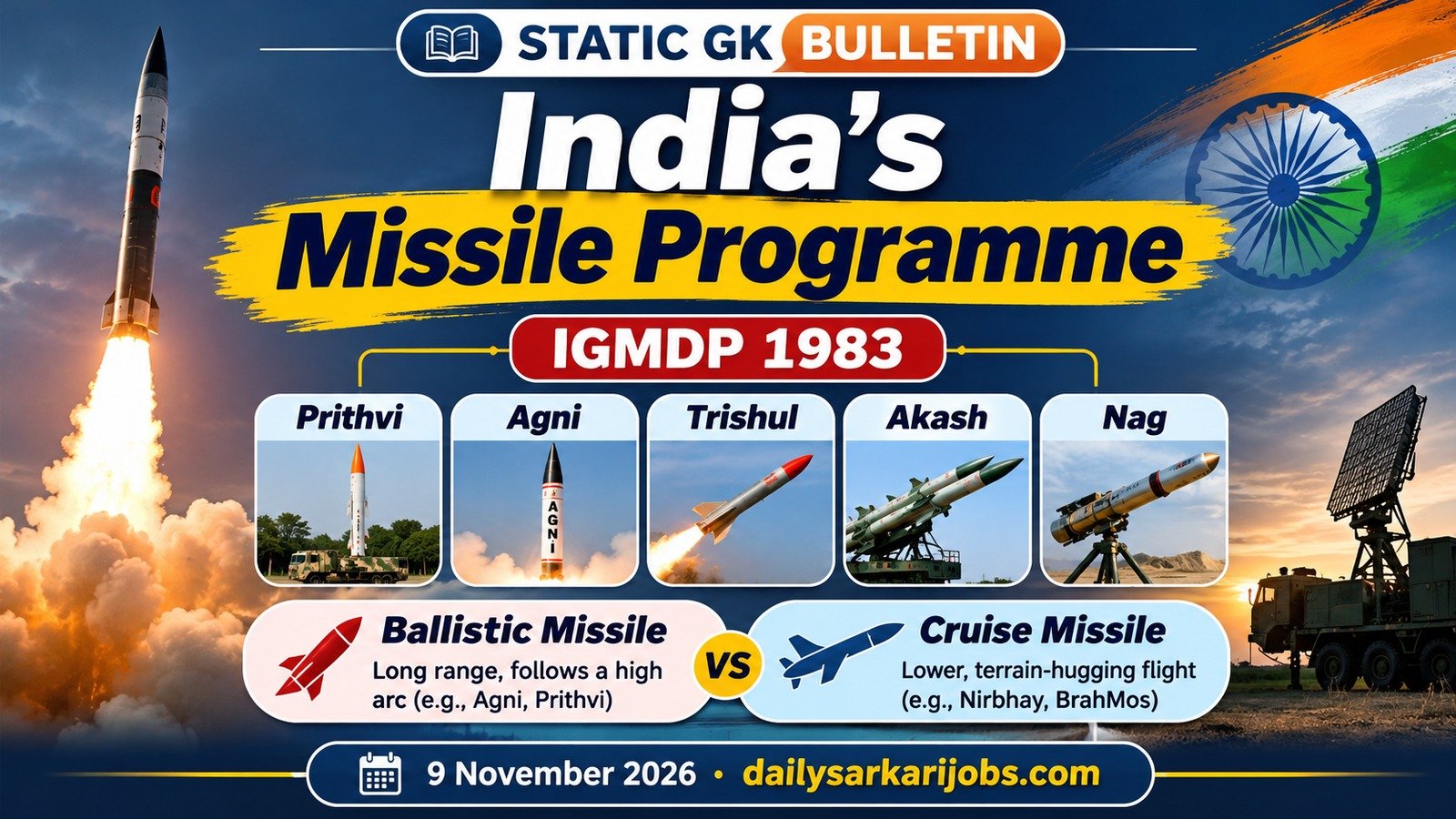
Missile questions look like a list of names to be memorised, and that is why people lose marks on them.There is one distinction that organises the entire topic, and it has nothing to do with names.
A Ballistic Missile Is Thrown. A Cruise Missile Flies.
A ballistic missile is launched like a stone.Its engine burns for the first part of the journey, lifting it high — often right out of the atmosphere — and then it stops. After that the missile is simply falling, following the arc that gravity gives it. Most of its flight is unpowered.
A cruise missile is launched like an aircraft.It has wings and an engine that runs the whole way. It flies low, it stays inside the atmosphere, and it can turn.
Ballistic
Cruise
Engine runs
Only at the start
All the way
Path
A high arc, largely unpowered
Low and level, like an aeroplane
Leaves the atmosphere?
Usually yes, for longer ranges
No
Can it change course?
Very little once the engine cuts off
Yes, it is steered throughout
Indian example
Agni, Prithvi
BrahMos, Nirbhay
Once you hold that, the names sort themselves.Anything in the Agni or Prithvi family is ballistic. BrahMos is a cruise missile. And the reason a cruise missile is hard to stop is not that it is fast — it is that it flies low enough to stay under radar for much of its route.
Jargon, Defined Once
Surface-to-surface means launched from the ground at a target on the ground; surface-to-air means launched from the ground at something flying. The name always reads launcher-to-target.
Fire and forget means the missile guides itself after launch, so the crew can move immediately instead of holding position to steer it.
A top-attack weapon strikes a tank from above, where the armour is thinnest.
Re-entry technology is what lets a warhead survive coming back into the atmosphere. It is the hard part of a long-range ballistic missile, and it is what Agni was first built to prove.
DRDO is the Defence Research and Development Organisation, the body that designs India’s military systems.
The IGMDP and Its Five Missiles
The Integrated Guided Missile Development Programme was launched in 1983 under DRDO, headed at the outset by Dr A. P. J. Abdul Kalam. Its purpose was to build a complete set of missile types at once, rather than one at a time — which is what the word integrated is doing in the name.
Missile
Type
Worth remembering
Prithvi
Surface-to-surface
Ranges of 150, 250 and 350 km for the Army, Air Force and Navy
Agni
Ballistic
Began as a technology demonstrator for re-entry, grew into a whole family
Akash
Surface-to-air
About 25 km; can engage several targets at once
Nag
Anti-tank
Third generation, fire-and-forget, top-attack
Trishul
Short-range surface-to-air
Completed as a technology demonstration
A memory hook that works: PATAN.Prithvi, Agni, Trishul, Akash, Nag — five letters, five missiles, and the word is a place name you already know.
Exam Alert: Four Traps
BrahMos is not part of the IGMDP.It is a joint venture with Russia, and its name comes from the Brahmaputra and the Moskva. It is also a cruise missile, while the programme’s headline weapons are ballistic. This is the single most common wrong answer on the topic.
Akash and Trishul are surface-to-air; Prithvi is surface-to-surface.Two of the five shoot at aircraft and one shoots at the ground.
Nag is the anti-tank one.Short name, short range, and the only one of the five aimed at armour.
1983 and Kalam go together.The year the programme began and the man who led it are usually asked as one question.
Did You Know: Agni Was Not Meant to Be a Weapon
Agni entered the programme as a technology demonstrator.Its job was to prove that India could build a warhead able to survive re-entry — the heat and stress of falling back into the atmosphere at enormous speed. It was an experiment, not a product.
It is now the family the whole programme is remembered for.That is worth noticing as a general pattern rather than a piece of trivia: in long research programmes, the item listed as a demonstration quite often turns out to be the one that mattered, and the ones listed as products quietly close.Trishul, by contrast, ended as a demonstration and went no further.
Why a Reader Should Care
Defence is a small, high-yield section, and missiles supply most of its questions.The names, the types and the year recur without changing, which makes this one of the cheapest sets of marks in the syllabus.
Today’s Current Affairs explainer is on India’s record sixth Asian Champions Trophy. The connection is the shape rather than the subject: both are long home-grown projects where the result shows up many years after the decision to start.
Practice Questions
Q1. The Integrated Guided Missile Development Programme was launched in (a) 1974 (b) 1983 (c) 1991 (d) 1998 Answer: (b) 1983 It was run by the DRDO and headed at the outset by Dr A. P. J. Abdul Kalam.
Q2. Which of these is NOT one of the five missiles of the IGMDP? (a) Trishul (b) Nag (c) BrahMos (d) Akash Answer: (c) BrahMos That one is a cruise missile developed jointly with Russia, and its name combines the Brahmaputra and the Moskva.
Q3. The Nag missile is designed as a (a) Surface-to-air missile (b) Anti-tank missile (c) Submarine-launched missile (d) Air-to-air missile Answer: (b) Anti-tank missile It is described as third generation, fire-and-forget and top-attack, striking armour where it is thinnest.
Q4. Which statement correctly distinguishes a cruise missile from a ballistic missile? (a) A cruise missile is unpowered for most of its flight (b) A cruise missile always carries a nuclear warhead (c) A cruise missile is powered throughout and flies within the atmosphere (d) A cruise missile has a longer range by definition Answer: (c) A cruise missile is powered throughout and flies within the atmosphere The other kind burns its engine only at the start and then follows the arc gravity gives it, usually leaving the atmosphere on the way.
Q5. Within the IGMDP, Agni was originally taken up as (a) A surface-to-air system (b) An anti-tank system (c) A technology demonstrator for re-entry (d) A naval cruise missile Answer: (c) A technology demonstrator for re-entry Trishul was the other project that was completed as a demonstration, while Akash and Nag went on to induction.
30-Second Revision
The hinge:ballistic is thrown, cruise flies.Ballistic burns briefly then falls on an arc, usually leaving the atmosphere; cruise is powered and steered the whole way, low and inside it.
The programme:IGMDP, 1983, DRDO, Dr A. P. J. Abdul Kalam.
The five — PATAN:Prithvi (surface-to-surface, 150/250/350 km), Agni (ballistic, began as a re-entry demonstrator), Trishul (short-range surface-to-air), Akash (surface-to-air, about 25 km, multi-target), Nag (anti-tank, fire-and-forget, top-attack).
The trap:BrahMos is NOT in the IGMDP — it is an India-Russia cruise missile named after the Brahmaputra and Moskva.
Two of the five (Akash, Trishul) shoot at aircraft; one (Nag) shoots at tanks.
What Is Not Settled
One note on a published error, because it will mislead you if you meet it.At least one official government page lists Prithvi as a surface-to-air missile.It is not; Prithvi is surface-to-surface, which is how every standard reference and every examination treats it. The range figures on that same page — 150, 250 and 350 km for the Army, Air Force and Navy — are the ones in general use.
Second, ranges and generations move as variants are added. The figures above are the programme-era ones that examinations use. For a current operational figure, go to the Ministry of Defence or DRDO directly rather than to a coaching list.
Sources
Press Information Bureau material on the Integrated Guided Missile Development Programme — its launch in 1983 under the DRDO, headed at the outset by Dr A. P. J. Abdul Kalam; Agni as a technology demonstration project for re-entry technology; Prithvi with ranges of 150, 250 and 350 km for the Army, Air Force and Navy; Akash as a surface-to-air system of about 25 km with multi-target handling; Nag as a third-generation fire-and-forget, top-attack anti-tank missile; and Trishul as completed in the form of a technology demonstration.
The distinction between ballistic and cruise missiles, and the status of BrahMos as an India-Russia joint venture named after the Brahmaputra and the Moskva, are standard defence reference material.
Where an official page conflicts with the standard classification of Prithvi, the conflict is stated above rather than quietly resolved.