Ecology is usually taught as a vocabulary list — trophic level, biomass, pyramid, succession.There is a single sentence underneath all of it, and once you have it the rest of the chapter stops needing to be memorised.
Energy Flows One Way. Matter Goes Round in Circles.
Sunlight arrives, plants capture a little of it, and from that moment it is on a one-way journey out.Every time one organism eats another, most of what was captured is spent on staying alive and leaves as heat. It does not come back. The sun has to send more tomorrow.
Atoms behave in the opposite way.The carbon, nitrogen and water in a leaf pass into the animal that eats it, into the animal that eats that one, into the soil when both die, and back into another leaf. The same atoms have been going round for a very long time. Nothing new has to arrive.
That difference explains almost everything else in this chapter.It is why food chains are short, why there are always fewer tigers than deer, why one pyramid can never be inverted while the others can, and why there are nutrient cycles but no energy cycle.Energy is spent; matter is only borrowed.
Jargon, Defined Once
An ecosystem is a community of living things together with the non-living surroundings they interact with, treated as one working unit. The term was coined by the British botanist A. G. Tansley in 1935.
Abiotic means the non-living part — sunlight, temperature, water, air, soil and minerals. Biotic means the living part.
A trophic level is the step an organism occupies in the feeding order. Trophic simply means feeding. Producers are the first level, herbivores the second, and so on.
Autotrophs make their own food, heterotrophs cannot and must eat others, and saprotrophs feed on dead material.
Biomass is the total weight of living material at a level, not the number of individuals.
Who Does What in an Ecosystem
Role
What they do
Examples
Producers
Capture sunlight and make food by photosynthesis
Green plants, algae, phytoplankton
Primary consumers
Eat the producers — the herbivores
Deer, grasshopper, cow
Secondary consumers
Eat the herbivores
Frog, small snake, fox
Tertiary consumers
Eat the secondary consumers; the top carnivores
Tiger, eagle, large snake
Decomposers
Break down the dead and return the nutrients to the soil
Bacteria, fungi
Decomposers are the ones most often misplaced.They are not a fourth kind of consumer sitting at the top. They work on every level at once, and they are the step that closes the matter loop — without them the nutrients would stay locked in dead bodies and the cycle would stop.
The 10 Per Cent Law, and Why Food Chains Are Short
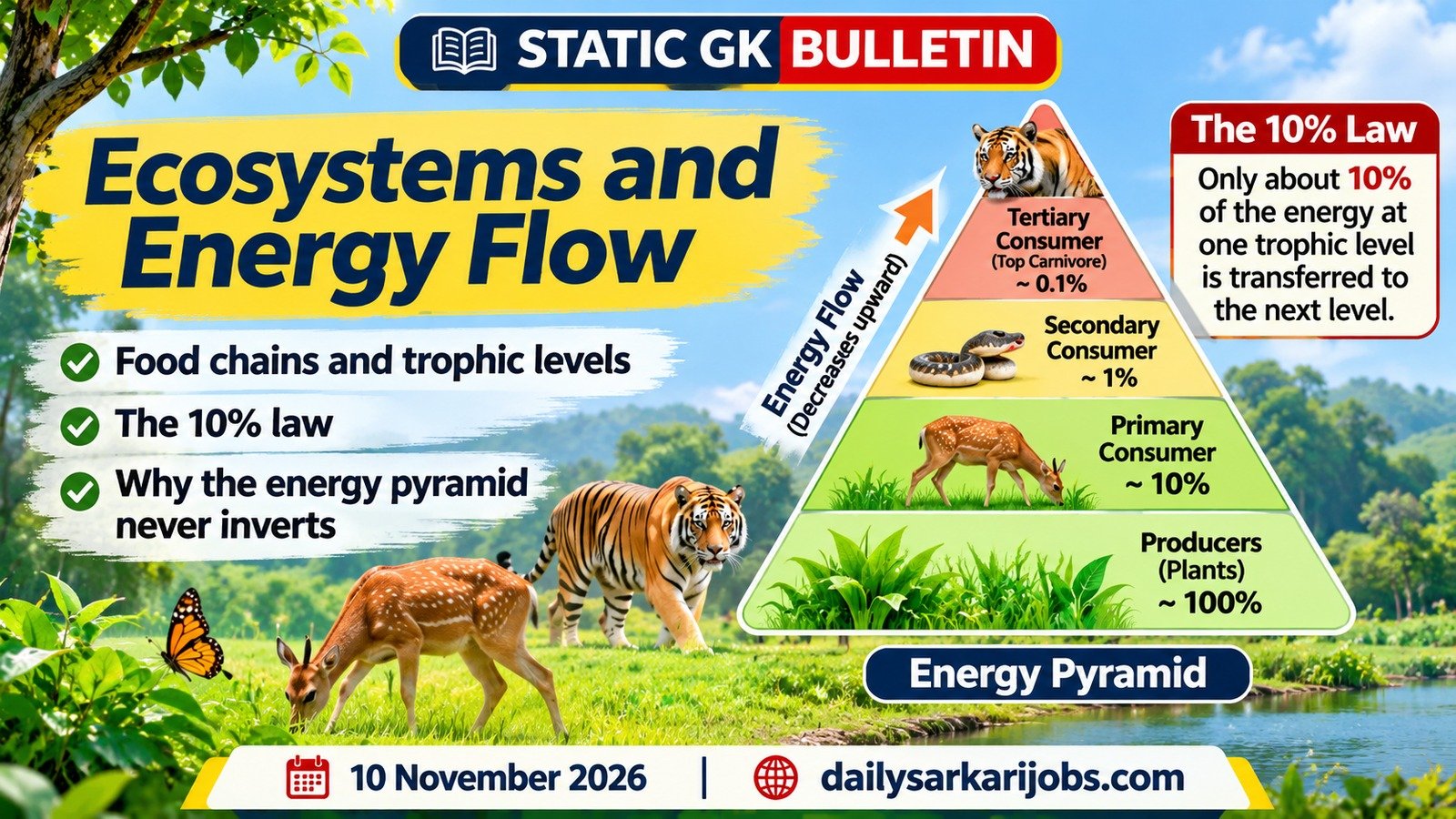
Only about 10 per cent of the energy at one trophic level reaches the next.The other 90 per cent or so is used in respiration, movement and ordinary living, and lost as heat. This is usually called Lindeman’s ten per cent law, after the ecologist who set it out in 1942, and it is a rough rule rather than a precise constant.
Trophic level
Roughly how much energy is left
Producers
1,000 units
Herbivores
100 units
Small carnivores
10 units
Top carnivores
1 unit
Follow that column down and the answer to a very common question falls out.After four or five steps there is simply not enough energy left to support another level, which is why real food chains almost never run longer than that — and why top predators are always rare. A tiger is not rare because it is unlucky. It is rare because arithmetic will not allow many of them.
Food Chains, Food Webs and the Two Starting Points
A food chain is a single line of who eats whom. A food web is the real thing — many chains crossing, because most animals eat more than one food.
A food web is more stable than a chain.If one link fails, the others carry the load; in a single chain, a break stops everything above it.
A grazing food chain starts with living producers — grass to deer to tiger.
A detritus food chain starts with dead organic matter — fallen leaves to earthworms and fungi to the birds that eat them.
In many land ecosystems the detritus chain carries more of the energy than the grazing chain does, because most leaf material is never eaten alive; it falls and rots.
The Three Ecological Pyramids
Pyramid of
What it measures
Can it be inverted?
Number
How many individuals at each level
Yes — one tree feeds thousands of insects
Biomass
Total weight of living matter at each level
Yes — commonly in the sea
Energy
Energy passing through each level
Never. Always upright
The last row is the one worth carrying out of this capsule.A pyramid of energy cannot be inverted, because that would mean a level passing on more energy than it received. Energy is not created on the way up. Numbers and weights can play tricks; energy cannot.
Exam Alert: Five Traps
The pyramid of energy is always upright.Number and biomass can invert. This single distinction is asked more than anything else in the chapter.
Decomposers are not consumers.They are a separate role and they act at every level.
Energy flows; nutrients cycle.There is no energy cycle, and that is not loose wording.
Tansley coined ecosystem in 1935; Lindeman gave the ten per cent law in 1942.Two names, two dates, regularly swapped in options.
Producers are the FIRST trophic level, not the base of a pyramid of consumers.Counting from the wrong end turns a correct answer into a wrong one.
Did You Know: In the Sea, the Pyramid of Biomass Stands on Its Head
Weigh everything in a patch of ocean on a given day and the tiny plants weigh less than the animals eating them.The pyramid of biomass comes out upside down, which looks impossible. It is not.
The explanation is speed, not quantity.Phytoplankton live for days and reproduce furiously. Over a year they produce an enormous amount of food; at any single moment, most of what they have produced has already been eaten, so very little is standing there to be weighed.A weighing is a photograph, not a total.Measure the energy passing through over time instead and the pyramid is the right way up again — which is exactly why the energy pyramid is the honest one.
Why a Reader Should Care
Environment and ecology is a short, high-yield section, and these definitions are reused in every question about pollution, conservation and climate that follows. They are also the cheapest marks in the subject, because the facts do not change from year to year. It sits beside our capsules on India’s national parks and protected areas and on the Air Quality Index, and the biodiversity targets in our CBD COP-17 explainer are written in exactly this vocabulary.
Today’s Current Affairs explainer is on COP31, the UN climate conference at Antalya, and the two make one argument together. Climate negotiation is an argument about the carbon cycle — about matter that was taken out of circulation and is being put back faster than the cycle can take it. What is being negotiated is the pace of a loop. The energy side of the story needs no negotiation at all, because the sun sends a fresh supply every morning and yesterday’s is already gone.
Practice Questions
Q1. The term ecosystem was coined by (a) Charles Elton (b) A. G. Tansley (c) Raymond Lindeman (d) Eugene Odum Answer: (b) A. G. Tansley The term dates from 1935; the ten per cent law of energy transfer came later, in 1942.
Q2. Approximately what proportion of the energy at one trophic level is passed on to the next? (a) 50 per cent (b) 25 per cent (c) 10 per cent (d) 90 per cent Answer: (c) 10 per cent The remainder is spent on respiration and ordinary living and lost as heat, which is why food chains rarely exceed four or five levels.
Q3. Which ecological pyramid can never be inverted? (a) The pyramid of energy (b) The pyramid of numbers (c) The pyramid of biomass (d) All three can be inverted Answer: (a) The pyramid of energy An inverted one would mean a level passing on more than it received, and energy is not created on the way up.
Q4. In an ecosystem, bacteria and fungi that break down dead organic matter are classified as (a) Primary consumers (b) Producers (c) Tertiary consumers (d) Decomposers Answer: (d) Decomposers They act at every trophic level rather than occupying one, and they are the step that returns nutrients to the soil.
Q5. A food chain that begins with fallen leaves and other dead organic matter is called a (a) Grazing food chain (b) Detritus food chain (c) Parasitic food chain (d) Predator chain Answer: (b) Detritus food chain The other kind begins with living producers, and on land the dead-matter route often carries more of the total energy.
30-Second Revision
The hinge:energy flows one way and leaks at every step; matter goes round in circles.That is why there are nutrient cycles and no energy cycle.
The parts:abiotic and biotic; producers, consumers, decomposers. Ecosystem coined by Tansley, 1935.
The number: the 10 per cent law (Lindeman, 1942) — which is why food chains stop at four or five levels and top predators are few.
The pyramids:number and biomass can invert; energy never can.
Two chains:grazing starts with living plants, detritus starts with dead matter. A food web is many chains crossing, and is more stable than any one of them.
What Is Not Settled
The ten per cent figure is an average, not a constant.Real transfer efficiencies vary a good deal between ecosystems and between levels, and ecologists treat the figure as a teaching rule. Examinations ask for ten per cent, so answer ten per cent — but know that it is a rounded generalisation and not a law of physics.
Second, trophic levels are tidier on paper than in nature. An omnivore occupies more than one level at once, and many animals change level with age or season. The ladder is a model that makes the arithmetic possible; the food web is the truer picture.
Sources
NCERT and standard environment and ecology material — the definition of an ecosystem and its abiotic and biotic components, the coining of the term by A. G. Tansley in 1935, the classification into producers, consumers and decomposers, trophic levels, grazing and detritus food chains, food webs, and the three ecological pyramids with the rule that the pyramid of energy is always upright.
Standard treatments of Lindeman’s ten per cent law (1942) and of the unidirectional flow of energy against the cyclic movement of nutrients, including the inverted pyramid of biomass observed in aquatic ecosystems and the reason for it.
Transfer efficiencies and the limits of the trophic-level model are noted above as approximations rather than fixed values, because that is how the scientific literature treats them.