The structure of India’s armed forces looks like a simple ladder and is not one. There is one fact at the top of it that surprises almost everybody, and once you have it the rest of the chart makes sense.
India’s Senior-most Military Officer Commands Nothing
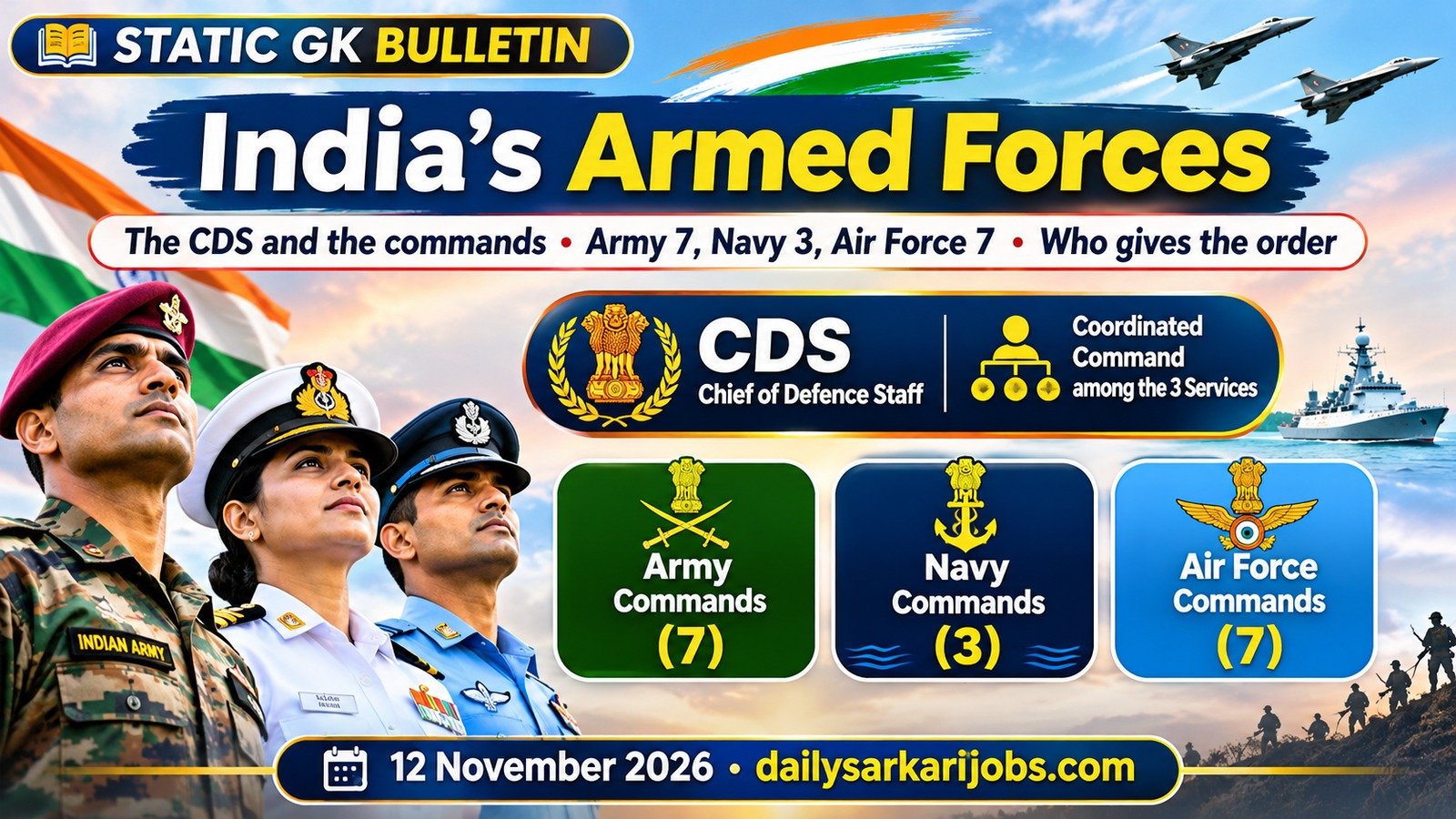
The Chief of Defence Staff is the professional head of the armed forces, and he cannot order a single soldier, ship or aircraft into action. The official description of the post is blunt about it: the office is advisory, and it is endowed with no operational command control.
The phrase used for his standing among the three service chiefs is primus inter pares — first among equals. He outranks nobody. He coordinates.
So where does the power to give an order actually sit? With the commands. India’s forces are divided into geographical and functional commands, and each is headed by a Commander-in-Chief who does hold operational control of everything inside it. The chiefs raise, train and equip their service; the commanders-in-chief fight it. Rank and command are two different things, and this chapter is mostly about keeping them apart.
Jargon, Defined Once
- The Supreme Commander of the armed forces is the President of India, a constitutional office rather than a military one.
- A command is a division of a service, usually by geography. Each has its own headquarters and its own commander, and it is where operational authority lives.
- The Chiefs of Staff Committee is the body where the three service chiefs sit together. The CDS is its Permanent Chairman.
- The Department of Military Affairs is one of the five departments of the Ministry of Defence, created alongside the CDS post. The CDS is its Secretary.
- A tri-service command draws from the Army, the Navy and the Air Force at once, rather than belonging to one of them.
The Chief of Defence Staff
| Fact | Detail |
|---|---|
| Post created | 1 January 2020 |
| First holder | General Bipin Rawat, who died in office on 8 December 2021 |
| Second holder | General Anil Chauhan, from 30 September 2022 to 30 May 2026 |
| Current holder | General N. S. Raja Subramani, since 31 May 2026 |
| Other hats | Secretary, Department of Military Affairs; Permanent Chairman, Chiefs of Staff Committee |
| Operational command | None over the three services |
The post was vacant for almost ten months between December 2021 and September 2022, and during that gap the senior-most service chief chaired the Chiefs of Staff Committee instead. That is worth remembering as the fallback arrangement, not as an alternative design.
How Many Commands Each Service Has
| Service | Commands | Made up of |
|---|---|---|
| Army | Seven | Six operational and one training |
| Navy | Three | Western, Eastern and Southern |
| Air Force | Seven | Five operational and two functional |
The Navy’s three are the ones most worth learning by heart, because they are few, they are fixed, and they turn up constantly in questions about where an exercise or a ship is based.
| Naval command | Headquarters | Headed by |
|---|---|---|
| Western Naval Command | Mumbai | A Flag Officer Commanding-in-Chief, of the rank of Vice Admiral |
| Eastern Naval Command | Visakhapatnam | A Flag Officer Commanding-in-Chief, of the rank of Vice Admiral |
| Southern Naval Command | Kochi | A Flag Officer Commanding-in-Chief, of the rank of Vice Admiral |
The Tri-Service Bodies
- The Andaman and Nicobar Command is India’s tri-service command based in the Andaman and Nicobar Islands — the one place where the three services sit under a single operational commander.
- The Strategic Forces Command handles India’s nuclear delivery arrangements.
- The Integrated Defence Staff is the joint staff organisation that supports the Chiefs of Staff Committee.
- The CDS does hold command authority over three newer inter-service bodies — the Defence Cyber Agency, the Defence Space Agency and the Armed Forces Special Operations Division.
The Ranks at the Top
| Service | Four-star head | Five-star honorary rank |
|---|---|---|
| Army | General | Field Marshal |
| Navy | Admiral | Admiral of the Fleet, never conferred in India |
| Air Force | Air Chief Marshal | Marshal of the Indian Air Force |
India has conferred a five-star rank three times in its history. Field Marshal on K. M. Cariappa and Sam Manekshaw, and Marshal of the Indian Air Force on Arjan Singh. The naval equivalent has never been given to anyone.
Exam Alert: Five Traps
- The CDS has no operational command over the three services. This is the single most common wrong assumption on the topic.
- The Supreme Commander is the President, not the Prime Minister and not the Defence Minister.
- The Navy has three commands; the Army and the Air Force have seven each. Three, seven, seven.
- The Andaman and Nicobar Command is the tri-service one. The Strategic Forces Command is also tri-service in composition, but it is the Andaman and Nicobar Command that is the geographical one.
- Eastern Naval Command is at Visakhapatnam, not Kolkata. Western is Mumbai, Southern is Kochi.
Did You Know: The CDS Commands Three Things, and None of Them Is a Service
An officer with no operational command over the Army, the Navy or the Air Force does command something. Three inter-service organisations report to him: the Defence Cyber Agency, the Defence Space Agency and the Armed Forces Special Operations Division.
Look at that list and the logic of the whole post becomes visible. Cyber, space and special operations are precisely the areas that do not belong to any one service, because a cyber attack, a satellite and a special-forces raid can each involve all three at once. The CDS was given command of exactly the things that could not sensibly be given to a single chief. He commands the gaps between the services, which is a fair description of the whole job.
Why a Reader Should Care
Defence is a small section and this is the frame the rest of it hangs on, because a question about an appointment, a command, an exercise or a rank all assumes you know this chart. It sits with our capsules on India’s missile programme, on the Central Armed Police Forces — which are a different thing entirely, under the Home Ministry rather than Defence — and on the eight next-generation corvettes.
Today’s Current Affairs explainer is on the two naval exercises India held this week, and this capsule is the answer key to it. IMNEX-26 ran at Visakhapatnam, which the table above identifies as the headquarters of the Eastern Naval Command. An exercise is not held in a city; it is held by a command — and knowing which one tells you which stretch of ocean the exercise is really about.
Practice Questions
Q1. The Supreme Commander of the Indian Armed Forces is
(a) The Prime Minister (b) The President of India (c) The Defence Minister (d) The Chief of Defence Staff
Answer: (b) The President of India It is a constitutional office rather than a military one, and the holder does not exercise day-to-day command.
Q2. The post of Chief of Defence Staff came into effect on
(a) 15 August 2019 (b) 26 January 2021 (c) 1 January 2020 (d) 1 April 2022
Answer: (c) 1 January 2020 General Bipin Rawat was the first holder, and he died in office in December 2021.
Q3. Which statement about the Chief of Defence Staff is correct?
(a) He exercises operational command over all three services (b) He is the Supreme Commander of the armed forces (c) He outranks the three service chiefs (d) He is first among equals and holds no operational command over the services
Answer: (d) He is first among equals and holds no operational command over the services He is, however, the Permanent Chairman of the Chiefs of Staff Committee and the Secretary of the Department of Military Affairs.
Q4. The headquarters of the Eastern Naval Command is at
(a) Kolkata (b) Chennai (c) Visakhapatnam (d) Port Blair
Answer: (c) Visakhapatnam The Western Naval Command is headquartered at Mumbai and the Southern Naval Command at Kochi.
Q5. India’s tri-service geographical command is the
(a) Strategic Forces Command (b) Andaman and Nicobar Command (c) Integrated Defence Staff (d) Army Training Command
Answer: (b) Andaman and Nicobar Command It draws personnel from the Army, the Navy and the Air Force under a single operational commander.
30-Second Revision
- The hinge: the CDS commands nothing in the three services. He is first among equals; operational command sits with the Commanders-in-Chief of commands.
- The CDS: post from 1 January 2020; Bipin Rawat (died in office), Anil Chauhan, and N. S. Raja Subramani since 31 May 2026. Secretary, DMA; Permanent Chairman, COSC.
- The count: Army 7, Navy 3, Air Force 7. Supreme Commander: the President.
- The Navy’s three: Western — Mumbai, Eastern — Visakhapatnam, Southern — Kochi, each under a Flag Officer Commanding-in-Chief.
- Tri-service: Andaman and Nicobar Command, Strategic Forces Command, Integrated Defence Staff; the CDS separately commands the cyber, space and special operations bodies.
What Is Not Settled
The names of the three service chiefs are deliberately left out of this capsule. They change on a fixed retirement cycle, the sources consulted disagreed with each other on at least one of them, and a wrong name is worse than no name. Check the Army, Navy or Air Force website, or a Press Information Bureau release, on the day you need it. The structure above does not change; the occupants do.
Second, India’s command structure is under active review. Proposals for integrated theatre commands — merging units of the three services under single regional commanders — have been discussed for years. Nothing in the chart above has been replaced, and until something is formally created, answer from the structure as it stands.
Sources
- Reference material on the Chief of Defence Staff of India — the creation of the post with effect from 1 January 2020, the succession from General Bipin Rawat (1 January 2020 to 8 December 2021, died in office) through General Anil Chauhan (30 September 2022 to 30 May 2026) to General N. S. Raja Subramani (from 31 May 2026), the description of the office as advisory and endowed with no operational command control, its primus inter pares standing, the roles of Secretary of the Department of Military Affairs and Permanent Chairman of the Chiefs of Staff Committee, the vacancy between December 2021 and September 2022, and the CDS’s command authority over the Defence Cyber Agency, Defence Space Agency and Armed Forces Special Operations Division.
- Reference material on the Indian Armed Forces — the President as Supreme Commander, seven Army commands (six operational and one training), three Navy commands, seven Air Force commands (five operational and two functional), and the tri-service Andaman and Nicobar Command, Strategic Forces Command and Integrated Defence Staff.
- Reference material on the commands of the Indian Navy — the Western Naval Command at Mumbai, the Eastern Naval Command at Visakhapatnam and the Southern Naval Command at Kochi, each headed by a Flag Officer Commanding-in-Chief of the rank of Vice Admiral, and the description of the Andaman and Nicobar Command as a tri-service command.