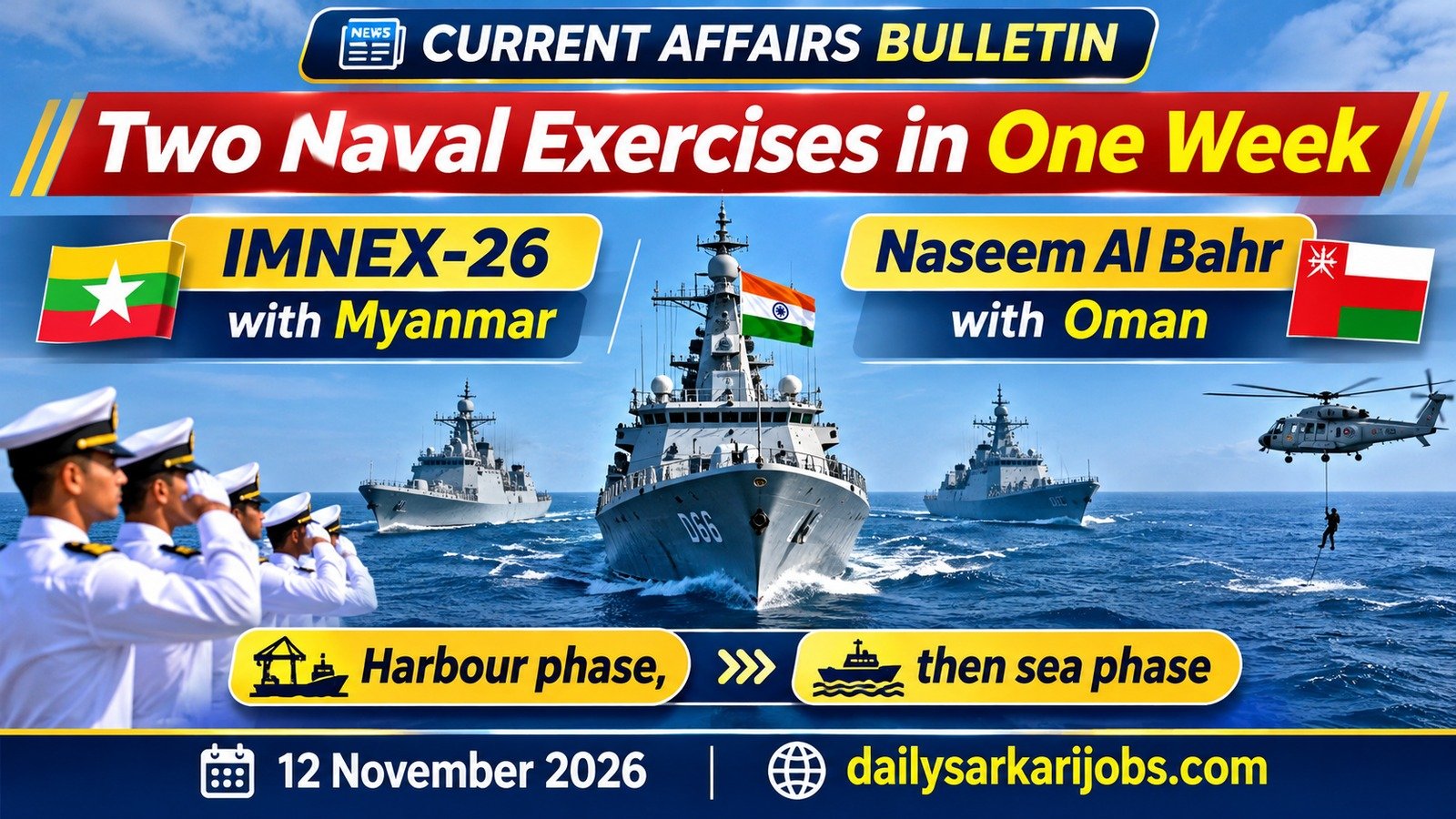
Two Indian naval exercises with two different countries were under way in the same week of November 2026.Exercise names are one of the most heavily asked categories in the whole defence section, and most people try to memorise the list. There is a shortcut, and it is hiding in the names themselves.
Half the Names Tell You the Answer. The Other Half Never Will.
India’s exercise names fall into two families, and they behave completely differently.
Varuna (France), Dustlik (Uzbekistan), Naseem Al Bahr (Oman)
That single split cuts the memory work roughly in half.You never have to learn an acronym exercise — you read it. IMNEX decodes on sight. What is left to actually memorise is the second family, and that list is much shorter than the one most people try to carry.
One warning, because it is where the marks are lost.A name in the second family tells you nothing at all. Naseem Al Bahr is Arabic for sea breeze, which sounds like it could belong to several countries. Varuna is a Sanskrit name for an exercise with France. Dustlik is Uzbek. Do not reason from the language of the name to the partner — the two do not have to match.
Jargon, Defined Once
A bilateral exercise has two countries; a multilateral one has more.
The harbour phase is the part in port — planning, briefings, expert exchanges and visits between ships, before anybody sails.
The sea phase is the part at sea, where the ships actually manoeuvre and drill together.
Interoperability is the goal of all of it: being able to operate as one force — same signals, same procedures, same understanding of an order — without having to invent it on the day.
A cross-deck visit is each navy’s crew going aboard the other’s ship. VBSS is Visit, Board, Search and Seizure, the drill for stopping and inspecting a suspect vessel.
IMNEX-26: India and Myanmar at Visakhapatnam
The 8th edition of the India–Myanmar Naval Exercise ran at Visakhapatnam from 10 to 14 November 2026.
India fielded INS Rana and INS Sumedha; Myanmar sent UMS King Sin Phyu Shin, which arrived on 10 November.
The opening ceremony was held on board INS Rana.
The harbour phase covered professional interactions, Subject Matter Expert Exchanges, cross-deck visits and sporting events; the sea phase covered coordinated maritime operations and tactical manoeuvres.
It is framed within India’s MAHASAGAR vision — Mutual and Holistic Advancement for Security and Growth Across Regions.
Note the venue, because it is not an accident and it connects to today’s other capsule.Visakhapatnam is the headquarters of the Indian Navy’s Eastern Naval Command, which is the command that faces the Bay of Bengal — and Myanmar is a Bay of Bengal neighbour. The exercise is being run from the command whose waters it concerns.
Naseem Al Bahr: India and Oman
Naseem Al Bahr means Sea Breeze, and this was the 15th edition — one of India’s longest-running naval exercises with any partner.
It is held with the Royal Navy of Oman.
INS Surat took part, working with the Omani vessel Al-Mu’azzar during the sea phase.
The harbour phase covered Explosive Ordnance Disposal, mine countermeasure operations and hydrography.
The sea phase included VBSS drills and cross-deck operations.
Fifteen editions against eight is itself worth noticing.The number of an exercise is a rough measure of how old and how steady a defence relationship is, and it is the detail most often asked. Oman sits at the mouth of the Persian Gulf, on the route almost all of India’s imported oil travels.
The Bilateral Exercises Worth Knowing
Exercise
Partner
Service
Yudh Abhyas
United States
Army
Vajra Prahar
United States
Special Forces
Varuna
France
Navy
Garuda
France
Air Force
Shakti
France
Army
Indra
Russia
Armed forces
SLINEX
Sri Lanka
Navy
Mitra Shakti
Sri Lanka
—
Sampriti
Bangladesh
—
Dharma Guardian
Japan
Army
Dustlik
Uzbekistan
Army
Khanjar
Kyrgyzstan
Special Forces
Surya Kiran
Nepal
—
Nomadic Elephant
Mongolia
—
Lamitiye
Seychelles
—
France is the one to look at twice.Three separate exercises, one for each service — Shakti for the Army, Varuna for the Navy, Garuda for the Air Force. No other partner in this list appears three times, and a question that asks which country India exercises with across all three services has one answer.
Exam Alert: Five Traps
IMNEX is with Myanmar, SLINEX with Sri Lanka.Both end in NEX, both are naval, and they are swapped constantly.
Varuna is France, not Russia.Indra is the Russian one. Two Sanskrit names, two different countries.
Naseem Al Bahr is with Oman, not with any other Gulf state, and the Arabic name proves nothing by itself.
Count the editions.IMNEX-26 was the 8th; Naseem Al Bahr was the 15th. The edition number is asked as often as the partner.
Harbour phase first, sea phase second.Never the other way round, and a question that reverses them is wrong.
Did You Know: Almost Every Naval Exercise Is Built the Same Way
Look at the two exercises above and the structure is identical, though the countries, the seas and the ships are different.Harbour phase: talk, plan, swap experts, visit each other’s ships. Sea phase: go out and do it.
That is not a coincidence or a template copied out of laziness.The hard part of two navies working together is not sailing — it is discovering, before anything is at stake, all the small ways in which each side assumes something the other does not. A signal that means one thing here and another there. A different standard procedure for the same emergency. The harbour phase exists to find those differences alongside a pier, where finding them costs nothing.The sea phase is the test; the harbour phase is the reason the test can be passed.
Why a Reader Should Care
Military exercises are close to a guaranteed question in SSC, Railways, Banking and Defence papers, because they happen constantly, they come with a clean name-and-country pair, and the examiner can set one from any month of the year. This capsule sits with our explainers on the BIMSTEC Maritime Security Exercise and on the eight next-generation corvettes, and with our capsule on India’s missile programme.
Today’s Static GK capsule is on the structure of India’s armed forces, and it answers the question this post raises. IMNEX-26 was run from Visakhapatnam because that is the headquarters of the Eastern Naval Command. The capsule explains what a command is, who heads one, how many each service has — and why India’s most senior military officer is not the one giving the order.
Practice Questions
Q1. IMNEX-26, the naval exercise held at Visakhapatnam in November 2026, was conducted between India and (a) Malaysia (b) Myanmar (c) Mauritius (d) the Maldives Answer: (b) Myanmar It was the 8th edition of the exercise, and the name itself stands for India-Myanmar Naval Exercise.
Q2. Naseem Al Bahr, meaning Sea Breeze, is a naval exercise between India and (a) Oman (b) Qatar (c) the United Arab Emirates (d) Saudi Arabia Answer: (a) Oman The 2026 edition was the 15th, which makes it one of India’s longest-running bilateral naval exercises.
Q3. Exercise Varuna is conducted by India with (a) Russia (b) the United States (c) France (d) Japan Answer: (c) France The exercise with Russia is Indra, and India also holds Shakti and Garuda with the same European partner for its army and air force.
Q4. In the 2026 edition of the India-Myanmar naval exercise, which Indian Navy ships took part? (a) INS Vikrant and INS Vikramaditya (b) INS Surat and INS Kolkata (c) INS Rana and INS Sumedha (d) INS Shivalik and INS Kadmatt Answer: (c) INS Rana and INS Sumedha The Myanmar Navy was represented by UMS King Sin Phyu Shin, and the opening ceremony was held on board the first of the two Indian ships.
Q5. A bilateral naval exercise is normally conducted in which order? (a) Sea phase followed by harbour phase (b) Harbour phase followed by sea phase (c) Only a sea phase (d) Air phase followed by sea phase Answer: (b) Harbour phase followed by sea phase The first stage covers planning, expert exchanges and cross-deck visits in port, and the second takes the ships out for manoeuvres together.
30-Second Revision
The hinge:the acronym names decode themselves (IMNEX, SLINEX) and the given names never will (Varuna, Dustlik, Naseem Al Bahr). Memorise only the second family.
IMNEX-26:8th India–Myanmar naval exercise, Visakhapatnam, 10–14 November 2026, INS Rana and INS Sumedha against UMS King Sin Phyu Shin.
Naseem Al Bahr:15th edition with the Royal Navy of Oman; INS Surat worked with Al-Mu’azzar.
The shape:harbour phase, then sea phase, in that order, in nearly every bilateral naval exercise.
The France rule:Shakti (Army), Varuna (Navy), Garuda (Air Force) — one partner across all three services.
What Is Not Settled
Two honest limits. First, the exact dates of the 2026 Naseem Al Bahr were not stated in the reporting used here, only that the 15th edition was held and reported on 12 November 2026. The edition number and the participating ships are solid; the dates are not, and are left out rather than guessed.
Second, the service against two or three names in the table above is shown as a dash, because the source consulted did not specify it and inventing it would be worse than a gap. Check the Ministry of Defence or the service’s own release before answering a question that turns on the service rather than the country.
Sources
Reporting of the commencement of IMNEX-26, the 8th India–Myanmar Naval Exercise, at Visakhapatnam from 10 to 14 November 2026 — the opening ceremony on board INS Rana, the participation of INS Rana and INS Sumedha and of UMS King Sin Phyu Shin, the harbour and sea phases with Subject Matter Expert Exchanges and cross-deck visits, and the framing within the MAHASAGAR vision.
Reporting of 12 November 2026 on the 15th edition of Naseem Al Bahr with the Royal Navy of Oman — the participation of INS Surat alongside Al-Mu’azzar, the harbour phase covering Explosive Ordnance Disposal, mine countermeasure operations and hydrography, and the sea phase covering VBSS drills and cross-deck operations.
Reference material on India’s bilateral military exercises and their partner countries, for the table above.