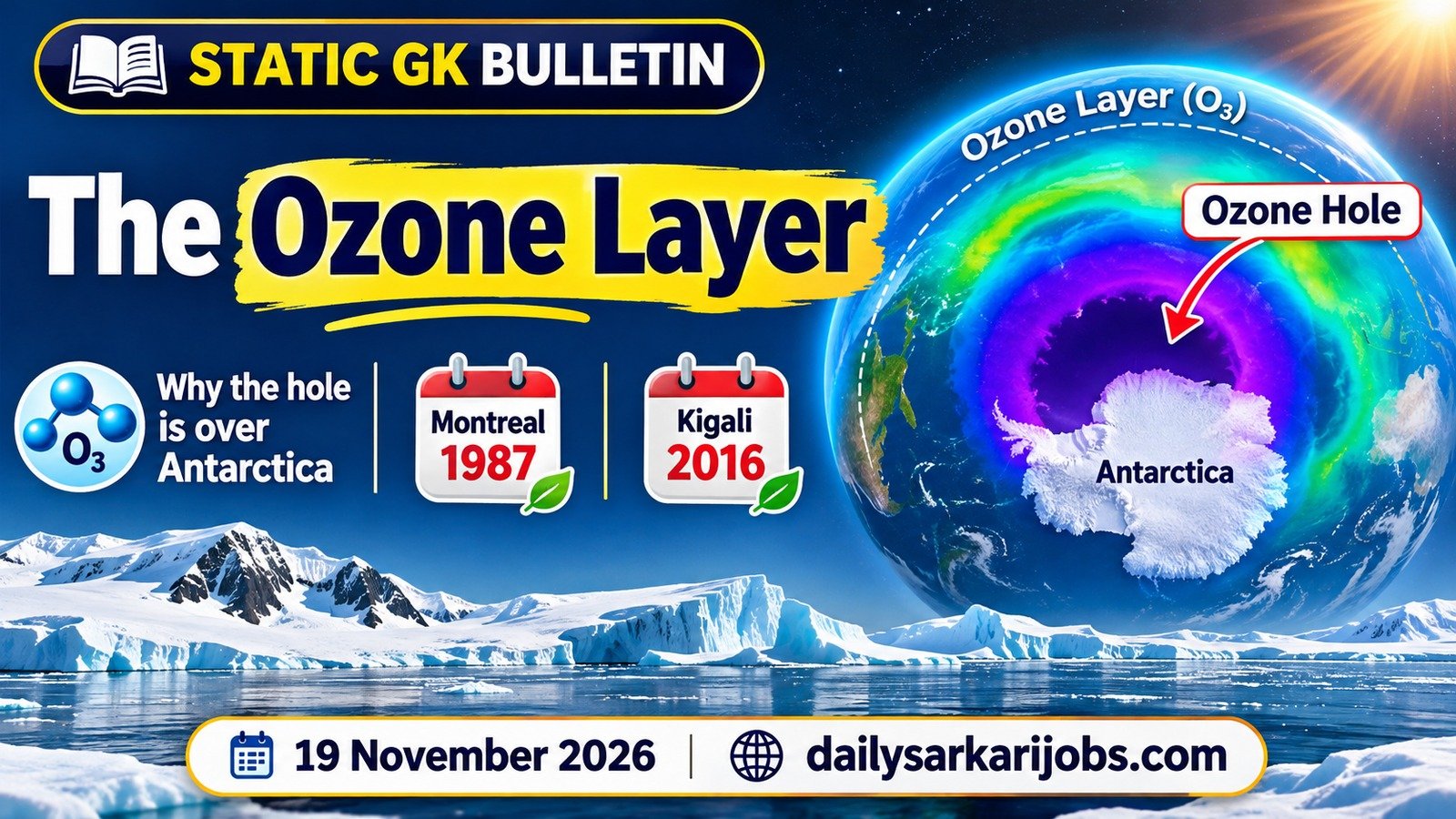
The ozone hole opens over Antarctica.Nobody in Antarctica ever manufactured the chemicals that caused it. That single oddity explains the whole topic, and it is where examiners aim.
The Damage Appears Where the Chemicals Are Not
The gases that destroy ozone were made in factories in Europe, North America and Asia.They are stable enough to survive for decades, so winds carry them everywhere and the atmosphere mixes them thoroughly. By the time they reach the stratosphere they are spread across the whole planet.
What is special about Antarctica is not the chemicals. It is the cold.Three things line up there and nowhere else:
The polar vortex — a ring of winds that seals off the air above Antarctica for about five months of winter, so nothing fresh mixes in.
Polar stratospheric clouds — they form only below about minus 78 degrees Celsius. Their icy surfaces turn harmless chlorine compounds into reactive ones.
Spring sunlight — when the Sun returns in September and October, it switches the waiting chlorine on and ozone is destroyed very fast.
The Arctic has a weaker vortex and its clouds last a fraction as long, which is why no comparable hole forms there.So the hole is not a map of where the pollution came from. It is a map of where the cold is.
Jargon, Defined Once
Ozone is oxygen with three atoms instead of two. Same element, different molecule, completely different behaviour.
The stratosphere is the layer of atmosphere above the one we live in; the troposphere is the lowest layer, where weather happens.
Ultraviolet radiation is the invisible, high-energy part of sunlight that burns skin and damages living cells.
Ozone-depleting substances are the man-made chemicals that break ozone apart — chiefly CFCs, halons, HCFCs, carbon tetrachloride, methyl chloroform and methyl bromide.
A Dobson Unit measures how much ozone sits in the column of air above a point. About 300 is normal; below 220 is counted as a hole.
HFCs replaced CFCs in cooling. They do not harm ozone at all — but they are powerful greenhouse gases, which is why they were added to the treaty later.
Good Ozone and Bad Ozone Are the Same Gas
Stratospheric ozone
Ground-level ozone
Where
Roughly 15 to 35 km up, densest near 25 km
At the surface, where we breathe
How it got there
Formed naturally by sunlight acting on oxygen
Formed when vehicle and factory fumes react in sunlight
What it does
Absorbs ultraviolet radiation and protects life
Irritates the lungs, damages crops, makes smog
Verdict
Good ozone — we want more of it
Bad ozone — a pollutant
It is the same molecule in both rows.Ozone is not good or bad in itself; it is good where it is far above us and bad where it is in our lungs.A question that treats the two as different gases is testing exactly this.
How One Chlorine Atom Does So Much Damage
Ultraviolet light breaks a CFC molecule high in the stratosphere and frees a chlorine atom.That atom destroys an ozone molecule — and then comes out of the reaction unchanged, ready to do it again.
A single chlorine atom can destroy on the order of a hundred thousand ozone molecules before it is finally removed.Bromine, released from halons, is reckoned to be forty to fifty times more destructive still, atom for atom.That multiplication is why very small quantities of these gases mattered so much.
The Treaties
The Vienna Convention came into force on 22 September 1988. It was the framework agreement — an agreement to co-operate, with no binding cuts.
The Montreal Protocol was adopted on 16 September 1987 and came into force on 1 January 1989. This is the one with teeth: it names the substances and sets the phase-out dates.
In 2008 both became the first multilateral environmental treaties in history to achieve universal ratification.
The Kigali Amendment was adopted at Kigali, Rwanda, on 15 October 2016 and came into force on 1 January 2019. It brought in HFCs, which harm the climate rather than the ozone layer.
India ratified the Kigali Amendment in September 2021, and is to cut HFCs by 85 per cent from a 2024 to 2026 baseline by 2047.
World Ozone Day is 16 September — the date the Montreal Protocol was adopted. The day is not a coincidence; it is the anniversary.
Exam Alert: Five Traps
The hole is over Antarctica, not over the industrial countries that made the chemicals.Cold, not pollution, decides where it opens.
Stratospheric ozone is good, ground-level ozone is bad — and they are the same gas.
Vienna 1985 is the framework; Montreal 1987 is the protocol with the actual phase-outs.Framework first, teeth second.
HFCs do NOT deplete ozone.They are greenhouse gases, and the Kigali Amendment of 2016 is what brought them in.
World Ozone Day is 16 September, the date the Montreal Protocol was adopted in 1987.
Did You Know: This Is the One Environmental Treaty That Actually Worked
About 98 per cent of the controlled ozone-depleting substances have been phased out against 1990 levels, and the ozone layer is expected to recover around the middle of this century.Set that beside thirty years of climate negotiations and the contrast is painful.
The honest reason is that the ozone problem was an easier one.It had a small number of chemicals, a small number of manufacturers, and substitutes that already existed. Carbon dioxide comes from everything everybody does, and there is no drop-in replacement for it.The Montreal Protocol proves that global agreements can work — and quietly shows why the climate one is so much harder.
Why a Reader Should Care
Environment is a compact, high-yield section, and the ozone treaties are among the most asked items in it, because the dates are fixed and the distinctions are clean. It sits with our capsule on the Air Quality Index, where ground-level ozone appears as a pollutant in its own right, with our explainers on COP31 at Antalya and CBD COP-17, and with our capsule on India’s biodiversity hotspots.
Today’s Current Affairs explainer is on Voyager 1 reaching one light-day from Earth, and the two meet in a straight line. Light takes a day to reach Voyager and about eight minutes to reach us. What it runs into on the way in is this layer, which strips out the ultraviolet before it gets to the ground. One capsule is about how far light travels; the other is about what stops the dangerous part of it.
Practice Questions
Q1. The ozone layer is found in which layer of the atmosphere? (a) The troposphere (b) The stratosphere (c) The mesosphere (d) The thermosphere Answer: (b) The stratosphere It sits roughly 15 to 35 kilometres up and absorbs most of the Sun’s ultraviolet radiation.
Q2. The Montreal Protocol was adopted in (a) 1985 (b) 1992 (c) 1987 (d) 2016 Answer: (c) 1987 It came into force on 1 January 1989, and World Ozone Day is observed on the anniversary of its adoption.
Q3. The ozone hole forms over Antarctica mainly because of (a) Heavy local industry there (b) Volcanic eruptions in the region (c) Extreme cold, the polar vortex and polar stratospheric clouds (d) The thinning of the Earth’s magnetic field Answer: (c) Extreme cold, the polar vortex and polar stratospheric clouds The chemicals responsible are spread evenly worldwide, so it is the conditions rather than the source that decide where the hole appears.
Q4. The Kigali Amendment of 2016 deals with the phase-down of (a) Hydrofluorocarbons (b) Chlorofluorocarbons (c) Methyl bromide (d) Carbon tetrachloride Answer: (a) Hydrofluorocarbons These substances do not damage the ozone layer at all, but they are powerful greenhouse gases.
Q5. World Ozone Day is observed every year on (a) 5 June (b) 22 April (c) 2 December (d) 16 September Answer: (d) 16 September The date marks the adoption of the Montreal Protocol on that day in 1987.
30-Second Revision
The hinge:the hole opens where the cold is, not where the chemicals were made — polar vortex, polar stratospheric clouds below minus 78 degrees, and returning spring sunlight.
The layer:stratosphere, roughly 15 to 35 km, absorbs ultraviolet. Ground-level ozone is the same gas and is a pollutant.
The chemistry:CFCs, halons, HCFCs, carbon tetrachloride, methyl chloroform, methyl bromide; one chlorine atom destroys on the order of 100,000 ozone molecules; HFCs do not deplete ozone.
The treaties:Vienna in force 22 Sept 1988 (framework); Montreal Protocol adopted 16 Sept 1987, in force 1 Jan 1989; universal ratification in 2008; Kigali Amendment 15 Oct 2016, in force 1 Jan 2019.
India and the day: ratified Kigali in September 2021, HFC cut of 85% by 2047; World Ozone Day 16 September; hole measured below 220 Dobson Units.
What Is Not Settled
The altitude of the ozone layer is quoted differently in different books.Some give 15 to 35 kilometres, others 15 to 50. Both are describing the same thing with different cut-offs, because ozone thins out gradually rather than stopping at a line. The densest concentration is near 25 kilometres, and that is the safest thing to say.
Second, the figure for how many ozone molecules one chlorine atom destroys is an estimate, not a measurement.Around a hundred thousand is the number usually quoted. The point of it is the order of magnitude — that a tiny quantity of gas does enormous damage — rather than the digits.
Sources
The United Nations Environment Programme on the Montreal Protocol — adoption on 16 September 1987, regulation of nearly 100 ozone-depleting substances including CFCs, halons, HCFCs, carbon tetrachloride, methyl chloroform, methyl bromide and HFCs, the description of it as one of the rare treaties to achieve universal ratification, the phase-out of 98 per cent of controlled substances against 1990 levels, and the projected recovery of the ozone layer by the middle of this century.
The UNEP ozone timeline — the reporting of the Antarctic ozone hole in 1985 by British Antarctic Survey scientists, the entry into force of the Vienna Convention on 22 September 1988, the entry into force of the Montreal Protocol on 1 January 1989, and universal ratification in 2008, the first multilateral environmental treaties to achieve it.
UNEP on the Kigali Amendment — adoption at Kigali on 15 October 2016, the addition of HFCs to the controlled substances with a phase-down of 80 to 85 per cent by the late 2040s, and entry into force on 1 January 2019.
Standard environment reference material for the science — the ozone layer in the stratosphere at roughly 15 to 35 kilometres with its densest concentration near 25 kilometres, the distinction between stratospheric and ground-level ozone, the role of the polar vortex, polar stratospheric clouds forming below about minus 78 degrees Celsius and returning spring sunlight, the catalytic destruction of ozone by chlorine with bromine 40 to 50 times more effective, the Dobson Unit with about 300 as normal and below 220 counted as a hole, and India’s ratification of the Kigali Amendment in September 2021 with an 85 per cent HFC cut by 2047.
Where the quoted altitude of the layer and the estimate of molecules destroyed per chlorine atom vary between sources, the post says so above rather than picking one figure and presenting it as exact.