
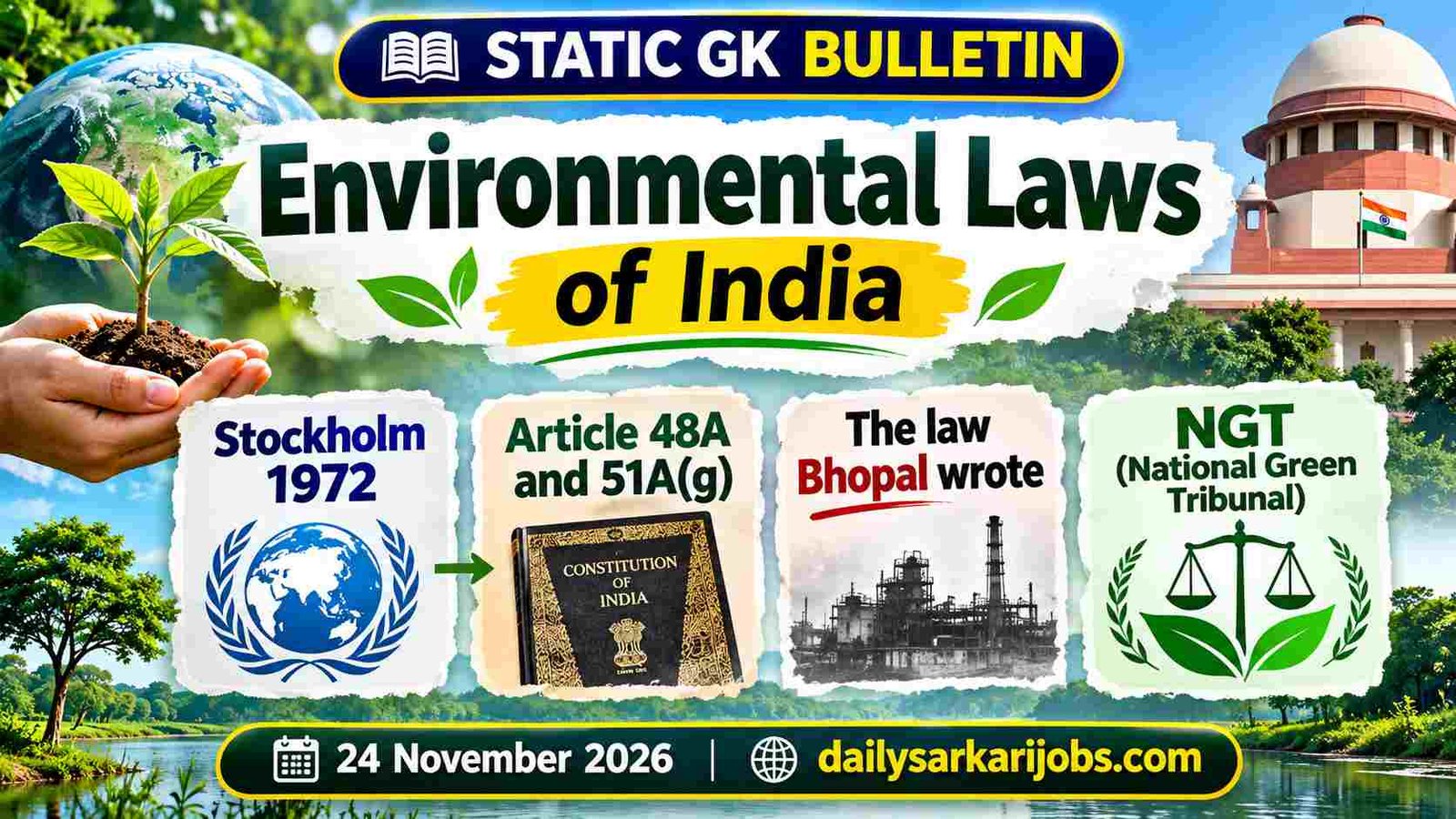
Most students learn India’s environmental laws as a list of Acts and years, which is exactly why the years slide around. There is a pattern underneath, and once you see it the dates lock into place: India’s environmental law was written after the damage, never before it. Each law answers something that had already happened — a world conference the country had just attended, or a disaster it had just suffered. Learn the trigger and the law comes with it.
The chain of cause and effect
| What happened | What followed |
|---|---|
| Stockholm Conference, June 1972 | Wild Life (Protection) Act, 1972 |
| India acts on Stockholm | Water Act, 1974, which created the CPCB |
| 42nd Amendment, 1976 | Articles 48A and 51A(g) added |
| Air pollution concern grows | Air Act, 1981 |
| Bhopal gas tragedy, December 1984 | Environment (Protection) Act, 1986 |
| Demand for a specialist court | National Green Tribunal Act, 2010 |
That table is the whole topic. Everything below only fills it in.
1972: the conference that started it
The United Nations Conference on the Human Environment was held at Stockholm in June 1972. It is the hinge of the entire story, because India signed up to its decisions and then had to legislate to honour them. That is not a historical guess — the Environment (Protection) Act, 1986 says so in its own preamble, which refers to the decisions taken at Stockholm in June 1972.
The same year, Parliament passed the Wild Life (Protection) Act, 1972, which protects wild animals, birds and plants and works through six schedules giving different degrees of protection. The schedule a species sits in decides how heavily it is protected, which is why that word appears in so many questions. For where protected species actually live, see our capsules on national parks and protected areas and India’s four biodiversity hotspots.
1974 and 1981: water first, then air
The Water (Prevention and Control of Pollution) Act, 1974 came first, and it did something more lasting than regulate discharge: it created the Central Pollution Control Board. The CPCB was constituted in 1974 under that Act and sits under the Ministry of Environment, Forest and Climate Change, with State Pollution Control Boards beneath it.
The trap is here. The CPCB was not created by the 1986 Act. It was created by the Water Act of 1974, and later given powers under the Air Act of 1981 as well. Water came before air by seven years, and the board came with the water law. Its monitoring work, including the air quality index, is covered in our capsule on the Air Quality Index, GRAP and NCAP.
1976: the Constitution catches up
Four years after Stockholm, the 42nd Amendment Act, 1976 wrote the environment into the Constitution itself, in three separate ways. This is the most examinable paragraph in the topic.
| Provision | What it does | Binding on |
|---|---|---|
| Article 48A | Protect and improve the environment; safeguard forests and wildlife | The State |
| Article 51A(g) | Protect and improve the natural environment; compassion for living creatures | Every citizen |
| Seventh Schedule | Forests and wild animals moved to the Concurrent List | Centre and states |
Take each in turn. Article 48A is a Directive Principle of State Policy, so it guides the government but cannot be enforced in court. Article 51A(g) is a Fundamental Duty, and its wording is worth knowing: to protect and improve the natural environment including forests, lakes, rivers and wildlife, and to have compassion for living creatures.
The Fundamental Duties themselves were added by the same 42nd Amendment, on the recommendation of the Swaran Singh Committee. There were originally ten, raised to eleven by the 86th Amendment in 2002, which added the duty of a parent or guardian to provide education to a child between six and fourteen. See our capsule on Fundamental Rights, Directive Principles and Fundamental Duties.
The third change is the one most notes miss. The 42nd Amendment moved five subjects from the State List to the Concurrent List: education, forests, weights and measures, protection of wild animals and birds, and administration of justice. Forests became Entry 17-A and protection of wild animals and birds Entry 17-B, with effect from 3 January 1977. In plain terms, forests stopped being a purely state subject, and the Centre gained the power to legislate on them. For the lists themselves, see important Articles, Schedules and Parts.
1986: the law that Bhopal produced
The Bhopal gas tragedy of December 1984 is widely regarded as the reason the Environment (Protection) Act was enacted in May 1986. It is called umbrella legislation, which means it does not replace the Water and Air Acts but sits above them, providing a framework and letting the Centre coordinate the authorities created under both.
One more detail turns this into a two-mark answer. The Act was passed under Article 253, the provision that lets Parliament legislate to give effect to international agreements — which is how a conference in Sweden in 1972 ends up as an Indian statute in 1986. Article 253 is the thread that ties Stockholm to Bhopal.
2010: a court of its own
The National Green Tribunal was created by the National Green Tribunal Act, 2010, to handle environmental cases with the technical expertise ordinary courts lack.
| Feature | Detail |
|---|---|
| Created by | National Green Tribunal Act, 2010 |
| Principal bench | New Delhi |
| Other benches | Bhopal, Pune, Kolkata and Chennai |
| Time limit | Dispose of applications within six months |
| Appeal lies to | The Supreme Court, within ninety days |
Four regional benches plus the principal bench, so five in all. The six-month disposal mandate is the detail papers like, because it is the clearest sign of why a separate tribunal was thought necessary at all. India’s international commitments since then are traced in our explainers on the CBD COP-17 biodiversity commitments and COP31 at Antalya.
Exam Alert
- Stockholm, June 1972 is the starting gun. The 1986 Act’s preamble refers to its decisions, and Article 253 is the power used.
- The CPCB was created by the Water Act, 1974, not by the 1986 Act. Water 1974 came before Air 1981.
- Article 48A is a Directive Principle; Article 51A(g) is a Fundamental Duty. Both were added by the 42nd Amendment, 1976.
- The 42nd Amendment moved forests and protection of wild animals and birds to the Concurrent List, with effect from 3 January 1977.
- Fundamental Duties came on the Swaran Singh Committee‘s recommendation; ten originally, eleven after the 86th Amendment, 2002.
- The Environment (Protection) Act, 1986 is umbrella legislation and followed the Bhopal tragedy of December 1984.
- The Wild Life (Protection) Act, 1972 works through six schedules.
- NGT: Act of 2010, principal bench New Delhi, four other benches, six months to decide, appeal to the Supreme Court in ninety days.
Did You Know?
- Forests were a state subject until 1977. Until the 42nd Amendment took effect on 3 January 1977, the Centre had no general power to legislate on forests at all — a single constitutional change rewrote who controls India’s woodland.
- The 1986 Act names a foreign conference in its preamble. It is unusual for an Indian statute to open by citing a meeting held in Sweden fourteen years earlier, and it is the clearest proof that the law was an international promise being kept.
- The Constitution asks citizens for compassion. Article 51A(g) is one of the few places where the Constitution uses a word of feeling rather than a word of obligation.
- The green court has a deadline the ordinary courts do not. The NGT is meant to dispose of a matter within six months — an explicit answer to how slowly environmental cases used to move.
30-Second Quick Revision
- The hinge: every Indian environmental law follows an event — a conference or a catastrophe.
- 1972: Stockholm Conference and the Wild Life (Protection) Act, six schedules.
- 1974 and 1981: Water Act, which created the CPCB, then the Air Act.
- 1976: 42nd Amendment adds Article 48A, Article 51A(g) and moves forests to the Concurrent List.
- 1986: Environment (Protection) Act after Bhopal, umbrella law, passed under Article 253.
- 2010: National Green Tribunal, principal bench Delhi, six-month disposal.
Test Your Knowledge
Q1. The Central Pollution Control Board was constituted under which Act?
(a) The Environment (Protection) Act, 1986 (b) The Air Act, 1981 (c) The Water (Prevention and Control of Pollution) Act, 1974 (d) The National Green Tribunal Act, 2010
Answer: (c) The Water (Prevention and Control of Pollution) Act, 1974 It was constituted in 1974 and later given powers under the Air Act of 1981 as well.
Q2. Article 48A of the Constitution, on protection of the environment, is
(a) A Fundamental Right (b) A Directive Principle of State Policy (c) A Fundamental Duty (d) A provision of the Seventh Schedule
Answer: (b) A Directive Principle of State Policy It binds the State but is not enforceable in court; the citizen’s counterpart is Article 51A(g), a Fundamental Duty.
Q3. Which amendment moved forests and the protection of wild animals and birds from the State List to the Concurrent List?
(a) The 44th Amendment, 1978 (b) The 73rd Amendment, 1992 (c) The 86th Amendment, 2002 (d) The 42nd Amendment, 1976
Answer: (d) The 42nd Amendment, 1976 The change took effect from 3 January 1977, and the same amendment added Articles 48A and 51A(g).
Q4. The Environment (Protection) Act, 1986 was enacted mainly to give effect to decisions taken at
(a) The Rio Earth Summit, 1992 (b) The Stockholm Conference, 1972 (c) The Kyoto Protocol, 1997 (d) The Paris Agreement, 2015
Answer: (b) The Stockholm Conference, 1972 Its preamble says so, and Parliament used Article 253, the power to legislate for international agreements.
Q5. Within what period is the National Green Tribunal expected to dispose of applications?
(a) Three months (b) One year (c) Six months (d) Two years
Answer: (c) Six months Its principal bench is at New Delhi, with four other benches at Bhopal, Pune, Kolkata and Chennai.
Want the full ten-question set as a PDF? Head to our Test Your Knowledge page.
Verified on 24 November 2026 against reference material on the Environment (Protection) Act 1986, the National Green Tribunal, the Central Pollution Control Board, the Directive Principles, Part IVA of the Constitution, the Concurrent List and the Wild Life (Protection) Act 1972.