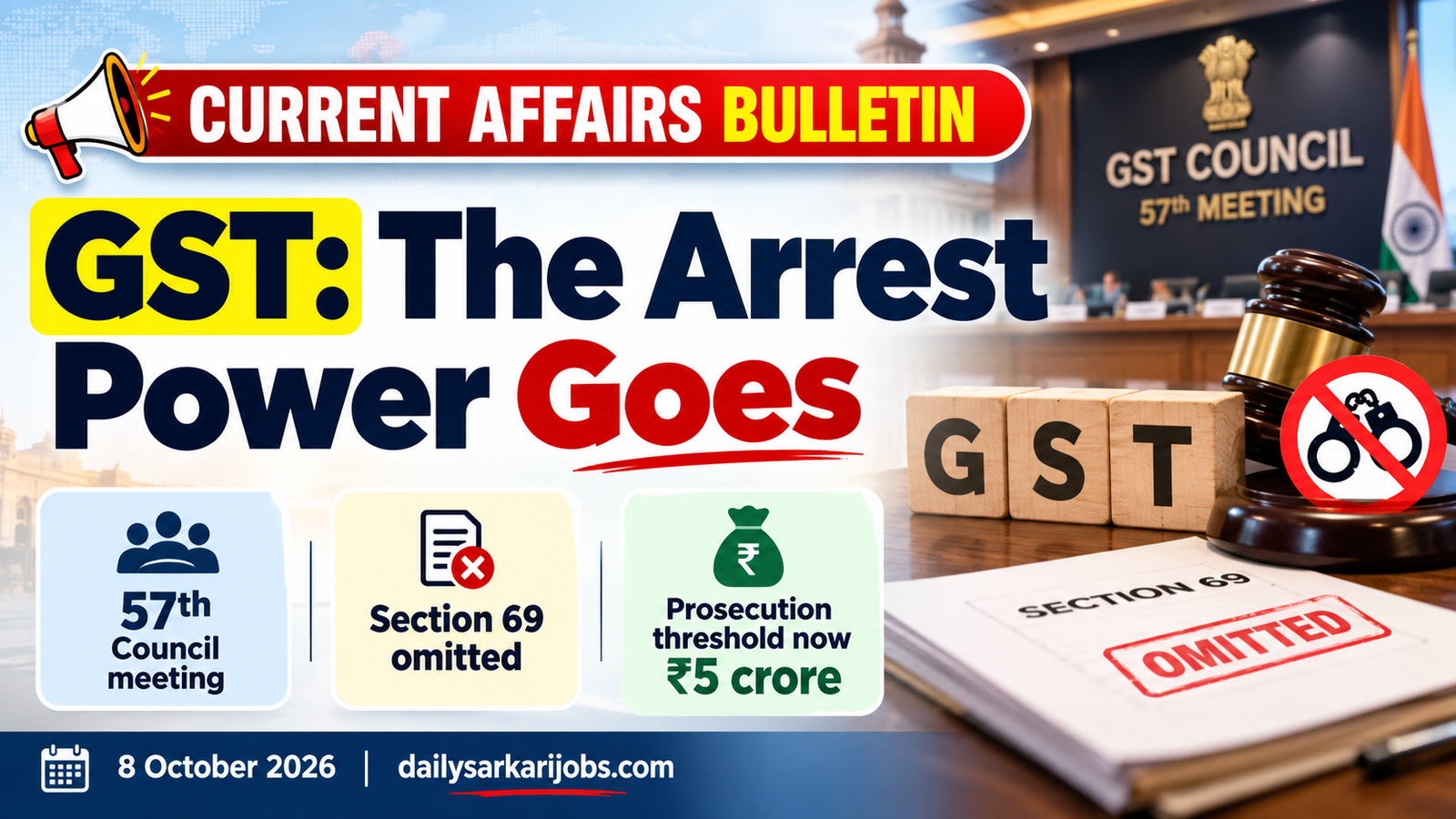
Nine years of GST Council meetings have been reported the same way: which goods got cheaper, which got dearer. Today’s meeting did that too. But the part that matters is not on any rate list. The Council recommended taking away the tax officer’s power to arrest you.
The 57th meeting of the GST Council was held in New Delhi on 8 October 2026, chaired by the Union Finance Minister. Explained in plain language for SSC, RRB NTPC, State PSC, banking general awareness and UPSC Prelims.
The Hinge: This Meeting Changed What Can Be Done to You
Hold two meetings side by side and the difference is the whole story.
| The 56th meeting (September 2025) | The 57th meeting (October 2026) | |
|---|---|---|
| What it changed | The rates — the slab structure was cut to two main rates plus a de-merit rate | The relationship between the taxpayer and the tax officer |
| Who felt it | Every buyer, through prices | Every registered business, through the risk it carries |
| How it was reported | Front page | Mostly in the tax press |
A tax reform that reduces the tax administration’s powers, rather than the taxpayer’s rate, is unusual anywhere in the world. Here is the list, and it is worth reading slowly.
| Change | Before | After |
|---|---|---|
| Power to arrest under section 69 of the CGST Act | The officer could arrest for specified offences | The section is to be omitted altogether |
| Threshold for prosecution | ₹1 crore | ₹5 crore |
| Maximum general penalty under section 125 | ₹25,000 | ₹10,000 |
| Minimum amount for a show cause notice | None — a notice could issue for any sum | ₹10,000 |
| Penalty where tax and interest are paid after an order | Full penalty | 5 per cent in non-fraud cases if paid within 30 days (section 73) or 60 days (section 74A) |
| Stopping a vehicle to check the e-way bill | Routine roadside interception | Only on specific intelligence, with authorisation from a Joint Commissioner or above; no interception in a State the goods are merely passing through |
| Confiscation under section 130 | Could apply to goods and vehicles in transit | Not to apply to goods or conveyances in transit |
But Read What It Takes in Return
Run the sorting question this site uses on every institution — is this protecting, or limiting? — except point it at the taxpayer instead. Both columns fill up, and that tells you this is a bargain rather than a gift.
| What the taxpayer gains | What the system gains |
|---|---|
| No arrest power; a five-fold higher prosecution threshold; smaller penalties; a floor under notices | E-invoicing extended to reverse-charge and import-of-services cases for turnover of ₹5 crore and above |
| Automatic refunds — 90 per cent of zero-rated and inverted-duty refunds provisionally sanctioned by the system, acknowledgment cut from 15 days to 10 | TDS at 2 per cent on business-to-business supplies of plastic, e-waste, tyre and used-cooking-oil waste |
| Blocked credits opened up under section 17(5) — input tax credit now allowed on outdoor catering, health and life insurance, telecom towers, pipelines outside factories, free samples, and goods written off on shelf-life expiry | Reverse charge on the same waste streams when supplied by an unregistered to a registered person |
| Late fee waived for taxpayers with turnover up to ₹5 crore who file within the month the return was due | Returns and credit reconciliation tightened through new rules |
The State is giving up the stick and taking the camera. Coercion is being replaced by data: fewer powers to arrest and confiscate, more invoices reported electronically, more tax deducted at source, more transactions visible without anyone stopping a lorry. That trade is the single most transferable idea in this story, and it is how modern tax administration is going everywhere.
The Rate and Exemption Changes
Smaller in significance, but these are the ones a question is most likely to quote.
- Psyllium seeds (isabgol) — NIL GST, whether fresh, chilled, frozen or dried
- Seaweed-extract bio-stimulants registered under Schedule VI of the Fertiliser Control Order — classified under heading 3101 as fertilisers
- Re-treaded tractor tyres — aligned with the rate on new tractor tyres
- Sublimation paper — classified under heading 4809, past cases regularised as is
- Toys — clarified that the entries cover all of heading 9503, not only tricycles, scooters and pedal cars
On services, the Council recommended a 5 per cent option with restricted credit for electric-vehicle passenger transport and rental with operator where the cost of charging is included, and 5 per cent without credit for delivery services ordered through an e-commerce operator, other than courier and postal. Exemptions were recommended for helicopter seat-sharing passenger transport to and from the specified North-Eastern States, Sikkim and Bagdogra; for storage and warehousing of sowing seeds and curing of coffee for cultivators; and for amounts paid to the National Highways Authority of India under the Toll-Operate-Transfer model.
The Appellate Tribunal
The Council also recommended aligning the CGST Act and the GST Appellate Tribunal rules with the Tribunals Reforms Act, 2026 and the new national tribunals rules. The most practical item: where an order involves only a penalty and no tax demand, the pre-deposit for an appeal is capped at ₹40 crore — ₹20 crore central and ₹20 crore State.
A pre-deposit is the money a taxpayer must put down before an appeal will even be heard. Capping it matters because an uncapped percentage of a very large penalty can price a business out of its own appeal, which converts a disputed demand into a final one without anybody deciding the dispute.
The Honest Caution: None of This Is Law Yet
The release says so itself. The recommendations “would be given effect through the relevant circulars, notifications and law amendments, which alone shall have the force of law”. That sentence is not boilerplate, and three things follow from it.
- The Council recommends; it does not legislate. The Supreme Court held in 2022 that the Council’s recommendations are persuasive and bind nobody — see the GST Council capsule for how that works and why the Council was designed that way
- Omitting section 69 needs Parliament. The power to arrest sits in the CGST Act, so removing it is an amendment to an Act, which means a Bill, which means the whole legislative process. That is the furthest-away change on the entire list
- Rate changes move faster, because they are made by notification rather than by statute
So if an exam asks what the 57th Council meeting did, the correct verb is “recommended”. Watch for the notifications over the coming weeks and for the amending Bill in a later session.
Why a Reader Should Care
Most people meet GST only as a line on a restaurant bill. For about one and a half crore registered businesses it is something else entirely: a monthly filing obligation backed, until now, by the possibility of arrest. A small trader who made a classification mistake and a deliberate fraudster faced the same machinery.
Raising the prosecution threshold five-fold and removing the arrest power is an admission that the machinery was pointed at too many people. Whether it works depends entirely on whether the data replacing it is accurate — which is why the e-invoicing and tax-deduction items in the second table are not a footnote. They are the other half of the deal.
Practice Questions
Q1. The 57th meeting of the GST Council recommended omitting which section of the CGST Act, 2017?
(a) Section 16 (b) Section 69 (c) Section 73 (d) Section 130
Answer: (b) Section 69 Three of the other sections were amended at the same meeting rather than removed — one deals with input tax credit, one with non-fraud demands and one with confiscation. The section recommended for deletion is the one that allowed an officer to take a person into custody.
Q2. The threshold for launching prosecution under GST was recommended to be raised to…
(a) ₹2 crore (b) ₹3 crore (c) ₹5 crore (d) ₹10 crore
Answer: (c) ₹5 crore The old figure was one crore, so this is a five-fold increase and the clearest signal of the meeting’s direction. Remember it alongside the new ten-thousand-rupee floor below which a show cause notice cannot be issued at all.
Q3. Under the 57th Council’s recommendations, interception of a vehicle to verify the e-way bill may be carried out…
(a) By any officer at any time (b) Only on specific intelligence and with authorisation from a Joint Commissioner or above (c) Only at State borders (d) Only between 6 a.m. and 6 p.m.
Answer: (b) Only on specific intelligence and with authorisation from a Joint Commissioner or above The change has two limbs: a reason is now required, and so is a senior officer’s approval. A State the goods are merely passing through may not stop them at all, and goods in transit are taken outside the confiscation provision.
Q4. Which item was recommended for a NIL rate of GST at the 57th Council meeting?
(a) Re-treaded tractor tyres (b) Sublimation paper (c) Psyllium seeds (isabgol) (d) Seaweed-extract bio-stimulants
Answer: (c) Psyllium seeds (isabgol) The other three were reclassified or aligned with an existing rate rather than exempted outright. The right answer covers the product fresh, chilled, frozen and dried, which is the kind of detail a question likes to test.
Q5. The recommendations of the GST Council take legal effect…
(a) Immediately on being announced (b) From the first day of the next financial year (c) Only through notifications, circulars and amendments to the law (d) On ratification by half the State legislatures
Answer: (c) Only through notifications, circulars and amendments to the law This is stated in the Council’s own press release and was settled by the Supreme Court in 2022, which held that the recommendations are persuasive rather than binding. Anything requiring a change to the Act itself has to go through Parliament.
Ten more questions on this and today’s Static GK capsule are waiting on our Test Your Knowledge page, with a free PDF. Today’s capsule is on the Union Budget — the document the Constitution never calls a Budget.
Sources: the Press Information Bureau release of 8 October 2026 setting out the recommendations of the 57th meeting of the GST Council, which gives the date and place, the chair and attendance, the omission of section 69, the prosecution threshold of ₹5 crore, the reduction of the section 125 general penalty ceiling to ₹10,000, the ₹10,000 floor for show cause notices, the 5 per cent reduced penalty under sections 73 and 74A, the e-way bill interception and section 130 changes, the section 17(5) blocked-credit relaxations, the refund automation, the e-invoicing extension, the reverse charge and 2 per cent deduction on waste streams, the rate and exemption items, and the ₹40 crore pre-deposit cap in penalty-only appeals; and the same release for the statement that the recommendations take effect only through circulars, notifications and law amendments. The 2022 Supreme Court ruling that Council recommendations are persuasive rather than binding is covered in this site’s GST Council capsule. Dates of effect are given only for a few items in the release and are not assumed here for the rest; nothing in this post is law until the implementing instruments are issued, and the arrest provision in particular requires an amendment to the CGST Act.