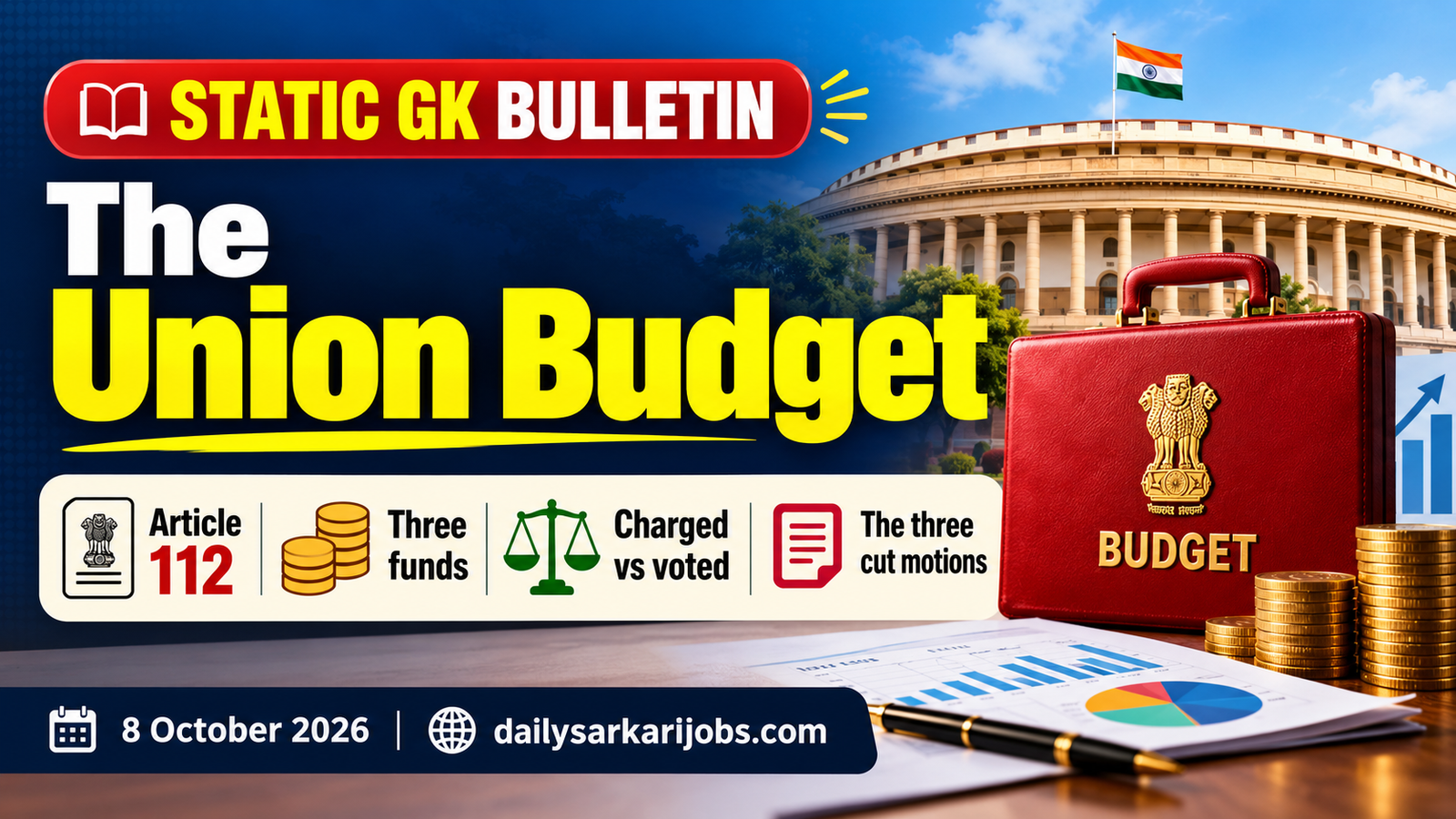
Open the Constitution and look for the word “Budget”. It is not there. Article 112 calls it the annual financial statement, and that is not pedantry — it is the clue to the whole chapter. A statement is not an authorisation. Laying the estimates before Parliament gives the Government no right to spend a single rupee. The right to spend comes later, from two further steps, and nearly every question on this topic is really a question about which step you are looking at.
This is the second capsule in our new series on the economy, explained in plain language for SSC, RRB NTPC, banking exams, State PSC and UPSC Prelims.
The Hinge: Three Articles, Three Separate Permissions
The Budget looks like one event. In law it is three, and each one does something the previous one did not.
| Article | What it does | What it does NOT do |
|---|---|---|
| 112 | The President causes the annual financial statement — the estimated receipts and expenditure — to be laid before both Houses | It does not authorise anything. It is a statement of intention |
| 113 | The estimates of voted expenditure go to the Lok Sabha as Demands for Grants, which may assent, refuse, or reduce | A grant still does not let money out of the bank |
| 114 | An Appropriation Bill is introduced to draw the granted sums from the Consolidated Fund. Once passed, money may be withdrawn | — |
The clinching words are in Article 114 itself: no money shall be withdrawn from the Consolidated Fund of India except under appropriation made by law. Parliament voting for a grant is not enough; it must then pass an Act. That is why the Appropriation Bill exists at all, and why a question asking “what authorises government spending?” has exactly one right answer.
Two more details in the same articles that are regularly asked. Under Article 113, no demand for a grant can even be made except on the recommendation of the President — the House cannot propose its own spending. And under Article 114, no amendment may be moved to an Appropriation Bill that varies the amount or alters the destination of a grant. The House may say no at the Demands stage; by the Appropriation stage the arguing is over.
Follow One Rupee: The Three Funds
Every rupee the Government touches sits in one of three places, and two of them are in Article 266.
| Fund | Article | What goes in | To take money out |
|---|---|---|---|
| Consolidated Fund of India | 266(1) | All revenues, all loans raised, all recoveries of loans. Everything the Government earns or borrows | Parliamentary authorisation, by law |
| Public Account of India | 266(2) | Money the Government holds in trust for somebody else — provident funds, small savings | No parliamentary authorisation for the depositors’ own money. It was never the Government’s to vote on |
| Contingency Fund of India | 267 | An imprest placed at the disposal of the President, corpus ₹30,000 crore | The President may authorise an advance for urgent unforeseen expenditure. Parliament approves afterwards, and the Fund is then recouped from the Consolidated Fund |
Read the Public Account row again, because it is the one that confuses people. Your provident fund contribution is not government revenue. The Government is holding it, and when it gives it back nobody needs to vote. That single idea explains why the Public Account exists as a separate head at all.
The Contingency Fund is the emergency float, and its logic is “spend first, explain later” — the opposite of everything else in this chapter. ₹30,000 crore is the current corpus, as stated in the Budget documents. Be careful here: the Fund stood at ₹500 crore for decades and several widely used reference pages, including government ones, have not been updated. When two figures are in circulation for the same thing, trust the Budget documents of the current year.
Charged and Voted: The Clearest Protection Table in the Constitution
Article 112(3) lists expenditure charged on the Consolidated Fund. Under Article 113, charged expenditure shall not be submitted to the vote of Parliament — though it may be discussed.
- The emoluments and allowances of the President and other expenditure relating to his office
- The salaries and allowances of the Chairman and Deputy Chairman of the Rajya Sabha, and the Speaker and Deputy Speaker of the Lok Sabha
- Debt charges — interest, sinking fund charges, redemption charges and the cost of raising and servicing loans
- Salaries, allowances and pensions of Judges of the Supreme Court; pensions of Judges of the Federal Court and of High Courts
- The salary, allowances and pension of the Comptroller and Auditor-General
- Any sums required to satisfy a judgment, decree or award of any court or arbitral tribunal
- Any other expenditure declared by the Constitution or by Parliament by law to be so charged
Now ask why each one is on that list, because the answer is the same every time: these are the payments that must survive a hostile House.
| Item | What a vote could otherwise do |
|---|---|
| Debt charges | A majority in a bad mood could refuse to pay interest, and India would default for a political reason |
| Judges of the Supreme Court and High Courts | The government being judged could starve the judges judging it — see the Supreme Court capsule |
| The Comptroller and Auditor-General | The institution auditing the Government could be defunded by the Government it audits |
| The President and the presiding officers | The offices that must stand above the majority would depend on it |
| Court decrees | The State could lose a case and then decline to pay |
That is the protecting-or-limiting test again, and here every single row is a protection. Learn the reasoning once and you will never need to memorise the list.
The Budget in Parliament, Stage by Stage
| Stage | What happens |
|---|---|
| Presentation | The Finance Minister lays the annual financial statement, the Demands for Grants and the Finance Bill. Since 2017 the Budget has been presented on 1 February, and the separate Railway Budget was merged into it in the same year |
| General discussion | Both Houses discuss the Budget as a whole. No vote is taken, and no cut motion may be moved |
| Standing Committee scrutiny | The House adjourns and the Demands go to the departmentally related standing committees, which examine them ministry by ministry and report back. Their reports are persuasive, not binding |
| Voting on Demands | Lok Sabha only. It discusses and votes on a handful of Demands chosen by the Business Advisory Committee. Cut motions may be moved here |
| The guillotine | On the last allotted day the Speaker puts all remaining Demands to the vote together, discussed or not. In some years every Demand has been guillotined |
| Appropriation Bill | The granted sums plus the charged expenditure are consolidated into one Bill. Once it is an Act, money may be withdrawn |
| Finance Bill | Taken up after the Appropriation Bill. It gives effect to the tax proposals, and must be passed within 75 days of the Budget’s introduction |
Both the Appropriation Bill and the Finance Bill are Money Bills under Article 110, which means the Rajya Sabha may only recommend and must return the Bill within 14 days. The upper House has no power over the Budget at all beyond offering advice.
The Three Cut Motions
| Cut motion | The amount moved | What it says |
|---|---|---|
| Policy Cut | That the amount of the Demand be reduced to ₹1 | Total disapproval of the policy behind the Demand |
| Economy Cut | That the amount be reduced by a specified sum | The spending is justified but excessive |
| Token Cut | That the amount be reduced by ₹100 | A specific grievance within the Government’s responsibility |
The amounts are the whole answer: one rupee, a stated sum, one hundred rupees. A memory hook that works: a Policy Cut leaves the ministry a single rupee, which is the loudest thing a House can say short of a no-confidence motion. If any cut motion is carried, it amounts to a defeat of the Government on a financial measure and the Council of Ministers is expected to resign.
In practice none passes, because a government with a majority cannot lose one. Their real function is to compel a reply.
When the Money Runs Out or the Year Runs Short
| Instrument | Article | When it is used |
|---|---|---|
| Supplementary grant | 115 | The amount granted for a service proves insufficient during the year |
| Additional grant | 115 | Money is needed for a new service not contemplated in the Budget |
| Excess grant | 115 | Money has already been spent beyond the granted amount. It goes to the Public Accounts Committee first, and is regularised after the year has ended |
| Vote on Account | 116 | A grant in advance to carry the Government for part of the year, used when the Budget cannot be passed before 1 April — typically in an election year |
| Vote of Credit | 116 | An unexpected demand on the resources of India so large or indefinite that it cannot be stated in the usual detail |
| Exceptional Grant | 116 | A grant forming no part of the current service of any financial year |
The one people get wrong is the excess grant, because it runs backwards. Every other instrument asks permission before spending; this one asks forgiveness afterwards, and the Public Accounts Committee examines it before Parliament regularises it.
Where the Budget Sits in the Bigger Machine
Three other pieces of the system meet the Budget, and the capsules on each are worth reading together.
- The Finance Commission decides what share of the Union’s taxes goes to the States before the Union has a rupee to budget with
- The GST Council decides the rates that fill much of the pot, and its 57th meeting on 8 October 2026 is today’s Current Affairs explainer
- The Monetary Policy Committee handles the other half of macroeconomic policy. The Budget is fiscal policy — taxing and spending, decided by the elected government. Monetary policy is interest rates, decided by a statutory committee. Knowing which is which answers a surprising number of questions
- The Comptroller and Auditor-General audits the spending afterwards and reports to Parliament under Article 151
The Fiscal Responsibility and Budget Management Act, 2003 sits alongside, requiring the Government to lay fiscal policy statements with the Budget and to work towards stated deficit targets. Article 112 begins with the President, and so in form does the whole chapter — but in substance every operative power here belongs to the Lok Sabha.
Practice Questions
Q1. The Constitution refers to the Union Budget as the…
(a) Union Budget (b) Annual Financial Statement (c) Statement of Accounts (d) Appropriation Statement
Answer: (b) Annual Financial Statement The familiar word appears nowhere in the text, which is the point of the question. Article 112 uses a phrase that describes exactly what the document is: an estimate of receipts and expenditure, laid before both Houses.
Q2. Money can be withdrawn from the Consolidated Fund of India only…
(a) After the Lok Sabha passes the Demands for Grants (b) After the President signs the annual financial statement (c) Under an appropriation made by law (d) After the Finance Bill is passed
Answer: (c) Under an appropriation made by law A vote on the Demands is a necessary step but not a sufficient one, which is the trap here. Article 114 requires a further statute, and that statute is the Appropriation Act.
Q3. Which of the following is NOT charged on the Consolidated Fund of India?
(a) The salary of the Comptroller and Auditor-General (b) Pensions of Judges of High Courts (c) The salary of the Prime Minister (d) Debt charges of the Government of India
Answer: (c) The salary of the Prime Minister Three of these are in the Article 112(3) list because the people or obligations concerned must be insulated from an angry majority. The head of government is not insulated from the House at all — he depends on its confidence, so his salary is voted like any other.
Q4. A Token Cut motion proposes that the amount of a Demand be reduced by…
(a) ₹1 (b) ₹100 (c) ₹1,000 (d) A specified amount
Answer: (b) ₹100 One of the wrong options is the Policy Cut, which reduces the whole Demand to a single rupee, and another is the Economy Cut, which names a sum. The one asked about is a small fixed figure used to air one specific grievance.
Q5. A Vote on Account is provided for by which Article?
(a) Article 113 (b) Article 114 (c) Article 115 (d) Article 116
Answer: (d) Article 116 The neighbouring articles cover the Demands, the Appropriation Bill and the supplementary and excess grants respectively. The one asked about groups three unusual instruments together, the other two being the vote of credit and the exceptional grant.
Ten more questions on this and today’s Current Affairs explainer are waiting on our Test Your Knowledge page, with a free PDF. Today’s explainer is on the 57th GST Council meeting — the meeting that recommended taking away the tax officer’s power to arrest.
Sources: the Constitution of India, Part V, Chapter II, for Article 112 including the full list of charged expenditure in clause (3), Article 113 on Demands for Grants and the President’s recommendation, Article 114 on Appropriation Bills and the bar on amendments, Article 115 on supplementary, additional and excess grants, Article 116 on votes on account, votes of credit and exceptional grants, and Articles 266 and 267 on the Consolidated Fund, the Public Account and the Contingency Fund; the Government’s own Key to Budget Documents for the definitions of the three funds, the Contingency Fund corpus of ₹30,000 crore, the count of 102 Demands for Grants in 2025-26, and the statement of which documents are required by the Constitution and which by the Fiscal Responsibility and Budget Management Act, 2003; and a published parliamentary primer for the stages in Parliament, the three cut motions and the guillotine. Note that the Contingency Fund corpus is still shown as ₹500 crore on some government reference pages that have not been updated; the figure printed here is the one in the current Budget documents. The number of Demands for Grants changes from year to year and should be rechecked.