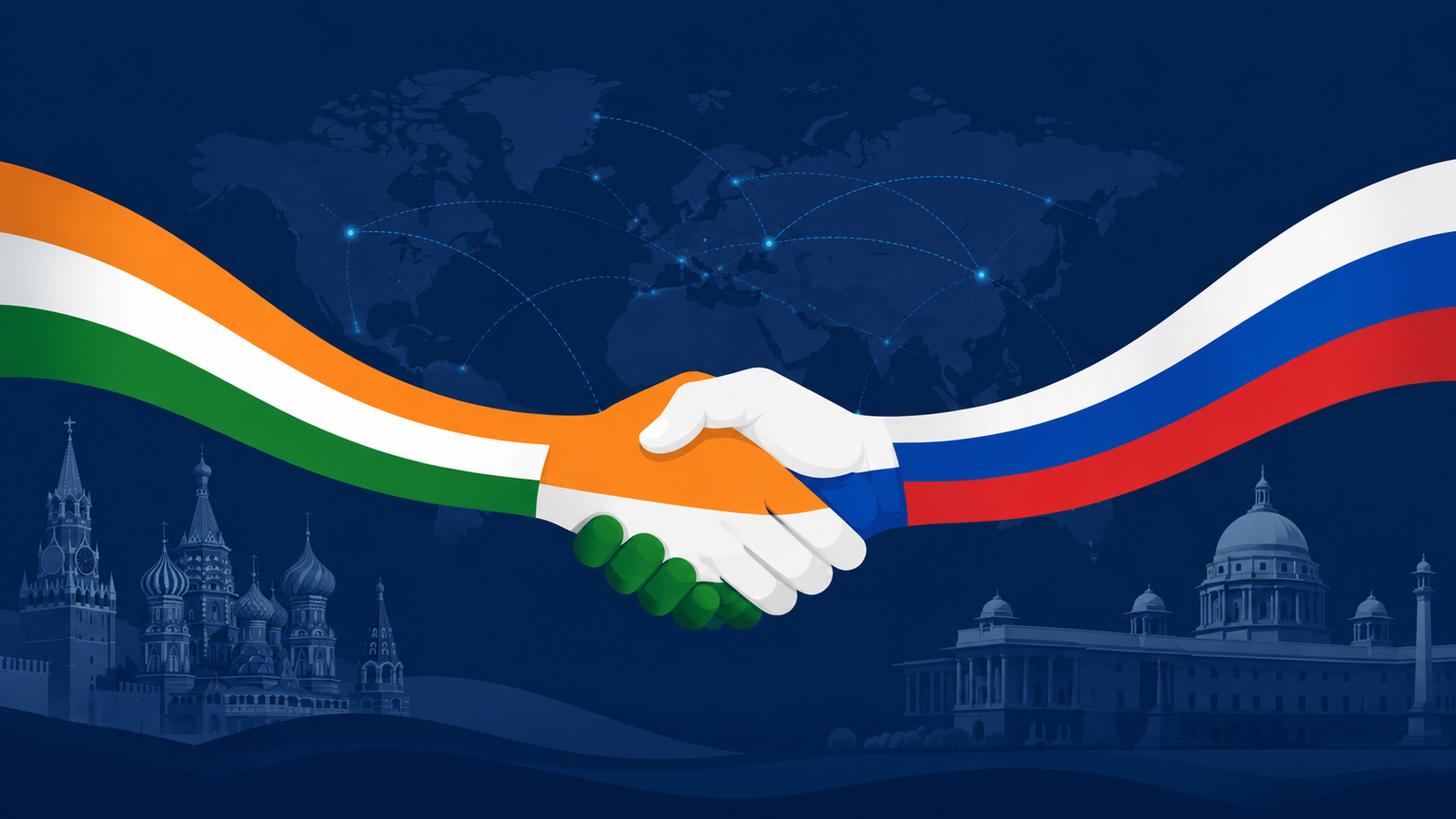
On 24 August 2026, External Affairs Minister S. Jaishankar co-chaired the 27th session of the India-Russia Inter-Governmental Commission on Trade, Economic, Scientific, Technological and Cultural Cooperation (IRIGC-TEC) in Moscow, and separately met President Vladimir Putin. On its own, this reads like routine diplomatic one-liner material — the kind of fact a Static GK page lists and moves on from. But this particular visit sits at the intersection of two of the biggest India-related foreign-policy stories of the last 18 months, and understanding why it happened now is far more useful for an exam (and for general awareness) than just knowing that it happened.
What Actually Happened
- Jaishankar co-chaired the 27th IRIGC-TEC session with Russia’s First Deputy PM Denis Manturov, covering trade, investment, energy, fertilisers, nuclear cooperation, connectivity, technology, space and mobility.
- He separately met President Putin and handed over a “personal message” from PM Modi.
- Putin noted bilateral trade “declined slightly in 2025” but “is now rising again,” crediting Modi’s personal attention to the relationship, and said he hoped to meet Modi again on the sidelines of the Shanghai Cooperation Organisation (SCO) events.
- Jaishankar described the relationship as having “consistently demonstrated resilience and adaptability” even amid a “complex international landscape” — diplomatic language that is doing a lot of work, explained below.
Why It Matters: The Backstory Most Reports Skip
To see why this visit is significant, you need the timeline that led up to it:
| When | What Happened |
|---|---|
| Aug 2025 | The US raised tariffs on Indian goods to 50%, explicitly citing India’s continued purchases of discounted Russian crude oil as a factor. |
| Through late 2025 | India held its position on Russian oil purchases even as trade talks with Washington stayed unresolved; bilateral India-Russia trade dipped slightly. |
| 2 Feb 2026 | India and the US announced a trade framework cutting US tariffs on Indian goods from 50% to 18%, with India committing to reduce Russian oil purchases and increase imports of US energy. |
| 7–9 Feb 2026 | The tariff cut and the related executive order on Russian-oil-linked tariffs took effect. |
| 24 Aug 2026 | Jaishankar travels to Moscow anyway, co-chairs the 27th IRIGC-TEC, meets Putin, and both sides publicly emphasise continuity and growth of the relationship. |
Read together, this is not a contradiction — it’s a demonstration of what Indian foreign policy calls “strategic autonomy” or multi-alignment: maintaining independent, substantive relationships with competing powers (here, the US and Russia) rather than choosing a single bloc. India struck a deal with Washington on tariffs and oil, but it did not walk away from Moscow — instead, the IGC agenda visibly pivoted toward areas beyond oil (fertilisers, nuclear energy, connectivity, technology, space, mobility), which is consistent with a relationship trying to rebalance a lopsided, oil-driven trade equation into something broader and less politically exposed.
The trade-imbalance numbers make the “why” concrete: bilateral trade nearly quintupled from about $13 billion (2021-22) to nearly $60 billion (2025-26), but almost all of that growth was Russian oil flowing into India at discounted prices — which is exactly why the imbalance grew even faster, from $6.6 billion to over $50 billion in India’s disfavour. A relationship that lopsided, built overwhelmingly on one commodity, is structurally fragile — which is precisely why both sides are now talking up nuclear, tech, connectivity and space cooperation instead.
Key Terms for Your Exam
| Term | What It Means |
|---|---|
| IRIGC-TEC | India-Russia Inter-Governmental Commission on Trade, Economic, Scientific, Technological and Cultural Cooperation — the primary institutional mechanism for India-Russia economic engagement, meeting annually and alternating venues. |
| Strategic Autonomy | India’s foreign-policy doctrine of making independent choices in international relations rather than aligning permanently with one bloc or power — frequently tested in Polity/IR sections. |
| SCO | Shanghai Cooperation Organisation — a Eurasian political, economic and security grouping that includes India, Russia and China among its members. |
| Reciprocal Tariff | A tariff imposed by one country to match or respond to another country’s trade policies or duties — the mechanism the US used to raise tariffs on India in 2025. |
Probable Exam Angles
Q: What is the full form of IRIGC-TEC, and who co-chaired its 27th session in 2026?
A: India-Russia Inter-Governmental Commission on Trade, Economic, Scientific, Technological and Cultural Cooperation; co-chaired by EAM S. Jaishankar and Russia’s First Deputy PM Denis Manturov.
Q: To what level did the US cut tariffs on Indian goods under the February 2026 trade framework, from what earlier level?
A: From 50% to 18%, effective 7 February 2026.
Q: What foreign-policy principle best explains India continuing to deepen Russia ties while also striking a tariff deal with the US?
A: Strategic autonomy / multi-alignment.
Sources: ProKerala — Jaishankar on India-Russia partnership, Outlook India — Putin’s remarks, Morgan Lewis — US-India trade deal summary. Disclaimer: This analysis reflects publicly reported statements and figures as on 24 August 2026; trade figures and tariff arrangements are subject to revision as official data is finalised. Treat the “probable exam angles” as illustrative practice, not a guarantee of what will be asked.