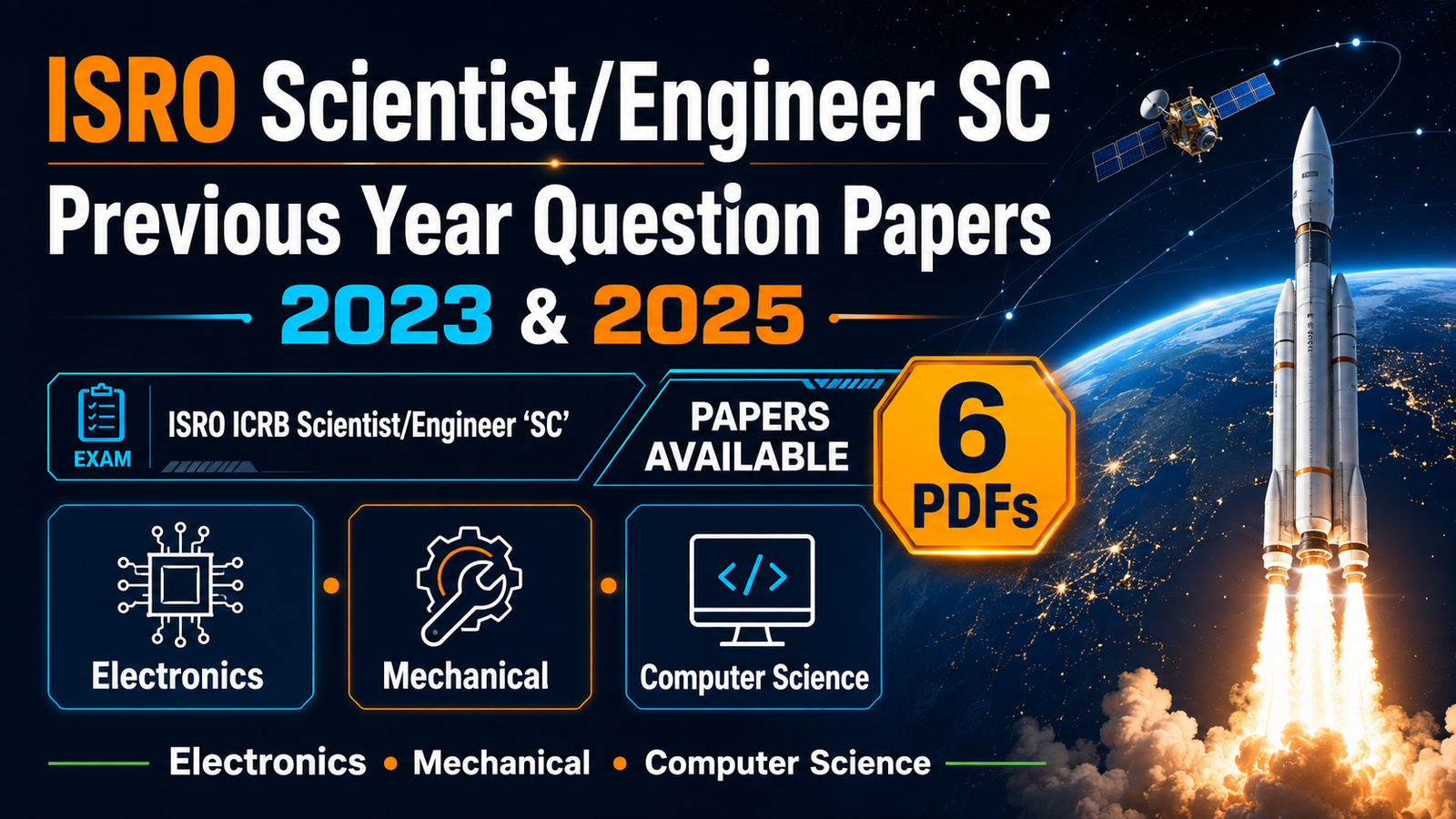
The Indian Space Research Organisation (ISRO) releases the actual question papers of its Scientist/Engineer ‘SC’ written test through the ISRO Centralised Recruitment Board (ICRB), and six of them are now available for free download — Electronics, Mechanical and Computer Science, for both the 2023 and the 2025 recruitment cycles. Each paper carries 95 questions for 100 marks in a 2-hour bilingual test, split into 80 discipline-specific questions in Part ‘A’ and 15 aptitude questions in Part ‘B’. If you have applied under the current advertisement ISRO:ICRB:03(EMC):2026, these papers are the closest thing to a real mock test you will get.
−0.33 for every wrong answer in Part ‘A’; no negative marking in Part ‘B’
Medium of Paper
Bilingual — Hindi and English
Question Paper Format
Objective multiple-choice with four options (a), (b), (c), (d); OMR answer sheet in the 2023 and 2025 papers
Booklet Series
A, B, C, D or E printed on the top right corner — must be written and bubbled on the OMR sheet
File Format
PDF — free download, no registration needed
Official Website
isro.gov.in
Download ISRO Scientist/Engineer SC Previous Year Question Papers (PDF)
All six papers below are the official ISRO booklets, exactly as released on the ICRB recruitment page. Each one contains the full 95 questions with all four answer options in Hindi and English.
Area / Discipline Specific (Electronics, Mechanical or Computer Science)
80
80
+1 for a correct answer, 0 for no answer, −0.33 for a wrong answer
Part ‘B’
Aptitude / Ability Test
15
20
Questions carry different marks (1 or 2 each); no negative marking
Total
—
95
100
2 hours, single sitting
Question type
Objective multiple-choice, four options, exactly one correct
Multiple answers marked
Treated as a wrong answer — negative marking applies in Part ‘A’
Answer sheet
Separate OMR sheet; only black or blue ball point pen allowed
Booklet series
A / B / C / D / E — writing and bubbling it on the OMR sheet is mandatory, otherwise the sheet is not evaluated
OMR copy
Candidates are given a copy of their own OMR answer sheet to retain for future reference
Language
Every question is printed in both Hindi and English in the same booklet
Part ‘A’ page count
Around 39 to 48 printed pages per booklet (excluding the cover sheet)
Note: The 2023 and 2025 papers above were conducted as OMR-based written tests. The current 03(EMC):2026 advertisement describes the first stage as a Written Test / CBT of 100 marks, followed by an interview of 100 marks with shortlisting in a 1:5 ratio and a final panel weighted 50% test and 50% interview. The delivery mode may therefore differ, but the question standard and the 80 + 15 structure are the best available reference.
Topic-wise Coverage Seen in the Papers
The following is a subject map built by reading through the 2023 and 2025 booklets themselves — it is not an officially published syllabus, since ISRO does not release one for this test. Treat it as a guide to where the 80 Part ‘A’ questions actually came from.
Discipline
Topics that appeared in the 2023 and 2025 papers
Electronics
Analog electronics — operational amplifiers, feedback amplifiers, BJT, FET and MOSFET, diodes, Zener and rectifier circuits, oscillators. Digital electronics — logic gates, flip-flops, counters, multiplexers, ADC and DAC. Signals and systems — Fourier analysis, Laplace transform, Z-transform, convolution, sampling and the Nyquist rate. Control systems — transfer functions, stability, state space, PID control. Communication systems — analog and digital modulation, PSK and QAM, noise, probability and random variables. Electromagnetics — transmission lines, waveguides, antennas, microwave basics. Devices and circuits — semiconductor physics, CMOS, power electronics (SCR and thyristors), memory, network theorems and resonance.
Mechanical
Strength of materials — stress and strain, Mohr’s circle, bending moment and shear force, torsion, beams, columns and buckling, springs, fatigue. Thermodynamics and power engineering — entropy and enthalpy, Carnot, Otto and Rankine cycles, boilers, steam turbines, nozzles. Refrigeration and air conditioning. Heat transfer — conduction, convection, radiation. Fluid mechanics — viscosity, Reynolds number, laminar and turbulent flow, boundary layer, drag and lift. Theory of machines and machine design — gears, bearings, clutches, cams, vibration. Manufacturing — casting, welding, rolling, machining (turning, milling, drilling), tolerances and metrology. Engineering materials and heat treatment, composites. Industrial engineering and operations research — PERT and CPM.
Computer Science
Algorithms — complexity analysis, greedy and dynamic programming, Dijkstra and Floyd–Warshall, sorting, hashing. Data structures — stacks, queues, heaps, trees and graphs. Operating systems — processes and threads, scheduling, deadlock, semaphores, paging and page faults. DBMS — SQL, relational model, normal forms, transactions, indexing. Computer networks — OSI model, TCP and UDP, IP addressing, firewalls. Theory of computation and compilers — regular expressions, grammars, lexical and syntax analysis, code generation. Digital logic and computer organisation — Karnaugh maps, flip-flops, multiplexers, counters, instruction set architecture, pipelining. Software engineering — the V model, white box, black box and grey box testing, alpha and beta testing, unit, integration, system and acceptance testing (a notably heavy area in the 2025 paper). Engineering mathematics, cloud computing, artificial intelligence and cryptography (RSA) also appeared.
Part B – Aptitude / Ability Test: What Actually Comes
Part ‘B’ is only 15 questions but it is worth 20 marks and carries no negative marking, which makes it the cheapest 20 marks on the paper. These are the question types that appeared in the 2023 and 2025 booklets.
Question Type
What appeared in the papers
Calendar
Finding the day of the week for a given date
Logical deduction
Fact-based statements followed by “which of the following must also be a fact”
Syllogism
Statements and conclusions of the “some books are tables” type
Ratio and mixtures
Mixture and alligation problems, for example a 45-litre mixture with a given ratio
Mensuration
Volume and surface area, for example a cube of 8 cubic metres
Venn diagrams
Reading a figure to count how many play one game but not another
Series and pattern completion
Choosing the box or figure that completes a pattern
Coding and decoding
Combinations of letters and numbers to be decoded by a rule
Non-verbal reasoning
Figure-based questions on analogy and the odd one out
How to Use These Papers Effectively
Download the paper for your discipline from the table above — start with the 2025 paper, since it is the most recent picture of the standard.
Sit the full paper in one 2-hour block with a timer and no reference material, exactly as it would be in the exam hall.
Score yourself using the real marking scheme: +1 for correct, 0 for blank and −0.33 for wrong in Part ‘A’, and 1 or 2 marks with no penalty in Part ‘B’.
Mark every question you guessed even if you got it right — at −0.33 a wrong guess costs you a third of a correct answer, so guessing habits matter more here than in a no-penalty exam.
Use the topic table above to build your revision list from the subjects that actually repeated across 2023 and 2025, then attempt the older paper as a second timed mock closer to the exam.
Do not treat the topic map on this page as an official syllabus — ISRO does not publish one for this test, and the list is derived from the 2023 and 2025 papers only.
Do not practise these papers without the −0.33 penalty applied — scoring them as a plain out-of-95 test gives you a badly inflated idea of where you stand.
Do not skip Part ‘B’ in your preparation because it is “only aptitude” — it is 20 of the 100 marks with no negative marking, and 2-mark questions sit alongside 1-mark ones.
Do not leave the booklet series letter unmarked on the OMR sheet in the actual exam — the instructions state plainly that the answer sheet will not be evaluated without it.
Do not mark more than one option per question; the paper counts multiple answers as a wrong answer, which triggers negative marking in Part ‘A’.
Do not assume the 2026 exam will be identical — always cross-check the current advertisement, since the mode and stage weightage are set by that notification, not by an old paper.
Frequently Asked Questions
1. How many previous year papers are available here? Six papers — Electronics, Mechanical and Computer Science, for the 2023 and 2025 ISRO Scientist/Engineer ‘SC’ written tests.
2. How many questions and marks does the ISRO Scientist/Engineer SC paper carry? 95 questions for 100 marks — 80 discipline-specific questions of 1 mark each in Part ‘A’ and 15 aptitude questions totalling 20 marks in Part ‘B’.
3. Is there negative marking in the ISRO Scientist/Engineer SC exam? Yes — 0.33 marks are deducted for every wrong answer in Part ‘A’, while Part ‘B’ has no negative marking.
4. How much time is given for the paper? Two hours — the 2025 papers were held on 26 October 2025 from 1000 Hrs to 1200 Hrs.
5. Are the question papers in Hindi or English? Both — every question is printed bilingually in Hindi and English in the same booklet.
6. Does ISRO release an official syllabus for this exam? No, ISRO does not publish a topic-wise syllabus for the Scientist/Engineer ‘SC’ written test, which is why past papers are the standard way candidates map the subjects.
7. Are answer keys included with these papers? No — these are the question booklets only; for the current cycle the advertisement states the answer key will be published within 3 working days of the written test, with objections accepted for 5 days after that.
8. Which recruitment are these papers useful for right now? Advertisement ISRO:ICRB:03(EMC):2026 for 175 Scientist/Engineer ‘SC’ posts in Electronics, Mechanical and Computer Science, for which online applications are open till 16-09-2026.
Disclaimer: The information above has been compiled from the official notification for the convenience of job seekers. Candidates are advised to verify all details from the official website before applying.