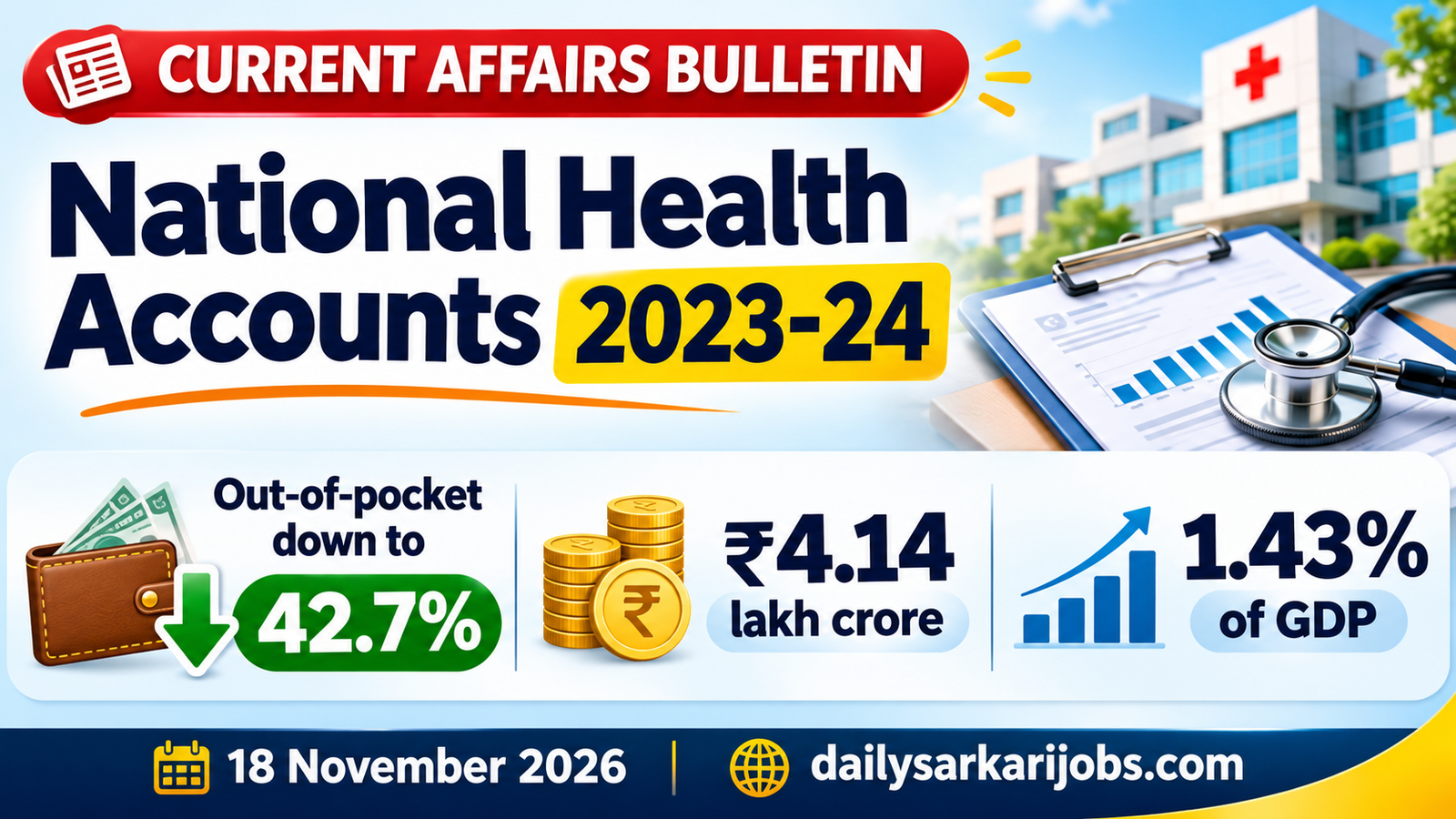
The Health Ministry’s National Health Accounts for 2023-24 were released in mid-November 2026. Every report of it led with how much the government now spends. That is the wrong number to lead with, and the report itself says why.
The Number That Matters Is the One Households Stop Paying
Out-of-pocket expenditure is what a family pays from its own pocket at the moment of treatment — the chemist’s bill, the test, the hospital deposit. It is the cruellest way to finance health care, because it falls on people exactly when they are least able to pay, and it is the single biggest reason households fall into poverty after an illness.
In 2013-14 it was 64.2 per cent of all health spending in India. In 2023-24 it is 42.7 per cent. Nearly twenty-two percentage points have moved off household bills and onto governments and insurance.
That is why the government-spending figure matters: not for its own sake, but because it is what pushed the other number down. Read the two together and the accounts tell one story — the same care is being bought, by somebody else.
Jargon, Defined Once
- National Health Accounts (NHA) is an annual accounting exercise that traces every rupee spent on health in a year — where it came from, who handled it, and what it bought.
- Total Health Expenditure (THE) is all spending on health in the country, from every source together.
- Government Health Expenditure (GHE) is the part paid by the Centre, states and local bodies.
- Out-of-Pocket Expenditure (OOPE) is the part paid directly by households at the time of care, with no insurance or government scheme behind it.
- Social security expenditure on health is spending through government-backed insurance and employee health schemes.
- Per capita simply means per person — the total divided by the population.
The Figures, Side by Side
| Measure | 2023-24 | Ten years earlier |
|---|---|---|
| Out-of-pocket share of all health spending | 42.7% | 64.2% (2013-14) |
| Government health expenditure | ₹4,14,196 crore | ₹1.30 lakh crore |
| Government health spend per person | ₹2,959 | ₹1,042 |
| Social security share of health spending | 11% | 6% |
| Total health expenditure | ₹9,52,122 crore (3.29% of GDP, ₹6,801 per person) | — |
Put two of those rows together and something quiet has happened. Government health expenditure is now 43.5 per cent of total health spending, against out-of-pocket’s 42.7 per cent. On these figures the government is now the larger payer, by a margin of well under a percentage point.
What the Accounts Do Not Say
Government health spending is 1.43 per cent of GDP. The National Health Policy of 2017 set a target of 2.5 per cent of GDP by 2025, up from 1.15 per cent at the time. The target year has passed and the figure is 1.43 per cent.
Both things are true at once, and a good answer says both. The share households pay has fallen a long way; the share of national income the state puts in has risen only a little. A falling out-of-pocket share with a nearly flat GDP share means the composition of health financing changed faster than its size.
Exam Alert: Five Traps
- 42.7 per cent is the out-of-pocket share of health spending, not of GDP. Shares of THE and shares of GDP are different denominators and the commonest mix-up on this topic.
- Government health expenditure is 1.43 per cent of GDP; total health expenditure is 3.29 per cent.
- The National Health Policy target is 2.5 per cent of GDP by 2025 — a government target, not an achievement.
- The NHA is produced by the National Health Systems Resource Centre under the Health Ministry, not by NITI Aayog and not by the Finance Ministry.
- These are the 2023-24 estimates, released in November 2026. The accounts always run a couple of years behind, so the data year and the release year are never the same.
Did You Know: The Accounts Are Built on a Framework India Did Not Write
The National Health Accounts follow the System of Health Accounts 2011, an international framework. That is the whole point of it. Every country that uses it counts health spending the same way, so India’s 42.7 per cent can be set against another country’s figure without arguing about definitions first.
This is the eleventh round of these estimates. Which means the comparison with 2013-14 is not two separate studies being lined up after the fact — it is the same ledger, kept the same way, for over a decade. That is what makes the fall from 64.2 to 42.7 a measurement rather than a claim.
Why a Reader Should Care
Health financing turns up in three places at once — as economy, as social-sector schemes, and as a straight data question with a number to recall. It sits with our explainer on Ayushman Bharat at eight years, which is the largest single reason the out-of-pocket share moved, with our capsule on important government schemes and with our explainer on the medical devices PLI scheme.
Today’s Static GK capsule is on India’s minerals, and the two share a habit of mind. Both look like lists to be memorised and are really maps to be read. Where the minerals are follows from where the old rock is; where the health money comes from follows from who was made responsible for paying. Learn the pattern and the list remembers itself.
Practice Questions
Q1. According to the National Health Accounts 2023-24, out-of-pocket expenditure as a share of total health spending is
(a) 64.2 per cent (b) 42.7 per cent (c) 11 per cent (d) 3.29 per cent
Answer: (b) 42.7 per cent A decade earlier the same figure stood at 64.2 per cent, so roughly twenty-two percentage points shifted away from households.
Q2. Government health expenditure in 2023-24 was about
(a) ₹1.30 lakh crore (b) ₹9.52 lakh crore (c) ₹25 lakh crore (d) ₹4.14 lakh crore
Answer: (d) ₹4.14 lakh crore The first option on that list is the figure for 2013-14, which is why the two are so often swapped.
Q3. Government health expenditure in 2023-24 was what share of GDP?
(a) 1.43 per cent (b) 2.5 per cent (c) 3.29 per cent (d) 42.7 per cent
Answer: (a) 1.43 per cent Total health expenditure from all sources together was 3.29 per cent of GDP in the same year.
Q4. The National Health Policy, 2017 set a target for government health expenditure of
(a) 1.15 per cent of GDP by 2020 (b) 5 per cent of GDP by 2030 (c) 2.5 per cent of GDP by 2025 (d) 10 per cent of GDP by 2040
Answer: (c) 2.5 per cent of GDP by 2025 It was to be reached from a base of 1.15 per cent, and the actual figure for 2023-24 is 1.43 per cent.
Q5. The National Health Accounts estimates are prepared by
(a) NITI Aayog (b) The Reserve Bank of India (c) The National Health Systems Resource Centre, Ministry of Health and Family Welfare (d) The Ministry of Finance
Answer: (c) The National Health Systems Resource Centre, Ministry of Health and Family Welfare The work is done by its National Health Accounts Technical Secretariat, using the System of Health Accounts 2011 framework.
30-Second Revision
- The hinge: watch what households stop paying — out-of-pocket expenditure fell from 64.2% to 42.7% of health spending in ten years.
- Government health expenditure: ₹4,14,196 crore, 1.43% of GDP, 43.5% of total health spending, ₹2,959 per person.
- Total health expenditure: ₹9,52,122 crore, 3.29% of GDP, ₹6,801 per person.
- Social security share rose from 6% to 11% of health spending.
- The gap: the National Health Policy 2017 target was 2.5% of GDP by 2025; the figure is 1.43%. Published by the NHSRC under the Health Ministry, eleventh round, System of Health Accounts 2011.
What Is Not Settled
Whether government spending has overtaken out-of-pocket spending for the first time is not stated in the sources used here. The arithmetic is plain — 43.5 per cent against 42.7 per cent — but whether that crossover has happened before in these accounts is a claim the reports do not make, so this post does not make it either.
Second, the exact date of release is given only as mid-November 2026. Reports appeared on 15 and 16 November 2026. If a question asks for a precise release date, the Health Ministry’s own announcement is the place to check rather than this capsule.
Sources
- Reporting of 15 and 16 November 2026 on the release of the National Health Accounts estimates for 2023-24 by the Union Ministry of Health and Family Welfare — for government health expenditure of ₹4.14 lakh crore against ₹1.30 lakh crore in 2013-14, the fall in the out-of-pocket share from 64.2 per cent to 42.7 per cent, the rise in the social security share from 6 per cent to 11 per cent, and per capita government health expenditure of ₹2,959 against ₹1,042 a decade earlier.
- The same reporting for the detailed figures — total health expenditure of ₹9,52,122 crore at 3.29 per cent of GDP and ₹6,801 per person; government health expenditure of ₹4,14,196 crore at 1.43 per cent of GDP and 43.5 per cent of total health expenditure; out-of-pocket expenditure of ₹4,06,197 crore; preparation by the National Health Accounts Technical Secretariat at the National Health Systems Resource Centre; the eleventh round of estimates; and the use of the System of Health Accounts 2011 framework.
- Reference material on the National Health Policy, 2017 — the target of raising government health expenditure to 2.5 per cent of GDP by 2025 from 1.15 per cent.
- Where a crossover claim and an exact release date are not supported by the sources used, the post says so above rather than asserting them.