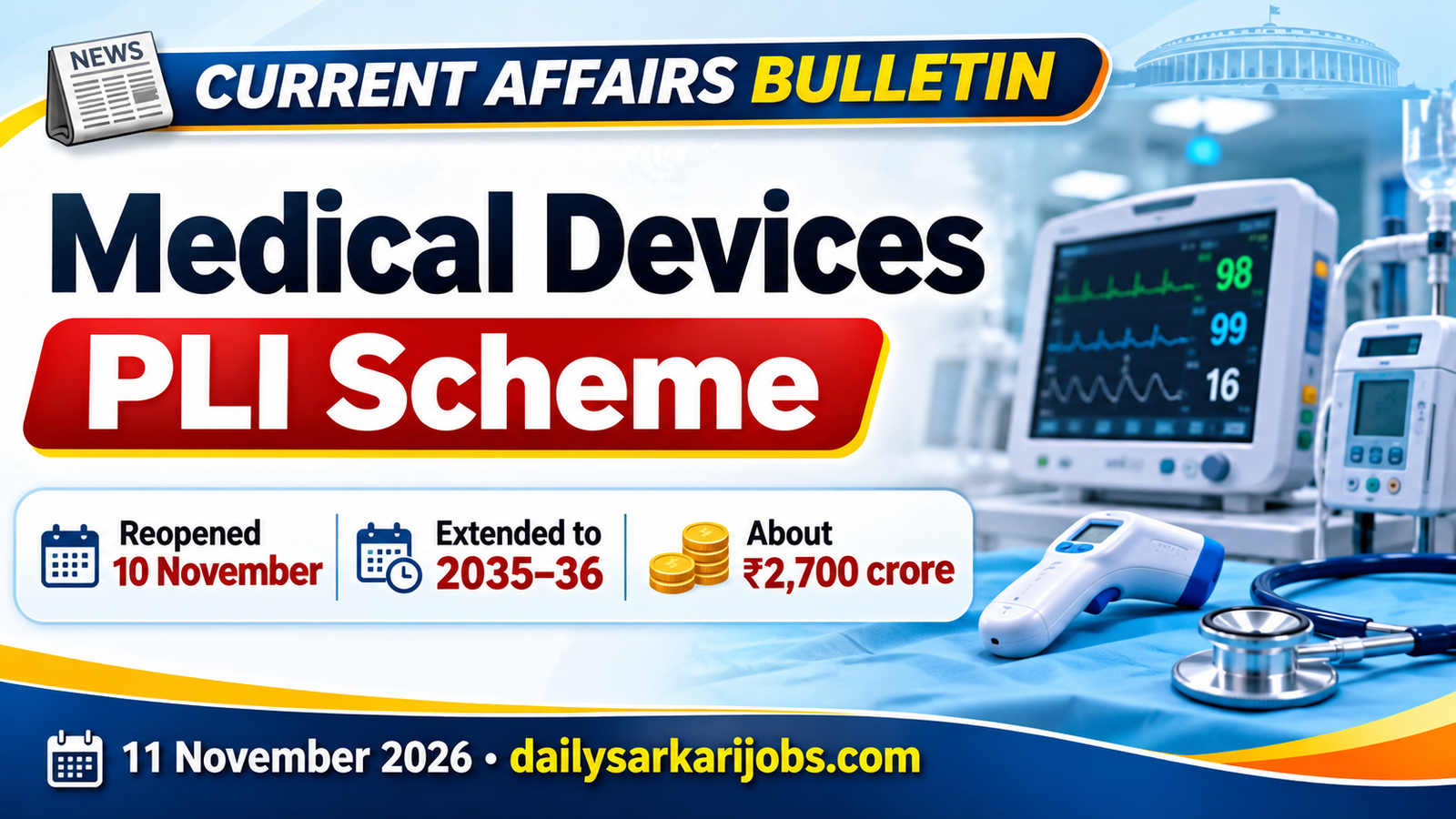
The Union government reopened the medical devices PLI scheme on 10 November 2026, extending it to 2035–36 and inviting fresh applications. The headline is the money. The interesting part is what the scheme now sorts applicants by, because it is not what it used to be.
The Scheme Stopped Asking Which Device, and Started Asking How Much of It India Makes
When the scheme began in 2020 its four categories were about what a machine does. Cancer care and radiotherapy. Radiology and imaging. Anaesthetics and cardio-respiratory. Implants. A doctor would recognise that list; it is organised by the patient.
The four categories now reported for the revised scheme are about something else entirely.
| Segment | What it covers |
|---|---|
| TS1 | Medical consumables, disposables and implants |
| TS2 | Critical components |
| TS3 | High-end devices at a nascent stage of domestic manufacturing |
| TS4 | High-end devices currently only assembled in India |
Read TS4 again. It is a government category for machines that India puts together out of parts made somewhere else. The scheme is not pretending the gap does not exist — it has given the gap a number and attached money to closing it.
That is the shift worth carrying. The first version asked which illness a device treats. The second asks how deep the manufacturing goes: are you making the consumable, the component, the whole machine, or only screwing it together? Four categories, arranged from shallow to deep.
Jargon, Defined Once
- PLI is Production Linked Incentive. The government pays a percentage of your extra sales of goods you made in India — so the subsidy arrives after the output does, not before.
- A greenfield project is a factory built from nothing on a fresh site, as against expanding one that already exists.
- Incremental sales means sales above a fixed base year, which is what the incentive is calculated on.
- A critical component is a part the finished machine cannot work without and that is hard to make — an X-ray tube, a detector, a specialised magnet.
- Assembly is putting bought-in parts together. Manufacturing is making the parts. The whole scheme turns on that difference.
What the First Phase Actually Did
These are the official figures, as reported by the Department of Pharmaceuticals in December 2025.
| Measure | Figure |
|---|---|
| Applicants approved | 28 |
| Greenfield projects commissioned | 24 |
| Products in production | 57 |
| Cumulative eligible sales | ₹13,624.52 crore |
| Of which exports | ₹6,425.48 crore |
| Incentives actually disbursed | ₹157.15 crore, to 7 applicants |
The last row is the one to notice. Twenty-eight approved, seven paid. That is how a production-linked scheme is meant to behave — the money follows the output, and most of the approved applicants had not yet produced enough to claim. Approval is not a payment.
Among the products now being made in India under the scheme: linear accelerators, MRI machines, ultrasound, CT scanners, mammography units, C-arm and X-ray machines. Every one of them is an imaging or radiation machine — the heavy end of the hospital.
What Changed on 10 November 2026
- The scheme runs to 2035–36, a long extension rather than a short one.
- About ₹2,700 crore of the outlay is available for the fresh round.
- An online portal opens in about ten days, and the application window stays open for an extended period rather than closing after a few weeks.
- Approved manufacturers get three years to set up their facilities, and may apply under more than one segment.
- The minimum sales threshold has been dropped and the minimum investment requirement reduced, which lowers the bar for smaller firms.
- Average incentive rates are about 5 per cent for TS1, about 9 per cent for TS2 and TS3, and 6 per cent for TS4 — highest where the manufacturing is deepest.
The rate table is the policy in one line. Making a critical component pays nearly twice what making a disposable pays. The government is not paying for output; it is paying for difficulty.
Exam Alert: Five Traps
- The administering ministry is Chemicals and Fertilizers, through the Department of Pharmaceuticals — not Health, and not Commerce. This is the single most common wrong answer on the topic.
- Launched 2020, outlay ₹3,420 crore; extended on 10 November 2026 to 2035–36 with about ₹2,700 crore available. Two sets of numbers, two dates.
- PLI pays on incremental sales, after production. It is not a grant, not a loan and not a tax break.
- 28 approved, 7 paid. A question that treats approvals as disbursements is wrong.
- The new segments are about manufacturing depth, the old ones about medical use. Do not mix the two lists.
Did You Know: India Exported Almost Half of What the Scheme Produced
Of ₹13,624.52 crore in eligible sales, ₹6,425.48 crore went abroad. That is about forty-seven per cent — nearly half the output of a scheme designed to reduce imports left the country.
It is not a contradiction, and it is worth understanding why. A factory built only for the home market is usually too small to be efficient at making complex machines. Exports are what let the volume reach the level where the cost per unit falls far enough to compete with an import. The export sale and the import substitution are the same factory running. Scale is the thing being bought.
Why a Reader Should Care
PLI schemes are among the most heavily asked items in the economy section, because there are fourteen of them across different sectors and examiners can ask about any one: which ministry, which outlay, which year, how the incentive works. This one sits with our capsules on the Mobile Phone Manufacturing Scheme, the Container Manufacturing Promotion Scheme and twelve years of Make in India — read the four together and the family resemblance becomes obvious.
Today’s Static GK capsule is on light, reflection and refraction, and the pair fit more neatly than they look. Look again at what the scheme has put into production: X-ray tubes, CT scanners, mammography units, MRI. Every one of them does the same thing — send a wave into a body, catch what comes out the other side, and turn it into a picture. The capsule is that idea at its simplest: a lens, a detector and the oldest imaging device there is, which is an eye.
Practice Questions
Q1. The Production Linked Incentive scheme for medical devices is administered by
(a) The Ministry of Health and Family Welfare (b) The Ministry of Commerce and Industry (c) The Department of Pharmaceuticals, Ministry of Chemicals and Fertilizers (d) The Ministry of Science and Technology
Answer: (c) The Department of Pharmaceuticals, Ministry of Chemicals and Fertilizers The scheme was launched in 2020 with an outlay of 3,420 crore rupees and a five-year incentive period.
Q2. On 10 November 2026 the medical devices PLI scheme was extended up to
(a) 2030-31 (b) 2035-36 (c) 2028-29 (d) 2040-41
Answer: (b) 2035-36 Fresh applications were invited at the same time, with about 2,700 crore rupees of the outlay still available.
Q3. Under a Production Linked Incentive scheme, the incentive is paid on
(a) Capital invested in the plant (b) Land acquired for the factory (c) Incremental sales of goods manufactured in India (d) Exports alone
Answer: (c) Incremental sales of goods manufactured in India Because the payment follows production, approval under the scheme does not by itself result in any money being disbursed.
Q4. Which of these is NOT one of the four target segments reported for the revised medical devices PLI scheme?
(a) Critical components (b) Medical consumables, disposables and implants (c) High-end devices only assembled in India (d) Veterinary diagnostic equipment
Answer: (d) Veterinary diagnostic equipment The fourth reported segment covers high-end devices at a nascent stage of domestic manufacturing, and the segments are arranged by depth of manufacturing.
Q5. As reported in December 2025, how many of the applicants approved under the scheme had actually received incentive payments?
(a) All 28 (b) Seven (c) Twenty-four (d) None
Answer: (b) Seven A total of 157.15 crore rupees had been disbursed by then, against cumulative eligible sales of 13,624.52 crore rupees.
30-Second Revision
- The hinge: the scheme stopped asking which device and started asking how deep the manufacturing is — and gave a category, TS4, to machines India only assembles.
- The event: reopened 10 November 2026, extended to 2035–36, about ₹2,700 crore available, portal in about ten days, three years to build.
- The origins: launched 2020, outlay ₹3,420 crore, run by the Department of Pharmaceuticals, Ministry of Chemicals and Fertilizers.
- The record: 28 approved, 24 greenfield projects, 57 products, ₹13,624.52 crore eligible sales, ₹6,425.48 crore exports, ₹157.15 crore paid to 7.
- The principle: PLI pays on incremental sales, after the output exists. Rates rise with difficulty: about 5% TS1, about 9% TS2 and TS3, 6% TS4.
What Is Not Settled
Two honest notes on the figures. First, the launch year is reported both as 2020 and as 2021–22 in different accounts. The Department of Pharmaceuticals’ own material gives 2020 for the launch and a five-year incentive period running from 2022–23, which is most likely what the two versions are each describing. Answer 2020 for the launch.
Second, the production figures do not agree because they measure different things. The official December 2025 statement gives ₹13,624.52 crore of cumulative eligible sales across 57 products; reports of the 10 November announcement speak of more than 60 devices and components and production worth over ₹16,000 crore. Different cut-off dates and different definitions. Quote the official figure with its date rather than blending them.
Third, the segment names TS1 to TS4 are as reported from the announcement, not as taken from the gazette notification, which had not been examined for this capsule. Check the notified text before quoting the names word for word.
Sources
- Press Information Bureau material from the Department of Pharmaceuticals, Ministry of Chemicals and Fertilizers — the launch of the PLI Scheme for Promoting Domestic Manufacturing of Medical Devices in 2020 with an outlay of ₹3,420 crore, four target segments, a five-year incentive period from 2022–23, and the position as of December 2025: 28 applicants approved, ₹157.15 crore disbursed to 7 applicants, 24 greenfield projects commissioned, production of 57 products including linear accelerators, MRI, ultrasound, CT, mammography, C-arm and X-ray machines, cumulative eligible sales of ₹13,624.52 crore including exports of ₹6,425.48 crore.
- Reporting of the ministry’s statement of 10 November 2026 — the extension of the scheme to 2035–36, about ₹2,700 crore available, the four target segments described above, the online portal expected within ten days, the open application window, the three years allowed to set up facilities, permission to apply under multiple segments, the removal of the minimum sales threshold and reduction of the minimum investment requirement, and average incentive rates of about 5 per cent, 9 per cent and 6 per cent.
- Where the launch year and the production figures differ between sources, the difference is stated above rather than resolved silently.