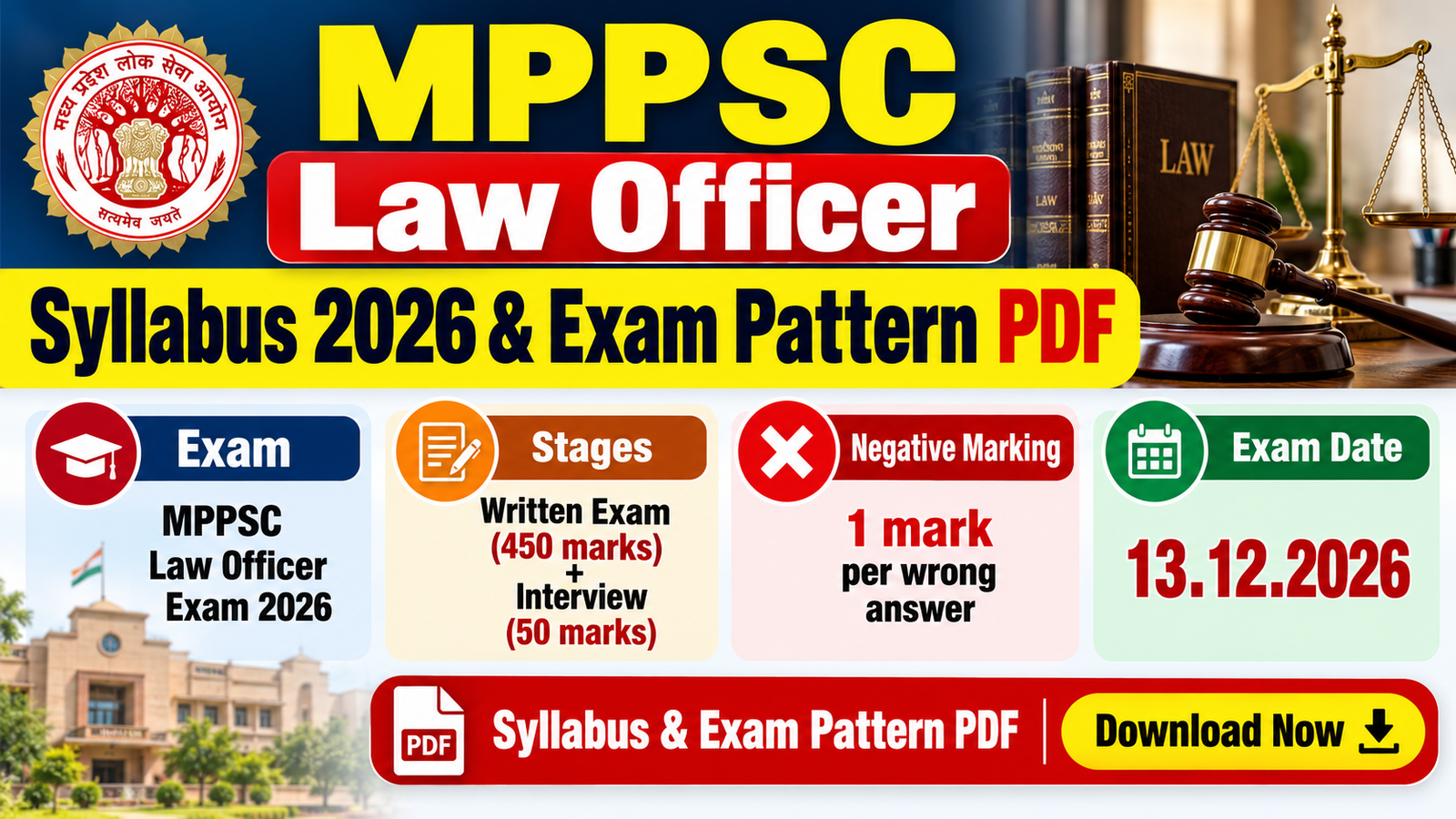
One 3-hour paper, 150 multiple-choice questions, and 1 mark lost for every wrong answer: that is the written test for the MPPSC Law Officer (Vidhi Adhikari) exam. The Commission released the exam plan and syllabus on 08.10.2026 for the 4 Law Officer posts in the Madhya Pradesh Jail Department. 50 questions test general studies about Madhya Pradesh, and 100 test law, from the Constitution to the state’s own Acts.
All dates except the first come from the recruitment notification (Advt. No. 13/2026), not from this notice.
Exam Pattern
Part
Questions
Marks
Time
Section A: General Studies
50
150
–
Section B: Subject (Law)
100
300
–
Written Exam Total
150
450
3 hours
Interview
–
50
–
Grand Total
–
500
–
Rule
Details
Mode
Offline exam on an OMR sheet, held in one 3-hour sitting
Question Type
Objective (multiple choice). Each question has four options, A, B, C and D, and only one is correct
Marks per Question
3 marks for each right answer
Negative Marking
1 mark is cut for each wrong answer. Your marks = (3 × right answers) − wrong answers
More Than One Option Marked
The answer is rejected and treated as not attempted
Language
Both sections come in Hindi and English. If the two versions differ, only the Hindi one is valid
Minimum Marks
At least 40% in Section A and 40% in Section B, counted separately. For notified SC, ST, OBC, EWS and disability-category candidates of Madhya Pradesh, the minimum is 30% in each section
Merit
The merit list is made by adding your marks in both sections
In short: you sit one paper of 150 questions, and each wrong answer takes away 1 of the 3 marks a right answer would have given you. You must clear the minimum in each section on its own, so a very strong law score cannot make up for a weak General Studies score.
What Happens After the Exam
Step
Details
1. Provisional answer key
After the exam, MPPSC puts the provisional answer key (the first version, which can still change) on mppsc.mp.gov.in. You get 5 days to send objections. Objections after that are not considered, and the fee paid for an objection is never refunded
2. Expert committee review
A committee of subject experts looks at every objection. If the key shows a wrong answer and another option is right, the key is corrected. If a question has more than one right answer, all of them are accepted. If no option is right, the question is removed. If the Hindi and English versions differ, only Hindi counts
3. Final answer key and result
The final answer key is published on the website, and after that no objections or letters are accepted. The committee’s decision is final. Everyone who sat the paper gets full marks for any removed question, and the result is made on the final key
4. Documents and interview call
Candidates are taken in merit order, up to 3 times the vacancies advertised for each category plus anyone tied on the last mark, and declared provisionally successful. They must send all documents proving eligibility by a last date announced with the result. Only those whose documents pass a close check are called for the interview, and documents are not accepted after the last date
5. Interview
The interview is for 50 marks, and there is no minimum qualifying mark for it. If you do not attend, you are treated as not eligible for selection. The Commission’s decision on whom to call is final and is put on its website
6. Re-checking
The exam system has no re-evaluation or recounting. Applications asking for it are not acted upon
Topic-wise Syllabus
Section A: General Studies (50 questions, 150 marks)
Unit
Topics
Unit 1: History of Madhya Pradesh
Ancient History of Madhya Pradesh: Prehistoric, Protohistoric and Historic periods
Medieval History of Madhya Pradesh
Modern History of Madhya Pradesh
Freedom Movement in Madhya Pradesh
Tribal History and Tribal Literature of Madhya Pradesh
Unit 2: Geography of Madhya Pradesh
Geographical location and extent of the state, major rivers, mountains
Climate: seasons, soils, temperature, rainfall, forest types and forest produce
Agriculture: major crops, sources of irrigation, irrigation projects
Thermal power projects, non-conventional energy sources, major minerals
Population size, growth and literacy, transportation, food processing industries
Unit 3, Part A: Politics of Madhya Pradesh
Governor, Chief Minister, Cabinet, Vidhan Sabha, High Court, Lokayukta
State Secretariat, Chief Secretary, Divisional Commissioner, Police Commissioner
District Administration, Urban Administration, Local Self Government, Panchayati Raj Institutions
State Election Commission, State Information Commission, State Scheduled Castes Commission, State Scheduled Tribes Commission, State Backward Classes Commission, State Commission for Women
Scheduled Caste and Scheduled Tribe Prevention of Atrocities Act, 1989; Panchayats Extension to Schedule Areas (PESA) Act, 1996; Environment Protection Act, 1986; Madhya Pradesh Govansh Vadh Pratishedh Adhiniyam, 2004
Unit 3, Part B: Economy of Madhya Pradesh
Overview of the Economy of Madhya Pradesh
Status of Agriculture and Rural Development in Madhya Pradesh
Development of Industrial and Infrastructural Framework in Madhya Pradesh
Status of Education, Health and Skill Development in Madhya Pradesh
Status of Madhya Pradesh in Sustainable Development Goals, Ease of Doing Business and Multidimensional Poverty Index
Unit 4: Tribes of Madhya Pradesh: Heritage, Folk Culture and Folk Literature (with special reference to M.P.)
Geographical spread of tribes in Madhya Pradesh, constitutional provisions related to tribes
Major tribes of Madhya Pradesh and Particularly Vulnerable Tribal Groups (PVTGs), tribal welfare programs
Tribal culture of Madhya Pradesh: traditions, special arts, festivals, celebrations, language, dialects and literature
Madhya Pradesh tribals’ contribution to the freedom struggle of India, iconic tribal personalities of the state, popular institutes related to tribes, tribal museums, publications etc.
Folk culture and folk literature of Madhya Pradesh
Unit 5: Important Contemporary Events of International, National and Madhya Pradesh and Information and Communication Technology
Important international and national contemporary events
Important contemporary events and major public welfare schemes of Madhya Pradesh
Prominent personalities and important places of Madhya Pradesh
Computers, Information and Communication Technology, E-Governance
Basic knowledge of Artificial Intelligence (AI), Machine Learning, Cloud Computing, Data Science and Internet of Things
Section B: Law (100 questions, 300 marks)
Unit
Acts and Laws
Unit I: Basic Laws of India
The Constitution of India
Bharatiya Nagarik Suraksha Sanhita, 2023
The Bharatiya Nyaya Sanhita, 2023
The Bharatiya Sakshya Adhiniyam, 2023
The Prevention of Corruption Act, 1988
National Security Act, 1980
Unit II: Madhya Pradesh Miscellaneous Minor Acts
Madhya Pradesh Excise Act, 1915
Madhya Pradesh State Security Act, 1990
Madhya Pradesh Lok Sewaon ke Pradan ki Guarantee Adhiniyam, 2010
Unit III: Prevention of Harassment of Women and Children related laws
The Protection of Children from Sexual Offences (POCSO) Act, 2012
Sexual Harassment of Women at Workplace (Prevention, Prohibition and Redressal) Act, 2013
Protection of Women from Domestic Violence Act, 2005
Juvenile Justice (Care and Protection of Children) Act, 2015
Indecent Representation of Women (Prohibition) Act, 1986
Unit IV: Specific Laws
The Prevention of Damage to Public Property Act, 1984
Legal Services Authority Act, 1987
The Scheduled Castes and Scheduled Tribes (Prevention of Atrocities) Act, 1989
The Protection of Human Rights Act, 1993
The Prison Act, 1894 (along with Madhya Pradesh State local amendments)
The Prisoner’s Act, 1900 (along with Madhya Pradesh State local amendments)
Criminal Procedure (Identification) Act, 2022
M.P. Prisoners Release on Probation Act, 1954
The Probation of Offenders Act, 1958
Unit V: Miscellaneous Criminal Laws
The Explosive Act, 1884
The Essential Commodities Act, 1955
Narcotic Drugs and Psychotropic Substances Act, 1985
Arms Act, 1959
Information Technology Act, 2000
Right to Information Act, 2005
Note: if the Central or State Government amends any of these Acts, the amended version is also part of the syllabus.
Preparing for this exam?
Our papers page links to the official MPPSC archive of earlier question papers, so you can practise objective questions in the same style before the exam.
Do not mark two options for one question. The notice says such an answer is cancelled and counted as not attempted.
Do not guess without thinking. Every wrong answer takes away 1 mark, and a right one only gives you 3.
Do not study only law. You need the minimum in General Studies and in Law separately, and a low score in either one can end your chances.
Send answer-key objections inside the 5-day window. Late ones are not looked at, and the objection fee is not returned.
Send your eligibility documents before the last date announced with the result, because the Commission does not accept them after that date.
If a question reads differently in Hindi and English, go by the Hindi version. That is the one the Commission will treat as correct.
Frequently Asked Questions
When is the MPPSC Law Officer exam?
The recruitment notice gives 13.12.2026 as the written exam date, with admit cards available from 03.12.2026.
How many stages are there in the MPPSC Law Officer selection?
There are two: the written exam (450 marks) and an interview (50 marks), though the recruitment notice says the written exam is held only if 500 or more candidates apply.
How many questions are asked, and in which language?
The paper has 150 multiple-choice questions, 50 in General Studies and 100 in Law, to be done in 3 hours, in Hindi and English.
Is there negative marking in the MPPSC Law Officer exam?
Yes, you get 3 marks for each right answer and lose 1 mark for each wrong one.
What are the minimum marks needed?
You need at least 40% in General Studies and 40% in Law separately, and 30% in each for notified SC, ST, OBC, EWS and disability-category candidates of Madhya Pradesh.
What does the Law section cover?
It has five units covering 31 laws in all: basic laws such as the Constitution, BNSS, BNS and BSA; Madhya Pradesh minor Acts; laws on women and children; specific laws such as the Prison Act; and criminal laws such as the NDPS and IT Acts.
How long do I have to object to the answer key?
You get 5 days after the provisional answer key is published on mppsc.mp.gov.in, and the objection fee is not refunded.
How many candidates are called for the interview?
Up to 3 times the vacancies in each category, plus anyone tied on the last mark, and the interview is for 50 marks with no minimum pass mark.
Disclaimer: The information above has been compiled from the official notification for the convenience of job seekers. Candidates are advised to verify all details from the official website before applying.