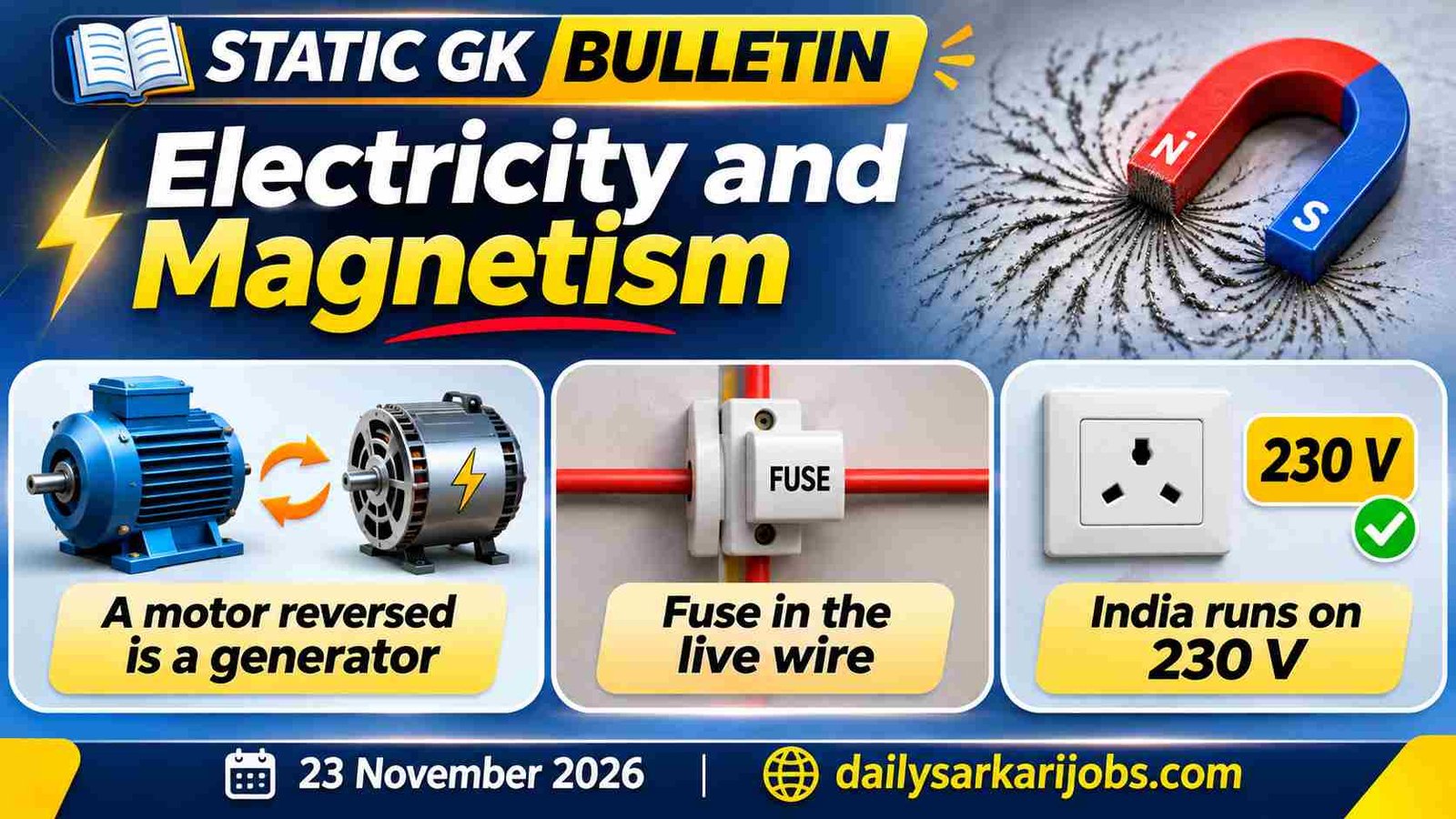
Here is the idea that collapses half this chapter into one sentence: an electric motor and an electric generator are the same machine, run in opposite directions. Put electricity in and you get motion out — that is a motor. Push motion in and you get electricity out — that is a generator. The fan in your room and the turbine in a power station are built on the same relationship between electricity and magnetism, read forwards and backwards. Hold that, and the rules, the hand-rules and the machines stop being a list to memorise and become one idea with two faces.
⚡ QUICK FACTS
Ohm’s law
V = I x R
Indian mains
230 V, 50 Hz
Home wiring
Parallel, never series
Motor vs generator
Same machine, reversed
The three quantities, and the one equation
Picture water in a pipe. Current is how much water flows per second. Voltage is the pressure pushing it. Resistance is how narrow the pipe is. Raise the pressure and more flows; narrow the pipe and less flows. That is the whole of Ohm’s law before any algebra.
Quantity
Symbol
Unit
Current
I
Ampere (A)
Voltage, or potential difference
V
Volt (V)
Resistance
R
Ohm, written as the Greek letter omega
Charge
Q
Coulomb (C)
Power
P
Watt (W)
Energy billed
–
Kilowatt-hour (kWh), the commercial unit
Ohm’s law is V = I x R, stated by Georg Simon Ohm. Power is P = V x I. One ampere is one coulomb of charge passing a point each second, and the instruments that measure these are in our capsule on scientific instruments and inventions.
Two connection facts carry a great many marks. An ammeter is connected in series and has very low resistance, because it must let the current through unchanged. A voltmeter is connected in parallel and has very high resistance, because it must not steal current from the circuit it is measuring. Series for the ammeter, parallel for the voltmeter — swapping them is the standard trap.
Series and parallel, and why your house is parallel
Series
Parallel
Path for current
One single path
Several separate paths
Total resistance
Adds up, so it rises
Falls below the smallest one
If one device fails
Everything stops
The rest keep working
Voltage across devices
Divided between them
Same across each
Used for
Fuses, old fairy lights
Household wiring
Household wiring is parallel, and the reason is practical. If your home were wired in series, switching off one light would kill every appliance in the house, and each device would receive only a share of the voltage. In parallel, every socket gets the full 230 volts and each appliance is independent of the others. That is the single most-asked household wiring question.
The heating effect, and the fuse
Current passing through a wire heats it. That is a nuisance in a cable and the entire point in a heater, an iron or an old filament bulb.
A fuse turns this nuisance into protection. It is a short piece of wire with a low melting point, deliberately the weakest link in the circuit. If the current climbs too high, the fuse melts first and breaks the circuit before the wiring or the appliance is damaged. The fuse is always placed in the live wire — put it in the neutral and the appliance would stay connected to the live supply even after the fuse blew, which is exactly the danger it exists to prevent. A Miniature Circuit Breaker, or MCB, does the same job with a switch that can be reset instead of a wire that must be replaced.
The three wires in your wall
Wire
Job
Live
Carries current in at high potential; the fuse sits here
Neutral
Completes the circuit and returns the current
Earth
A safety path into the ground for leaked current
Earthing is worth understanding rather than memorising. A metal-bodied appliance such as a fridge or an iron is connected by the earth wire to a metal plate buried in the ground. If a live wire inside ever touches the metal body, the current rushes down that easy path to earth instead of waiting for a person to touch the appliance. Earthing protects the user; the fuse protects the circuit. They are different jobs, and questions do swap them.
Magnetism, and the two hands
A magnet has a north and a south pole, and poles cannot be separated — break a magnet in half and you get two complete magnets, not a loose north and a loose south. Like poles repel, unlike poles attract.
The bridge to electricity was found by Hans Christian Oersted, who noticed that a compass needle moved when a current flowed in a nearby wire. A current creates a magnetic field. Wind that wire into a coil around an iron core and you have an electromagnet, which can be switched on and off — the basis of the electric bell, the relay and the crane that lifts scrap iron.
Then Michael Faraday found the reverse: move a magnet near a coil and a current appears in it. This is electromagnetic induction, and it is the reason every power station on earth works. Coal, gas, nuclear fission, falling water and wind all do the same final job — they spin a magnet near a coil. Everything else is only the method of spinning.
Rule
Use
What it gives
Fleming’s left-hand rule
Motors
Direction of the force, or motion
Fleming’s right-hand rule
Generators
Direction of the induced current
A memory trick that survives exam pressure: left for locomotion, right for generation. The left hand tells you which way the motor turns; the right hand tells you which way the generated current flows.
Motor, generator, transformer
Now the hinge pays off.
Motor: electrical energy into mechanical energy. Current through a coil in a magnetic field makes the coil turn. Fans, pumps, mixers, trains.
Generator or dynamo: mechanical energy into electrical energy. A coil turned in a magnetic field produces current. Every power station.
Transformer: changes the voltage of alternating current. A step-up transformer raises voltage and a step-down lowers it.
A transformer works only on alternating current, never on direct current, because it needs a changing magnetic field, and a steady DC current does not change. That is a favourite one-mark question. It is also why the grid uses AC: electricity is stepped up to very high voltage for long-distance transmission, which cuts the energy lost as heat in the wires, and stepped back down near homes.
Direct current (DC)
Alternating current (AC)
Direction
Always the same
Reverses periodically
Source
Cells and batteries
Generators and the mains
In India
–
Reverses 50 times a second, 50 Hz
Transformer works?
No
Yes
The Indian supply
Indian mains supply is 230 volts at 50 hertz for a single-phase domestic connection, and 400 volts between phases on a three-phase supply. Hertz means cycles per second, so 50 Hz means the current reverses direction fifty times each second. Most of the world uses something close to this; North America is the big exception, at about 120 volts and 60 hertz. Indian plugs and sockets follow the standard IS 1293, whose 2019 edition has been enforced through mandatory certification since 2022.
Your electricity bill is in units, and one unit is one kilowatt-hour — a 1,000-watt appliance running for one hour. A 1,500-watt geyser used for two hours therefore consumes three units. Where that electricity is stored and when it is released is the subject of our explainer on grid-scale energy storage.
Exam Alert
Ohm’s law V = I x R; P = V x I; the commercial unit of energy is the kilowatt-hour, not the watt.
Ammeter in series, voltmeter in parallel. Ammeter has low resistance, voltmeter has high resistance.
Household wiring is in parallel, so each appliance gets the full voltage and works independently.
The fuse goes in the live wire and has a low melting point. Earthing protects the person; the fuse protects the circuit.
Oersted: current produces magnetism. Faraday: changing magnetism produces current, called electromagnetic induction.
Fleming’s left hand for motors, right hand for generators.
A transformer works on AC only, because it needs a changing magnetic field.
India: 230 V, 50 Hz. North America is about 120 V, 60 Hz.
Breaking a magnet gives two complete magnets, never an isolated pole.
Did You Know?
Every thermal, nuclear and hydro station does the same final thing. Whatever the fuel, the last step is identical: spin a magnet near a coil. Coal, uranium and falling water are just three ways of turning the same shaft.
A fuse is designed to fail. It is the only component in your house whose whole purpose is to break before anything else does.
Oersted’s discovery was an accident in a lecture. He noticed a compass needle twitch near a current-carrying wire — and that twitch connected two subjects that had been studied separately for centuries.
High voltage is a money-saving trick. Transmission lines run at hundreds of thousands of volts because higher voltage means lower current for the same power, and it is current that wastes energy as heat in the wire.
30-Second Quick Revision
The hinge: a motor and a generator are one machine run in opposite directions.
The equations: V = I x R and P = V x I; billing is in kilowatt-hours.
Safety: fuse in the live wire protects the circuit; earthing protects the person.
Wiring: homes are parallel, so every socket gets the full 230 V.
The two discoveries: Oersted, current makes magnetism; Faraday, changing magnetism makes current.
Transformers: AC only, step-up for transmission and step-down for use.
Test Your Knowledge
Q1. In household wiring, appliances are connected in (a) Series (b) Parallel (c) A mixture of series and parallel in equal measure (d) Neither, they are connected directly to the earth wire Answer: (b) Parallel This way each appliance gets the full supply voltage and keeps working when another is switched off.
Q2. An electric fuse is always connected in the (a) Neutral wire (b) Earth wire (c) Live wire (d) Transformer coil Answer: (c) Live wire If it sat in the neutral, the appliance would remain connected to the live supply even after the fuse melted.
Q3. A transformer cannot work on direct current because (a) DC has too little voltage (b) DC flows only through metals (c) DC produces no magnetic field at all (d) A steady DC gives no changing magnetic field Answer: (d) A steady DC gives no changing magnetic field Induction requires change, which is why the grid is built on alternating current.
Q4. Fleming’s right-hand rule is applied to (a) Electric motors (b) Generators (c) Transformers (d) Fuses Answer: (b) Generators Left for locomotion and right for generation is the usual way to keep the two apart.
Q5. The domestic mains supply in India is (a) 110 V at 60 Hz (b) 230 V at 60 Hz (c) 400 V at 50 Hz (d) 230 V at 50 Hz Answer: (d) 230 V at 50 Hz The 400 V figure is the voltage between phases on a three-phase supply, and North America is the main user of roughly 120 V at 60 Hz.
Want the full ten-question set as a PDF? Head to our Test Your Knowledge page.
Verified on 23 November 2026 against standard reference material on electricity, magnetism and electromagnetic induction, and against published data on mains electricity by country for the Indian supply voltage, frequency and plug standard.