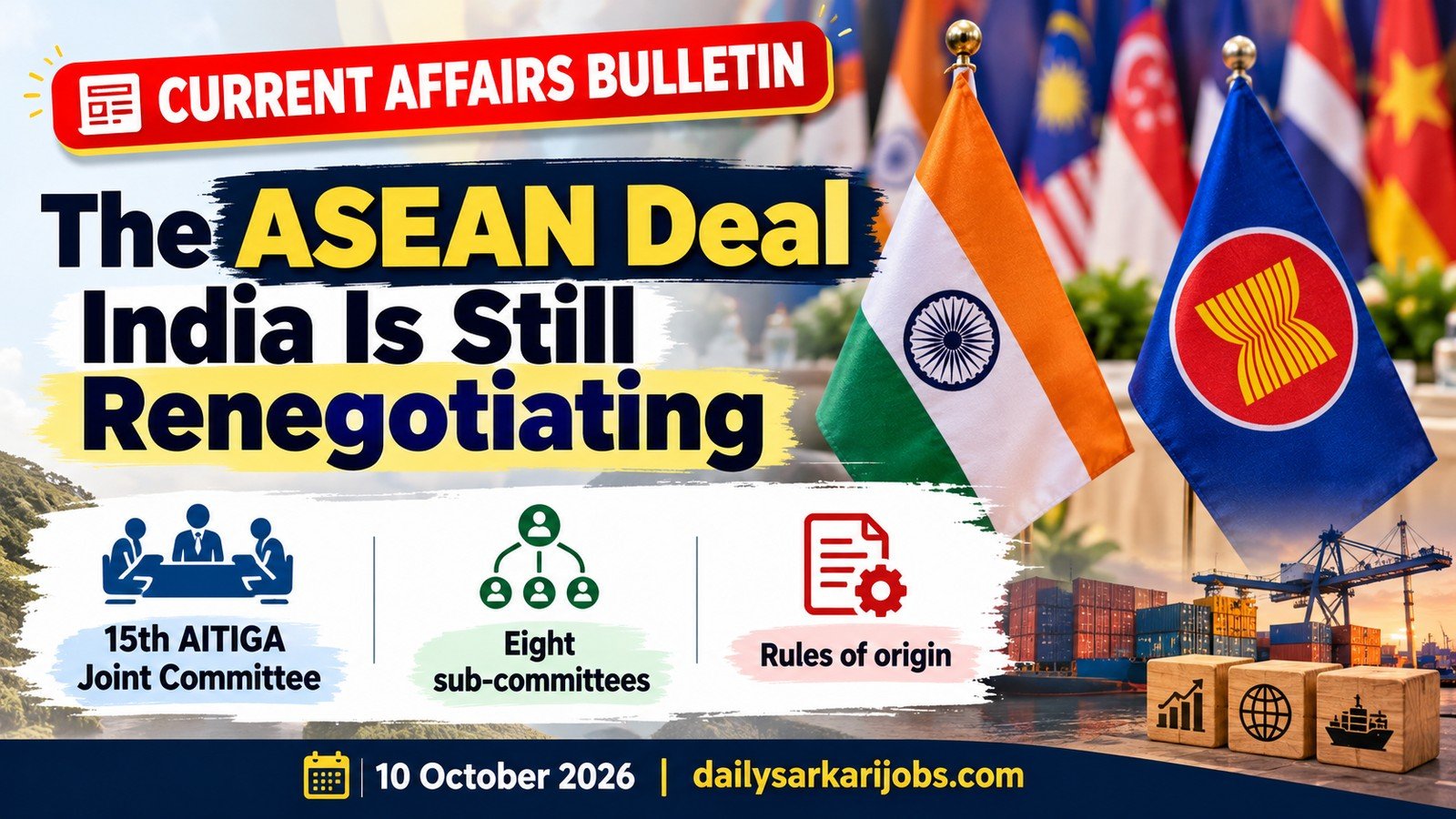
On 9 October 2026 the 15th meeting of the ASEAN-India Trade in Goods Agreement Joint Committee ended in Jakarta. The committee did what the previous fourteen had done: it told its sub-committees to hurry up. The review of this trade agreement was formally tasked in September 2022 and was supposed to finish in 2025. It is now October 2026, and the next meeting is scheduled for January 2027.
That is not a criticism. It is the most useful fact in the story, and this explainer is built around it.
The Hinge: Count the Rounds Before You Read the Communiqué
A press release about a trade negotiation always sounds the same. Both sides reaffirmed their commitment. The committee directed the sub-committees to expedite pending chapters. Read in isolation, that is progress.
Now count. The review was tasked in September 2022. By October 2026 the Joint Committee has met fifteen times — roughly once a quarter for four years. The stated aim, printed by the Department of Commerce itself, was to conclude the review in 2025. The 15th meeting did not announce a conclusion. It announced that the sub-committees should work faster, with time-bound deliverables, and that the next meeting in January 2027 would review their progress.
Fifteen meetings and a missed deadline is the story. It tells you something no single release does: this is a hard renegotiation, not a formality. Whenever you read about a continuing negotiation, find out how many rounds have already happened and what the original deadline was. Those two numbers turn a bland communiqué into an answer you can write a paragraph about.
What AITIGA Actually Is
A Free Trade Agreement is a treaty in which countries cut or remove customs duties on each other’s goods. AITIGA is the goods half of a larger India-ASEAN relationship built in three pieces.
| Agreement | Signed | In force |
|---|---|---|
| Framework Agreement on Comprehensive Economic Cooperation — the umbrella | 2003, at the 2nd ASEAN-India Summit | — |
| AITIGA, Trade in Goods | 13 August 2009, Bangkok | 1 January 2010 |
| AITISA, Trade in Services | 13 November 2014 | 1 July 2015 |
| AIIA, the Investment Agreement | 12 November 2014 | 1 July 2015 |
Notice the gap: five years between goods and services. India opened its market to ASEAN goods in 2010 and only got a services agreement in 2015 — and services are what India is strongest at. That sequencing is the oldest Indian complaint about this agreement, and it is the background to everything being renegotiated now.
ASEAN is the Association of Southeast Asian Nations: Brunei, Cambodia, Indonesia, Lao PDR, Malaysia, Myanmar, the Philippines, Singapore, Thailand and Viet Nam. All ten were at the Jakarta meeting.
Who Was in the Room
| Detail | |
|---|---|
| Dates | 6 to 9 October 2026, hybrid format |
| Venue | The ASEAN Secretariat, Jakarta, Indonesia |
| India’s co-chair | Shri Nitin Kumar Yadav, Additional Secretary, Department of Commerce |
| ASEAN’s co-chair | Ms. Mastura Ahmad Mustafa, Deputy Secretary General (Trade), Malaysia |
| Sub-committees that met alongside | Three of eight — Legal and Institutional Issues, National Treatment and Market Access, and Rules of Origin |
| Next Joint Committee | January 2027, in India |
The co-chairing arrangement is worth one line of memory. India always co-chairs; the ASEAN side is chaired by whichever member state is coordinating the India relationship, currently Malaysia. ASEAN does not negotiate as a single state — it negotiates as ten states with a coordinator, which is one reason agreement is slow.
The Eight Sub-Committees, and Why the List Matters
No single press release names all eight. Assembling them from the 8th, 10th and 15th Joint Committee releases gives the full set, and the list is itself a map of what a modern trade negotiation is about.
| Sub-committee | What it negotiates |
|---|---|
| SC-NTMA — National Treatment and Market Access | Tariffs, and the rule that an imported good must not be treated worse than a domestic one |
| SC-ROO — Rules of Origin | Where a good counts as having been made |
| SC-CPTF — Customs Procedures and Trade Facilitation | Paperwork, clearance times, documentation |
| SC-SPS — Sanitary and Phytosanitary Measures | Food safety, plant and animal health rules |
| SC-STRACAP — Standards, Technical Regulations and Conformity Assessment | Product standards and whose test certificate is accepted |
| SC-TR — Trade Remedies | Anti-dumping and safeguard measures when imports surge |
| SC-LII — Legal and Institutional Issues | The treaty text, dispute settlement, review machinery |
| SC-ETC — Economic and Technical Cooperation | Capacity building and technical assistance |
Only one of those eight is about tariffs. That is the single most useful thing the list teaches. A trade agreement in 2026 is mostly about standards, certificates, customs paperwork and origin rules — the things that decide whether a duty cut is usable at all. The same pattern appears in India’s agreement with the EFTA bloc, where the headline was an investment commitment rather than a tariff line.
Rules of Origin: the Chapter That Is Really the Argument
Rules of origin decide which country a good legally comes from. They matter because an FTA gives a lower duty only to goods originating in a partner country. If the rule is loose, a good made in a third country can be lightly processed in an ASEAN member and then enter India at the FTA rate — and India gets the import without the partner ever having made it.
Watch where this sub-committee meets. At the 8th Joint Committee in April 2025, four sub-committees met in New Delhi and the Rules of Origin sub-committee met separately in Jakarta. At the 15th, only three of eight met alongside the Joint Committee — and Rules of Origin was one of them. A chapter that keeps getting its own schedule is the chapter that is not agreed.
This is the same question the site has met before in a different form: in price statistics, who is asked about the price decides what the number means. In trade, who is allowed to certify where a good was made decides what the agreement is worth. The rule and the referee matter more than the rate.
Two Official Numbers, Both Correct
Ask how big India-ASEAN trade is and you get different answers from two governments, and both are right.
| Source | Figure | What it counts |
|---|---|---|
| Department of Commerce, India (10th Joint Committee release) | USD 123 billion | Bilateral trade in financial year 2024-25, April to March |
| ASEAN Secretariat | USD 106.83 billion | Two-way merchandise trade in calendar year 2024 |
| Department of Commerce, India (8th Joint Committee release) | USD 121 billion | Bilateral trade in financial year 2023-24 |
The gap is not a mistake — it is two calendars and two statistical agencies. India counts April to March and includes what its own customs data records; ASEAN counts January to December and compiles from ten national sources. Before quoting a trade figure, say which year and whose data it is, because an examiner’s answer key will have picked one.
One number both sides agree on: ASEAN accounts for about 11 per cent of India’s global trade, and India is ASEAN’s eighth largest trading partner.
Why India Wants the Review
- The agreement is from 2009. It was negotiated before GST, before Make in India, and before India had a manufacturing strategy to protect. The tariff schedules reflect the economy India had, not the one it has.
- The concessions were not symmetrical. The Department of Commerce has said the review is meant to address uneven tariff liberalisation by partner countries and the resulting injury to Indian industry.
- The agreement is hard to use. Both sides describe the aim as making AITIGA more user-friendly — which is an admission that exporters find the paperwork, certificates and origin proofs not worth the duty saving.
- Goods came first, services came late. India’s comparative strength is in services, and the goods agreement ran alone for five years.
Read that list as a general lesson about old trade agreements. An FTA signed fifteen years ago locks in the bargaining power of fifteen years ago. India’s newer agreements are negotiated from a different position entirely, which is why the recent ones look so different from this one.
The Words That Appear in Every Trade Release
| Term | In plain words |
|---|---|
| Tariff | A customs duty on an imported good |
| Tariff line | One row in the customs tariff — one specific product category |
| National treatment | Once a good is inside the country, it must not be taxed or regulated worse than a domestic one |
| Rules of origin | The test that decides which country a good counts as coming from |
| Trade remedy | A duty imposed to counter dumping, subsidies or an import surge |
| SPS measures | Food safety and plant or animal health rules |
| Joint Committee | The standing body that runs the agreement and its review |
| Hybrid format | Some delegates in the room, some on video |
Why a Reader Should Care
A trade agreement is the only instrument of economic policy that a country cannot change on its own. A tax rate, an interest rate, a subsidy — all of those can be altered by one government in one decision. A tariff bound by treaty takes fifteen meetings and ten other countries.
That is why a review like this one takes four years and counting, and why the institutions India builds at home can move so much faster than the ones it negotiates abroad. Sovereignty is easy to exercise and hard to recover, and AITIGA is the clearest live example India has.
Practice Questions
Q1. The ASEAN-India Trade in Goods Agreement was signed on
(a) 13 August 2009 at Bangkok (b) 1 January 2010 at Jakarta (c) 13 November 2014 at Nay Pyi Taw (d) 8 October 2003 at Bali
Answer: (a) 13 August 2009 at Bangkok The second option is the date it entered into force, the third is the services agreement, and the fourth is the year of the umbrella framework agreement.
Q2. The review of AITIGA was formally tasked to the Joint Committee in
(a) September 2022 (b) January 2010 (c) November 2014 (d) October 2026
Answer: (a) September 2022 The 15th Joint Committee met in October 2026, four years after the review began, and the original aim was to conclude it in 2025.
Q3. How many sub-committees negotiate the AITIGA review?
(a) Five (b) Six (c) Eight (d) Ten
Answer: (c) Eight One of the wrong options is the number of ASEAN member states, which is a common confusion. Only one of the sub-committees deals with tariffs.
Q4. Rules of origin in a free trade agreement decide
(a) The rate of duty on a good (b) Which country a good counts as having been made in (c) Which currency the invoice is in (d) Whether a service may be supplied
Answer: (b) Which country a good counts as having been made in The purpose is to stop goods from a third country being routed through a partner to claim the lower duty, which is why this chapter is the hardest to settle.
Q5. The 15th AITIGA Joint Committee meeting was held at
(a) Vanijya Bhawan, New Delhi (b) Putrajaya, Malaysia (c) The ASEAN Secretariat, Jakarta (d) Bangkok, Thailand
Answer: (c) The ASEAN Secretariat, Jakarta The next meeting after it is scheduled for January 2027 in India, and the agreement itself was signed in the city named in the last option.