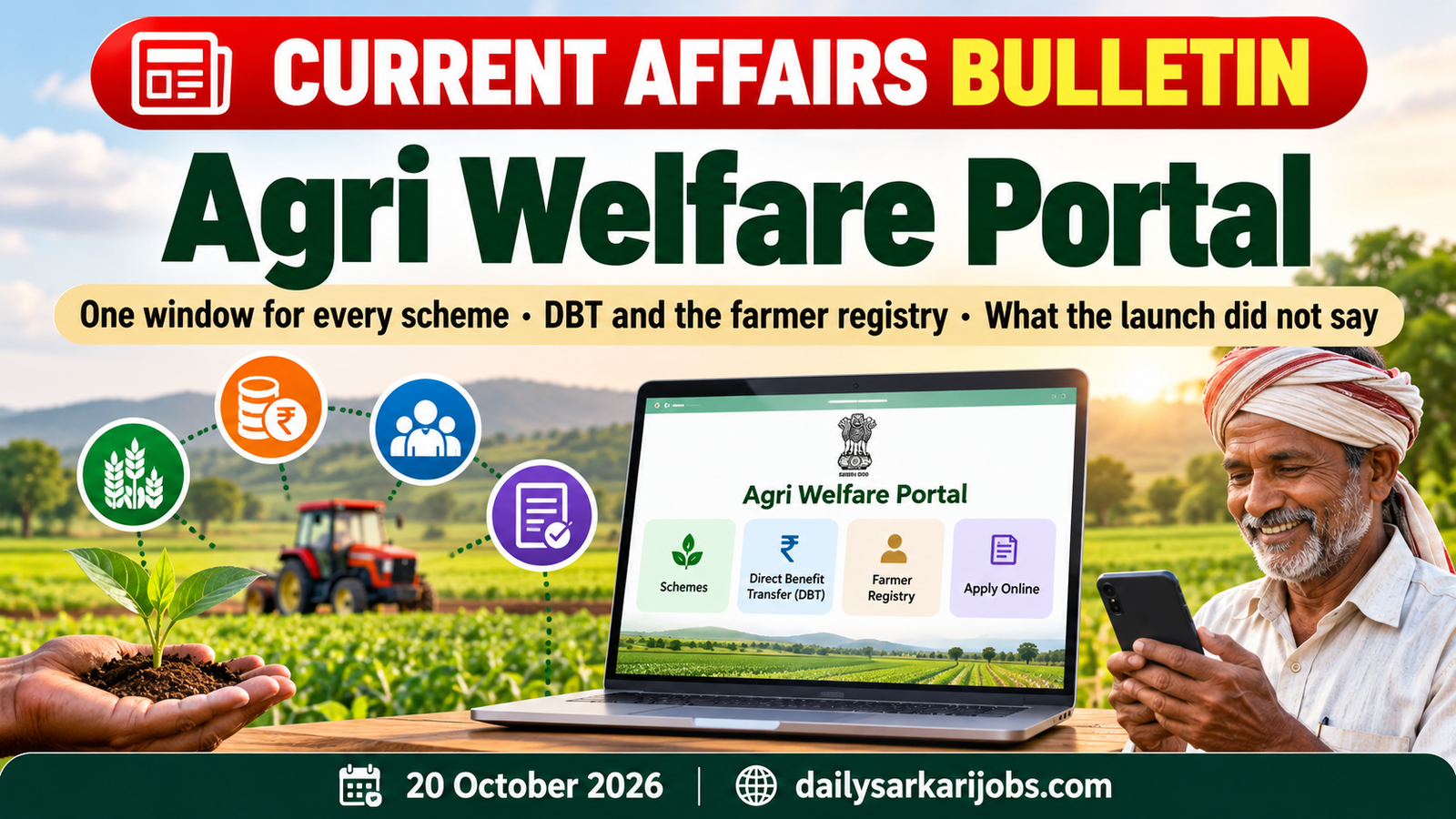
On 19 October 2026 the Union Agriculture Minister launched an upgraded Agri Welfare Portal — a single place where a farmer can check a scheme, test eligibility, apply, and receive money, from a mobile phone. The Ministry’s Digital Agriculture Division built it with the National Informatics Centre.
Every single-window launch is also a confession. It says that until now the same services were spread across offices and websites that the citizen had to go and find. That is the useful way to read this one.
⚡ QUICK FACTS
What was launched
The upgraded Agri Welfare Portal
When
19 October 2026
By whom
The Union Minister of Agriculture and Farmers Welfare
Built by
The Digital Agriculture Division with the National Informatics Centre
What it offers
Schemes, subsidies, eligibility checks, online application and DBT payments
Also on it
Weather, scientific practices, seed and fertiliser availability, market prices
Designed for
Basic smartphones, weak networks, and screen-reader users
Connected to
PM-KISAN, AgriStack, PMFBY, DBT and Krishi Vigyan Kendras
The Hinge: a Portal Is a Promise About Information, Not About Software
The sharpest thing said at the launch was a warning, not a boast. The Minister told officials that outdated or incomplete information could undermine public trust in the system, and directed that the portal be kept accurate and regularly updated.
That sentence deserves more attention than the launch itself. A government website is not a brochure. People act on what it says — they decide whether to apply, whether they qualify, when the last date is. An official page carrying a stale deadline does more damage than no page at all, because a citizen who was misled by the Government has no way of knowing they were.
So the test of this portal is not whether it works today. It is whether somebody is paid to keep it true next March. Building a site is a project with an end date; keeping it accurate is a permanent job, and the second is far harder to fund than the first.
Why a Farmer Needed a Single Window at All
Think about what the list of connected systems is actually telling you. The portal links to income support, an insurance scheme, a data stack, a payment mechanism and a network of training centres — five different things, run by different arms, each with its own form.
What it connects to
What that thing does
PM-KISAN
Income support paid directly to a farmer’s bank account
PMFBY
Pradhan Mantri Fasal Bima Yojana — the crop insurance scheme
AgriStack
The digital foundation, including a registry of farmers
DBT
Direct Benefit Transfer — money paid straight into an account rather than through an intermediary
Krishi Vigyan Kendras
District-level farm science centres, used here for training
The registry is the quiet one, and it is what makes the rest possible. Direct Benefit Transfer cannot work unless the State can answer, reliably, “who is this farmer and which account is theirs?” The income-support capsule explained what changes when money arrives directly — and a registry is the unglamorous thing that had to exist first.
The Same Idea the Site Has Met Three Times This Month
And notice the accessibility clause, which is easy to skim past. The portal is built to work with screen readers and for persons with disabilities, and to run on basic phones and weak networks. Yesterday’s explainer on the Asian Para Games made the point from the sporting side: when categories and access are designed in at the start they cost almost nothing, and when they are retrofitted they cost a great deal.
Why This Matters for a Farmer Specifically
Agricultural support in India is not one scheme. It is many, and they are not all aimed at the same problem.The Minimum Support Price capsule showed one instrument — a price the Government will pay. Income support is a second. Insurance is a third. Credit is a fourth. A farmer does not experience these as policy categories; they experience them as separate queues.
The Dhan-Dhaanya capsule made the same observation from inside the Government: that scheme is explicitly a convergence of thirty-six existing programmes rather than a thirty-seventh, because the problem was never the number of schemes but the sequencing. A portal is the citizen-facing half of exactly that admission.
What the Words Mean
Term
In plain words
Single window
One place to do several things that previously needed several places
DBT
Direct Benefit Transfer — money paid into the beneficiary’s own bank account
AgriStack
The Government’s digital foundation for agriculture, including a registry of farmers
PMFBY
Pradhan Mantri Fasal Bima Yojana, the crop insurance scheme
Krishi Vigyan Kendra
A district farm science centre that trains and advises farmers
FPO
Farmer Producer Organisation — a group of farmers who sell together to get a better price
PACS
Primary Agricultural Credit Society, the village-level cooperative credit body
Why a Reader Should Care
The honest caution first, because the release invites it. There is no outlay, no user target, no timeline and no figure of any kind in the announcement. That is normal for a portal launch and it is also the reason a reader should hold judgement — the thing worth watching is how many farmers complete an application on it, and that number has not been published.
The deeper point is about what the State is choosing to be. A government that puts its schemes on a phone is betting that the barrier was never willingness but distance — the bus fare, the day of work lost, the clerk who was not at his desk. If that bet is right, this is a large change delivered quietly. If the barrier was actually literacy, connectivity or trust, a better website will not move it.
Practice Questions
Q1. The upgraded Agri Welfare Portal launched in October 2026 was built by the Ministry’s Digital Agriculture Division together with (a) ISRO (b) The National Informatics Centre (c) NABARD (d) The Food Corporation of India Answer: (b) The National Informatics Centre It is the Government’s own technology arm for building and running official websites and digital services.
Q2. PMFBY, one of the schemes the portal connects to, is (a) An income support scheme (b) A crop insurance scheme (c) A credit guarantee scheme (d) A fertiliser subsidy scheme Answer: (b) A crop insurance scheme Income support is delivered by a different scheme on the same portal, which is what makes the first option tempting.
Q3. Direct Benefit Transfer means that (a) Subsidised goods are sold at a fair price shop (b) Money is paid into the beneficiary’s own bank account (c) Loans are written off by banks (d) Benefits are given as vouchers Answer: (b) Money is paid into the beneficiary’s own bank account Removing the intermediary is the whole point, and it only works once the State can reliably identify the beneficiary and their account.
Q4. A Krishi Vigyan Kendra is (a) A village cooperative bank (b) A grain storage depot (c) A district-level farm science centre (d) A wholesale agricultural market Answer: (c) A district-level farm science centre They are used for training and advice, and the portal routes a training campaign through them.
Q5. At the launch, the Minister specifically warned that (a) The portal would be chargeable after one year (b) Outdated or incomplete information could undermine public trust (c) The portal would replace all district offices (d) Only registered FPOs could use it Answer: (b) Outdated or incomplete information could undermine public trust He directed officials to keep it accurate and regularly updated, which matters because citizens act on what an official page tells them.