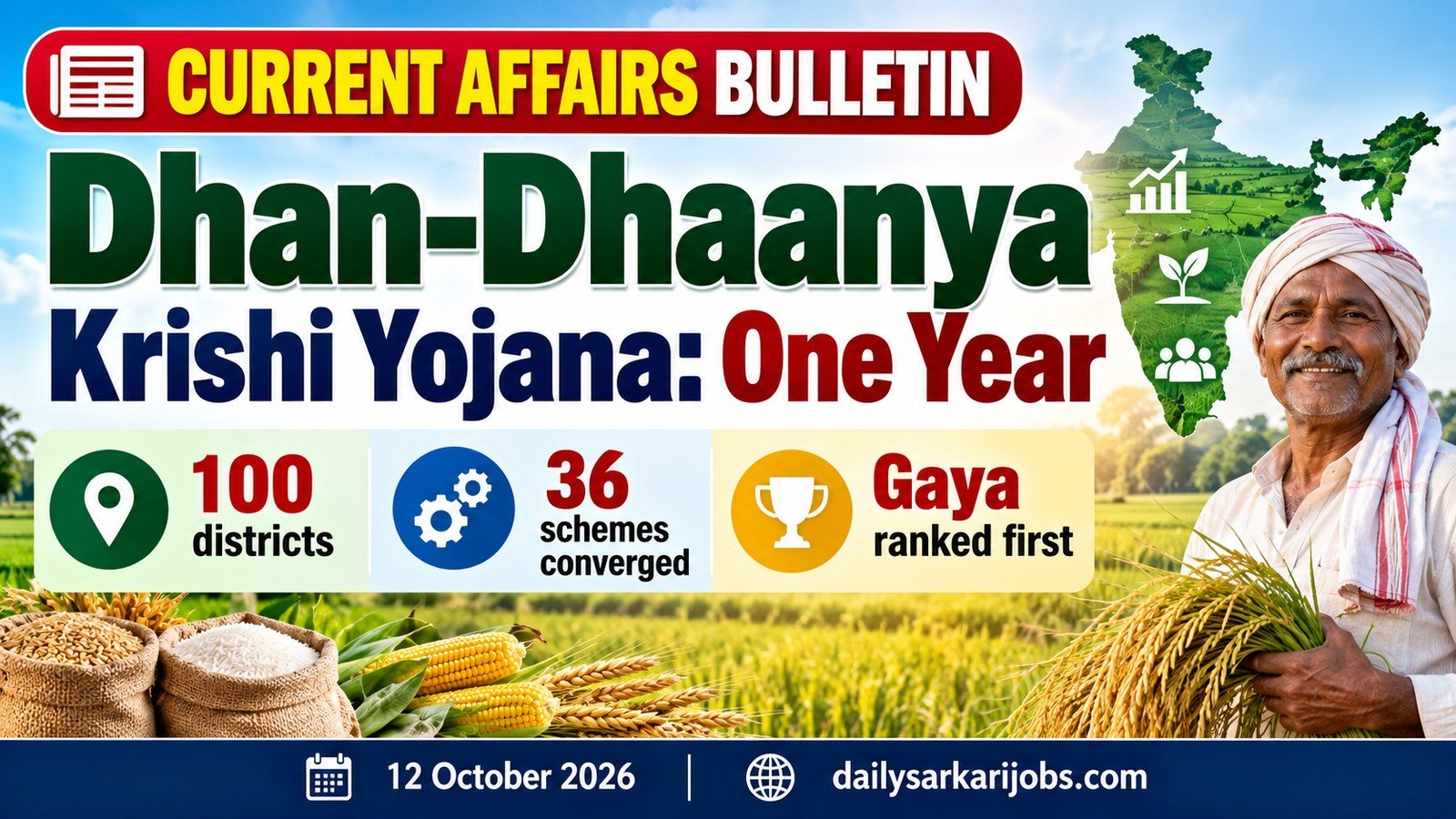
The Prime Minister Dhan-Dhaanya Krishi Yojana completed one year on 11 October 2026, and the Union Agriculture Minister marked it by handing out prizes. Gaya in Bihar was ranked first among the scheme’s 100 districts, Nagaur in Rajasthan second and Umaria in Madhya Pradesh third, with eighteen districts recognised in all.
The prize-giving is not a ceremony attached to the scheme. It is the scheme. This explainer is about why a ranking turned out to be the main instrument of a ₹24,000 crore a year agricultural programme.
The Hinge: the Scheme’s Real Instrument Is a League Table
Read the design and one feature does all the work. One hundred districts are scored every month on 121 indicators and publicly ranked against one another. At the end of a year the top three are named on a national stage.
No district official was given a new power or a new budget line by that ranking. What they were given is a position in a list that their peers, their state government and their Collector’s next posting committee can all see. The scheme assumes that a District Collector who is twenty-second will work harder than one who is simply told to do better, and that nothing concentrates attention like being measured against someone comparable.
This site has met the idea before under another name. The Comptroller and Auditor General has no power to punish anyone; an audit report’s force comes entirely from being laid before Parliament and read out loud. Call the pattern what it is: accountability by embarrassment. It is now the fourth institution on this site built on it, and once you can name it you will see it everywhere in Indian administration — because it is cheap, it needs no new law, and it works on exactly the officials who care about their records.
The design was borrowed openly. The Cabinet note says the scheme draws on the Aspirational Districts Programme, launched in January 2018 for 112 underdeveloped districts, which invented this method in India: pick the worst performers, publish the ranking, let competition do what instruction could not.
What the Scheme Actually Is
It is a convergence scheme, which is an unusual thing to be. It does not create a new programme for farmers. It takes 36 Central schemes spread across 11 Ministries and Departments, adds relevant State schemes, and insists that in these 100 districts they be planned together, in the same year, under one district plan.
| Detail | |
|---|---|
| Cabinet approval | 16 July 2025 |
| Launch | 11 October 2025 |
| Outlay | ₹24,000 crore a year, for six years from 2025-26 |
| Districts | 100 |
| Farmers expected to benefit directly | About 1.7 crore |
| Schemes converged | 36 Central schemes from 11 Ministries and Departments, plus State schemes |
| Indicators tracked | 121, reviewed monthly |
The ordinary complaint about Indian government spending is not that there is too little of it but that it arrives in unrelated pieces. A district gets an irrigation project one year, a storage godown three years later and a credit drive in between, each from a different ministry, none aware of the others. Convergence is the attempt to fix the sequencing rather than the amount, and that is the same idea as upgrading an ITI by pooling what several agencies already spend.
How the 100 Districts Were Chosen, and Why the Criteria Matter
Districts were picked on three indicators, and the choice of indicator is itself a statement about what the government thinks is wrong.
| Criterion | What it means | What it implies |
|---|---|---|
| Low agricultural productivity | Less output per hectare than the national average | The obvious one — the land is underperforming |
| Low cropping intensity | Fewer crops grown per year on the same land | Usually a water problem, not a farming one — a second crop needs assured irrigation, and who controls the water decides what can be grown |
| Low agricultural credit disbursement | Less institutional lending reaching farmers | A banking problem — farmers without formal credit borrow informally and at ruinous rates |
Read that table again: only one of the three criteria is about farming. The other two are about water and about banks. The government is saying, in the construction of its own eligibility list, that the binding constraint in a backward agricultural district is usually not the farmer’s skill — it is whether water arrives twice a year and whether a bank will lend.
The number of districts given to each State is fixed by that State’s share of net cropped area and of operational holdings, with at least one district for every State. That last clause is political arithmetic rather than agricultural arithmetic, and it is worth noticing: a purely technical list would have clustered in a handful of States.
Who Runs It
| Level | Body | What it does |
|---|---|---|
| District | District Dhan-Dhaanya Samiti, chaired by the District Collector, including progressive farmers and department officers | Writes the District Agriculture and Allied Activities Plan |
| State | A State-level committee on the same pattern | Steers convergence across the State’s districts |
| National | Two committees — one of Union Ministers, one of Secretaries | Policy direction and inter-ministerial coordination |
| Alongside | Central Nodal Officers, District Nodal Officers, NITI Aayog, Krishi Vigyan Kendra scientists | Review, guidance and technical support |
The district writes its own plan. That is the second design choice worth noticing: the scheme does not send one template to a hundred places. Each district builds a plan around its own soil, rainfall, cropping pattern, water availability and infrastructure, which is the only sensible approach in a country where soil type and cropping pattern change every few hundred kilometres, and which echoes the logic of planning from the district upward.
What Happened in Year One
- Gaya (Bihar) ranked first, Nagaur (Rajasthan) second and Umaria (Madhya Pradesh) third; 18 districts were recognised across the six objectives.
- Gadchiroli, Maharashtra presented on water conservation and drought management in drought-affected terrain.
- Alluri Sitharama Raju, Andhra Pradesh presented on shifting a low-rainfall district to high-value, low-water horticulture.
- Banka, Bihar presented its natural-farming land revival model, aimed at cutting dependence on chemical fertilisers.
- Work in Kishtwar (Jammu and Kashmir), Korba (Chhattisgarh) and Fazilka (Punjab) was also singled out.
- A new Khet Bachao Abhiyan on balanced fertiliser use runs in all States from 22 October to 30 November 2026.
Now the honest part, and the reason to read a press release carefully. The one-year release names districts, ranks them and describes what they did. It does not publish a single outcome figure — no number for how much productivity rose, how much cropping intensity improved or how much extra credit reached farmers across the 100 districts.
That is not evidence of failure. One agricultural year is genuinely too short to measure productivity, and the dashboard tracking those 121 indicators plainly exists. But a ranking published without the underlying numbers tells you who is ahead and not how far anyone has travelled, and the distinction is exactly the one the parliamentary committee on the NTA drew when it said an agency that counts registrations is not thereby counting outcomes. Expect the outcome figures in year two, and treat their absence or presence as the real test.
The Six Objectives, in Plain Words
| Objective | What it means on the ground |
|---|---|
| Productivity | More output from the same hectare |
| Crop diversification and sustainable practices | Moving away from one crop repeated endlessly, and away from heavy chemical use |
| Post-harvest storage | Godowns at panchayat and block level, so a farmer need not sell the day the crop is cut |
| Irrigation | Assured water, which is what makes a second crop possible |
| Credit | Short-term and long-term institutional lending, instead of the moneylender |
| Governance and service delivery | The administrative plumbing that decides whether the other five actually arrive |
Post-harvest storage is the least glamorous and arguably the most valuable. A farmer with nowhere to keep a crop must sell it in the week everybody else is selling, which is the week the price is lowest. Storage is not a logistics problem; it is a bargaining-power problem wearing a logistics costume.
Why a Reader Should Care
Agriculture still supports a far larger share of India’s workforce than its share of national output, and that gap is the single largest structural fact about the Indian economy. No amount of growth elsewhere closes it on its own.
What makes this scheme interesting is not its size but its admission. By converging 36 schemes instead of announcing a thirty-seventh, the Government is conceding that the problem was never a shortage of programmes. And by ranking districts every month, it is conceding that the problem was never a shortage of instructions either. Both are unusually honest diagnoses for a scheme launch, and both are worth remembering the next time a new programme is announced for a problem that already has thirty-six.
Practice Questions
Q1. The Prime Minister Dhan-Dhaanya Krishi Yojana covers how many districts?
(a) 50 (b) 100 (c) 112 (d) 150
Answer: (b) 100 One of the wrong options is the number of districts under the Aspirational Districts Programme of 2018, on which this scheme is modelled, which is the trap here.
Q2. Which of the following is NOT one of the three criteria used to select the districts?
(a) Low agricultural productivity (b) Low cropping intensity (c) Low agricultural credit disbursement (d) High rural poverty ratio
Answer: (d) High rural poverty ratio Two of the three actual criteria are not about farming at all — one is really about water and the other about banking.
Q3. The scheme converges how many Central schemes, and across how many Ministries and Departments?
(a) 24 schemes across 8 departments (b) 30 schemes across 10 departments (c) 36 schemes across 11 departments (d) 40 schemes across 12 departments
Answer: (c) 36 schemes across 11 departments The point of the design is that nothing new was created; existing programmes were made to arrive in the same district in the same year under one plan.
Q4. Which district was ranked first at the scheme’s one-year review in October 2026?
(a) Nagaur, Rajasthan (b) Umaria, Madhya Pradesh (c) Banka, Bihar (d) Gaya, Bihar
Answer: (d) Gaya, Bihar Two of the wrong options were placed second and third, and the remaining one was recognised separately for a natural-farming model rather than for its overall rank.
Q5. The Khet Bachao Abhiyan announced at the review concerns
(a) Balanced use of fertilisers (b) Crop insurance enrolment (c) Minimum support price procurement (d) Farm mechanisation subsidies
Answer: (a) Balanced use of fertilisers It runs in all States from 22 October to 30 November 2026 and is a soil health campaign, which is why it follows from the diversification and sustainability objective rather than from the credit one.