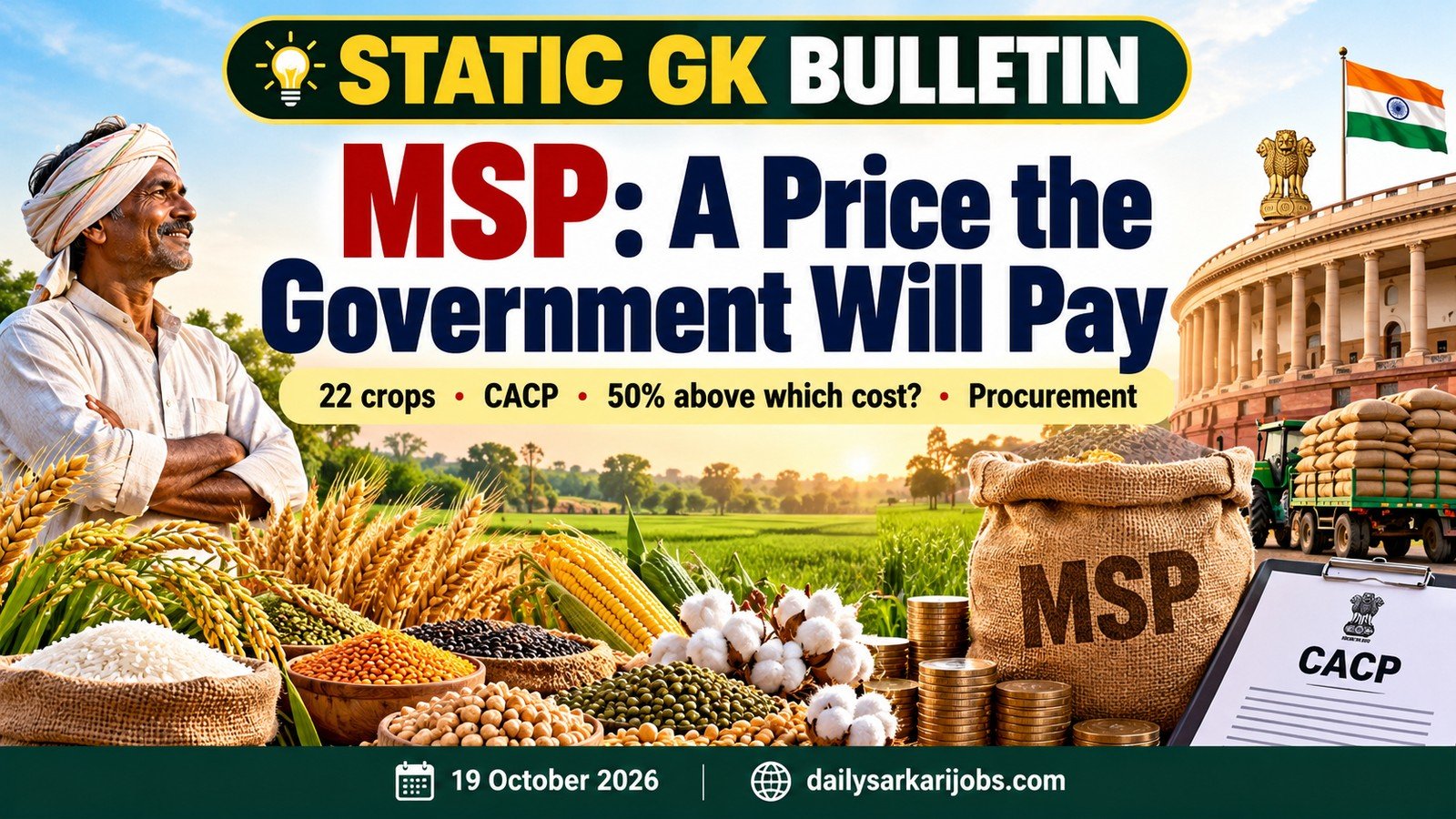
A Minimum Support Price is not a price anybody is forced to pay. It is a price at which the Government says it is willing to buy. That distinction is the whole subject, and almost every argument about MSP comes back to it.
This capsule opens a new series on agriculture and the rural economy, explained in plain language for SSC, RRB NTPC, banking exams, State PSC and UPSC Prelims.
The Hinge: an Announcement Is Not a Purchase
An MSP becomes real for a farmer only when an agency actually turns up and buys the crop at that price. If nobody does, the MSP is a number in a press release and the farmer sells at whatever the local market offers.
So the question that matters is never “what is the MSP for this crop?” It is “is this crop procured, where, and in what quantity?” The two questions have very different answers, and only the first one is in the headlines.
This is exactly the habit yesterday’s trade explainer asked for, moved from the port to the mandi. A trade agreement delivers nothing until an exporter actually claims the lower duty; an MSP delivers nothing until a procurement agency actually buys. In both cases the announcement is the easy half and the take-up is the real measure.
The 22 Crops, and Why They Are Grouped That Way
MSPs are announced every year for 22 mandated crops. The grouping follows the cropping seasons, which is why learning the seasons first makes the list almost automatic.
| Group | Count | The crops |
|---|---|---|
| Kharif | 14 | Paddy, jowar, bajra, ragi, maize, tur (arhar), moong, urad, groundnut, sunflower seed, soyabean, sesamum, nigerseed, cotton |
| Rabi | 6 | Wheat, barley, gram, masur (lentil), rapeseed and mustard, safflower |
| Commercial | 2 | Jute and copra |
Notice that the groups are seasons, not kinds of crop. Kharif is the monsoon crop, sown with the rains and harvested after them; rabi is the winter crop, sown on residual moisture and harvested in spring. The capsule on soils and crops explains why a particular crop belongs to a particular season — and once that is clear, nobody has to memorise which list a crop sits in.
Two crops get their price without being on the list. Toria is fixed from the rapeseed and mustard MSP, and de-husked coconut from the copra MSP. A derived price is a cheap way to cover a crop without running a separate cost survey for it, and it is the kind of detail an examiner likes precisely because it is a footnote.
Fifty Per Cent Above Cost — but Which Cost?
Since 2018-19 the rule has been that MSP is set at not less than one and a half times the cost of production, following the announcement in that year’s Union Budget. In the Government’s own words it guarantees a minimum return of 50 per cent over the all-India weighted average cost of production.
That sentence is doing something very specific, and the specific thing is the word “cost”. Read what the official description says the cost contains:
- Paid-out costs — hired labour, rent on leased land, seeds, fertilisers, irrigation, diesel and electricity, and interest on working capital
- The imputed value of family labour — what the farmer’s own household work would have been worth
Now notice what that description does not mention: any rent for the land the farmer already owns, or interest on the farmer’s own capital. In the public debate the narrower measure is called A2 plus FL and the wider one C2, and the long-running demand that MSP be set at “one and a half times C2” is a demand to change which cost the 50 per cent is added to.
The reusable idea is the one this site keeps returning to: when a promise is a percentage, go and find what it is a percentage of. Fifty per cent is a fixed number. The cost is not, and the cost is where the policy actually lives.
What CACP Weighs
The Commission is not a calculator. Cost of production is one input among several, and the official list of what it considers is worth reading once because the items pull in different directions.
- Cost of production
- The demand and supply situation, at home and abroad
- Prices, domestic and international
- Inter-crop price parity — what one crop pays relative to another
- Terms of trade between agriculture and non-agriculture
- The likely effect of the price policy on the rest of the economy
- A minimum margin of 50 per cent over the cost of production
Inter-crop price parity is the quiet one, and it is how a price becomes an instruction. If paddy pays better than pulses, farmers grow paddy — so an MSP is not only a safety net, it is a signal about what to sow. The income-support capsule made the same point from the other side: a subsidy arrives attached to an instruction, while income support is neutral about what you do with it.
Procurement: Where the Policy Is Actually Tested
The Government’s own figures show the scale, and they also show the lopsidedness.
| Measure | Then | Now |
|---|---|---|
| Foodgrain procurement | 761.40 lakh tonnes in 2014-15 | 1,175 lakh tonnes in 2024-25 |
| MSP paid out for foodgrains | ₹1.06 lakh crore | ₹3.33 lakh crore, benefiting 1.84 crore farmers |
| Pulses procurement | 1.52 lakh tonnes over 2009-14 | 82.98 lakh tonnes over 2020-25 |
Read the last row twice. It is an enormous percentage increase — the release puts it above seven thousand per cent — and it is still a small quantity beside the foodgrain total in the row above it. A huge percentage rise from a tiny base and a large absolute quantity are two different facts, and a reader who confuses them will misjudge the whole policy.
That matters because the composition of procurement decides who the policy reaches. Procurement is dominated by paddy and wheat, so a farmer growing them in a State with a working procurement system experiences MSP as a real floor, while a farmer growing something else may never meet it. The Dhan-Dhaanya capsule noted that the Government’s own eligibility criteria point at water and credit rather than at farming skill — and procurement geography belongs on that same list of things that decide a farmer’s outcome before any decision of theirs does.
What the Words Mean
| Term | In plain words |
|---|---|
| MSP | The price at which the Government is willing to buy a notified crop |
| CACP | Commission for Agricultural Costs and Prices — it recommends, it does not announce |
| Mandated crops | The 22 crops for which MSP is announced every year |
| Kharif | The monsoon crop, sown with the rains |
| Rabi | The winter crop, sown after the monsoon on residual moisture |
| Procurement | The Government actually buying the crop at MSP |
| A2 plus FL | Paid-out costs plus the imputed value of family labour |
| C2 | The wider measure, which also counts rent on owned land and interest on owned capital |
| Inter-crop price parity | What one crop’s price is worth compared with another’s |
Why a Reader Should Care
Food prices are the one part of the economy everybody feels directly. The capsule on how India measures inflation showed that food still carries the largest single weight in the consumer price basket, which means a decision about what to pay a farmer is also a decision about what a household pays at the shop. MSP sits exactly on that seam, and that is why it is politically impossible to settle.
And the honest caution is about what MSP is not. It is not a legal guarantee, and none of the Government’s own releases quoted here claims it is. It is a policy commitment backed by an annual announcement and by whatever procurement actually happens — which takes you straight back to the first sentence of this capsule.
Practice Questions
Q1. Minimum Support Prices are recommended by
(a) The Food Corporation of India (b) The Commission for Agricultural Costs and Prices (c) NITI Aayog (d) The Reserve Bank of India
Answer: (b) The Commission for Agricultural Costs and Prices It recommends after taking the views of State Governments and concerned Central Ministries, and the announcement itself is made by the Government.
Q2. MSP is announced annually for how many mandated crops?
(a) 14 (b) 20 (c) 22 (d) 25
Answer: (c) 22 They split into 14 kharif, 6 rabi and 2 commercial crops, and one of the wrong options is the kharif count on its own.
Q3. The two commercial crops covered by MSP are
(a) Cotton and sugarcane (b) Jute and copra (c) Tea and coffee (d) Rubber and tobacco
Answer: (b) Jute and copra Cotton is a kharif crop on the list, which is what makes the first option tempting, and prices for toria and de-husked coconut are derived from two of the listed crops.
Q4. Since 2018-19, MSP has been fixed at a level that gives a minimum return of
(a) 25 per cent over cost (b) 50 per cent over cost (c) 75 per cent over cost (d) 100 per cent over cost
Answer: (b) 50 per cent over cost The same rule is also stated as setting the price at not less than one and a half times the cost of production, which is the identical thing said differently.
Q5. In the MSP debate, A2 plus FL refers to
(a) Paid-out costs plus the imputed value of family labour (b) The wholesale price of the crop (c) Paid-out costs plus rent on owned land (d) The procurement target for a season
Answer: (a) Paid-out costs plus the imputed value of family labour The wider measure also counts rent on land the farmer owns and interest on the farmer’s own capital, and the long-running demand is that the 50 per cent margin be added to that instead.