Explained in plain language for SSC, RRB NTPC, banking exams, State PSC, CAPF and UPSC Prelims.
⚡ QUICK FACTS
How many CAPFs
Seven
Which ministry
Ministry of Home Affairs
Oldest
Assam Rifles, raised 1835 as the Cachar Levy
Largest
Central Reserve Police Force
Where police sits
Entry 2 of the State List
Where the Union enters
Entry 2A of the Union List
Who inserted Entry 2A
The 42nd Amendment Act, 1976, in force 3 January 1977
The odd one out
Assam Rifles — administered by the MHA, operationally under the Army
The Hinge: Read the Constitution’s Own Sentence About Police
Almost every revision note says the same thing — police is a State subject. That is true, and it is not the whole sentence. The Seventh Schedule, State List, Entry 2 reads: Police (including railway and village police) subject to the provisions of Entry 2A of List I.
Read the last six words again. The State’s own entry on police is written as being subject to an entry in the Union List. And Entry 2A of the Union List is about deploying an armed force of the Union in any State in aid of the civil power, together with the powers and liabilities of those personnel while so deployed.
So the design is this: the ordinary policing of India belongs to the States, and the armed force that arrives when a State cannot cope belongs to the Union.Entry 2A was inserted by the 42nd Amendment Act, 1976 and came into force on 3 January 1977 — which is itself a reminder from the amendments capsule that an Act’s year and its commencement year are often different.
Where it sits
What it covers
State List, Entry 1
Public order — but expressly not the use of any naval, military or air force or other armed force of the Union
State List, Entry 2
Police, including railway and village police — subject to Entry 2A of the Union List
Union List, Entry 1
Defence of India, including preparation for defence
Union List, Entry 2
Naval, military and air forces; any other armed forces of the Union
Union List, Entry 2A
Deployment of an armed force of the Union in any State in aid of the civil power
The transferable habit: when a subject appears in both Lists, find the words that join them. Here the join is written into the State entry itself, which is unusual and is exactly the kind of detail an examiner likes.
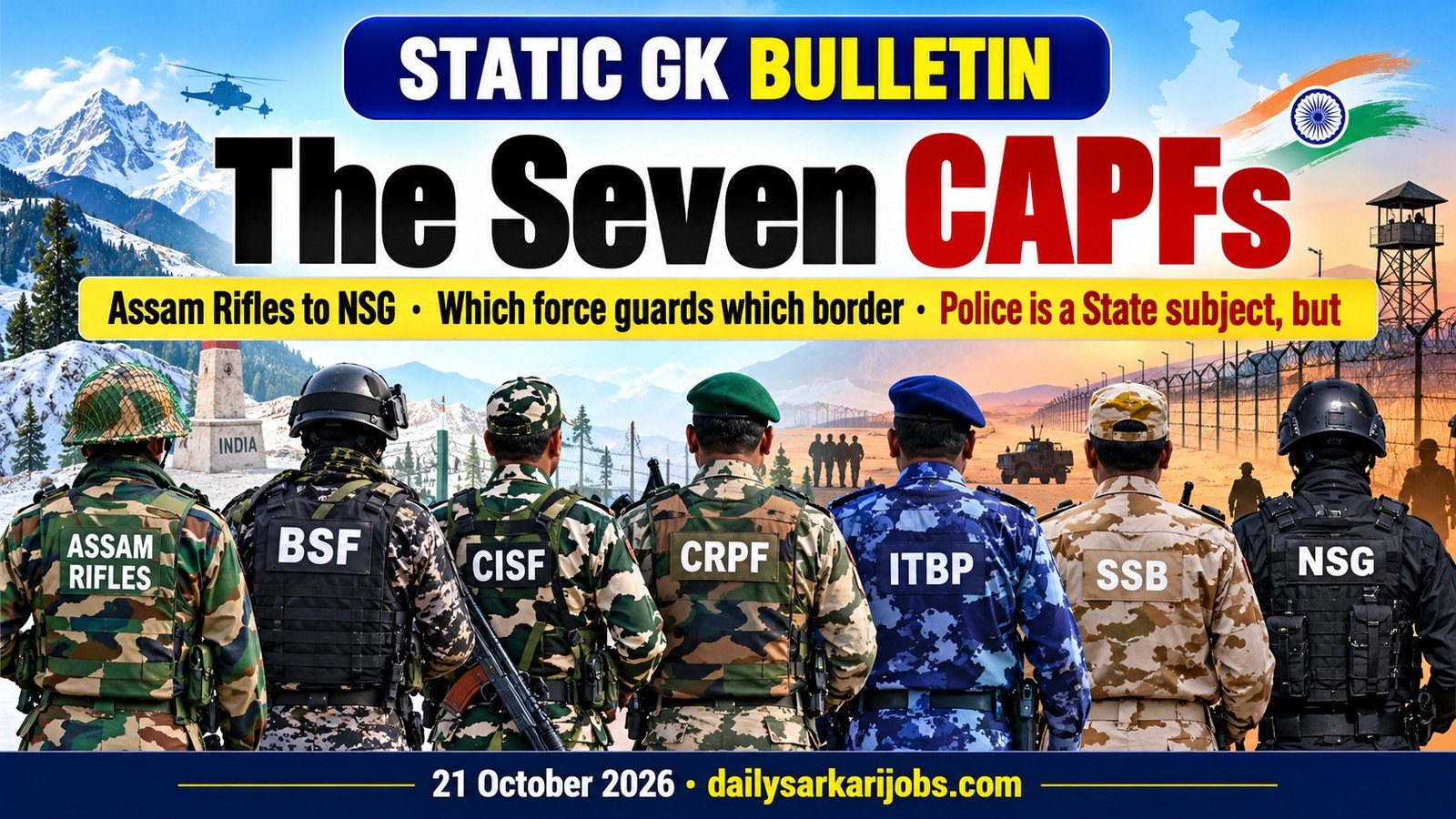
The Seven Central Armed Police Forces
Force
Raised
What it mainly does
Assam Rifles (AR)
1835, as the Cachar Levy
Guards the India–Myanmar border and works on counter-insurgency in the North East
Central Reserve Police Force (CRPF)
27 July 1939, as the Crown Representative’s Police
Internal security, law and order assistance to States, anti-Naxal operations
Indo-Tibetan Border Police (ITBP)
24 October 1962
Guards the India–China border, roughly 3,488 km, from the Karakoram Pass eastward
Sashastra Seema Bal (SSB)
1963, as the Special Service Bureau
Guards the India–Nepal and India–Bhutan borders
Border Security Force (BSF)
1 December 1965
Guards the India–Pakistan and India–Bangladesh borders
Central Industrial Security Force (CISF)
10 March 1969
Protects industrial undertakings, airports, metro systems and key installations
National Security Guard (NSG)
1984
Counter-terrorism and hostage rescue; personnel are deputed from other forces
A note on the CISF date, because two versions circulate. Most accounts give 10 March 1969, and that is the answer to learn; a few give 15 March. The Act is the CISF Act, 1968, which is the year before the force existed — the law came first and the force followed.
The Pattern: Almost Every One Was Raised After Something Went Wrong
Put the reasons beside the dates and the list stops being seven things to memorise.
Assam Rifles, 1835 — raised as a militia to protect tea gardens and settlements in Assam.
CRPF, 1939 — raised in response to unrest in the Princely States, and renamed by the CRPF Act, 1949, which made it an armed force of the Union.
ITBP, 1962 — raised in the aftermath of the Sino-Indian war, for a border that until then had been patrolled by police parties.
SSB, 1963 — also a consequence of 1962, and for nearly forty years it was not a border guarding force at all.
BSF, 1965 — raised after Pakistani attacks on border posts in Kutch in April 1965 showed that State armed police could not hold a border against an army.
CISF, 1969 — raised to protect industrial undertakings of the Central Government, a job nobody had owned before.
The BSF entry is the one to remember, because it is the argument of the whole chapter in a single sentence. A State’s armed police is built for riots and crime, not for soldiers crossing a line on a map — so the moment the threat changed, the answer had to be a central force. That is precisely what Hot Springs had already demonstrated six years earlier, at a cost of ten lives.
Two Oddities Worth Knowing by Heart
First, the Assam Rifles answers to two masters. Its administrative control sits with the Ministry of Home Affairs and its operational control with the Indian Army. No other central armed police force is split this way, and the split is a favourite question. The capsule on defence reform explains why such divided arrangements are so hard to undo once they exist.
Second, the SSB changed job and kept most of its initials. It began in 1963 as the Special Service Bureau and worked under the external intelligence agency, not the Home Ministry. It was renamed Sashastra Seema Bal in 2001, moved to the Ministry of Home Affairs, and was declared a border guarding force for the India–Nepal border in June 2001 and the India–Bhutan border in March 2004.
The idea behind that move has a name — one border, one force. Before it, more than one agency could be responsible for the same stretch of frontier; after it, each border has a single force that owns it. Whenever a reform’s name contains the word one, ask what was duplicated before.
What the Words Mean
Term
In plain words
CAPF
Central Armed Police Force — the official term for the seven forces under the Ministry of Home Affairs
Paramilitary
An older, looser word still used in newspapers; the Government’s own term is CAPF
In aid of the civil power
A force sent to help the civil administration, which stays in charge
Border guarding force
A force formally given charge of a particular international border
Deputation
Serving in another organisation for a period while belonging to your own
Why a Reader Should Care
Because this is where the Constitution’s tidiest-looking rule turns out to be a negotiation.The Seventh Schedule puts police with the States, and yet the forces that appear at a riot, a border, an airport or a hostage situation are usually the Union’s. The emergency provisions capsule covers the far end of that same spectrum, where the Union takes over a State’s government altogether. Between ordinary policing and President’s Rule sits a whole architecture most people never learn, and it is built out of seven forces and two entries in a schedule.
And because the exam asks it constantly. The raising years, the borders, the ministry, the dual control of the Assam Rifles and the State-subject question appear in SSC, CAPF, State PSC and banking papers year after year. Learn the pattern — each force came after a failure — and the dates stop being arbitrary.
Practice Questions
Q1. Under the Seventh Schedule, police is placed in (a) The Union List (b) The State List (c) The Concurrent List (d) No list at all Answer: (b) The State List The entry is worded as being subject to an entry in the Union List, which is what lets central forces be deployed in a State.
Q2. Which is the oldest of the Central Armed Police Forces? (a) Central Reserve Police Force (b) Border Security Force (c) Assam Rifles (d) Indo-Tibetan Border Police Answer: (c) Assam Rifles It began in 1835 as the Cachar Levy and carried four different names before taking its present one in 1917.
Q3. The Indo-Tibetan Border Police was raised in (a) 1949 (b) 1962 (c) 1965 (d) 1969 Answer: (b) 1962 The other years in the options are the raising or renaming years of three different central forces, which is why this question is set so often.
Q4. The Border Security Force guards which borders? (a) India and China (b) India and Nepal, India and Bhutan (c) India and Myanmar (d) India and Pakistan, India and Bangladesh Answer: (d) India and Pakistan, India and Bangladesh Each of the wrong options belongs to a different force, so the question is really a test of the one border one force idea.
Q5. Which force has administrative control under the Ministry of Home Affairs but operational control under the Indian Army? (a) Central Industrial Security Force (b) Assam Rifles (c) Sashastra Seema Bal (d) National Security Guard Answer: (b) Assam Rifles It is the only one of the seven split this way, and the arrangement has been debated for years without being changed.