
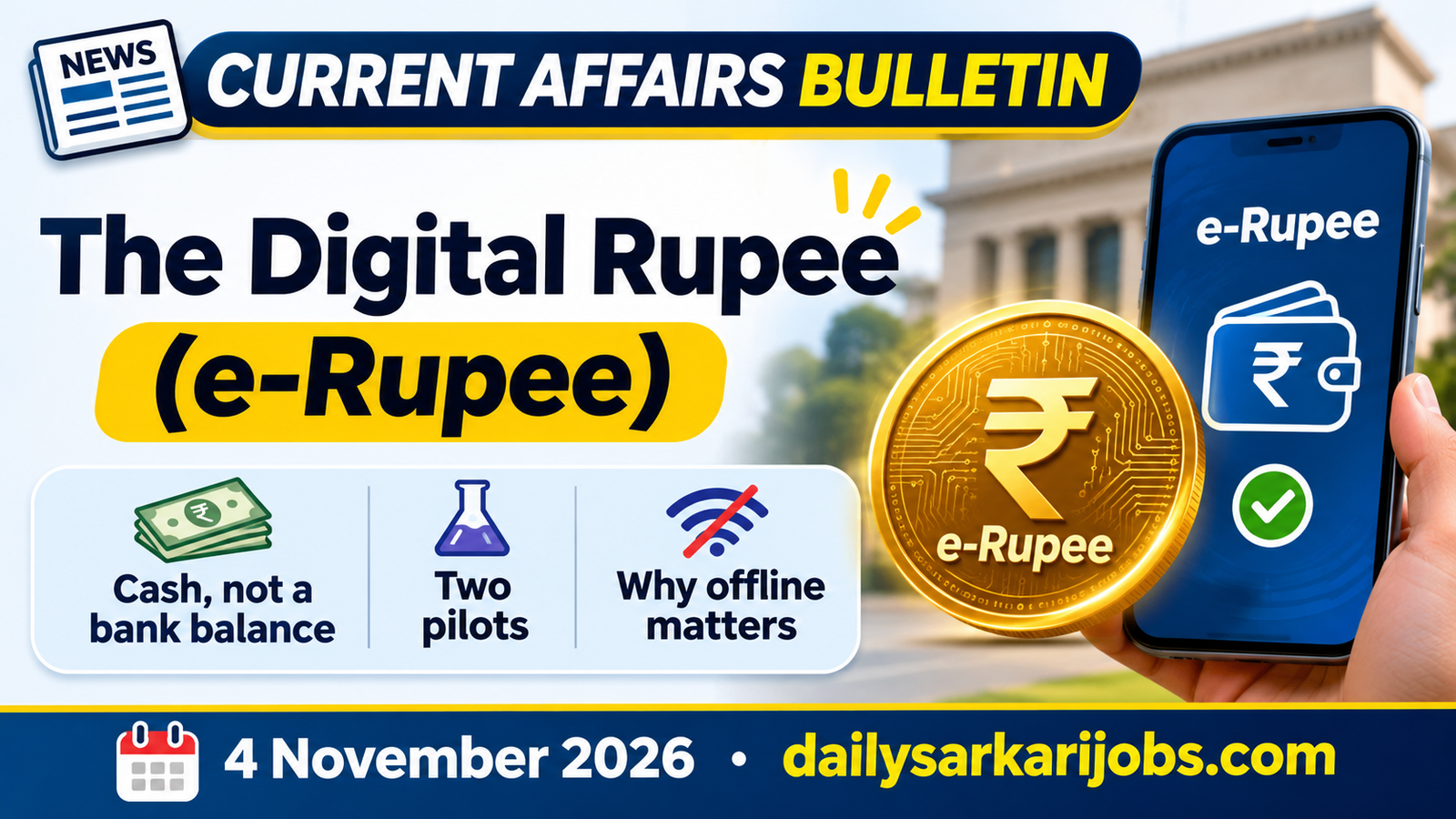
The Digital Rupee is back in the news because the Reserve Bank is working on letting it be spent without an internet connection. That sounds like a small technical detail. It is actually the clearest possible statement of what the digital rupee is meant to be.
Almost everyone’s first reaction is the same: we already have UPI, so why build this? The answer is the single most valuable idea in this topic, and it is the one exams test.
The Hinge: The Digital Rupee Is Cash, Not a Bank Balance
Think about what actually happens when you pay by UPI. No money moves to you or from you directly. A message travels, your bank reduces a number in its ledger, the other bank increases a number in its ledger, and the two banks settle up later. UPI is an instruction, and what it moves is a claim on a bank.
Now think about a hundred-rupee note. It is not a claim on a bank; it is a promise from the Reserve Bank of India itself. Hand it over and the payment is finished. Nobody has to settle anything afterwards.
The digital rupee is the second thing, in digital form. The RBI’s own description is that e₹ is the digital form of the rupee, issued by the RBI, at par with physical cash, and a liability of the Reserve Bank. It is legal tender under Section 26 of the RBI Act, 1934 and guaranteed by the Central Government.
| UPI | Digital Rupee (e₹) | |
|---|---|---|
| What it is | A way of sending instructions | Money itself, in digital form |
| What you hold | A claim on your bank | A liability of the RBI |
| Where it sits | In a bank account | In a wallet |
| When the payment is final | After the banks settle | Immediately, wallet to wallet |
| Does it pay interest? | A savings account does | No |
Jargon, defined once. Legal tender means money a creditor cannot lawfully refuse in settlement of a debt. A liability of the RBI means the RBI owes it — which is exactly what the promise printed on a currency note is.
And This Is Why Offline Matters
Cash has one quality no digital payment has ever matched: it works when nothing else does. No signal, no power, no server — a note still buys bread.
So a digital currency that claims to be cash has to work offline, or the claim is incomplete. The RBI’s own position is that offline use is intended for places with limited or no internet connectivity, and that different solutions are still being explored. That is the honest status: a live line of work rather than a finished product.
Hold the logic rather than the headline. Offline capability is not a convenience feature bolted on at the end. It is the test of whether the digital rupee really is cash.
The Two Pilots, Which Are Asked as a Pair
| Pilot | Began | Who uses it | What it is for |
|---|---|---|---|
| Wholesale, e₹-W | 1 November 2022 | Banks and financial institutions | Settling secondary market transactions in government securities, and later interbank and call money settlement |
| Retail, e₹-R | 1 December 2022 | The public and merchants | Everyday payments through wallets offered by banks and non-banks |
Memory trick: wholesale came first, exactly one month earlier — the first of November, then the first of December. Big money before small money.
The retail pilot opened with four banks — State Bank of India, ICICI Bank, Yes Bank and IDFC First Bank — in Mumbai, New Delhi, Bengaluru and Bhubaneswar, before widening. The Digital Rupee itself had been announced in the Union Budget 2022-23.
Five More Facts Worth Carrying
- e₹ comes in the same denominations as notes and coins, and wallets give change.
- No interest is paid on an e₹ wallet balance — exactly like the cash in your pocket. This is a favourite one-mark question.
- Distribution is two-tier. The RBI creates e₹ and issues it to banks and non-banks, which onboard customers and open wallets. The RBI does not deal with you directly, just as it does not hand you notes directly.
- A CBDC-QR payment settles wallet to wallet without passing through a bank account, while a UPI-QR payment made from an e₹ app settles on UPI timelines.
- CBDC is a form of money; UPI is a payment system. They are not competitors in the way headlines suggest, and a question that treats them as the same kind of thing is testing exactly this.
Why a Reader Should Care
The digital rupee is a guaranteed topic in banking examinations and recurs in SSC, Railways and State PCS general awareness. The facts that get asked are the two pilot dates, the issuing authority, the legal section, the absence of interest and the difference from UPI.
It sits directly on top of our capsule on payment and settlement systems, which covers RTGS, NEFT, IMPS, UPI and NPCI. Read the two together and the whole payments landscape falls into place: that capsule is about the pipes, this one is about what flows through them.
For the Reserve Bank’s other roles, see our capsules on the Monetary Policy Committee and on banking awareness and the policy rates. Issuing currency and setting the repo rate are two different jobs of the same institution, and questions often mix them deliberately.
Today’s Static GK capsule is on the human body, and the two share a distinction worth borrowing. The digital rupee is money itself rather than a claim on a bank, and the body can store food and water but never oxygen. Both chapters turn on the difference between holding a thing and merely moving it around.
What Is Not Settled
Two honest notes. Both CBDC programmes remain pilots, so the number of participating banks, cities and users keeps changing — quote any such figure with its date. And offline functionality is still being developed; the RBI says solutions are being explored, so treat it as work in progress rather than a launched feature.
Practice Questions
Q1. The Digital Rupee (e₹) is
(a) A cryptocurrency issued by private firms (b) A liability of the Reserve Bank of India (c) A deposit held with a commercial bank (d) A type of mutual fund unit
Answer: (b) A liability of the Reserve Bank of India It is the digital form of the rupee, at par with physical cash and legal tender under Section 26 of the RBI Act, 1934.
Q2. The wholesale Digital Rupee pilot (e₹-W) began on
(a) 1 December 2022 (b) 1 February 2022 (c) 1 November 2022 (d) 1 April 2023
Answer: (c) 1 November 2022 Its first use case was settling secondary market transactions in government securities, and the retail pilot followed exactly one month later.
Q3. Which of the following is true of an e₹ wallet balance?
(a) It earns the savings bank interest rate (b) It earns the repo rate (c) It earns a rate fixed by the Government (d) It earns no interest
Answer: (d) It earns no interest The balance behaves like the cash in your pocket, which is one of the clearest differences from a bank deposit.
Q4. The main difference between UPI and the Digital Rupee is that
(a) UPI is faster (b) UPI is only for merchants (c) UPI moves a claim on a bank, while e₹ is money itself (d) UPI is issued by the Reserve Bank
Answer: (c) UPI moves a claim on a bank, while e₹ is money itself One is a payment system and the other is a form of currency, which is why a CBDC payment settles wallet to wallet without touching a bank account.
Q5. The retail Digital Rupee pilot was launched initially in which four cities?
(a) Mumbai, New Delhi, Bengaluru and Bhubaneswar (b) Mumbai, Chennai, Kolkata and New Delhi (c) New Delhi, Hyderabad, Pune and Kochi (d) Mumbai, Ahmedabad, Lucknow and Patna
Answer: (a) Mumbai, New Delhi, Bengaluru and Bhubaneswar Four banks took part at the start, and the pilot was widened to more cities and banks afterwards.
30-Second Revision
- The hinge: e₹ is cash in digital form — a liability of the RBI, legal tender under Section 26 of the RBI Act, 1934 — while UPI is an instruction that moves a claim on a bank. That is why offline capability matters: cash works when the network does not.
- Two pilots: wholesale e₹-W from 1 November 2022 (government securities settlement, for financial institutions) and retail e₹-R from 1 December 2022 (public and merchants, through wallets). Announced in the Union Budget 2022-23.
- Retail pilot opened with four banks — SBI, ICICI, Yes Bank and IDFC First — in Mumbai, New Delhi, Bengaluru and Bhubaneswar.
- Features: same denominations as notes and coins; no interest on balances; two-tier distribution through banks and non-banks; CBDC-QR settles wallet to wallet without passing through a bank account.
Sources
- Reserve Bank of India, FAQs on the Digital Rupee (e₹) — the definition of e₹ as the digital form of the rupee and a liability of the RBI, legal tender under Section 26 of the RBI Act, 1934, the retail and wholesale types and their uses, the denominations, the absence of interest, the two-tier distribution, the CBDC-QR settlement behaviour, and the statement that offline solutions are still being explored.
- Press Information Bureau backgrounder on the Digital Rupee (December 2022) — the wholesale pilot from 1 November 2022 with government securities settlement as the first use case, the retail pilot from 1 December 2022, the four launch banks and four launch cities, and the announcement in the Union Budget 2022-23.
- Both programmes remain pilots and their coverage changes, so participation figures should always be quoted with a date.