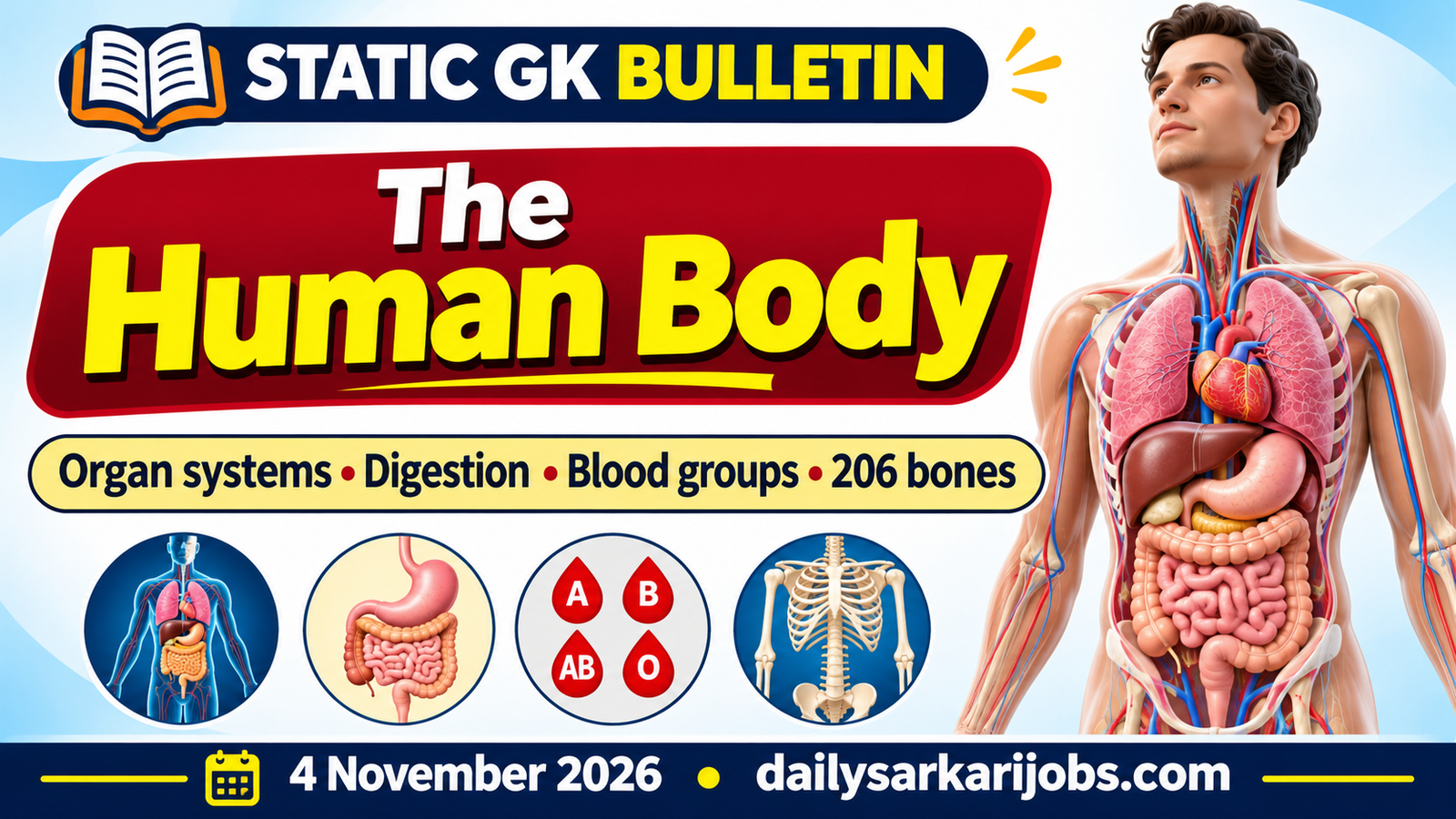
General Science questions about the human body look like a pile of unrelated facts — how many bones, which gland is largest, which juice digests what. Most candidates try to memorise the pile. There is an order underneath it, and it comes from one simple limitation of the body.
The Hinge: The Body Can Store Food and Water, but Not Oxygen
You can live for weeks without food, a few days without water and only a few minutes without oxygen. That ranking is not a curiosity. It is the reason the body is built the way it is.
Food can be stored, so digestion is allowed to be slow and happen in stages. Water can be stored and recovered, so the kidneys work on a daily rhythm. Oxygen cannot be stored at all, so everything about breathing and blood is built for continuous flow — and whatever must never stop gets the most protection.
| Need | How long you can go without it | What the body does about it |
|---|---|---|
| Food | Weeks | Stored as fat and as glycogen in the liver; digestion runs in stages |
| Water | Days | Recovered by the kidneys and the large intestine |
| Oxygen | Minutes | No store at all — so the heart and lungs run without pause, inside a bony cage |
That is why the heart and lungs sit behind the ribs and the brain inside the skull, while the stomach and intestines sit in a soft abdomen. The body armours what cannot be interrupted and leaves the rest comparatively exposed. Carry this and the chapter stops being a list.
Jargon, Defined Once
- Organ — a structure made of several tissues doing one main job, such as the heart or the liver.
- Gland — an organ that makes and releases a substance. An exocrine gland releases it through a duct (saliva, sweat); an endocrine gland releases it straight into the blood (hormones).
- Enzyme — a protein that speeds up a chemical reaction. Digestive enzymes cut large food molecules into small ones.
- Hormone — a chemical messenger carried by the blood from a gland to the organ it acts on. An enzyme does the work; a hormone gives the instruction.
The Systems, in One Table
| System | Main organs | What it is for |
|---|---|---|
| Digestive | Mouth, stomach, small and large intestine, liver, pancreas | Break food down small enough to enter the blood |
| Respiratory | Nose, trachea, lungs, diaphragm | Take in oxygen, give out carbon dioxide |
| Circulatory | Heart, blood vessels, blood | Carry everything to everywhere |
| Excretory | Kidneys, ureters, bladder | Remove waste and control water |
| Nervous | Brain, spinal cord, nerves | Sense, decide, signal — fast |
| Endocrine | Pituitary, thyroid, adrenal, pancreas | Sense, decide, signal — slow, by hormones |
Notice the last two. The nervous system and the endocrine system do the same job by different means: one sends electrical signals along nerves in milliseconds, the other sends chemicals through the blood over minutes or hours. Fast and temporary against slow and lasting.
Digestion: Where Each Thing Actually Happens
This sequence is the single most asked part of the chapter. Learn it as a journey rather than a list.
| Where | What is released | What it acts on |
|---|---|---|
| Mouth | Saliva, with the enzyme ptyalin (salivary amylase) | Starch |
| Stomach | Gastric juice, with pepsin and hydrochloric acid | Proteins; the acid also kills germs |
| Small intestine | Bile from the liver and pancreatic juice (trypsin, amylase, lipase) | All three — and most absorption happens here |
| Large intestine | No digestive enzymes | Absorbs water and forms waste |
Two corrections almost everyone needs. First, the stomach is not where most digestion happens — the small intestine is, and it is also where nearly all absorption takes place. Second, the large intestine does no digesting at all; its job is water.
Did You Know: The Most Famous Digestive Juice Has No Enzymes
Bile is produced by the liver and stored in the gall bladder — and it contains no digestive enzymes whatsoever.
All it does is break fat into smaller droplets, a process called emulsification, so that the enzyme lipase has more surface to work on. Bile is not a cutter; it is a chopping board. And note the trap inside the trap: the gall bladder stores bile, it does not make it.
Blood and Circulation
- The heart has four chambers — two atria above, two ventricles below. Blood passes through it twice in one circuit, which is called double circulation.
- Red blood cells carry oxygen using haemoglobin and live about 120 days. White blood cells fight infection. Platelets clot the blood.
- Blood groups: the ABO system gives four groups, and the Rh factor turns those four into eight.
- O negative is the universal donor and AB positive the universal recipient. The donor gives the group with the fewest markers; the recipient accepts because it already has them all.
- Blood is slightly alkaline, at a pH of about 7.4.
The instruments used on this system — the stethoscope, the sphygmomanometer for blood pressure, the ECG — are covered in our capsule on scientific instruments and inventions, and they are asked in the same papers.
The Numbers That Keep Coming Back
- 206 bones in an adult. A newborn has around 300; many fuse as the child grows. The femur is the longest bone and the stapes, in the middle ear, the smallest.
- The skin is the largest organ; the liver is the largest gland and also the largest internal organ.
- The pituitary is the master gland, because it directs several others — though it is itself directed by the hypothalamus in the brain.
- Insulin is made in the islets of Langerhans in the pancreas, which is both an exocrine and an endocrine gland.
- Resting heart rate about 72 beats a minute; normal blood pressure about 120 over 80; body temperature about 37°C.
Three Traps Worth Marking
- Largest organ against largest gland. The skin is the largest organ; the liver is the largest gland. A question naming only one of those two words is testing exactly this.
- Master gland against the gland that controls it. The pituitary is the master gland, but the hypothalamus controls the pituitary.
- The pancreas is both kinds of gland at once. It releases digestive juice through a duct and insulin straight into the blood. It is the standard example when a question asks for a gland that is both exocrine and endocrine.
Why a Reader Should Care
General Science carries real weight in SSC, Railways and State PCS papers, and the human body is the most repeated block inside it. The bone count, the largest gland, the universal donor and the digestive enzymes recur year after year and never change.
It pairs directly with our capsule on vitamins and deficiency diseases. That one is about what the body needs in tiny amounts; this one is about the machinery that gets it there. Read them together and the whole biology section of the syllabus is covered.
Today’s Current Affairs capsule is on the Digital Rupee, and the two share more than you would expect. The hinge there is that the digital rupee is money itself rather than a claim on a bank; the hinge here is that oxygen cannot be stored, only moved. Both chapters turn on the difference between holding a thing and merely moving it around.
Practice Questions
Q1. Which is the largest gland in the human body?
(a) Pancreas (b) Thyroid (c) Liver (d) Pituitary
Answer: (c) Liver It is also the largest internal organ, and it produces bile, which is then stored in the gall bladder.
Q2. Bile is produced by the liver and stored in
(a) The pancreas (b) The gall bladder (c) The duodenum (d) The spleen
Answer: (b) The gall bladder It contains no digestive enzymes at all, and only breaks fat into smaller droplets so that lipase can act on them.
Q3. The enzyme present in saliva is
(a) Pepsin (b) Trypsin (c) Lipase (d) Ptyalin
Answer: (d) Ptyalin Also called salivary amylase, it begins the digestion of starch while food is still in the mouth.
Q4. Which blood group is known as the universal donor?
(a) AB positive (b) O negative (c) A negative (d) B positive
Answer: (b) O negative The universal recipient is the first option, and the Rh factor is what turns the four ABO groups into eight.
Q5. The number of bones in an adult human body is
(a) 186 (b) 306 (c) 206 (d) 256
Answer: (c) 206 A newborn has around three hundred, and many of them fuse together as the child grows.
30-Second Revision
- The hinge: food lasts weeks, water days, oxygen minutes — and oxygen cannot be stored at all. That is why the heart and lungs never stop and sit inside a bony cage, while digestion is allowed to be slow.
- Digestion: mouth → ptyalin on starch; stomach → pepsin and HCl on protein; small intestine → bile and pancreatic juice, and most absorption; large intestine → water only. Bile has no enzymes and is stored, not made, in the gall bladder.
- Blood: four-chambered heart, double circulation; RBC about 120 days, haemoglobin carries oxygen; O negative is the universal donor, AB positive the universal recipient; blood pH about 7.4.
- Numbers and traps: 206 bones (about 300 at birth), longest femur, smallest stapes; skin the largest organ but liver the largest gland; pituitary the master gland but controlled by the hypothalamus; the pancreas is both exocrine and endocrine.
Sources
- NCERT science textbooks and standard human physiology material — the organ systems and their functions, the digestive sequence and the enzymes released at each stage, the role of bile, the structure of the heart and double circulation, the composition of blood, and the endocrine glands and their hormones.
- The ABO and Rh blood group systems and the universal donor and recipient classifications are standard transfusion medicine, reproduced here at syllabus level rather than clinical level.
- Figures such as the resting heart rate, blood pressure and body temperature are the conventional averages used in textbooks; individual values vary, and nothing here is intended as medical guidance.