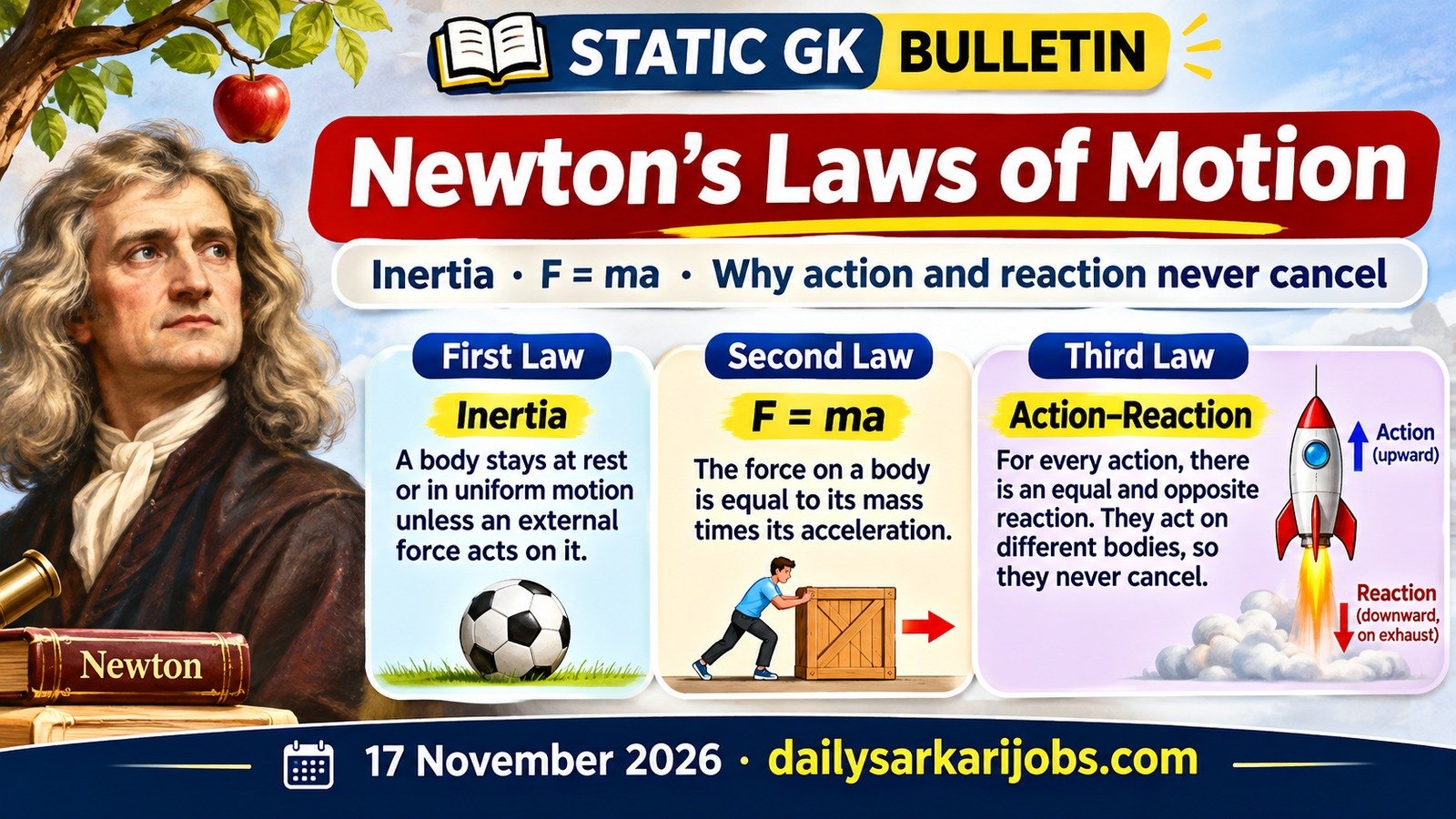
Three laws, written down in 1687, still explain almost everything that moves at ordinary speeds.Most students can recite them and still get the questions wrong, because one idea at the centre is usually missed.
A Force Is Never Alone. It Is Always One Half of a Pair.
Push a wall and the wall pushes you back, with exactly the same strength, in exactly the opposite direction.That is the third law, and everybody learns it. The part that gets missed is where the two forces land.
Your push acts on the wall. The wall’s push acts on you.They are on two different bodies, so they can never cancel each other out. Cancelling only happens when two forces act on the same object.
Get that one point and a whole chapter opens up.You walk because you push the ground backwards and the ground pushes you forwards. A boat moves because the oar pushes water back and the water pushes the boat on. A rifle recoils because it pushed the bullet. A rocket rises because it threw hot gas downwards — not because the gas pushes against the air, which is why rockets work in space at all.
Jargon, Defined Once
Force is a push or a pull. Its unit is the newton, written N.
Inertia is the tendency of an object to keep doing what it is already doing. More mass means more inertia — mass is the measure of inertia.
Momentum is mass multiplied by velocity. A heavy slow lorry and a light fast bullet can carry similar momentum.
Velocity is speed in a stated direction; acceleration is the rate at which velocity changes. Slowing down and turning are both acceleration.
Balanced forces cancel out and change nothing; unbalanced forces are what actually produce acceleration.
Friction is the force that resists sliding. It is the reason the first law looks false in everyday life.
The Three Laws
Law
What it says
What it gives you
First(Law of Inertia)
A body stays at rest, or keeps moving in a straight line at constant speed, unless an unbalanced force acts on it
Defines force — force is whatever changes this state
Second
The rate of change of momentum is proportional to the applied force, in the direction of that force — giving F = ma when mass is constant
Measures force — and defines the newton
Third
For every action there is an equal and opposite reaction, on a different body
Pairs forces — and gives conservation of momentum
Why the First Law Looks Wrong, and Is Not
Roll a ball along the floor and it stops. The first law says it should carry on for ever.Nothing is broken: friction and air resistance are forces, and they are what stop the ball. Remove them — a puck on smooth ice, a spacecraft between planets — and the ball really does keep going.
The first law is not a smaller version of the second.It does the job of saying what a force is in the first place: the thing that changes a body’s state of rest or of uniform motion. The second law then tells you how much.
Everyday Examples Worth Memorising
A bus brakes and you lurch forward — inertia of motion; your body keeps moving after the bus slows.
A bus starts and you fall backwards — inertia of rest; your body has not started moving yet.
A cricketer pulls his hands back while catching — a longer time to stop the ball means a smaller force, straight from the second law.
Dust flies off a beaten carpet — the carpet moves, the dust’s inertia keeps it where it was.
A gun recoils, a rocket lifts off, a swimmer moves forward — all third law.
Seat belts and airbags, and sand pits for long jump — all of them stretch the stopping time to cut the force.
Exam Alert: Five Traps
Action and reaction act on DIFFERENT bodies, so they never cancel.The single most common wrong answer in this chapter.
The second law is really about momentum.F = ma is the form it takes when mass does not change; a rocket losing fuel is the standard exception.
Mass is the measure of inertia — not weight.Weight is a force and changes with gravity; mass and inertia do not.
The first law defines force; the second measures it.A question asking which law gives the definition of force wants the first.
The SI unit of force is the newton, and the unit of momentum is kilogram metre per second.Different quantities, different units.
Did You Know: Newton Wrote the Second Law About Momentum, Not About F = ma
The formula every student learns, force equals mass times acceleration, is not how Newton stated it.He wrote that the change of motion is proportional to the force applied — and by motion he meant what we now call momentum, mass multiplied by velocity.
The difference matters exactly once, and it is the case that gets asked.F = ma assumes the mass stays the same. A rocket’s mass does not: it is burning and throwing away fuel every second, so a large part of its push comes from the mass leaving, not from acceleration of a fixed mass. The momentum form handles that; the school formula does not.Newton’s own version is the more general one.
Why a Reader Should Care
Physics in SSC, Railways and State PSC papers is mostly mechanics, and mechanics is mostly these three laws, asked either as a definition or as an everyday example to be explained. It sits with our capsule on light, reflection and refraction, the other heavily asked physics chapter, with scientific instruments and inventions and with the human body. Our capsule on India’s missile programme is the third law at national scale, since every launch is momentum thrown one way to send a vehicle the other.
Today’s Current Affairs explainer is on the ASEAN-India Summit at Manila, and one word crosses over. Inertia is the first law’s name for a body that keeps on its existing course until something outside pushes it. It is also the honest description of a grouping that moves only by consensus: ASEAN carries on as it is unless all eleven members push together.
Practice Questions
Q1. Newton’s first law of motion is also known as the law of (a) Momentum (b) Inertia (c) Gravitation (d) Acceleration Answer: (b) Inertia It states that a body keeps its state of rest or of uniform motion in a straight line until an unbalanced force acts on it.
Q2. Which law of motion gives us the measure of force? (a) The first law (b) The third law (c) The second law (d) The law of gravitation Answer: (c) The second law It relates force to the rate of change of momentum, and in its familiar form gives F = ma.
Q3. Action and reaction forces do not cancel each other because they (a) Are unequal in size (b) Act in the same direction (c) Act at different times (d) Act on two different bodies Answer: (d) Act on two different bodies Forces cancel only when they act on the same object, which is why walking, swimming and rocket propulsion all work.
Q4. The SI unit of force is the (a) Newton (b) Joule (c) Watt (d) Pascal Answer: (a) Newton One such unit is the force that gives a mass of one kilogram an acceleration of one metre per second squared.
Q5. A cricketer moves his hands backwards while catching a fast ball in order to (a) Increase the ball’s momentum (b) Reduce the force on his hands (c) Increase the ball’s velocity (d) Change the ball’s mass Answer: (b) Reduce the force on his hands Taking longer to bring the ball to rest lowers the rate of change of momentum, and therefore the force.
30-Second Revision
The hinge:action and reaction act on different bodies, so they never cancel — which is why you can walk, swim and launch a rocket.
First law:inertia. No unbalanced force, no change. It defines what a force is; mass is the measure of inertia.
Second law: force equals the rate of change of momentum; F = ma when mass is constant. It measures force and defines the newton.
Third law:equal and opposite, on a different body. It gives conservation of momentum.
The stock examples: lurching in a braking bus (inertia of motion), falling back as it starts (inertia of rest), a cricketer’s hands, a beaten carpet, recoil, rockets.
What Is Not Settled
Nothing here is scientifically disputed, but the wording differs between textbooks.Some state the second law as F = ma from the start; others state it as the rate of change of momentum and derive F = ma afterwards. Both are accepted. If a question asks you to state the law, the momentum form is the safer answer, because it is correct in every case.
Second, these laws hold at ordinary speeds and ordinary sizes.They break down near the speed of light and inside the atom, where relativity and quantum mechanics take over. No objective paper at this level will push you there, but it is worth knowing that the laws have a boundary rather than being universal.
Sources
Standard school and competitive-examination physics reference material on Newton’s laws of motion — the first law as the law of inertia, defining force as what changes a body’s state of rest or uniform motion in a straight line; the second law as the rate of change of momentum being proportional to the applied force and acting in its direction, yielding F = ma for constant mass; and the third law as equal and opposite forces acting on two different bodies, from which conservation of momentum follows.
The same material for the definitions of force, inertia, momentum (mass times velocity), velocity, acceleration, balanced and unbalanced forces and friction, for the newton as the SI unit of force, and for the standard worked examples — a passenger lurching in a braking bus, dust leaving a beaten carpet, a fielder drawing his hands back while catching, recoil of a gun, and rocket propulsion.
Where textbooks differ on how the second law should be stated, the post says so above rather than presenting one wording as the only correct one.