
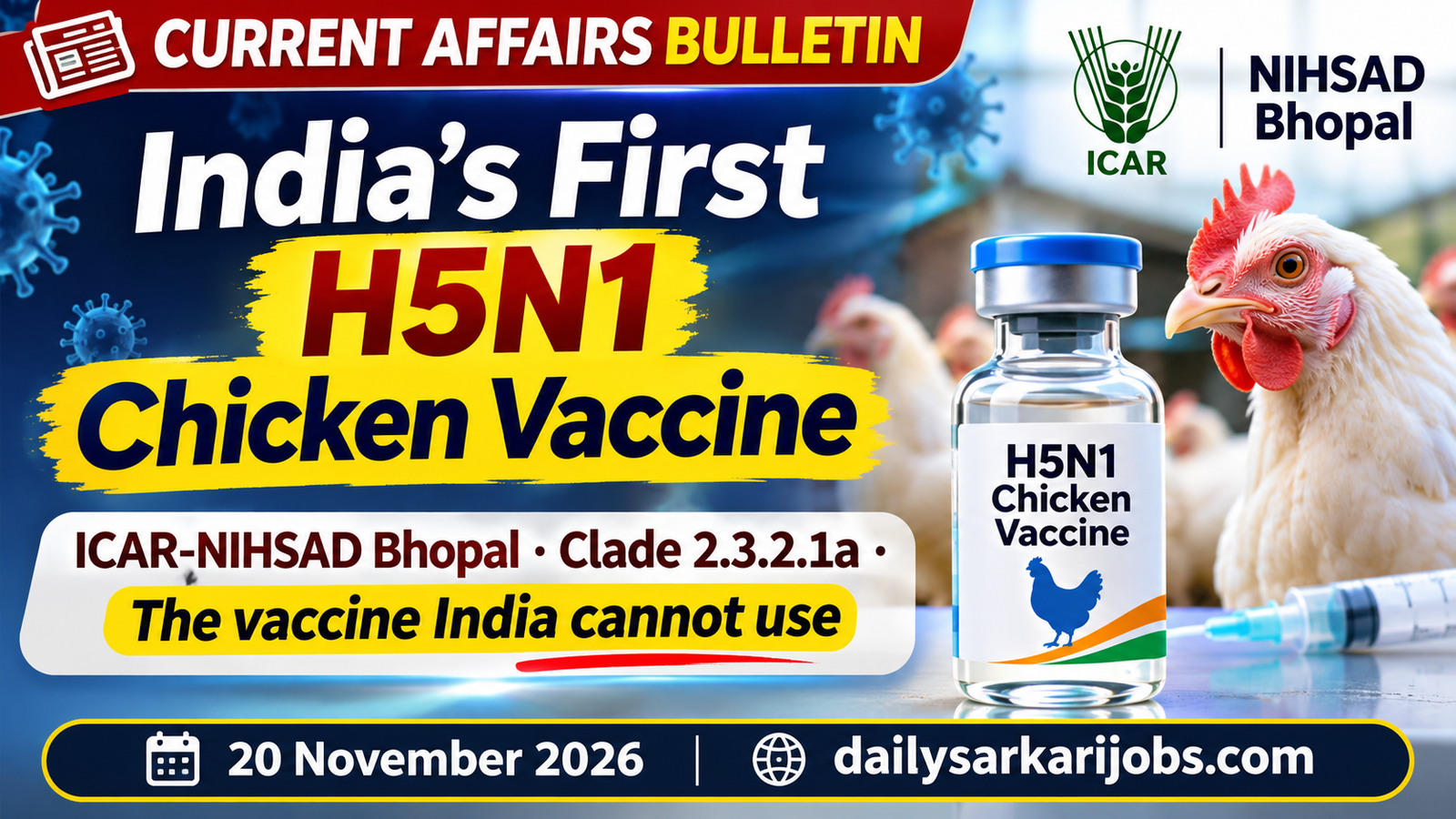
On 20 November 2026, Union Agriculture and Farmers Welfare Minister Shivraj Singh Chouhan is to dedicate to the nation India’s first indigenous H5N1 vaccine for chickens, built by ICAR-NIHSAD in Bhopal. Here is the part almost every headline left out: India is not allowed to use it. In its own declaration to the world animal health body in August 2025, India stated plainly that vaccination against highly pathogenic bird flu has not been allowed in India. So the country has just finished building a shield it has a standing rule against carrying. That is not a contradiction — it is the whole point, and understanding why is worth more in an exam than the date.
What exactly was launched
The vaccine is an inactivated vaccine — meaning the virus inside it has been killed, so it cannot cause disease but still teaches the bird’s body to recognise the enemy. It targets H5N1 Clade 2.3.2.1a, and the government says no commercial vaccine for this particular clade existed anywhere before.
| Item | Detail |
|---|---|
| Name | India’s first indigenous inactivated H5N1 (Clade 2.3.2.1a) HPAI vaccine |
| Institute | ICAR-National Institute of High Security Animal Diseases, Bhopal |
| Dedicated by | Shivraj Singh Chouhan, Agriculture and Farmers Welfare Minister |
| Date and venue | 20 November 2026, at ICAR-NIHSAD, Bhopal |
| Target animal | Chickens (poultry), not humans |
| Why it matters | First vaccine anywhere against this clade of H5N1 |
Two words in that table do the heavy lifting. HPAI stands for Highly Pathogenic Avian Influenza — the severe form of bird flu, which can kill close to 100 per cent of the birds it infects. A clade is a family branch of the virus; flu viruses mutate constantly, so scientists sort them into clades, and a vaccine built for one clade may do little against another. Clade 2.3.2.1a is the branch behind most chicken outbreaks in India.
Why India does not vaccinate its chickens
India’s method for bird flu is called stamping out, or detect and cull. When a case is confirmed, the birds are killed rather than treated. It sounds brutal, and it is expensive, but it has a cold logic behind it that exams like to test.
A vaccinated bird develops antibodies — the same antibodies a bird develops after surviving an infection. From a blood test alone, you often cannot tell the two apart. So the moment a country starts vaccinating, its surveillance goes blurry: a vaccinated flock can quietly carry and spread the virus while every test comes back looking reassuring. Countries that export poultry guard against exactly this, because trading partners want proof of freedom from the disease, not proof of vaccination.
That proof is formal. India files a self-declaration of freedom from HPAI with the World Organisation for Animal Health (WOAH), the global body that sets animal disease rules. The current one was sent on 11 August 2025 and took effect from 1 August 2025, covering 44 poultry compartments. A compartment is a tightly sealed poultry unit — fenced, kept about 2 km away from other poultry or villages, with controlled entry, vehicle disinfection and treated feed and water — tested every 30 days, or every 21 days when the disease is active in the country. Those 44 compartments are India’s passport into export markets.
| State | Compartments |
|---|---|
| Tamil Nadu | 22 |
| Maharashtra | 13 |
| Chhattisgarh | 6 |
| Uttar Pradesh | 2 |
| Odisha | 1 |
| Total | 44 |
How an outbreak is handled today
The drill comes from the Action Plan for Prevention, Control and Containment of Avian Influenza, run by the Department of Animal Husbandry and Dairying. Note who sits at the centre of it: ICAR-NIHSAD Bhopal — the same institute that built the vaccine is also the national reference laboratory that confirms every outbreak.
| Step | What happens |
|---|---|
| Confirmation | NIHSAD Bhopal confirms and informs the Centre and the state |
| Infected zone | 1 km from the case; live birds culled, extendable to 3 km |
| Surveillance zone | 1 km to 10 km around the site, acts as a buffer |
| Destruction | Birds, eggs, feed and litter destroyed; premises disinfected |
| Compensation | Fixed rates, paid on the spot; Centre bears 50 per cent |
| Disease-free again | Declared after three clear months of negative surveillance |
The stakes: why poultry is not a small matter
India is the second largest egg producer in the world. The Basic Animal Husbandry Statistics 2025 put 2024-25 egg production at 149.11 billion eggs, poultry meat at 5.18 million tonnes out of total meat production of 10.50 million tonnes, and per capita availability at 106 eggs a year. Egg output is concentrated in a handful of states, which is also why a single outbreak can be a national problem. For the wider farm picture, see our capsule on soils and crops of India and on India’s first soil carbon payments to farmers.
| Rank | State | Share of eggs |
|---|---|---|
| 1 | Andhra Pradesh | 18.37% |
| 2 | Tamil Nadu | 15.63% |
| 3 | Telangana | 12.98% |
| 4 | West Bengal | 10.72% |
| 5 | Karnataka | 6.67% |
The government’s own note on the vaccine spells out the downside risk. Since the first detection in India in 2006, more than 500 H5N1 and H5N8 outbreaks have been reported. The 2006 outbreak alone caused estimated direct and indirect losses of Rs 2,200 to 3,000 crore. One outbreak in Manipur cost the equivalent of 0.5 per cent of that state’s own output. A major nationwide outbreak, the note warns, could shave up to 1.5 per cent off India’s GDP growth, with more than 20 per cent of the poultry population at risk if it ran uncontrolled.
The human angle, kept in proportion
H5N1 is mainly a bird disease, and it does not spread easily between people. But it does cross over occasionally, and when it does it is severe. The World Health Organization has recorded 1,003 human H5N1 cases with 479 deaths across 25 countries since 2003, India among them. Clade 2.3.2.1a specifically has turned up in several mammals and in three human cases. This is the practical meaning of One Health — the idea that human, animal and environmental health are one system, not three. A vaccine for chickens is, in that frame, a public health measure. Wild migratory birds are how the virus travels between continents, which quietly links this story to our wetlands: see India’s 103 Ramsar sites. On what India spends on health overall, see National Health Accounts 2023-24.
So what is the vaccine actually for?
Three honest answers. First, readiness: building a vaccine takes years, and a country that waits for a crisis to start work will be too late. India now holds the capability and can switch it on if the policy ever changes. Second, self-reliance: no commercial vaccine existed for this clade, so buying one from abroad was never an option in the first place. Third, leverage: a domestic vaccine strengthens India’s hand in any future international discussion about moving from culling towards controlled vaccination, a debate several poultry-exporting countries are already having. Field use in India would still need a policy change and regulatory clearance — the launch is a scientific milestone, not a change in the rules.
Exam Alert
- ICAR-NIHSAD is in Bhopal, Madhya Pradesh. Expect a match-the-institute-to-the-city question.
- The clade is 2.3.2.1a and the virus is H5N1. Papers love exact strain labels.
- India’s policy is stamping out (detect and cull), not vaccination — the single most likely trick in the question.
- The global animal health body is WOAH, the World Organisation for Animal Health, formerly called the OIE.
- Zones: 1 km infected zone, 1 to 10 km surveillance zone, three months to disease-free status.
- 149.11 billion eggs in 2024-25 and rank 2 in the world; Andhra Pradesh leads among states.
- The nodal department is the Department of Animal Husbandry and Dairying under the Ministry of Fisheries, Animal Husbandry and Dairying; the minister dedicating the vaccine holds the Agriculture and Farmers Welfare portfolio.
Did You Know?
- HPAI can kill nearly 100 per cent of an infected flock, which is why the response is culling rather than treatment — most of the birds would die anyway.
- The lab that confirms outbreaks also built the vaccine. NIHSAD Bhopal is both India’s national reference laboratory for avian influenza and the developer of the new vaccine.
- India’s 44 export compartments sit in only five states, and Tamil Nadu alone holds half of them.
- Compensation to farmers is shared 50:50 between the Centre and the state, and the Action Plan says it should be paid on the spot, at the time of culling.
30-Second Quick Revision
- What: India’s first indigenous inactivated H5N1 (Clade 2.3.2.1a) vaccine for chickens.
- Who and where: ICAR-NIHSAD, Bhopal; dedicated by Shivraj Singh Chouhan.
- When: 20 November 2026.
- The twist: India does not permit HPAI vaccination of poultry; the policy is detect and cull.
- Why: vaccination blurs surveillance and threatens the WOAH freedom-from-disease declaration covering 44 compartments.
- Scale: 149.11 billion eggs, world rank 2; 500-plus outbreaks since 2006.
Test Your Knowledge
Q1. Which institute developed India’s first indigenous H5N1 vaccine for chickens?
(a) ICAR-IVRI, Izatnagar (b) ICAR-NIHSAD, Bhopal (c) NIV, Pune (d) ICAR-NDRI, Karnal
Answer: (b) ICAR-NIHSAD, Bhopal The National Institute of High Security Animal Diseases at Bhopal is also India’s national reference laboratory for avian influenza.
Q2. What is India’s standing policy on highly pathogenic avian influenza in poultry?
(a) Compulsory annual vaccination (b) Voluntary vaccination in export compartments (c) Stamping out by culling, with no vaccination permitted (d) Treatment with antivirals
Answer: (c) Stamping out by culling, with no vaccination permitted India told WOAH in August 2025 that vaccination against HPAI is not allowed; infected and exposed birds are destroyed instead.
Q3. The new vaccine targets which clade of H5N1?
(a) 2.3.4.4b (b) 1.1.2 (c) 7.2 (d) 2.3.2.1a
Answer: (d) 2.3.2.1a This is the branch responsible for most chicken outbreaks reported in India.
Q4. Under the Action Plan, how large is the infected zone around a confirmed case?
(a) 500 metres (b) 1 km, extendable to 3 km (c) 5 km (d) 10 km
Answer: (b) 1 km, extendable to 3 km Birds within that ring are culled; the band from 1 km to 10 km is the surveillance zone that acts as a buffer.
Q5. India’s egg production in 2024-25, as per Basic Animal Husbandry Statistics 2025?
(a) 149.11 billion eggs (b) 98.4 billion eggs (c) 211.6 billion eggs (d) 64.2 billion eggs
Answer: (a) 149.11 billion eggs That output makes India the world’s second largest egg producer, with per capita availability of 106 eggs a year.
Want the full ten-question set as a PDF? Head to our Test Your Knowledge page.
Verified on 20 November 2026 against the Press Information Bureau release on the vaccine, India’s August 2025 self-declaration to the World Organisation for Animal Health, the Action Plan for Prevention, Control and Containment of Avian Influenza, and Basic Animal Husbandry Statistics 2025.