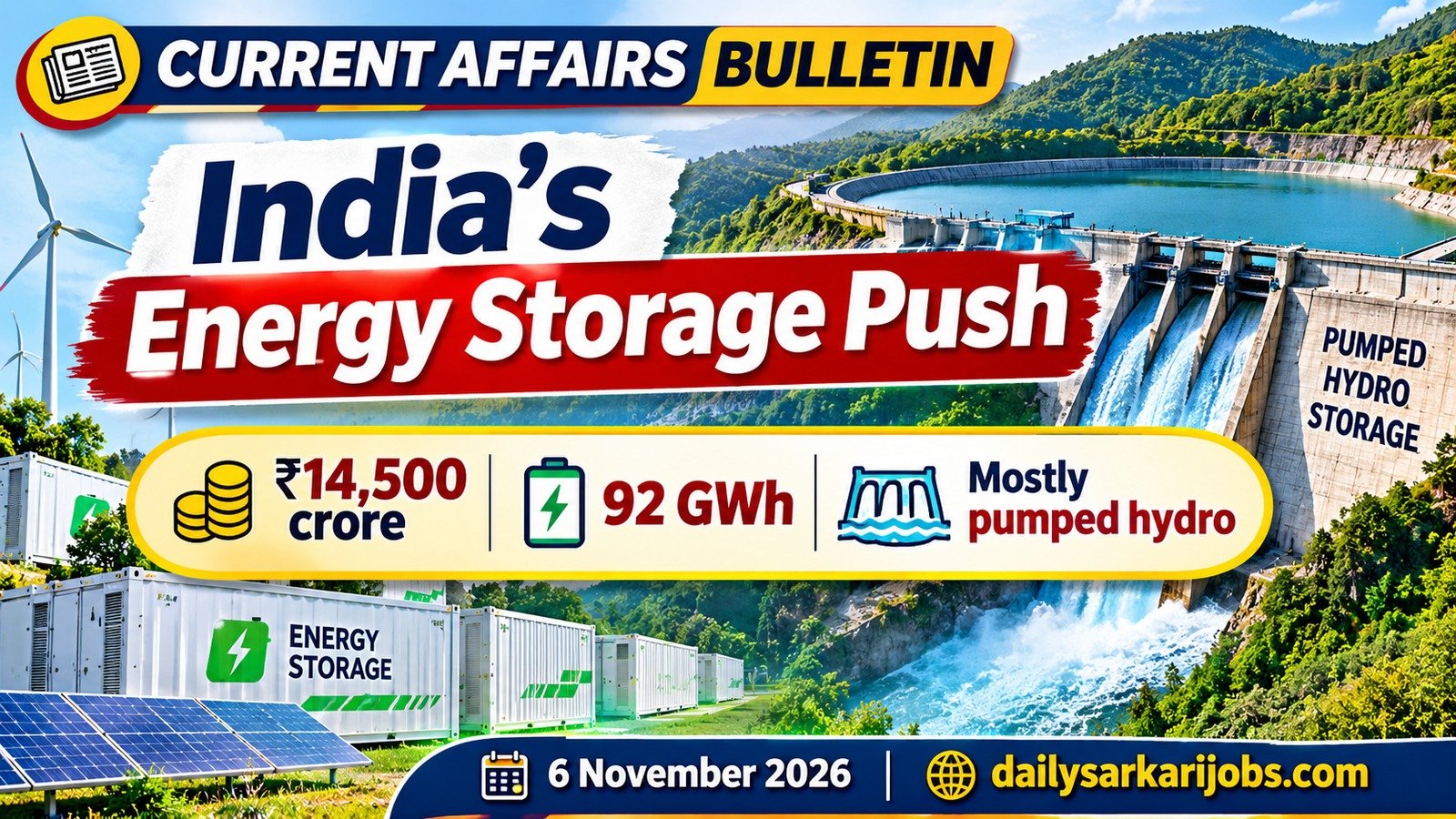
On 4 November 2026 the Union Cabinet approved ₹14,500 crore of Viability Gap Funding to build 92 GWh of grid-scale energy storage. It reads like an electricity story. It is really a story about time.
The Biggest Battery in the Plan Is Not a Battery
Of the 92 GWh being supported, only 30 GWh is batteries. Sixty GWh — nearly two-thirds — is water pumped uphill.
Technology
Share of the 92 GWh
What it is
Hydro Pumped Storage (PSP)
60 GWh
Water pumped to an upper reservoir, released through turbines when power is needed
Battery Energy Storage (BESS)
30 GWh
Large banks of batteries, charged and discharged like a phone
Alternative technologies
2 GWh
A small reserved slice for newer methods still being proven
Pumped storage is not new technology. It is more than a century old, and it is beautifully simple.When power is cheap and plentiful, you spend it lifting water up a hill. When power is scarce and dear, you let the water fall back down through a turbine and get most of that electricity back.The hill is the battery. It does not degrade the way a chemical cell does, it lasts for decades, and India has the terrain for it.
Jargon, Defined Once
Viability Gap Funding (VGF) is a government grant that closes the gap between what a project costs and what it can realistically earn. The project is needed but would not pay for itself, so the Government pays part of the capital cost to make it bankable. It is a one-time push, not a running subsidy.
Grid-scale means storage connected to the national power system, serving everybody — not the inverter in a house or the battery in a car.
A discom is a distribution company, the utility that actually sells electricity to your meter.
Domestic Content Requirement (DCR) is a rule that a set share of what is built must be made in India. Battery projects under this scheme must meet at least 40 per cent.
Tariff-based competitive bidding means the capacity goes to whoever offers to supply it at the lowest price, rather than being handed out.
GW and GWh Are Not the Same Thing — and This Is Where Marks Are Lost
Solar and wind capacity is measured in gigawatts. Storage is measured in gigawatt-hours.They look alike on the page and they measure completely different things.
GW (gigawatt)
GWh (gigawatt-hour)
Measures
How fast energy flows
How much energy is held
Everyday parallel
The width of a tap
The size of the bucket
Used for
Power plants, solar farms
Storage, batteries, reservoirs
So “92 GWh of storage” is a statement about quantity held, not speed delivered.A question that offers 92 GW as an option is testing exactly this, and it is the easiest mark on the topic to drop.
Why India Needs This At All
India’s problem is no longer making clean power. It is having it at the right hour.Solar output peaks around midday and falls to nothing after sunset. Household demand does the opposite — it peaks in the evening, when the lights, fans and televisions come on and the sun has gone.
Storage is the bridge across those hours. It takes the surplus of the afternoon and delivers it in the evening. Without it, every unit of solar built after a point is wasted, and the grid falls back on coal and gas to cover the evening peak. This is why storage is described as what makes round-the-clock renewable power possible.
The Numbers Worth Carrying
₹14,500 crore of Viability Gap Funding, running from FY 2026-27 to FY 2030-31.
92 GWh of new capacity, which the Government says is about 170 per cent of India’s present grid-scale storage — so this one scheme is roughly tripling what exists.
It is meant to help reach a requirement of 411 GWh by 2031-32.
Total investment expected: about ₹97,600 crore.The grant is about fifteen per cent of the money that should follow it, which is the whole idea of VGF.
Capacity is allocated by tariff-based competitive bidding, with public and private discoms eligible.
Battery projects must meet a 40 per cent Domestic Content Requirement.
Exam Alert: Four Points to Mark
92 GWh, not 92 GW.Storage is energy, not power.
Pumped hydro is the larger share.60 GWh of 92 — a question assuming the scheme is all batteries is wrong, and it is the most likely trap here.
This is not the first storage VGF scheme. An earlier scheme supported 4,000 MWh of batteries with an outlay of about ₹9,400 crore, of which about ₹3,760 crore was budgetary support, paying up to 40 per cent of capital cost in five tranches. The new scheme is far larger and, crucially, covers pumped hydro as well.
411 GWh is the requirement by 2031-32; 92 GWh is what this scheme supports.Two different numbers that sit in the same sentence in most reports.
Did You Know: The Round Trip Loses Energy, and It Is Still Worth It
No storage returns everything you put in. Pumping water uphill and letting it fall back gives you back most of the electricity, not all of it; the rest is lost to friction and heat. The same is true of a battery.
So why store at all, if storing loses energy?Because the alternative is losing all of it. Solar power that nobody needs at two in the afternoon is not saved for later — it is simply not generated, or it is thrown away. A storage system that returns most of what it takes is infinitely better than surplus that vanishes.Storage is not judged against perfection; it is judged against waste.
Why a Reader Should Care
Energy is one of the most heavily asked Current Affairs areas, and this scheme sits at the centre of it. It connects directly to our explainers on the National Green Hydrogen Mission and the International Solar Alliance. Those are about making clean energy; this one is about keeping it until it is wanted. Our explainer on E100 and ethanol blending covers the transport side of the same transition.
Today’s Static GK capsule is on the Maratha Empire, and the two share a shape. The Marathas worked out that holding the right places mattered more than holding the most land. A storage scheme is the same insight applied to time instead of territory: having the power at the right hour beats having more of it.
Practice Questions
Q1. The Viability Gap Funding scheme approved on 4 November 2026 supports how much grid-scale storage capacity? (a) 411 GWh (b) 92 GWh (c) 4,000 MWh (d) 92 GW Answer: (b) 92 GWh Storage is measured in gigawatt-hours rather than gigawatts, and the 411 figure is the requirement projected for 2031-32.
Q2. Within that capacity, the largest share is allotted to (a) Battery energy storage (b) Alternative technologies (c) Hydro pumped storage (d) Solar thermal storage Answer: (c) Hydro pumped storage Sixty of the ninety-two gigawatt-hours use water lifted to an upper reservoir, with thirty in batteries and two reserved for emerging methods.
Q3. The outlay approved for the scheme is (a) ₹14,500 crore (b) ₹9,400 crore (c) ₹97,600 crore (d) ₹3,760 crore Answer: (a) ₹14,500 crore About ₹97,600 crore is the total investment the scheme is expected to draw in, not the Government’s own contribution.
Q4. Viability Gap Funding is best described as (a) A monthly operating subsidy (b) A loan repayable with interest (c) A grant covering part of the capital cost to make a needed project bankable (d) A tax exemption on imported equipment Answer: (c) A grant covering part of the capital cost to make a needed project bankable It is a one-time push rather than a running payment, which is why it suits large infrastructure built once and used for decades.
Q5. Battery projects under the scheme must meet a minimum Domestic Content Requirement of (a) 20 per cent (b) 60 per cent (c) 75 per cent (d) 40 per cent Answer: (d) 40 per cent Capacity itself is allocated through tariff-based competitive bidding, with public and private distribution companies eligible.
30-Second Revision
The hinge:the biggest battery in the plan is not a battery — 60 of the 92 GWh is pumped hydro, water lifted uphill when power is cheap and dropped through turbines when it is dear.
The scheme:₹14,500 crore of Viability Gap Funding, approved 4 November 2026, running FY 2026-27 to 2030-31, expected to pull in about ₹97,600 crore of investment.
The split:60 GWh pumped hydro, 30 GWh batteries, 2 GWh alternative technologies; 40 per cent domestic content for batteries; allocation by tariff-based competitive bidding.
The scale: about 170 per cent of existing grid-scale storage, against a requirement of 411 GWh by 2031-32.
The trap:GW is how fast, GWh is how much.Storage is always the second one.
What Is Not Settled
Two honest notes. First, the Cabinet release does not name the implementing ministry, and the detailed scheme guidelines — the per-project VGF caps, the bidding timetable, the disbursement tranches — had not been published when this was written. Expect the operational detail to change the picture a little.
Second, the figure of 170 per cent of present capacity is the Government’s own characterisation rather than an independently audited number, and installed grid-scale storage in India is growing quickly enough that any such comparison dates fast.Quote the 92 GWh and the ₹14,500 crore, which are fixed, with more confidence than the ratio.
Sources
Prime Minister’s Office release on the Cabinet decision, 4 November 2026 — the ₹14,500 crore outlay, the 92 GWh supported, the split of 60 GWh pumped storage, 30 GWh batteries and 2 GWh alternative technologies, the FY 2026-27 to 2030-31 period, the 411 GWh requirement by 2031-32, the figure of about ₹97,600 crore of expected investment, tariff-based competitive bidding, discom eligibility and the 40 per cent Domestic Content Requirement for batteries.
Contemporary reporting of the same Cabinet briefing, 4 and 5 November 2026, which carries the same figures.
The earlier Battery Energy Storage Systems VGF scheme — about ₹9,400 crore including about ₹3,760 crore of budgetary support, for 4,000 MWh by 2030-31, paying up to 40 per cent of capital cost in five tranches with at least 85 per cent of capacity offered to discoms — is from the Government’s own announcement of that scheme and is given here for contrast.