Explained in plain language for SSC, RRB NTPC, banking exams, State PSC and UPSC Prelims.
⚡ QUICK FACTS
How many National Akademis
Three
Which ministry
Ministry of Culture
What they are
Autonomous bodies, not government departments
Oldest
Sangeet Natak Akademi, inaugurated 28 January 1953
Sahitya Akademi inaugurated
12 March 1954
Lalit Kala Akademi founded
5 August 1954
Where all three sit
Rabindra Bhavan, Ferozeshah Road, New Delhi
Languages the Sahitya Akademi recognises
24 — and not the same 24 as the Constitution
The Hinge: Three Academies, One Building, Two Years
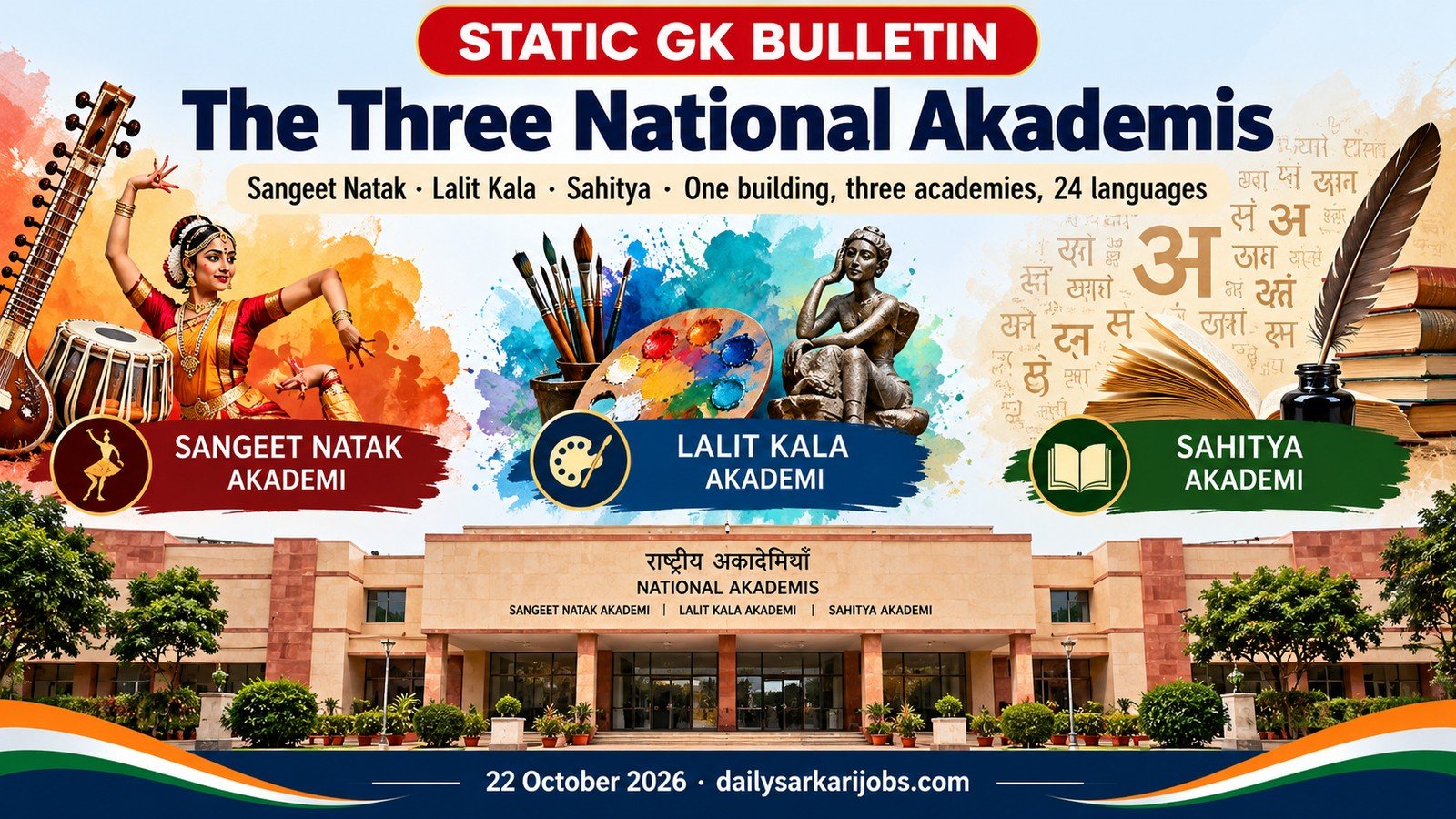
The easiest way to remember all three is to notice that they were built almost together, and that they still share an address. Sangeet Natak, Sahitya and Lalit Kala all have their headquarters at Rabindra Bhavan on Ferozeshah Road in New Delhi. One building, three academies, one ministry.
And they arrived within about eighteen months of each other, in a country that was barely five years old.The capsule on the Indian National Movement explains how much of that movement had been cultural as well as political — so a newly independent State setting up national academies for music and dance, for literature and for the visual arts, almost before it had built anything else, is not a decorative detail. It is a statement about what the new State thought a nation was made of.
The Three Akademis
Akademi
Set up
What it covers
Sangeet Natak Akademi
Created by a Government resolution of 31 May 1952; inaugurated 28 January 1953 by Dr Rajendra Prasad at Parliament House
The performing arts — music, dance and drama
Sahitya Akademi
Government resolution of December 1952; formally inaugurated 12 March 1954; registered as a society on 7 January 1956
Literature, in 24 languages
Lalit Kala Akademi
Founded 5 August 1954 in New Delhi
The visual arts — painting, sculpture, graphic art, photography
A memory trick that actually works: go in the order of the senses. First what you hear and watch performed (Sangeet Natak, 1953), then what you read (Sahitya, March 1954), then what you look at (Lalit Kala, August 1954). The order is also the order of the dates.
The Trap: the Sahitya Akademi’s 24 Languages Are Not the Constitution’s 22
This is the single most profitable fact in the chapter, because it looks like a repetition and is not. The Sahitya Akademi recognises 24 languages: the 22 listed in the Eighth Schedule of the Constitution, plus English and Rajasthani.
List
How many
The difference
Eighth Schedule of the Constitution
22
The languages the Constitution itself lists
Sahitya Akademi
24
The same 22, plus English and Rajasthani
So Rajasthani is recognised by the Sahitya Akademi and is not in the Eighth Schedule.The Constitution capsule sets out the Eighth Schedule — and the useful habit is the general one: when two bodies keep a list of the same kind of thing, check whether the lists are identical before assuming they are.
What Each Akademi Gives
Akademi
Its main honours
Sangeet Natak Akademi
The Akademi Award for practising artists, gurus and scholars, carrying ₹1,00,000, a shawl and a brass plaque; and the Akademi Fellowship (Ratna Sadsya), its highest honour. Awards are given in nine classical dance forms among other categories.
Sahitya Akademi
The Sahitya Akademi Award in each recognised language, with an equal number of translation prizes; the Bhasha Samman for languages the Akademi does not formally recognise and for classical and medieval literature; and Fellowships, including ones named after Ananda Coomaraswamy and Premchand.
Lalit Kala Akademi
Awards at the National Exhibition of Art, held every year since 1955; the Print Biennale India, an international printmaking exhibition begun in 2017; and Akademi Fellowships.
The Bhasha Samman is the quiet one and it is worth a sentence. It exists precisely for the languages that are not on the recognised list — so the Akademi has built an award for the gap in its own list. The awards and honours capsule has the rest of India’s major prizes.
Autonomous, Not Departmental — and Why That Was Deliberate
None of the three is a government department. They are autonomous bodies funded by the Ministry of Culture, and the Sahitya Akademi is registered as a society under the Societies Registration Act, 1860. A government that wanted the arts supported but did not want to be seen directing them had to put a layer between its money and its taste, and that layer is what an akademi is.
Run the usual test and the design appears. Ask of each feature whether it protects the body or limits it: an assured annual grant protects; a governing council drawn from artists rather than officials protects; and the absence of any statute — none of the three was created by an Act of Parliament — limits, because what a resolution sets up, a resolution can change. Maximum artistic freedom, minimum legal security.
What the Words Mean
Term
In plain words
Akademi
An academy — here, a national body for one field of the arts
Autonomous body
Funded by the Government but run by its own council
Fellowship
The highest honour an akademi gives, held for life and limited in number
Biennale
An exhibition held once every two years
Bhasha Samman
A Sahitya Akademi honour for languages outside its recognised list
Why a Reader Should Care
Because this is one of the few Art and Culture topics that is pure recall and therefore pure marks. Which akademi covers which art, the three founding years, the shared building, the ministry, and the 22-versus-24 language trap are asked again and again in SSC, State PSC and banking papers. The classical dances capsule is the natural companion, because the Sangeet Natak Akademi is the body that recognises those dance forms in the first place.
And because it answers a question people find genuinely puzzling: who decides what counts as classical? The answer, for dance, is an autonomous academy set up by a resolution in 1952 — not a court, not a ministry and not a committee of scholars abroad. Whenever something is called classical, national or recognised, somebody did the recognising, and it is usually worth finding out who.
Practice Questions
Q1. Which of the three National Akademis was inaugurated first? (a) Lalit Kala Akademi (b) Sangeet Natak Akademi (c) Sahitya Akademi (d) All three on the same day Answer: (b) Sangeet Natak Akademi It was inaugurated by Dr Rajendra Prasad at Parliament House in January 1953, more than a year before the other two.
Q2. The Lalit Kala Akademi was founded in (a) 1952 (b) 1953 (c) 1954 (d) 1956 Answer: (c) 1954 The other years are the resolution year of one sister akademi and the registration year of another, which is why this set of dates is a favourite.
Q3. The Sahitya Akademi recognises how many languages? (a) 22 (b) 24 (c) 18 (d) 23 Answer: (b) 24 The first option is the Eighth Schedule figure, and the difference between the two lists is English and Rajasthani.
Q4. The three National Akademis function under which ministry? (a) Ministry of Education (b) Ministry of Information and Broadcasting (c) Ministry of Tourism (d) Ministry of Culture Answer: (d) Ministry of Culture They are autonomous bodies rather than departments, which is the point of the arrangement.
Q5. Which Akademi honours music, dance and drama? (a) Sahitya Akademi (b) Lalit Kala Akademi (c) Sangeet Natak Akademi (d) Indian Council for Cultural Relations Answer: (c) Sangeet Natak Akademi Its name says so if the words are read literally, and it is also the body that recognises the classical dance forms.